


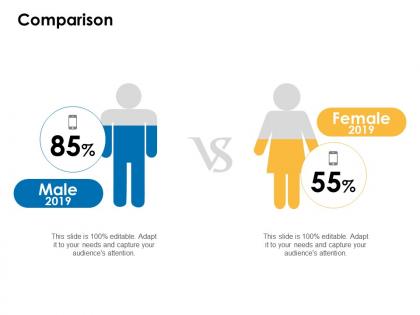
Comparison male female c355 ppt powerpoint presentation images




Try Before you Buy Download Free Sample Product
 Impress Your
 Audience
 100%
100% Editable
 Save Hours
 of Time


Our Comparison Male Female C355 Ppt Powerpoint Presentation Images are applicable from Buenos Aires to Bangkok. They contain a global flavor.
People who downloaded this PowerPoint presentation also viewed the following :
Comparison male female c355 ppt powerpoint presentation images with all 5 slides:
Our Comparison Male Female C355 Ppt Powerpoint Presentation Images contain a global flavor. They are applicable from Buenos Aires to Bangkok.




FAQs for Comparison male female c355 ppt
Key psychological differences in communication styles between males and females include directness versus relationship-building, task-focused versus emotion-focused approaches, competitive versus collaborative tendencies, hierarchical versus egalitarian structures, and problem-solving versus empathy-driven responses. These differences influence workplace dynamics, customer service interactions, team collaboration, and leadership approaches, with many organizations finding that understanding these patterns enhances communication effectiveness and strategic outcomes.
Societal expectations significantly influence professional opportunities by channeling men toward leadership, technical, and high-stakes roles while directing women toward supportive, caregiving, and collaborative positions. These ingrained biases affect hiring decisions, promotion trajectories, and salary negotiations across industries, with many organizations increasingly recognizing that diverse leadership teams deliver enhanced innovation, broader market insights, and ultimately stronger competitive advantage.
Workplace culture for men and women leaders differs through varying communication expectations, networking opportunities, decision-making perceptions, and work-life balance pressures. While male leaders often benefit from established networks and assertive leadership acceptance, female leaders frequently navigate double-bind scenarios, with many organizations finding that inclusive cultures ultimately deliver better performance and broader perspectives.
Male and female perspectives influence team decision-making by bringing diverse cognitive approaches, risk assessments, and communication styles to problem-solving processes. Research shows women often emphasize collaborative consensus-building and long-term considerations, while men frequently focus on competitive analysis and quick execution, with many organizations finding that balanced gender representation enhances strategic outcomes and reduces groupthink.
Gender differences in emotional intelligence create both challenges and opportunities in professional settings, with research showing women often excel in empathy and social awareness while men may demonstrate different emotional processing styles. These variations enable organizations to build more comprehensive teams by strategically combining diverse emotional strengths, ultimately delivering enhanced collaboration, improved conflict resolution, and better customer relationships across industries like healthcare, finance, and consulting.
Men typically demonstrate higher risk tolerance in financial decisions and competitive scenarios, while women often employ more comprehensive risk assessment, considering long-term implications and stakeholder impact. These complementary approaches enhance organizational decision-making, with many companies finding that gender-diverse leadership teams deliver superior risk management and strategic outcomes through balanced perspectives.
Stereotypes significantly influence STEM career trajectories by creating assumptions about mathematical aptitude, leadership capabilities, technical competence, and professional priorities that can limit opportunities for both genders. These perceptions affect hiring decisions, project assignments, and advancement opportunities, with many organizations finding that addressing unconscious bias through structured mentorship programs, diverse hiring panels, and inclusive workplace policies ultimately enhances innovation and competitive advantage.
Male networks traditionally emphasize competitive achievement and transactional connections, while female networks prioritize collaborative relationships, mentorship, and emotional support for career growth. However, male networks often provide more direct access to senior leadership and formal advancement opportunities, with many organizations increasingly recognizing that combining both approaches delivers enhanced professional development and broader strategic advantage.
Gender diversity enhances team performance through improved decision-making, broader perspectives, reduced groupthink, enhanced creativity, and better problem-solving capabilities. These diverse teams deliver superior innovation outcomes by combining different cognitive approaches, communication styles, and market insights, with many organizations finding that mixed-gender teams ultimately outperform homogeneous groups in both financial results and creative solutions.
Organizations can address unconscious bias by implementing structured interviews, diverse hiring panels, blind resume reviews, standardized evaluation criteria, and mandatory bias training for recruiters. These approaches streamline decision-making by minimizing subjective judgments, enhancing objectivity in candidate assessment, and creating transparent evaluation processes, with many companies finding that systematic hiring practices ultimately deliver more diverse teams and improved organizational performance.
Men typically prioritize career advancement and financial security as primary work-life balance components, while women often emphasize flexibility, family integration, and holistic well-being measures. These differing perspectives create both challenges and opportunities for organizations, with many companies finding that offering diverse benefits like remote work, flexible schedules, and comprehensive support systems ultimately enhances retention and productivity across all employees.
Male entrepreneurs typically face pressure to secure larger funding rounds and meet aggressive growth targets, while female entrepreneurs often encounter funding gaps but demonstrate stronger financial discipline and team-building skills. These complementary strengths create opportunities for strategic partnerships and diverse leadership approaches, with many organizations finding that gender-balanced entrepreneurial teams deliver enhanced innovation, better risk management, and ultimately stronger long-term business performance.
Gender differences in negotiation often manifest through varying communication styles, risk tolerance levels, relationship-building approaches, and outcome priorities, with research showing distinct patterns in assertiveness and collaborative tendencies. These differences can create strategic advantages when leveraged effectively, with many organizations finding that diverse negotiation teams combining different gender perspectives ultimately deliver more comprehensive solutions, enhanced stakeholder relationships, and improved long-term business outcomes.
Male professionals often gravitate toward formal mentorship structures and focus on career advancement strategies, while female professionals frequently benefit from sponsors who actively advocate for opportunities and navigate workplace dynamics. Research shows women particularly value mentors who address work-life integration and confidence-building, with many organizations finding that cross-gender mentoring relationships deliver broader perspectives, enhanced communication skills, and ultimately stronger leadership development across diverse teams.
Workplace gender equality strategies include implementing bias-free recruitment processes, establishing transparent pay scales, creating flexible work arrangements, providing mentorship programs, and setting diversity targets for leadership positions. These approaches streamline organizational culture by reducing discrimination, enhancing talent retention, and improving decision-making diversity, with many companies finding that comprehensive equality initiatives ultimately deliver stronger financial performance and competitive advantage.
No Reviews