


Comparison pie chart with industry and agriculture




Try Before you Buy Download Free Sample Product
 Impress Your
 Audience
 100%
100% Editable
 Save Hours
 of Time


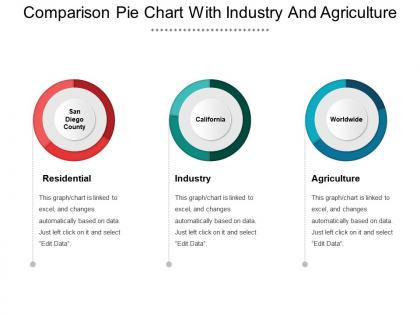
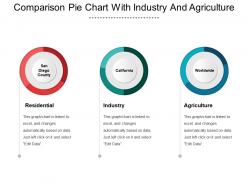
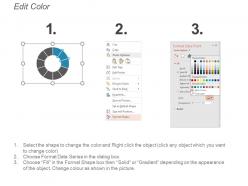
Create a stunning presentation using Comparison Pie Chart With Industry And Agriculture slideshow. Use this PPT graphic to showcase the contribution of agriculture, residency, and industry in different countries like Sam Diego, California and worldwide. You can use this pie chart template to show a small number of data categories and dominance of one category over the others. Customize the chart just the way you want them to look. Showcase the proportions and multiple statistics using Doughnut chart PowerPoint visual. You can use this pie chart template to show percentages of industry sectors contributing to the economy of the country. Give an example to show the market size of a particular business using this attractive business pie chart template. Also, showcase the advantages of pie charts and enable your readers to understand the information quickly. Now, download this practical and conceptualized comparison pie chart template and grab a large amount of information in a very short period of time.
People who downloaded this PowerPoint presentation also viewed the following :
Comparison pie chart with industry and agriculture with all 5 slides:
Involve yourself in fun and frolic with our Comparison Pie Chart With Industry And Agriculture. Indulge in the high jinks.
FAQs for Comparison pie chart with
Key factors driving industry sector growth over agriculture include technological automation, higher value-added manufacturing, urbanization trends, improved supply chain integration, and enhanced access to global markets. These developments enable industries to achieve greater scalability, operational efficiency, and profit margins compared to agriculture, with many manufacturing and service sectors finding that strategic technology adoption delivers faster innovation cycles and competitive advantages in increasingly dynamic market environments.
Employment rates vary significantly across regions, with developed economies like North America and Europe showing higher industrial employment (25-35%) compared to agricultural sectors (2-5%), while developing regions in Sub-Saharan Africa and South Asia maintain substantial agricultural workforces (50-70%) alongside growing industrial bases. These patterns reflect economic transitions and development stages, with many regions finding that strategic workforce development and industrial diversification ultimately deliver enhanced economic stability and competitive advantage.
Industrial activities typically generate higher carbon emissions, air pollution, and toxic waste, while agricultural practices contribute significantly to water consumption, soil degradation, and methane emissions from livestock. Both sectors present environmental challenges and opportunities, with many organizations finding that sustainable technologies, precision farming, and cleaner production methods ultimately deliver reduced environmental footprints and competitive advantages.
Revenue contributions between industry and agriculture vary significantly based on economic development levels, natural resources, and policy priorities across countries. Developing nations like Bangladesh or Kenya often see agriculture contributing 15-25% of GDP, while industrialized countries like Germany or Japan typically show industry dominating at 25-35% versus agriculture's 1-3%, ultimately reflecting each nation's economic structure and competitive positioning.
Technological advancements revolutionize both sectors through automation, data analytics, and precision systems, with industry leveraging robotics and IoT for streamlined manufacturing while agriculture adopts smart sensors and GPS-guided equipment. These innovations enhance operational efficiency, reduce resource waste, and accelerate production cycles, ultimately delivering competitive advantages and enabling organizations to scale operations while minimizing costs across increasingly technology-driven markets.
Government policy significantly impacts both sectors through regulatory frameworks, subsidies, tax incentives, environmental standards, and infrastructure investments, with industry often benefiting from technology grants and trade policies while agriculture receives crop subsidies and land-use protections. Through strategic policy combinations, governments enable industrial competitiveness and agricultural sustainability, with many developing nations finding that balanced approaches deliver economic diversification, food security, and long-term growth across both sectors.
Agriculture faces unique challenges including weather dependency, seasonal production cycles, soil degradation, water scarcity, and unpredictable market prices for commodities. Unlike industry sectors that operate in controlled environments with predictable inputs, agricultural businesses must navigate climate variability and biological uncertainties, while industrial operations focus more on supply chain optimization and technological integration for consistent outputs.
Agricultural supply chains emphasize perishability management, seasonal variability, and quality preservation through cold storage and rapid distribution, while industrial supply chains prioritize standardized processes, predictable demand forecasting, and cost optimization. Manufacturing industries benefit from consistent production cycles and longer shelf lives, whereas agriculture requires flexible logistics, weather-responsive planning, and specialized handling, ultimately delivering different competitive advantages based on sector-specific operational demands.
Consumer trends significantly influence industrial growth through demand for technology, sustainability, and convenience, while agriculture responds to health consciousness, organic preferences, and local sourcing demands. Industries can pivot quickly to capitalize on emerging trends like e-commerce and digital services, while agriculture faces longer adaptation cycles, with both sectors ultimately finding that consumer-driven innovation delivers competitive advantages and enhanced market positioning.
Globalization has enhanced industrial competitiveness through expanded markets, supply chain optimization, and technology transfer, while agriculture faces mixed impacts including increased market access but heightened competition from lower-cost producers. Many developed nations find their manufacturing sectors leveraging global networks for efficiency, while agricultural sectors increasingly rely on specialization, value-added processing, and sustainable practices to maintain competitive advantage in international markets.
Educational needs in industry include technical certifications, digital literacy, automation skills, safety training, and continuous professional development, while agriculture requires sustainable farming techniques, precision agriculture technology, and agricultural science knowledge. Both sectors increasingly demand data analytics, environmental management, and adaptability skills, with many organizations finding that cross-sector training in technology integration and sustainability delivers enhanced productivity and competitive advantage.
Market demands increasingly favor organic goods through heightened health consciousness, environmental awareness, and quality perceptions, while manufactured goods maintain dominance in cost-sensitive segments and convenience categories. This shift presents both challenges and opportunities, with retail chains, food processors, and agricultural producers finding that strategic positioning across both segments delivers competitive advantage, enhanced customer loyalty, and diversified revenue streams in an evolving marketplace.
Industry is projected to experience significantly higher job growth than agriculture over the next decade, with manufacturing, technology, and renewable energy sectors leading expansion while agricultural employment remains relatively stable. This divergence reflects increasing automation in farming, urbanization trends, and industrial diversification, with many economists finding that reskilling agricultural workers for industrial roles presents strategic workforce development opportunities.
Industry and agriculture contribute to GDP through manufacturing output, service provision, agricultural production, export revenues, and employment generation, with their relative proportions indicating economic development stages. Countries with higher industrial contributions typically demonstrate greater economic diversification and resilience, while agriculture-dependent economies face seasonal volatility, though balanced contributions across both sectors ultimately deliver sustainable growth and reduced economic risk.
Climate change affects agriculture through altered precipitation patterns, temperature fluctuations, soil degradation, and extreme weather events, while industrial practices face regulatory pressures, supply chain disruptions, and sustainability requirements. Through adaptive technologies and strategic planning, many organizations are finding that sustainable agricultural methods and green industrial processes deliver enhanced resilience, operational efficiency, and competitive advantage in an increasingly climate-conscious market.
-
Use of different colors is good. It's simple and attractive.
-
Good research work and creative work done on every template.