


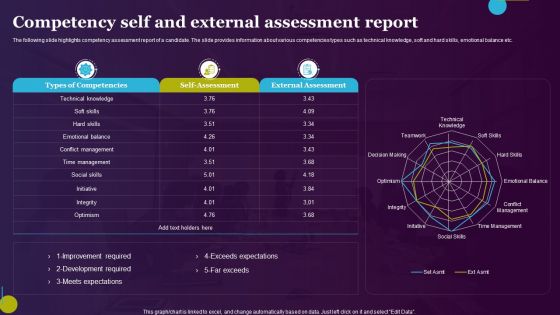
Competency Self And External Assessment Report




Try Before you Buy Download Free Sample Product
 Impress Your
 Audience
 100%
100% Editable
 Save Hours
 of Time


The following slide highlights competency assessment report of a candidate. The slide provides information about various competencies types such as technical knowledge, soft and hard skills, emotional balance etc.
People who downloaded this PowerPoint presentation also viewed the following :
Competency Self And External Assessment Report with all 7 slides:
Use our Competency Self And External Assessment Report to effectively help you save your valuable time. They are readymade to fit into any presentation structure.






FAQs for Competency Self And
Effective competency assessment frameworks include clear competency definitions, standardized evaluation criteria, multiple assessment methods, performance benchmarks, and continuous feedback mechanisms. These components work together by establishing transparent expectations, enabling objective measurement through diverse evaluation approaches, and providing ongoing development insights, with many organizations finding that this structured approach ultimately enhances talent development and organizational performance.
Organizations align competency assessments with strategic goals by identifying critical skills needed for future success, mapping current capabilities against these requirements, and developing targeted improvement plans. Through strategic workforce planning, companies can prioritize competencies that directly support business objectives, with many finding that this alignment enhances performance, accelerates goal achievement, and delivers sustainable competitive advantage.
Technology streamlines competency assessment processes by automating evaluations, enabling real-time feedback, integrating multiple assessment methods, and providing comprehensive analytics dashboards. Through AI-powered platforms and digital assessment tools, organizations in healthcare, finance, and manufacturing can reduce administrative overhead, accelerate certification timelines, and deliver more consistent evaluations, ultimately enhancing workforce development and operational efficiency.
Organizations ensure objectivity in competency assessments through standardized evaluation criteria, multiple assessor perspectives, structured behavioral interviews, and validated assessment tools. These methods minimize personal bias by establishing clear performance benchmarks, incorporating peer and supervisor feedback, and using data-driven scoring systems, ultimately delivering fair, consistent evaluations that enhance talent development and strategic workforce planning.
Competency assessments combine multiple evaluation methods including behavioral interviews, technical simulations, peer reviews, self-assessments, and scenario-based exercises to measure both soft and hard skills comprehensively. These approaches enable organizations to evaluate communication abilities alongside technical expertise, with many companies finding that strategic combinations deliver more accurate talent insights, ultimately enhancing hiring decisions and professional development outcomes.
Competency assessments should typically be conducted annually during performance reviews, with additional evaluations during role transitions, after major training programs, and when new skills become critical to business objectives. Many organizations are increasingly adopting quarterly or bi-annual cycles, especially in fast-evolving sectors like technology and healthcare, finding that more frequent assessments enable better talent development and strategic workforce planning.
Best practices for involving employees include self-assessment opportunities, collaborative goal-setting sessions, regular feedback dialogues, peer evaluation components, and transparent communication about assessment criteria and outcomes. Through these approaches, organizations enhance employee engagement, improve assessment accuracy, and foster professional development ownership, with many companies finding that participatory processes ultimately deliver higher job satisfaction and more targeted skill development initiatives.
Feedback from competency assessments drives employee development by identifying specific skill gaps, creating targeted learning pathways, and establishing measurable improvement goals. Organizations leverage these insights to design personalized training programs, mentorship opportunities, and career advancement plans, with many companies finding that structured competency feedback increases employee engagement and retention while building stronger internal talent pipelines.
Common challenges include defining clear competency frameworks, ensuring assessment accuracy and consistency, managing employee resistance to evaluation processes, integrating results with existing HR systems, and maintaining objectivity across different departments. Organizations often struggle with resource allocation and training managers to conduct effective assessments, while balancing standardization with role-specific requirements, ultimately requiring strategic planning and change management to deliver meaningful workforce development outcomes.
Cultural differences significantly impact competency assessments through varying communication styles, leadership expectations, feedback preferences, performance indicators, and behavioral norms across regions. Global organizations increasingly adapt their assessment frameworks by incorporating cultural sensitivity training, localized competency models, and diverse evaluation methods, ultimately delivering more accurate talent insights and enhanced employee engagement across multicultural teams.
Effectiveness metrics include assessment validity and reliability scores, employee performance improvement rates, skill gap identification accuracy, and training ROI measurements. Organizations typically track completion rates, participant feedback scores, and post-assessment behavioral changes, with many finding that combining quantitative performance data with qualitative feedback delivers comprehensive insights into program success and organizational development outcomes.
Competency assessments can be tailored by identifying role-specific technical skills, behavioral requirements, industry regulations, and performance metrics unique to each position. Healthcare roles might emphasize patient safety protocols and clinical expertise, while financial services focus on regulatory compliance and risk management, with many organizations finding that customized frameworks deliver more accurate hiring decisions and targeted development programs.
Organizations must consider employment law compliance, anti-discrimination regulations, data privacy requirements, documentation standards, and reasonable accommodation obligations during competency assessments. These legal frameworks ensure fair evaluation processes across industries like healthcare, finance, and manufacturing, while protecting both employee rights and organizational interests, ultimately delivering legally sound assessment practices that minimize litigation risks and enhance workforce development strategies.
Competency assessments contribute to succession planning by identifying high-potential employees, mapping skill gaps across leadership pipelines, and creating targeted development pathways for future roles. Through systematic evaluation of capabilities and leadership readiness, organizations can strategically prepare internal talent for critical positions, ultimately reducing external hiring costs while ensuring continuity and maintaining institutional knowledge during transitions.
Organizations can access HR consulting firms, competency assessment software platforms, industry-specific frameworks, professional development organizations, and internal training departments to develop effective assessment tools. These resources enable companies to create customized evaluation systems through benchmarking studies, template libraries, and expert guidance, with many finding that combining external expertise with internal knowledge streamlines implementation while ensuring assessments align with strategic business objectives.
-
Such amazing slides with easy editable options. A perfect time-saver.
-
A library of engaging, customizable and content-ready templates.