


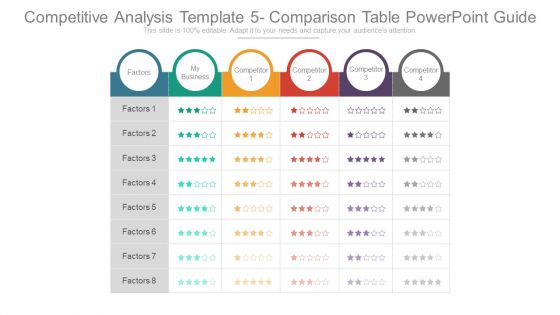
Competitive analysis template 5 comparison table powerpoint guide





Try Before you Buy Download Free Sample Product
 Impress Your
 Audience
 100%
100% Editable
 Save Hours
 of Time


Encourage enterprising ideas with our Competitive Analysis Template 5 Comparison Table Powerpoint Guide. Hand out hints on how to improve.
People who downloaded this PowerPoint presentation also viewed the following :
Competitive analysis template 5 comparison table powerpoint guide with all 7 slides:
Accept the bet with our Competitive Analysis Template 5 Comparison Table Powerpoint Guide. The chances will be greatly in your favor.
FAQs for Competitive analysis template 5 comparison
Honestly, I'd stick to five main areas: market share/revenue, how their products and pricing stack up against yours, their marketing tactics and what they spend on customer acquisition, plus customer satisfaction and retention numbers. Oh, and their digital stuff - website traffic, social media engagement, that kind of thing. I used to try tracking literally everything but you just end up drowning in data. Focus on what actually helps you make decisions - like are they undercutting your prices or stealing customers from specific segments? Keep it to maybe 3-5 metrics per category tops, and make sure you're comparing the same time periods.
Dude, skip the spreadsheet dump - nobody reads that stuff anyway. Color-coded matrices work great for showing competitor rankings. Scatter plots are perfect for market positioning too. I'm obsessed with using simple icons for strengths/weaknesses because people get it instantly. Charts help you catch patterns fast, like who owns the premium space or where gaps exist. Honestly? Stakeholders zone out with data tables but perk up with visuals. Start with a competitive positioning map as your main piece, then add supporting charts around it. Way more engaging than paragraphs of analysis.
SWOT analysis is honestly perfect for this - you basically map out each competitor's strengths, weaknesses, opportunities, and threats in one spot. Makes it super easy to spot patterns you'd totally miss otherwise. You'll quickly see where they're vulnerable (aka your chance to swoop in) and where they're absolutely killing it. The framework sounds pretty basic but trust me, it turns all that messy competitive research into something you can actually use. I'd probably do a quick SWOT for your top 3-5 competitors and maybe update it every quarter? The landscape changes faster than you think.
Honestly, quarterly is the bare minimum but it really depends on your space. Tech moves crazy fast, so I'd say monthly for those industries. More traditional stuff? Maybe every 6 months works fine. Set those calendar reminders, but don't ignore the big stuff when it happens - like when a competitor drops new pricing or launches something major. That's when you need to jump on it right away. Oh, and don't try tracking everyone under the sun. Pick 3-5 main competitors and actually stay on top of them instead of spreading yourself too thin.
Honestly, start with their website and SEC filings if they're public - that's your foundation. Job postings are weirdly revealing about where they're headed strategy-wise, so definitely check those out. IBISWorld and Forrester have solid industry reports too. LinkedIn's perfect for stalking their hiring trends and seeing who's jumping ship or coming aboard. Then hit up their social media, press releases, and review sites like G2. Customer reviews can be brutal but they'll tell you what's actually going on. Build your full picture by mixing the official stuff with the messier real-world intel.
So basically, you throw your top 3-5 competitors into a template and map out their features, pricing, messaging - all that stuff. Makes it super easy to see where you actually differ from everyone else. Sometimes you'll realize you're way less unique than you thought (which honestly sucks but is useful). The whole point is comparing apples to apples instead of just guessing. Fill it out section by section - don't try to do everything at once or you'll get overwhelmed. Once it's all laid out, your real advantages become pretty obvious.
So basically, you gotta figure out who your competitors are actually going after - like break the market down by age groups, buying habits, whatever makes sense for your thing. Then you can see if you're all fighting over the same customers or if there's some obvious gap everyone's ignoring. Honestly, most people skip this step and just do surface-level competitor research, which is pretty useless. Pick maybe 3-4 main segments to focus on first. That way you're not drowning in data but you can actually see how each competitor performs in those specific areas. Makes the whole analysis actually actionable instead of just... I don't know, busy work?
Look at who's going after your exact same customers first - those are the ones that'll actually hurt you. Then check out companies solving the same problem but differently. I used to waste so much time researching every single competitor (huge mistake honestly). Just focus on maybe 3-5 max that could realistically steal your customers. Market share tells you a lot, plus see if customers mention them in reviews alongside your brand. Geographic overlap matters too if you're not everywhere yet. The rest? Don't stress about them until they become relevant.
Don't try to analyze like 20 competitors at once - you'll just get overwhelmed and miss the good stuff. Stick to your top 3-5 direct ones. I made this mistake early on and wasted so much time. Skip the surface-level comparison charts everyone loves making. Instead, dig into their actual messaging and what customers are saying about them. Oh, and make sure your data isn't from 2019 or something outdated like that. The real key though? Actually turn all that research into something useful your team can act on, not just a pretty spreadsheet that sits there.
Look, competitive analysis templates are basically your secret weapon for figuring out what's already happening in your space. Map out your top 3-5 competitors first - see how they're pricing stuff, what features they're totally missing, and how they position themselves. It's kind of like getting the answers before a test, honestly. With that info, you can make way smarter calls about your pricing and what makes your product actually different. Way better than just throwing something out there and hoping it sticks. Plus you'll spot those market gaps that everyone else somehow missed.
Look, competitive analysis data only tells you half the story. Sure, you'll see their pricing and feature lists, but customer feedback shows what people actually care about. Which features do they love? What pisses them off? Reviews and surveys reveal all that stuff your spreadsheets miss. Honestly, some companies obsess over features that users barely even notice. Without real customer voices, you're just making educated guesses about why competitors win or lose. It's like trying to understand a movie by only reading the budget breakdown. So definitely mix customer feedback into whatever template you're using.
Just swap out the stuff that doesn't apply to your industry, honestly. B2B SaaS companies care about pricing tiers and customer acquisition costs. Retail? More about product mix and distribution. Healthcare has all those compliance headaches (which obviously don't matter if you're running a coffee shop). Start basic, then throw in 3-4 categories your stakeholders actually give a damn about. The whole point is flexibility - you don't need to track everything under the sun. Focus on what moves the needle in your specific world.
Honestly, looking at digital metrics beats trusting whatever competitors say about themselves in their fancy marketing stuff. Check their website traffic, social engagement, where they rank in search results, review scores - that's the real deal. Way more honest than those polished annual reports, you know? Track maybe 3-5 main competitors each month so you can spot patterns. It's pretty useful for finding weak spots where you could beat them, plus you'll catch new threats early. Sometimes I get a bit obsessed with the data but it really does show you what's actually happening versus what they want you to think.
Dude, visuals are a game changer for competitive analysis. Nobody wants to stare at endless spreadsheets - I mean, who has time for that? Bar charts work great for pricing comparisons, scatter plots show where everyone sits in the market, and heat maps make feature gaps super obvious. I swear, half the reports I've seen just sit there unread because they're pure text dumps. Charts let people see patterns right away. Your executives will actually flip through the whole thing instead of just reading your summary at the end. Start with maybe 2-3 key visuals that tell your story, then throw in data tables later if people want the nitty-gritty details.
Check out their pricing tiers and how often they switch things up. Are they going cheap to grab market share, positioning as premium, or just copying what everyone else does? Their discount game matters too - bundling deals and promos tell you tons about how they're trying to land customers. Some companies hide their prices behind "request a quote" nonsense, while others put everything right out there. Honestly, the transparency thing says a lot about their confidence. Track this stuff over a few months and you'll start seeing patterns. Makes it way easier to predict what they'll do next.
-
Much better than the original! Thanks for the quick turnaround.
-
Understandable and informative presentation.