


Competitive swot analysis powerpoint ideas




Try Before you Buy Download Free Sample Product
 Impress Your
 Audience
 100%
100% Editable
 Save Hours
 of Time


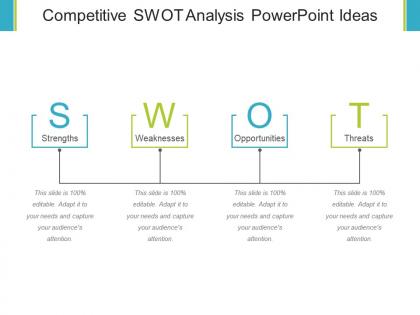
Analyse your company’s strengths, weaknesses, opportunities and threats using our competitive SWOT analysis PowerPoint ideas. You can easily assess a changing environment in your company at any given time. Identify and enforce strategies for your business to operate efficiently. Bring your team together and encourage them to work towards the organization’s objectives. SWOT analysis in market PPT slide can help evaluate your company's competitive position in the target market. Gauge all positive and negative factors inside and outside the firm that can affect the success.You can assess the performance, competition, risks involved and the potential of your product in the market. This competitive SWOT analysis PPT template will help you prepare a PowerPoint presentation that is simple, clear and concise. Guide your team to improve the areas of weakness. Motivate them by highlighting the strengths in this SWOT analysis presentation. Overcome all the challenges and execute your business on a firm streamlines strategy, effortlessly. Curate an effective PowerPoint presentation in less time using our SWOT analysis PPT template. Evaluate all the different angles with our Competitive Swot Analysis Powerpoint Ideas. Examine every conceivable impact.
People who downloaded this PowerPoint presentation also viewed the following :
Competitive swot analysis powerpoint ideas with all 5 slides:
Your ideas deserve an ovation. Get what you deserve with our Competitive Swot Analysis Powerpoint Ideas.



FAQs for Competitive swot
Key factors include competitor identification, market positioning analysis, financial performance evaluation, operational capabilities assessment, and strategic initiative tracking. These elements enable organizations to benchmark against rivals by examining pricing strategies, customer satisfaction levels, and resource allocation efficiency, with many businesses finding that comprehensive competitive intelligence ultimately delivers strategic advantages and identifies market opportunities for sustainable growth.
SWOT analysis helps identify market opportunities by systematically evaluating internal strengths against external market gaps, competitor weaknesses, and emerging industry trends. Through strategic assessment, organizations can pinpoint underserved customer segments, technological advantages, and competitive positioning gaps, while leveraging their unique capabilities to capitalize on market shifts, ultimately delivering sustainable growth and enhanced market share.
Competitor weaknesses can be leveraged by directly addressing their service gaps, targeting their underserved customer segments, investing in areas they neglect, and emphasizing superior capabilities in marketing messaging. Organizations often capitalize on competitors' operational inefficiencies, technology limitations, or poor customer experiences, ultimately delivering enhanced value propositions that capture market share and strengthen competitive positioning.
External threats significantly influence strategic planning by forcing businesses to reassess market positioning, resource allocation, and competitive advantages while identifying vulnerabilities in current operations. Companies typically respond by diversifying revenue streams, strengthening core competencies, and developing contingency plans, with many organizations finding that proactive threat analysis ultimately delivers enhanced resilience and sustainable competitive positioning.
Industry trends significantly influence competitors' strengths and weaknesses by determining which capabilities become advantageous or obsolete, shifting market demands, and creating new operational requirements. Companies with early digital adoption, sustainable practices, or agile infrastructure often transform former weaknesses into competitive advantages, while those slow to adapt find previous strengths becoming liabilities in evolving markets.
Companies use SWOT analysis to refine their unique selling propositions by identifying internal strengths to emphasize, weaknesses to address, market opportunities to capitalize on, and competitive threats to differentiate against. This strategic assessment enables organizations to craft compelling value propositions that highlight their competitive advantages, address market gaps, and position their offerings more effectively, with many businesses finding that regular SWOT evaluations significantly enhance their market positioning and customer appeal.
Key metrics for evaluating competitor strengths include market share, revenue growth, customer retention rates, brand recognition scores, and operational efficiency indicators. Through financial analysis, customer satisfaction surveys, and performance benchmarking, organizations can assess competitive positioning across pricing strategies, product innovation, and service delivery, ultimately identifying strategic gaps and opportunities for differentiation.
SWOT analysis informs pricing strategy by revealing internal cost advantages, premium value propositions from strengths, market positioning gaps, and competitive vulnerabilities that justify pricing decisions. Through strengths assessment, companies identify unique capabilities enabling premium pricing, while weaknesses analysis highlights areas requiring competitive pricing, with many organizations finding that threat evaluation reveals competitor pricing pressures and opportunities for strategic differentiation.
Common pitfalls include relying on outdated competitor data, focusing only on direct competitors while ignoring emerging threats, oversimplifying complex market dynamics, and allowing internal biases to skew objective assessment. Many organizations find that combining multiple research methods, regularly updating competitive intelligence, and involving cross-functional teams delivers more accurate analyses, ultimately enabling better strategic positioning and competitive advantage.
Companies should update their competitive SWOT analysis quarterly or biannually, depending on market volatility, with additional updates triggered by major industry shifts, competitor moves, or internal changes. This regular cadence enables organizations to maintain strategic agility, identify emerging opportunities, and respond to competitive threats proactively, ultimately delivering sustained competitive advantage in increasingly dynamic markets.
Technology advancements can be incorporated by evaluating digital capabilities as strengths, identifying tech gaps as weaknesses, assessing emerging technologies as opportunities, and recognizing disruption risks as threats. Through systematic analysis of AI, automation, and digital infrastructure, organizations streamline competitive positioning, enhance strategic decision-making, and ultimately deliver sustainable advantages in increasingly technology-driven markets.
**INPUT**: What qualitative factors should be considered alongside quantitative data in a SWOT analysis? **OUTPUT**: Qualitative factors include brand reputation, employee morale, organizational culture, leadership effectiveness, customer loyalty, and stakeholder relationships. These elements provide crucial context that numbers alone cannot capture, with many organizations finding that combining qualitative insights with quantitative metrics delivers more strategic decision-making and sustainable competitive advantage. [Word count: 50 words]
Businesses ensure objectivity in competitive SWOT analysis through data-driven research methods, third-party market intelligence, customer feedback analysis, and cross-functional team evaluations that minimize internal bias. These approaches enable organizations to gather verified competitor insights from multiple sources, including industry reports and direct market observations, ultimately delivering more accurate strategic assessments and competitive positioning advantages.
Customer feedback enhances competitive SWOT analysis accuracy by providing real-world insights into market perceptions, competitor performance gaps, and unmet customer needs that internal teams might miss. This external perspective enables organizations to identify authentic strengths and weaknesses across competitors, validate strategic assumptions, and uncover market opportunities, ultimately delivering more precise competitive positioning and data-driven strategic decisions.
Cultural differences significantly influence competitive analysis by affecting consumer preferences, business practices, regulatory compliance, and market positioning strategies across different regions. Companies must adapt their SWOT frameworks to account for local customs, communication styles, and purchasing behaviors, with many multinational organizations finding that standardized competitive assessments often miss critical cultural nuances that determine market success.
-
Colors used are bright and distinctive.
-
Use of icon with content is very relateable, informative and appealing.