


Complaint escalation plan customer complaint mechanism ppt sample




Try Before you Buy Download Free Sample Product
 Impress Your
 Audience
 100%
100% Editable
 Save Hours
 of Time


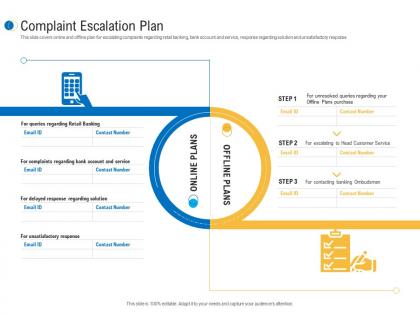
This slide covers online and offline plan for escalating complaints regarding retail banking, bank account and service, response regarding solution and unsatisfactory response
People who downloaded this PowerPoint presentation also viewed the following :
Complaint escalation plan customer complaint mechanism ppt sample with all 2 slides:
Use our Complaint Escalation Plan Customer Complaint Mechanism Ppt Sample to effectively help you save your valuable time. They are readymade to fit into any presentation structure.

FAQs for Complaint escalation plan customer complaint
Key components include clear escalation triggers, defined timeframes for each level, designated responsible personnel, standardized documentation processes, and communication protocols for updating customers. These elements work together by ensuring complaints move efficiently through organizational levels, maintaining accountability at each stage, and providing transparency to customers, ultimately delivering faster resolutions and improved customer satisfaction while protecting brand reputation.
Organizations determine escalation levels by categorizing complaints based on severity, complexity, customer impact, and potential business risk, while establishing clear criteria for each tier. Through systematic assessment frameworks, companies can route routine service issues to frontline staff, technical problems to specialized teams, and high-stakes complaints to senior management, ultimately ensuring faster resolution times and improved customer satisfaction across all complaint categories.
Communication serves as the foundation of effective complaint escalation plans, ensuring transparency, accountability, and timely resolution through clear protocols, regular updates, and systematic documentation. It enables organizations to maintain customer trust while streamlining internal processes, with many businesses finding that proactive communication reduces escalation frequency and enhances overall customer satisfaction.
Businesses measure complaint escalation effectiveness through resolution time tracking, customer satisfaction scores, escalation frequency rates, first-call resolution percentages, and repeat complaint analysis. These metrics enable organizations to identify bottlenecks, streamline response protocols, and enhance service quality, with many companies finding that systematic measurement ultimately delivers improved customer retention and operational efficiency.
Common pitfalls include unclear escalation criteria, inadequate staff training, poor communication channels, lengthy response times, and lack of follow-up procedures. Organizations often struggle with inconsistent handling across departments, insufficient documentation, and failing to empower frontline staff, with many companies finding that proper training and clear guidelines ultimately streamline resolution processes while enhancing customer satisfaction.
Technology enhances complaint escalation processes through automated routing systems, AI-powered priority classification, real-time tracking dashboards, and integrated communication platforms. These digital solutions streamline workflow management by reducing response times, ensuring consistent follow-up protocols, and providing comprehensive audit trails, with many customer service organizations finding significantly improved resolution rates and enhanced customer satisfaction.
**INPUT**: What criteria should be used to prioritize complaints during the escalation process? **OUTPUT**: Complaint prioritization should consider severity of impact, customer tier status, legal or regulatory implications, potential for viral exposure, and resolution complexity timeframes. These criteria enable organizations to strategically allocate resources, with many customer service teams finding that combining urgency matrices with business risk assessments ultimately delivers faster resolution times and enhanced customer retention. [Word count: 54 words]
Staff training is critically important for complaint escalation success, as it ensures consistent response protocols, proper issue classification, effective communication skills, and timely resolution processes. Well-trained teams in customer service, retail, and healthcare sectors significantly reduce escalation time, improve customer satisfaction rates, and minimize costly legal disputes, ultimately delivering enhanced operational efficiency and stronger customer relationships.
Best practices for documenting complaints include creating standardized intake forms, assigning unique tracking numbers, recording detailed incident descriptions, noting escalation triggers, and maintaining comprehensive resolution logs. These documentation methods streamline complaint management by ensuring accountability, enabling pattern analysis, and facilitating faster resolutions, with many organizations finding that systematic documentation reduces response times while enhancing customer satisfaction and regulatory compliance.
Customer feedback integrates into complaint escalation plans through regular surveys, complaint pattern analysis, resolution time tracking, and satisfaction scoring at each escalation tier. This continuous feedback loop enables organizations to identify bottlenecks, refine response protocols, and adjust escalation triggers, with many companies finding that data-driven plan evolution significantly reduces repeat complaints and enhances customer retention.
**INPUT**: What strategies can be employed to ensure timely resolution of escalated complaints? **OUTPUT**: Effective escalation strategies include automated routing systems, dedicated specialist teams, clear timeline protocols, priority classification frameworks, and real-time tracking dashboards. These approaches streamline resolution by assigning appropriate expertise, establishing accountability measures, and maintaining transparent communication channels, with many organizations finding that structured escalation processes reduce resolution times while enhancing customer satisfaction and operational efficiency. [Word count: 58 words]
A company's culture significantly shapes complaint escalation approaches through leadership attitudes, communication styles, employee empowerment levels, and customer-centricity focus. Organizations with collaborative cultures tend to resolve issues faster through cross-departmental coordination and proactive problem-solving, while hierarchical cultures may experience slower resolution times, with many companies finding that cultural alignment ultimately determines customer satisfaction outcomes and competitive advantage.
A transparent escalation process significantly enhances customer trust by demonstrating accountability, clear communication pathways, and commitment to resolution, while building loyalty through consistent follow-through and proactive updates. Organizations implementing transparent systems find that customers appreciate knowing exactly how their concerns progress, ultimately delivering stronger retention rates and improved satisfaction scores across service interactions.
Organizations effectively communicate escalation processes through multiple channels, clear timelines, proactive notifications, accessible documentation, and regular training for customer-facing staff. These communication strategies enhance transparency by providing customers with defined expectations, simple contact methods, and status updates throughout the escalation journey, ultimately delivering improved customer experiences and stronger relationships.
Senior management and leadership provide strategic oversight, final decision-making authority, and resource allocation for complex complaint resolutions that frontline teams cannot handle independently. Through executive involvement, organizations demonstrate commitment to customer satisfaction, ensure consistent policy application, and enable rapid resolution of high-stakes issues, ultimately strengthening customer relationships and organizational reputation.
-
Unique design & color.
-
Innovative and Colorful designs.
-
Perfect template with attractive color combination.
-
The content is very helpful from business point of view.