

Complete Guide Of Sustainable Agriculture Practices Powerpoint Presentation Slides





Try Before you Buy Download Free Sample Product
 Impress Your
Audience
 100%
Editable
 Save Hours
of Time


Check out our professionally designed Complete Guide of Sustainable Agriculture Practices PPT. The Conservation Agriculture deck covers sustainable agriculture overview with its multiple ecological and economic principles. Also, the Agroforestry PowerPoint Template includes evolution history and market analysis. Further, the Organic Farming Template addresses various sustainable agriculture practices, including conservation agriculture, agroforestry, organic farming, integrated pest management, precision agriculture, crop rotation and cover cropping, livestock management, water conservation and irrigation. Moreover, the Precision Agriculture deck will cover slides about smart agriculture and various software solutions. Lastly, the Crop Rotation presentation includes slides about the cost and impact assessment of adopting sustainable farming practices. Get access to this powerful template now.
People who downloaded this PowerPoint presentation also viewed the following :
Content of this Powerpoint Presentation
Slide 1: The slide introduces Complete Guide of Sustainable Agriculture Practices. State your Company Name.
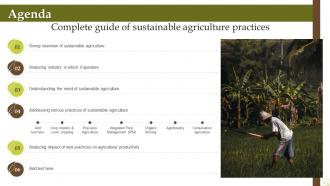
Slide 2: This is an Agenda slide. State your agendas here.
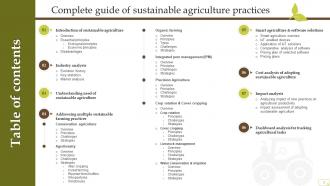
Slide 3: The slide displays Title of contents for the presentation.
Slide 4: The slide continues Table of contents.
Slide 5: This slide provides glimpse about summary of sustainable agriculture that can help farming businesses in conserving biodiversity & natural resources.
Slide 6: This slide highlights different principles of sustainable agriculture that can help to protect ecosystem health while maintaining profitability.
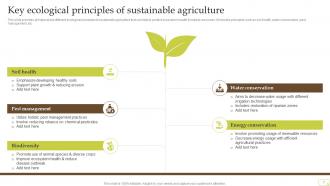
Slide 7: This slide renders about different ecological principles of sustainable agriculture that can help to protect ecosystem health & natural resources.
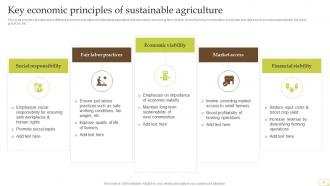
Slide 8: This slide presents about different economic principles of sustainable agriculture that can help to boost long term viability.
Slide 9: This slide provides glimpse about several disadvantages of sustainable agriculture that can pose many challenges for its farmers.
Slide 10: The slide renders Title of contents further.
Slide 11: This slide highlights about history of sustainable agriculture’s evolution and how it developed over time from conventional farming practices.
Slide 12: This slide provides glimpse about different facts and figures about sustainable agriculture that can help in conserving biodiversity & natural resources.
Slide 13: This slide presents about summary of international sustainable agriculture market for understanding its growing business and utilizing the opportunities.
Slide 14: The slide displays of contents which is to be discussed further.
Slide 15: This slide presents about top benefits of adopting sustainable agricultural practices for conserving our ecosystem.
Slide 16: The slide depicts Title of content further.
Slide 17: This slide provides glimpse about different sustainable agricultural practices that can help in conserving soil and water resources.
Slide 18: The slide represents Title of contents further.
Slide 19: This slide provides glimpse about summary of conservation agriculture that can help farming businesses in protecting and maintaining soil cover.
Slide 20: This slide provides glimpse about different principles of conservation agriculture that can help to protect soil from erosion and maintaining its cover.
Slide 21: This slide presents several challenges of conservation agriculture that can become disadvantages for its farmers.
Slide 22: This slide provides glimpse about different strategies of conservation agriculture that can help to protect soil from any type of disturbance.
Slide 23: The slide describes Title of contents further.
Slide 24: This slide provides glimpse about summary of agroforestry that can help in capturing & storing atmospheric carbon.
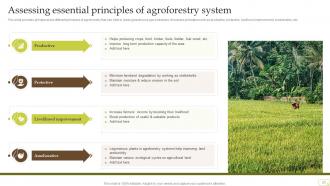
Slide 25: This slide present different principles of agroforestry that can help to lower greenhouse gas emissions.
Slide 26: This slide displays several challenges of agroforestry that can become disadvantages for its farmers.
Slide 27: The slide describes Title of contents further.
Slide 28: This slide provides glimpse about different strategies of agroforestry that can help in capturing & storing atmospheric carbon.
Slide 29: This slide highlights summary of alley cropping that can help in diversifying farmers’ income and boosting productivity.
Slide 30: This slide briefs about summary of forest farming that can help in diversifying farmers’ income and supporting community.
Slide 32: This slide shows summary of silvopasture that can help in conserving wildlife and biodiversity.
Slide 33: This slide highlights summary of windbreaks that can help in protecting agriculture produce and animals.
Slide 34: The slide depicts Title of contents further.
Slide 35: This slide provides glimpse about summary of organic farming that can help in conserving biodiversity & natural resources.
Slide 36: This slide provides glimpse about different principles of organic farming that can help in reducing use of chemicals.
Slide 37: This slide highlights different principles of organic farming that can help in conserving biodiversity & natural resources.
Slide 38: This slide represents about several challenges of organic farming that can become disadvantages for its farmers.
Slide 39: This slide provides glimpse about different strategies of organic farming that can help in reducing usage of chemical fertilizers and pesticides.
Slide 40: The slide describes Title of contents further.
Slide 41: This slide provides glimpse about summary of integrated pest management (IPM) that can help in decreasing risk of chemical use on humans.
Slide 42: This slide presents different principles of integrated pest management (IPM) that can help in reducing use of chemicals.
Slide 43: This slide provides glimpse about several challenges of integrated pest management (IPM) that can become disadvantages for its farmers.
Slide 44: This slide provides glimpse about different strategies of integrated pest management (IPM) that can help in managing pests.
Slide 45: The slide displays Title of contents further.
Slide 46: This slide provides glimpse about summary of precision agriculture (PA) that can help in enhancing crop productivity.
Slide 47: This slide highlights different principles of precision agriculture (PA) that can help in improving crop production sustainably.
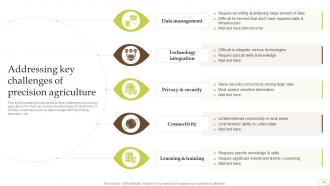
Slide 48: This slide presents glimpse about several challenges of precision agriculture (PA) that can become disadvantages for its farmers.
Slide 49: This slide briefs about different strategies of precision agriculture (PA) that can help in boosting crop production.
Slide 50: The slide depicts Title of contents further.
Slide 51: This slide provides glimpse about summary of crop rotation & cover cropping that can help in conserving soil health & fertility.
Slide 52: The slide displays Title of contents further.
Slide 53: This slide provides glimpse about different principles of crop rotation that can help in preventing soil erosion.
Slide 54: This slide highlights several challenges of crop rotation that can become disadvantages for its farmers.
Slide 55: This slide briefs about different strategies of crop rotation that can help in boosting crop production.
Slide 56: The slide renders Title of contents further.
Slide 57: This slide provides glimpse about different principles of cover cropping that can help in improving crop production sustainably.
Slide 58: This slide presents several challenges of cover cropping that can become disadvantages for its farmers.
Slide 59: This slide renders different strategies of cover cropping that can help in boosting crop production.
Slide 60: The slide dispalys Title of contents further.
Slide 61: This slide provides glimpse about summary of livestock management that can help in managing cattle effectively.
Slide 62: This slide highlights different principles of livestock management that can help in boosting farming income streams.
Slide 63: This slide describes several challenges of livestock management that can become disadvantages for its farmers.
Slide 64: This slide provides glimpse about different strategies of livestock management that can help in boosting farming income streams.
Slide 65: The slide displays Title of contents further.
Slide 66: This slide provides glimpse about summary of water conservation and irrigation that can help in efficient soil hydration.
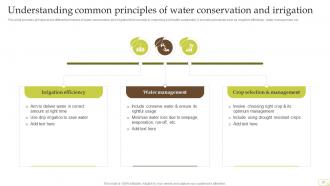
Slide 67: This slide highlights different principles of water conservation and irrigation that can help in improving soil health sustainably.
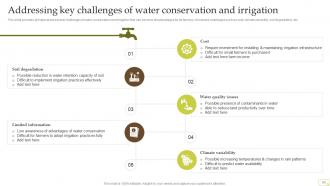
Slide 68: This slide shows several challenges of water conservation and irrigation that can become disadvantages for its farmers.
Slide 69: This slide presents about different strategies of water conservation and irrigation that can help in in efficient soil hydration.
Slide 70: The slide displays Title of contents which is to be discussed further.
Slide 71: This slide provides glimpse about summary of smart agriculture that can help in boosting crop productivity.
Slide 72: This slide briefs about multiple smart agriculture devices that can help in boosting crop productivity & profitability.
Slide 73: This slide provides glimpse about applying various smart agriculture devices that can help in increasing food productivity.
Slide 74: This slide highlights about comparative analysis of different farming solutions for selecting appropriate software solution for our business.
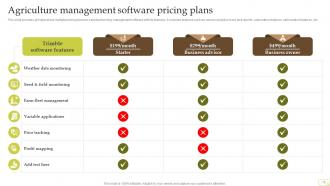
Slide 75: This slide renders glimpse about multiple pricing plans for selected farming management software with its features.
Slide 76: The slide describes Title of contents further.
Slide 77: This slide provides glimpse about analyzing annual costs incurred in the implementation of sustainable agriculture.
Slide 78: The slide renders Title of contents further.
Slide 79: This slide provides glimpse about impact analysis of crop productivity after implementation of sustainable agriculture.
Slide 80: This slide renders impact assessment of adopting sustainable farming with key parameters involved related to agricultural practices.
Slide 81: The slide displays title of contents which is to be discussed further.
Slide 82: This slide showcases the KPIs that would help to track the improvements with adoption of new sustainable agriculture practices.
Slide 83: This slide shows all the icons included in the presentation.
Slide 84: This slide is titled as Additional Slides for moving forward.
Slide 85: The slide displays Key factors affecting agricultural sustainability.
Slide 86: The slide demonstrates Sustainable farming practices to halt climate change.
Slide 87: The slide depicts Conceptual framework for sustainable agricultural practices.
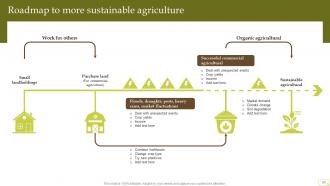
Slide 88: The slide describes Roadmap to more sustainable agriculture.
Slide 89: The slide represents Assessing lifecycle of organic farming practices.
Slide 90: The slide displays Workflow process of conservation agricultural practices.
Slide 91: This slide depicts Venn diagram with text boxes.
Slide 92: This slide shows Pie Chart with data in percentage.
Slide 93: This slide contains Puzzle with related icons and text.
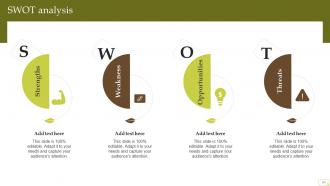
Slide 94: This slide shows SWOT describing- Strength, Weakness, Opportunity, and Threat.
Slide 95: This is a Thank You slide with address, contact numbers and email address.
Complete Guide Of Sustainable Agriculture Practices Powerpoint Presentation Slides with all 103 slides:
Use our Complete Guide Of Sustainable Agriculture Practices Powerpoint Presentation Slides to effectively help you save your valuable time. They are readymade to fit into any presentation structure.



























FAQs for Complete Guide Of Sustainable Agriculture Practices
So basically sustainable farming is all about keeping soil healthy long-term instead of just pumping out tons of crops right now. Conventional farms use a lot of synthetic fertilizers and pesticides - works great at first but kinda wrecks the soil after a while. With sustainable methods you're doing stuff like crop rotation, cover crops, and way less chemicals. Plus it's better for water conservation and doesn't kill off all the good bugs. Honestly I think it's the smarter move. If you wanna try it, maybe start with just cover crops?
So you plant different crops in the same spot each year instead of the same thing over and over. Legumes are great because they actually put nitrogen back into the soil - nature's pretty smart that way. Meanwhile, other crops pull different nutrients out, so rotating prevents your soil from getting totally drained of one thing. Also breaks up pest cycles since bugs usually target specific plants. My neighbor's been doing this for years and swears his yields are way better than when he just did corn every season. Honestly, just start with 3-4 different crops and see how it goes.
Cover crops are honestly a game-changer for erosion and biodiversity. Their canopy protects soil from getting hammered by rain and wind. Underground, the roots bind everything together like natural rebar. Different species bring in beneficial bugs, soil microbes, and wildlife too - crimson clover mixed with winter rye works really well. I'd test it on just one section first though, since every farm's different. You'll figure out what clicks before committing to larger areas. My neighbor swears by this approach and his soil health has improved dramatically over three seasons.
So basically IPM is way smarter than just spraying everything when you spot a pest. You start by figuring out what you're actually dealing with first - sounds obvious but you'd be surprised. Then you layer different approaches: beneficial bugs, crop rotation, pest-resistant plants, regular monitoring to catch issues early. My neighbor swears by this method and honestly his garden always looks amazing. The whole point is prevention over reaction. Chemicals become your backup plan when the natural stuff isn't working. Way more strategic than the spray-first approach most people default to.
Dude, organic farming is seriously amazing for soil health. You'll get way better water retention since compost and cover crops build up all that organic matter. The microbes go crazy in a good way - no synthetic pesticides means they can actually do their job creating this whole underground network. Plants end up way more resistant to diseases and pests because of it. Plus the biodiversity explosion is insane - beneficial bugs, birds, the works. Honestly, I'd start with just one field if you're thinking about switching. Focus on getting that soil biology pumping first, then expand from there.
Honestly, water management is what'll save your ass when the weather goes sideways. Drip irrigation and rainwater collection are game-changers - they squeeze efficiency out of every drop. Cover crops help too since they lock moisture into the soil. When those random droughts or crazy storms hit, you won't be panicking. Smart irrigation timing makes a huge difference. I'd start by figuring out where you're wasting the most water first - that's usually the low-hanging fruit that gives you quick wins.
Honestly, agroforestry is pretty cool - you mix trees with your regular crops or livestock. The trees help prevent erosion and make the soil way healthier. They also create these little microclimates that your crops love. Carbon sequestration is a nice bonus too, plus wildlife gets habitat. What I really like about it is the extra income - you can sell timber, fruit, or nuts on top of your main harvest. My neighbor started with just some windbreaks and now he's doing full alley cropping. I'd say start small though, see how it works with your specific land first.
Honestly, sustainable farming is way better for communities than people realize. It creates steady jobs and keeps all that farming expertise local instead of losing it. The soil gets healthier over time, so it handles droughts better - which is huge with climate change being so unpredictable. Plus diverse crops just make more sense than putting all your eggs in one basket, you know? Communities become less dependent on expensive inputs from outside companies. Food security improves too since local systems are more reliable when supply chains get messed up. You should definitely look up some regenerative farms near you for examples.
Honestly, GPS tractors and drones are totally changing the game right now. Farmers can hit just the spots that need fertilizer instead of blasting everything - saves like 30% waste which is huge. The soil sensors are actually pretty sick, they monitor conditions constantly. Your equipment automatically adjusts seed spacing based on what it's reading from the field. AI crop monitoring catches problems early too, which beats scrambling when everything's already going south. If you're thinking about investing, I'd go with the precision application stuff first since that's where you'll see money back fastest.
CarbonCloud or Cool Farm Tool are solid starting points - they're built for farms specifically. Both handle the basics like fuel, fertilizer, livestock numbers, equipment hours. Setup's honestly a pain at first but becomes routine pretty quick. Track monthly instead of scrambling at year-end, trust me on that one. Satellite monitoring's also huge now for cover crops and soil health - gives you real-time data without trudging through fields constantly. The whole thing feels overwhelming initially but most farmers I know got the hang of it within a few months. Just gotta stay consistent with inputting your data.
Honestly, the numbers are pretty solid on this. You'll save money on fertilizers and pesticides right off the bat. Better soil means better yields without dumping cash into amendments constantly. The premium prices for sustainable stuff are real too - my neighbor's been killing it with that angle. Takes like 2-3 years to really kick in though, and those transition years can be brutal financially. I'd test it on just one field first instead of going all-in. Way less risky that way.
So you really need to meet farmers where they're at, both location-wise and knowledge-wise. Hands-on demos at actual farms work way better than classroom stuff. Get successful farmers talking to other farmers - that peer learning is huge. Mobile extension services are clutch for remote areas, honestly. I've watched programs totally bomb when they get too academic or pretend money doesn't matter. Focus on showing real benefits like lower costs or better yields first. The environmental stuff can come later. Oh, and definitely partner with local co-ops to build trust faster.
So basically governments can throw money at the problem - subsidies for organic farming, tax breaks for conservation stuff, grants for solar panels on farms. Regulations help too, like banning nasty pesticides or making farmers protect their soil. Carbon credits are kinda cool actually - farmers literally get paid for storing carbon in dirt. Plus funding research and teaching programs so farmers aren't flying blind when they switch over. Honestly though, the whole thing only works if sustainable farming pays better than regular farming. Nobody's gonna change just to feel good about it.
Honestly, it comes down to consumers wanting better products. People are way more aware now about pesticides and environmental stuff, so they'll actually pay more for organic or local food. Farmers see that demand and switch their practices to grab that market share - makes total sense from a business perspective. The key thing (if you're farming) is being super transparent about what you're doing. Like, really spell out your methods because that builds trust with customers. It's pretty much basic supply and demand, but the "premium" part only works when people understand why your stuff costs more.
Honestly, biodiversity is like having the best farm crew ever - they work around the clock for free. You've got beneficial bugs handling pest control, soil microbes boosting fertility, and pollinators doing their thing. All without you buying expensive inputs. Plus diverse crops mean if one fails, you're not screwed. Weather gets crazy? Your farm can roll with it better. I'd start by just walking around and seeing what helpful critters you already have hanging out. Then figure out how to make them want to stick around. It's way easier than most people think.
-
I am extremely pleased with these PPT slides that we used for our event. They were easy to modify and came out great in all aspects!
-
Placing an order on SlideTeam is very simple and convenient, saves you a lot of your time.