


Farm And Agriculture Business Plan Powerpoint Presentation Slides




Try Before you Buy Download Free Sample Product
 Impress Your
 Audience
 100%
100% Editable
 Save Hours
 of Time


Explore our professionally designed Farm and Agriculture Business Plan, a comprehensive document that outlines the organizations objectives and strategies for achieving short and long term goals in the agricultural and farming sector. The Agriculture Business Plan PPT begins with a detailed company overview, including the vision, mission, goals, start up expenses, key products offered, and success factors. It goes on to cover customer analysis, presenting buyer personas and market sizing to help you better understand your target audience. The presentation includes a thorough competitor analysis, SWOT analysis, and Porters framework, offering a comprehensive view of the market landscape. The detailed marketing plan outlines strategies to effectively position your agricultural business in the market. In the financial summary section, youll find a revenue model, economic impact analysis, profit and loss statement, break even analysis, and more. This information is crucial for stakeholders and investors to understand the financial viability of your agriculture business. Download this comprehensive Primary Sector PPT now to access a valuable resource that will guide you through the planning process and help set the foundation for a successful venture in the agricultural sector.
People who downloaded this PowerPoint presentation also viewed the following :
Content of this Powerpoint Presentation
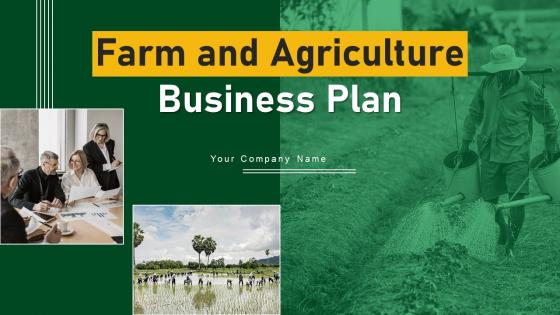
Slide 1: This slide displays the title Farm and Agriculture Business Plan. Put your Conmpany name and begin.
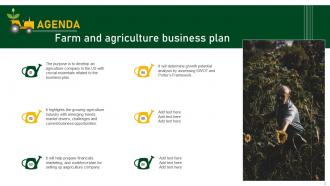
Slide 2: This slide displays the title Agenda.
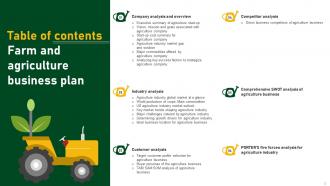
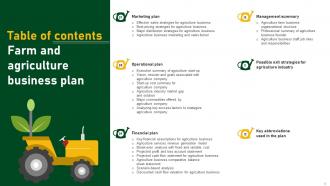
Slide 3: This slide exhibit table of content.
Slide 4: This slide exhibit table of content.
Slide 5: This slide exhibit table of content that is to be discuss further.
Slide 6: This slide provides a glimpse of the agriculture company including a quick pitch that describes the current market status of the industry.
Slide 7: This slide covers the agriculture company vision, mission, and goals.
Slide 8: This slide provides information about start-up expenditures that incur during the process of establishing a agriculture company.
Slide 9: This slide covers the problem associated with the agriculture industry and how the company will implement an effective service solution to overcome the existing gap.
Slide 10: This slide highlights the agriculture commodities by the company. It includes wheat (heard, soft and spring wheat), Rice (basmati, brown, sushi and jasmine rice) etc.
Slide 11: This slide covers the essential points to be considered while offering agriculture products in the market.
Slide 12: This slide exhibit table of content that is to be discuss further.
Slide 13: The purpose of this slide is to highlight the market size of the global agriculture industry.
Slide 14: The purpose of this slide is to highlight the world production of crops which includes sugar cane, maize, wheat, rice, paddy, oil palm fruit and potatoes.
Slide 15: This slide highlights the United States of America agriculture industry outlook which includes market share by industry, average farm size etc.
Slide 16: This slide highlights the market trends that have the potential to change the current market scenario, as well as ways that the company can stay ahead of competitors.
Slide 17: This slide highlights the key market trends that have the potential to change the current market scenario.
Slide 18: This slide portrays details about various challenges faced by the agriculture industry.
Slide 19: This slide portrays details about various challenges faced by the agriculture industry.
Slide 20: This slide caters to details about various growth drivers for agriculture industry.
Slide 21: This slide portrays an ideal business location for a agriculture business which highlights that US boats the biggest consumer market in the world.
Slide 22: This slide exhibit table of content that is to be discuss further.
Slide 23: This slide covers an assessment of how the company’s service will fit into a particular market and where they will acquire the most traction with customers.
Slide 24: This slide provides a glimpse of how to better understand the target audience, to fine-tune marketing campaigns, and increase e-commerce personalization.
Slide 25: The purpose of this slide is to depict the market potential of agriculture industry in terms of TAM, SAM, and SOM to assist startups and enterprise firms.
Slide 26: This slide exhibit table of content that is to be discuss further.
Slide 27: This slide is to provide a glimpse of major participants and key competitors of the industry to gain insight into their products, sales, and marketing tactic.
Slide 28: This slide exhibit table of content that is to be discuss further.
Slide 29: The purpose of this slide is to identify the industry' strengths, weaknesses, opportunities, and threats related to the business.
Slide 30: This slide exhibit table of content that is to be discuss further.
Slide 31: The threat of substitute products or services in the agriculture industry is moderate, as there are some alternative products.
Slide 32: This slide exhibit table of content that is to be discuss further.
Slide 33: This slide highlights the top sales strategies for agriculture business which include direct sales, focus niche markets, strong distribution, partnership.
Slide 34: This slide highlights the top pricing strategies for agriculture and farming business which include volume-based pricing strategies, cost-plus pricing strategies.
Slide 35: This slide highlights the top sales strategies for agriculture business.
Slide 36: This slide highlights customer journey mapping to track users' actions and key touch points across levels.
Slide 37: This slide exhibit table of content that is to be discuss further.
Slide 38: This slide highlights the business model for farm and agriculture business which includes key partners, key activities, value propositions, customer relationships.
Slide 39: This slide highlights the short-term and long-term milestones which includes establishing the company and acquiring land.
Slide 40: This slide provides a glimpse of important financial assumptions in terms of income, expense, and balance sheet.
Slide 41: This slide exhibit table of content that is to be discuss further.
Slide 42: The slide shows the effective revenue model of the agriculture industry, which displays the cost incurred and the various sources of income.
Slide 43: The slides highlight the break-even analysis of the firm.
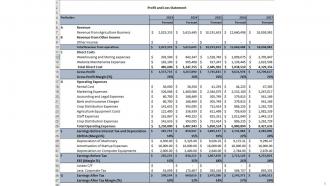
Slide 44: The slides provide a glimpse of the projected profit and loss statement to visualize the agriculture business financial performance for the next five years.
Slide 45: The slides provide a glimpse of the projected profit and loss statement to visualize the agriculture business financial performance for the next five years.
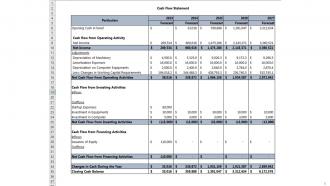
Slide 46: The slides highlight the company's cash flow statement to provide a detailed picture of what happened to a business's cash during a specified period.
Slide 47: The slides highlight the company's cash flow statement to provide a detailed picture of what happened to a business's cash during a specified period.
Slide 48: The slides cover the snapshot of the company's financial position at a specific time by showing the details of the assets of the company along with its liabilities.
Slide 49: The slides cover the snapshot of the company's financial position at a specific time by showing the details of the assets of the company along with its liabilities.
Slide 50: This slide is to examine the effects of potential future events on the company’s performance by considering different outcomes.
Slide 51: This slide is to examine the effects of potential future events on the company’s performance by considering different outcomes.
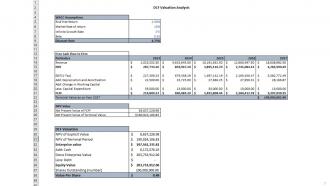
Slide 52: The purpose of this slide is to calculate the amount of money an investor would get from an investment after adjusting for the time value of money.
Slide 53: This slide exhibit table of content that is to be discuss further.
Slide 54: The slide highlights the organizational hierarchy in the company.
Slide 55: This slide highlights the founder’s biggest professional achievements and most valuable skills and the proven ways in which he will use those skills.
Slide 56: This slide highlights the job roles and responsibilities of agriculture staff to determine what kind of job has to be done and what kind of person is ideal for it.
Slide 57: This slide highlights the job roles and responsibilities of agriculture staff to determine what kind of job has to be done and what kind of person is ideal for it.
Slide 58: This slide exhibit table of content that is to be discuss further.
Slide 59: This slide represents exit strategies such as sell-offs, IPOs, mergers, and acquisitions that enable the entrepreneur to liquidate their position in a financial asset.
Slide 60: This slide exhibit table of content that is to be discuss further.
Slide 61: The purpose of this slide is to highlight the shorter version of existing words to save time and take up less space.
Slide 62: This is the icons slide.
Slide 63: This slide presents title for additional slides.
Slide 64: This slide display Venn.
Slide 65: This slide shows puzzle for displaying elements of company.
Slide 66: This slide exhibits ideas generated.
Slide 67: This slide display Our goal.
Slide 68: This slide exhibit Roadmap.
Slide 69: This slide presents your company's vision, mission and goals.
Slide 70: This is thank you slide & contains contact details of company like office address, phone no., etc.
Farm And Agriculture Business Plan Powerpoint Presentation Slides with all 78 slides:
Use our Farm And Agriculture Business Plan Powerpoint Presentation Slides to effectively help you save your valuable time. They are readymade to fit into any presentation structure.








FAQs for Farm And Agriculture Business Plan
Okay so first thing - nail down who's actually gonna buy your stuff and for how much. That's your market analysis right there. Then figure out your production timeline, what you're growing/raising, all that logistics stuff. The financial part honestly sucks but you gotta do it - startup costs, cash flow, when you'll break even. Don't skip the marketing strategy either. Oh and definitely plan for the worst case scenarios because farming's unpredictable as hell. Labor needs too - that one always gets underestimated. Keep it detailed enough to be useful but not so crazy complicated you'll never look at it again.
Dude, market analysis is basically your cheat sheet for not going broke. Figure out who's buying what and at what prices - saves you from growing tons of something nobody wants (been there). Look for gaps where you could jump in, like maybe everyone's doing tomatoes but nobody's growing herbs or whatever. Then decide if you want to sell direct to customers, wholesale to stores, or go the fancy specialty route. I mean, my uncle just planted whatever seemed cool and wondered why he couldn't pay his bills. Pick stuff people actually want to buy and build everything around that demand.
Dude, you're gonna need cash flow projections - like 3 years minimum showing monthly stuff. Farming income is so seasonal, most people totally mess this up during those dead months. Startup costs, operating expenses, equipment purchases - all that goes in there. Profit/loss statements and break-even analysis too. Oh and do best/worst case scenarios because banks eat that up. Shows you're not just winging it. Honestly? Find an ag accountant to look it over before you show anyone. Trust me on that one - they catch stuff you'd never think of.
Honestly, talk to your potential buyers first before you plant anything - saves you from growing stuff nobody wants. Hit up local restaurants, farmers markets, grocery stores. Figure out who you're targeting too. Health nuts? Fancy chefs? Regular families on a budget? I learned this the hard way but seriously just walk up and ask what they'd actually pay for. Scope out your competition while you're at it - what they're charging, where there might be gaps you could fill. Way better than guessing and ending up with tons of produce you can't move.
Dude, crop rotation is like insurance for your farm's future profits. It keeps soil healthy and breaks up pest cycles, so you're not dumping tons of cash into fertilizers and pesticides every season. Monoculture might seem easier short-term, but I've watched farms crash hard when their yields tanked and costs went crazy. You'll spread risk across different markets too, which smooths out those brutal price swings we all hate. Oh, and definitely work in cover crops - they're a game changer. Plan your rotation 3-5 years ahead. Trust me on this one.
Honestly, just bake risk management into everything you're already doing. Figure out what scares you most - bad weather, price drops, equipment breaking down, whatever. Then tackle each one head-on with stuff like crop insurance, emergency cash, or signing contracts early. I'm big on running three scenarios when I plan: best case, worst case, and the realistic middle ground. Oh, and diversifying crops is clutch too. Don't wait for disasters to hit before you think about this stuff - make it part of your regular routine from day one.
Look at your last 3-5 years of farm data first - revenue, expenses, yields, cash flow. That's your real baseline, not some fantasy numbers. Weather and markets will mess with you, so build in 10-15% cushions everywhere. Honestly? Most new farmers think they'll be profitable year one - huge mistake. Break everything into quarterly goals so you can pivot fast when things go sideways. Oh, and keep cash flow separate from profit goals. You still gotta pay bills while you're building equity, right?
Definitely add a tech section to your business plan - map out the specific tools you want and their potential ROI. I'd focus on stuff that actually solves your biggest headaches first. Precision ag software, automated irrigation, livestock monitoring, whatever fits your operation. Honestly, even a solid farm management app can save you hours tracking expenses and crop rotations. Break down implementation costs and timelines for each piece of tech. Don't forget training time though - that always takes longer than you think it will. Research what directly tackles your pain points instead of just buying the flashy stuff.
Definitely focus on soil health and water management first - that's your foundation. Carbon footprint tracking is getting crazy important with investors these days, so document stuff like cover crops or any renewable energy you use. Map out your crop rotation plans and how you're cutting back on pesticides. Waste management matters too, especially manure handling. Oh, and check what buffer zones you need around waterways - that caught my neighbor off guard last year. Start with auditing what you're doing now, then set some realistic improvement goals with actual deadlines.
Look, banks aren't gonna throw money at you just because you have a cute farm idea. They want proof you've actually thought this through - like real financial projections and how you'll handle when things go sideways (because they will). Your business plan shows them you understand the market and have a legit strategy to make money. Cash flow forecasts are huge for lenders. Honestly, the farms that get funded are the ones with solid backup plans, not just wishful thinking. Make your numbers bulletproof and show you've considered the worst-case scenarios.
Honestly, start with the obvious stuff - revenue per acre, gross margin, cash flow. But don't sleep on the operational side either. Yield per acre is huge. So are input costs like seeds and fertilizer (fertilizer prices have been brutal lately). Equipment efficiency matters too, plus any crop losses you're seeing. Since farming's so seasonal, track things monthly or quarterly depending on your cycles. Labor productivity's worth watching if you've got employees. Oh, and if you sell direct to customers, definitely measure satisfaction somehow. Pick maybe 5-6 metrics that match your biggest goals first, then add more as you get the hang of it.
So diversification is basically having backup plans for your farm income. Multiple streams mean you won't be totally screwed if one thing tanks. Different crops, value-added stuff like making jam or cheese, farm tours, event rentals - honestly the options are pretty endless. Just pick things that actually make sense with what you're already doing. Don't spread yourself too thin right off the bat. I'd say try one new thing first and see how it goes. My neighbor started with just selling eggs at the farmer's market and now she's got this whole agritourism thing going.
Zoning laws are your first stop - they'll tell you what you can actually grow/raise on your property. Water permits, pesticide rules, waste management... there's a bunch of environmental stuff to navigate. Food safety regs get intense if you're selling direct to people or restaurants (learned that the hard way with a friend's farm). Building codes matter for any structures you want. Labor laws are honestly a nightmare if you hire help. Your county extension office is clutch though - they've got checklists that'll save you from missing random requirements you'd never think of.
Honestly, start with what's right in your backyard. Local restaurants eat up that farm-to-table thing, and you'll make way more than selling wholesale. Farmers markets are solid too. Have you looked into joining a co-op? Sharing equipment costs is a game changer. CSA programs are pretty sweet - people pay upfront for weekly boxes, so you get cash flow and loyal customers. Your county extension office probably has tons of free help and grants you don't even know about. I'd map out what's nearby first. You'll find way more resources than you'd expect.
Honestly, going sustainable is one of the smartest moves you can make right now. Grants and certifications alone make it worth it - plus you can charge premium prices that regular farms can't touch. Your input costs drop too once things get rolling. Less fertilizer, healthier soil, cheaper energy bills. (I swear, sustainable farms always seem to have the happiest accountants lol.) Consumer demand isn't slowing down either, so you're basically future-proofing yourself. Pick 2-3 practices that actually make sense for what you're already doing and see what incentives your state offers. Some of the grant money out there is pretty wild.
-
The design is clean-cut, modern, and sleek, keeping the users' needs in mind. The multiple uses make this product worth every penny!
-
Spacious slides, just right to include text. SlideTeam has also helped us focus on the most important points that need to be highlighted for our clients.