


Agriculture Business Proposal Powerpoint Presentation Slides





Try Before you Buy Download Free Sample Product
 Impress Your
 Audience
 100%
100% Editable
 Save Hours
 of Time


Agriculture is the basis and bedrock for the whole society as well as the community. It provides people with natural resources and food. Supplying plant-based food is the optimum result of all agriculture businesses. Increase in demand of food is leading to the expansion of the farming market. Thus, utilize this Agriculture Business Proposal PowerPoint Presentation Slides to organize and maintain the agricultural needs of your clients. Research and inspect your agriculture area to determine the status of land with the assistance of this PPT template and create a well-suited plan of action for your company. Use this farming business PPT proposal to mention in detail the different stages of the agriculture project like landscaping, manure and fertilizers, pesticides and harvesting, and sales and packaging. Employ this invigorating agrarian sector PowerPoint presentation to create a systematic and organized timeframe to ensure the successful accomplishment of each stage on time. Give a clear account of investment that your clients will have to make for rendering your services and boosting up their business strategy by taking the help of this farm productive services PPT design. Build your clients trust by giving them a detailed account of the services that you offer and the roadmap that you follow to assure the completion of each task on time, with this agribusiness PPT visual. Talk about your project goals, measurable results, client testimonials, and key deliverables to leave a lasting impression on your clients. Analyze your core competency and the ways to develop your capabilities by taking the aid of this PPT graphic. You can also exhibit research on farm grant options and collaborations. Implement this cultivation services PowerPoint slideshow to educate your clients about the positive economic implications of sustainable agriculture activities. Download this expertly designed PowerPoint presentation to showcase your work contract and to boost the system of food production.
People who downloaded this PowerPoint presentation also viewed the following :
Content of this Powerpoint Presentation
When you plan to start any kind of business, it requires a considerable amount of planning and management. But when it comes to Agriculture business or Agribusiness, the effort that goes in doubles. This is because what you grow, the community consumes.
Agriculture business is the management, farming, production, marketing and distribution of agricultural products such as crops, forestry and livestock.
Starting an Agriculture business and not sure where to begin? Explore our PPT Template bundle on startup agriculture company business planning.
With modernization, we now have sophisticated machines that require little to no labor. This reduces the cost of production in the long run and facilitates more quantity and revenue. But these machines do not come in pocket friendly packages.
If you are planning to tap into the agriculture business or seeking financial support for your business, you must be wondering where you start! The answer lies in a well-drafted business proposal.
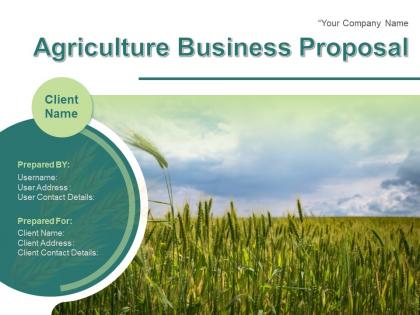
Agriculture Business Proposal
A well crafted proposal aligns with the interests of both parties. It ensures that the investors know where their money is going and what returns they can expect. It showcases the unique value your business brings to the table. Thes pre-designed slides are 100% editable and customizable. The structured layout simplifies conveying objectives, methodologies, and roles.
Let’s explore
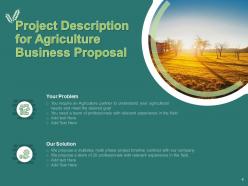
Template 1: Project Description for Agriculture Business Proposal

This Slide illustrates the problem statement of the agriculture business and the solutions provided by the company. To enhance clarity and engagement, each element is paired with relevant icons which make it easy for viewers to quickly grasp the content and make informed decisions.
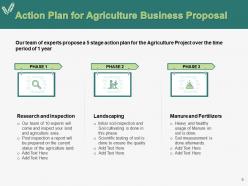
Template 2: Action Plan for Agriculture Business Proposal
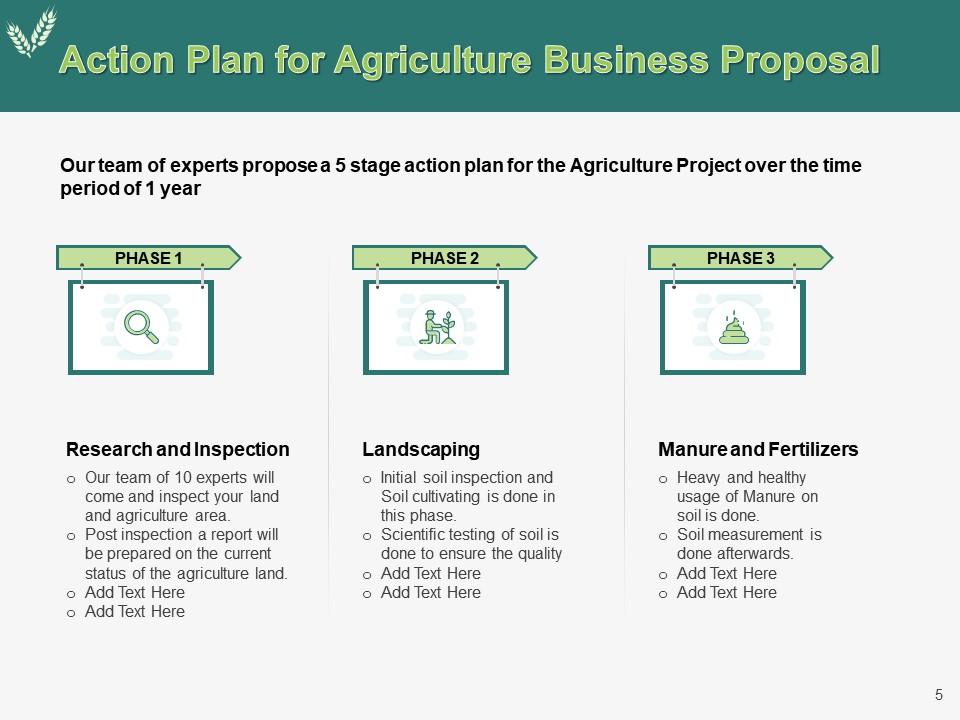
This template highlights the action plan for the agriculture business in five phases. The contents of the template are divided into two slides. Thes first phase is for research and inspection where the land is inspected and reports are prepared. This phase is followed by landscaping wherein the soil of the land is inspected and tested. The third phase is for manure and fertilizers. Here heavy and healthy usage of manure on soil is done.
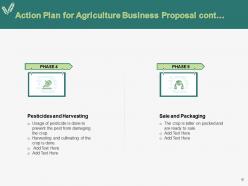
Template 3: Action Plan for Agriculture Business Proposal Continued Slide
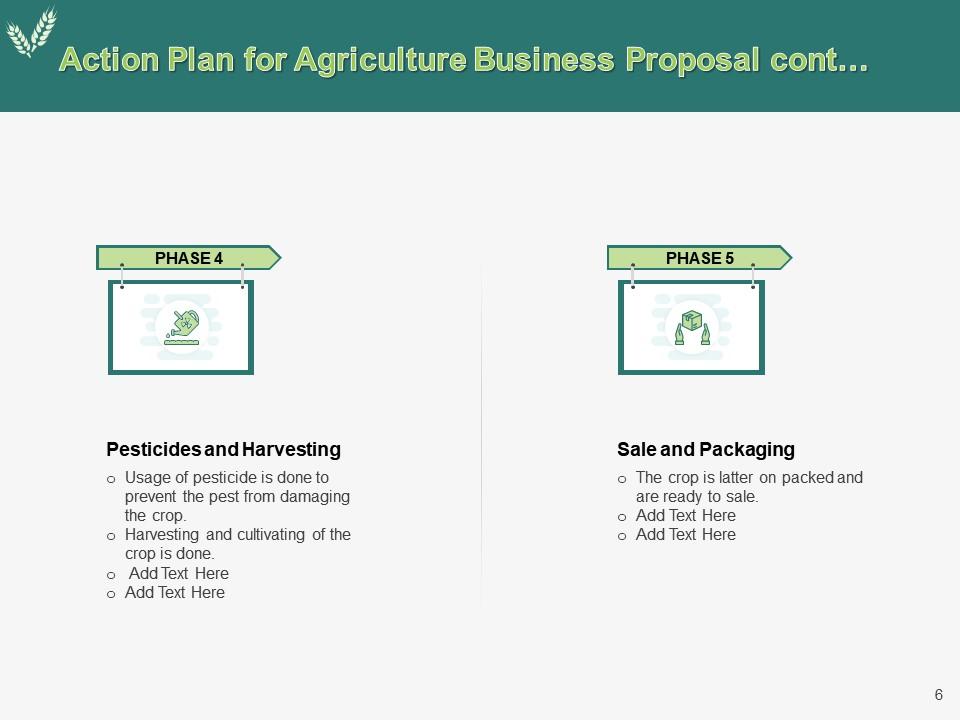
This slide represents the continuation of the action plan. It highlights the fourth and the fifth phase of the process. The fourth phase is for pesticides and harvesting. This phase helps in preventing the pest from damaging the crop. The last phase is sale and packaging of the crop. Where it gets ready to be sold.
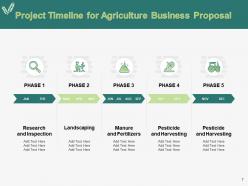
Template 4: Project Timeline for Agriculture Business Proposal
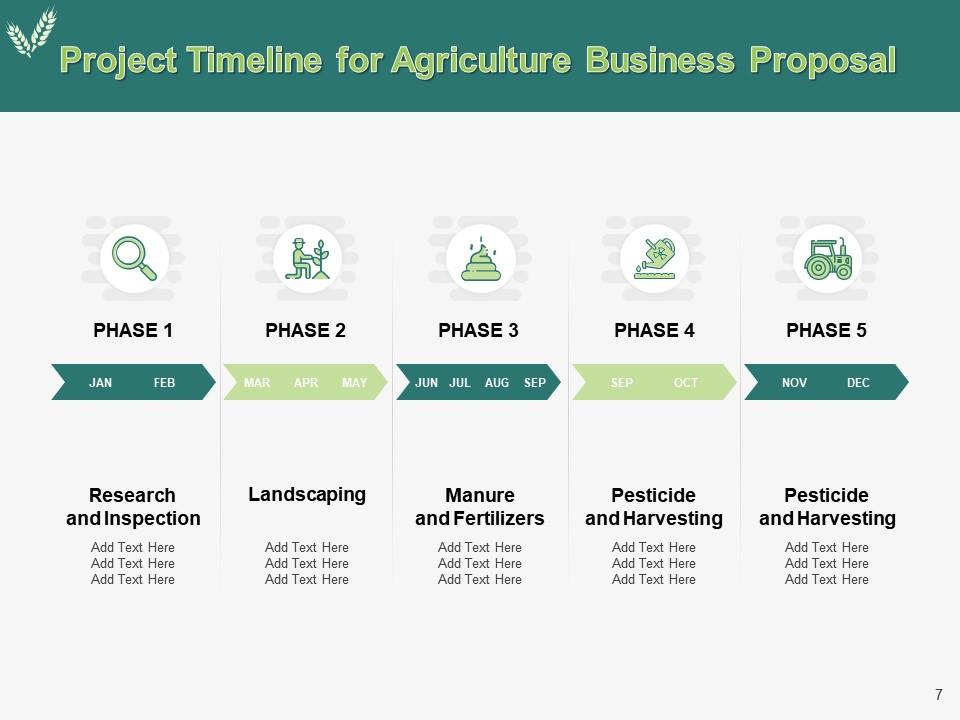
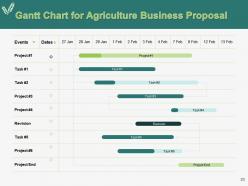
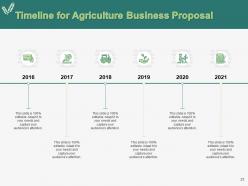
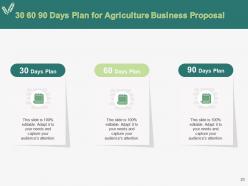
Establishing a time frame for services rendered is essential in an agriculture business proposal. It sets clear expectations and deadlines for both parties involved. A defined timeline ensures efficient communication, decision-making and execution of the process. It helps in managing resources properly, avoiding unnecessary delays and potential risks. This showcases professionalism and commitment to timely completion of the process.
Template 5: Your Investment for Agriculture Business Proposal
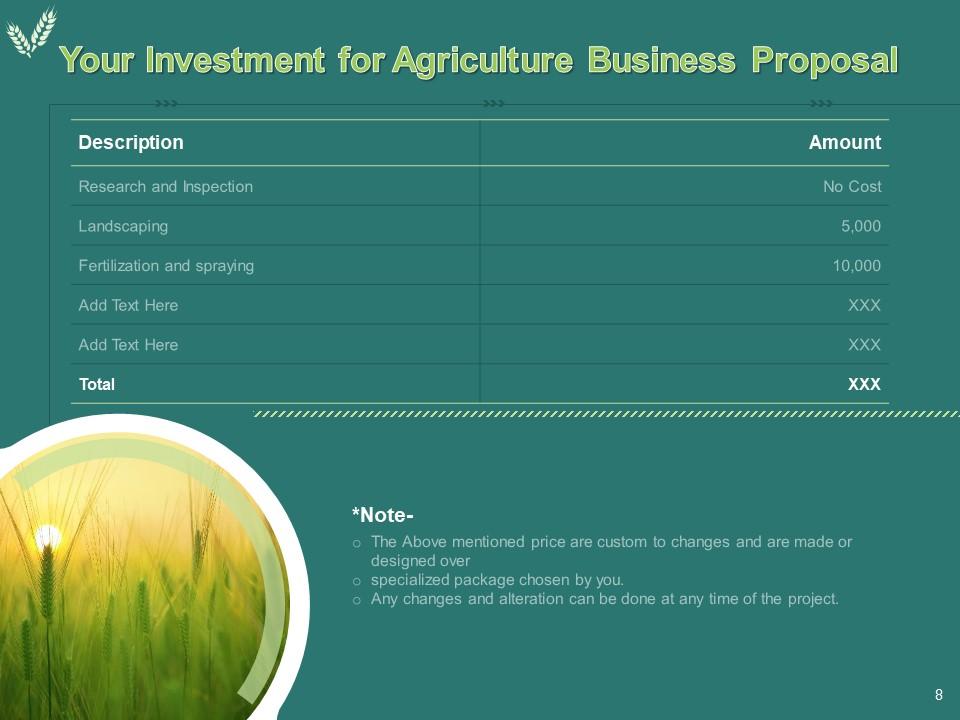
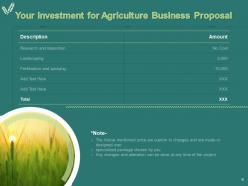
This slide highlights the total financial commitment needed for an agricultural business opportunity. It employs an organized tabular representation, with description of the task and its amount. It includes elements such as research and inspection, landscaping, fertilization and spraying, and more. There is a separate section to add notes regarding each task or if there is any additional information required.
Template 6: About Us for Agriculture Business Proposal
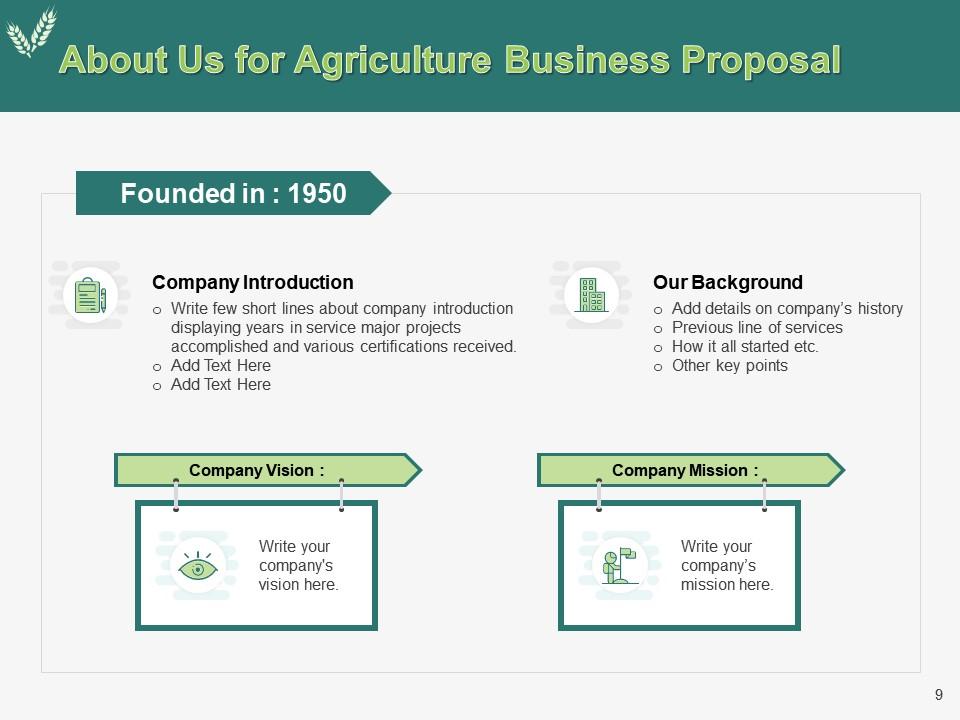
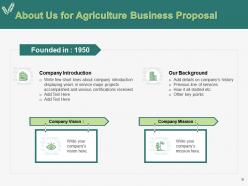
The purpose of this slide is to share information about the organization. It highlights details such as the establishment year, a brief company introduction, organization's background, its overarching vision and mission. It provides a concise overview that informs the audience about the company’s history and sets the stage for understanding its values and goals. This template is the foundation upon which the audience can build deeper engagement with the organization.
Template 7: Case Study for Agriculture Business Proposal
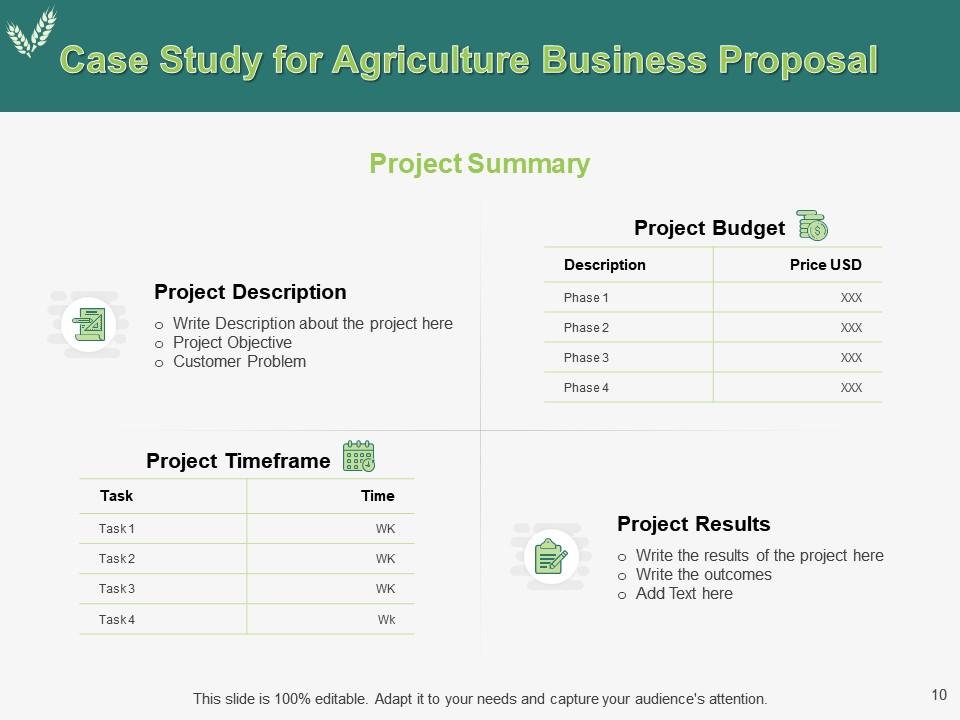
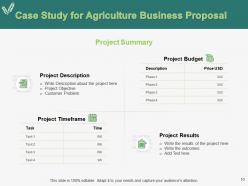
This slide highlights the case study for the agriculture business. It presents the goals of the project and the results of the services provided to prior clients. It showcases the project description, its budget and timeline in the form of tables for easy comprehension.
Template 8: Next Step for Agriculture Business Proposal
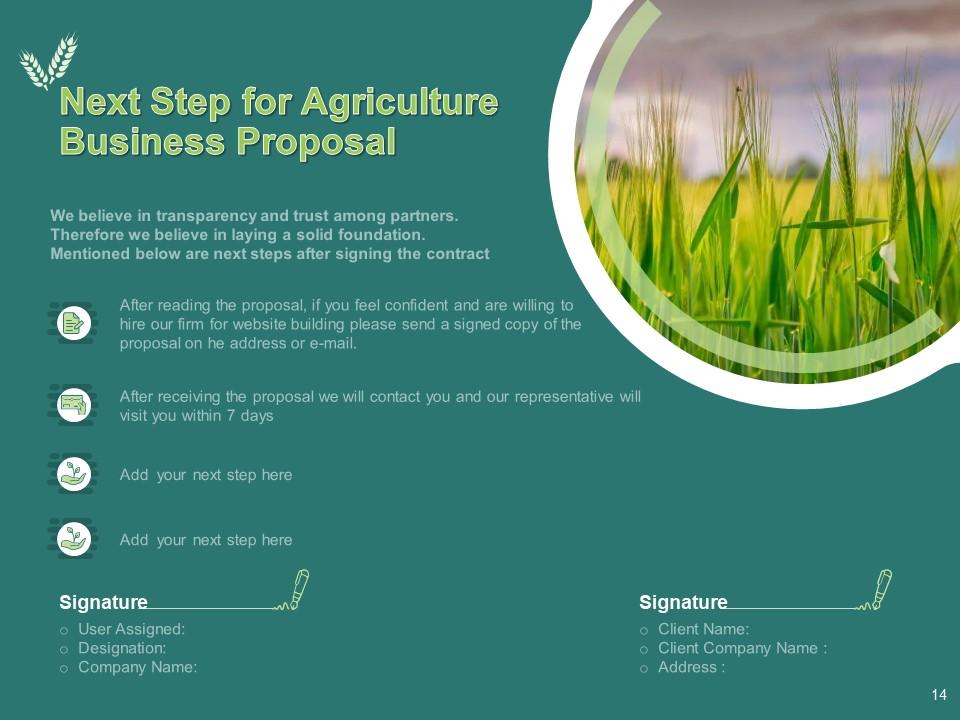
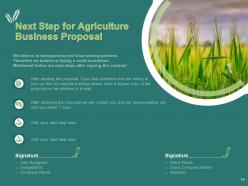
This template illustrates the next step for the business. Once the client is satisfied with the proposal, the representative will contact them in seven to eight days for further details. The client will then send in the signed copy to the company. This slide has a section for the company and client to sign along with their name, designation and company name.
Template 9: Terms and conditions for Agriculture Business Proposal
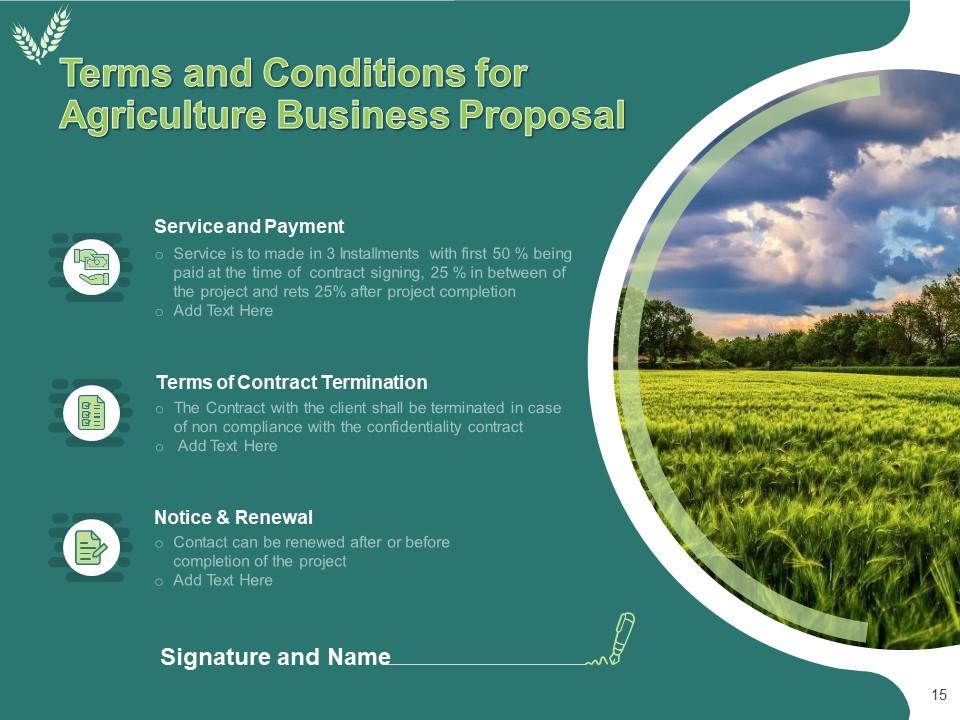
This Slide highlights an overview of the terms and conditions governing the contractual relationship between the company and a client or financer. It outlines aspects such as terms related to services and payments, highlights the conditions for the contract termination, notice period and options for renewal. This slide facilitates transparency and clarity in the partnership.
Wrapping Up
Agriculture business proposal enables organizations to streamline operations and uncover new growth opportunities. Employ these professionally curated PowerPoint templates to draft a compelling proposal to win over potential clients and stakeholders. It outlines the mutual benefits, strategies for activation and long-term vision and collaboration. These slides are the key to for presentation to be consistent and professional.
Agriculture Business Proposal Powerpoint Presentation Slides with all 23 slides:
Use our Agriculture Business Proposal Powerpoint Presentation Slides to effectively help you save your valuable time. They are readymade to fit into any presentation structure.



FAQs for Agriculture Business Proposal
So for your ag proposal, hit these key points: market analysis (who's buying your stuff), production timeline that's actually doable, and financial projections - honestly that's the make-or-break section so get those numbers solid. Include your team's experience too. Oh, and don't skip the land details - soil quality, water access, all that. Risk assessment is pretty crucial as well. The funding ask needs to be super specific about how much you need and where every dollar goes. I've seen too many proposals get shot down because they were vague about the money part. That specificity really sells it.
Look, market research stops you from throwing money at something nobody wants to buy. Find out who your actual customers are and what they'll pay for your stuff. Check out farmers markets to see what's moving - I always learn more there than from reading reports online. Survey local buyers and look up commodity prices too. Competition is everywhere, way more than you'd expect at first. But here's the thing - you might discover gaps you never thought about. Seasonal demand is huge in agriculture, so factor that in early.
Dude, you literally can't pitch an ag business without sustainability baked in these days. Investors expect to see your environmental game plan upfront. But here's the thing - it's not just tree-hugger stuff anymore. Smart sustainability cuts your input costs, builds better soil, and opens up those premium markets that actually pay well. I was just talking to my cousin about this (he runs a small farm) and he's making bank on his organic certification now. Compliance is getting tighter too, so you might as well get ahead of it. Don't tack sustainability on later - work those metrics straight into your financials from the start.
Look, most ag startups totally bomb this by being crazy optimistic about year one yields - don't be those guys. Break everything down quarterly since investors actually understand seasonality and commodity swings. Show your unit economics per acre/livestock head, and honestly? Start with your most conservative numbers first. Weather's gonna mess with you, input costs are all over the place, so build multiple scenarios - conservative, realistic, and optimistic. The path to profitability needs to be crystal clear. I've seen too many pitches that just show annual totals without any real breakdown, and investors see right through that.
Dude, specialty crops are where it's at right now. Microgreens, fancy mushrooms, herbs - way better margins than boring commodity stuff. Organic's still huge too. The whole farm-to-table thing? Not dying anytime soon, which is perfect for smaller farms. Processing stuff into ready-to-eat products can really boost your income. Oh, and don't sleep on agritourism - people love that experience. Farmers markets and CSAs are solid for direct sales. Honestly though, just scope out what everyone else is already doing in your area first. Then figure out what's missing and jump on that instead.
Honestly, regulatory stuff will make or break your ag business. Environmental regs, food safety, zoning - all that impacts your costs and timeline big time. Take organic certification - takes forever and costs a fortune, but you can charge premium prices. My cousin went through this whole mess with his farm and wished he'd planned better. Map out what applies to you early on. Build those compliance costs into your numbers from the start. Way better to overestimate now than get hit with surprise expenses later when you're already stretched thin.
Honestly, just cut to the chase immediately - what problem are you solving and how. Ag investors are data nerds, so hit them with your market size or ROI projections early. Your pitch should be way shorter than you think it needs to be. What sets you apart from everyone else doing similar stuff? Could be your tech, partnerships, whatever. Be super clear about how much money you want and what you'll actually do with it. Oh, and don't forget the call-to-action at the end - make it easy for them to take the next step.
Honestly, start with the basics - IoT sensors and precision farming tools will save you tons of headaches. Drones are absolutely worth it for monitoring crops, like having a bird's eye view 24/7. GPS machinery and automated irrigation make everything smoother. Data analytics platforms help optimize yields too, though the learning curve can be steep at first. Supply chain software connecting directly to buyers is clutch for cutting out middlemen. My advice? Don't go crazy buying everything at once. Pick one or two things that'll actually fix your biggest problems, then expand when you're seeing real returns. Skip the fancy stuff that looks cool but won't move the needle.
Honestly, there are tons of ways to stand out. Specialty crops are huge right now - think heirloom tomatoes or microgreens. Sustainable practices work too, especially if you can get organic certified. Direct sales are where it's at though. I've watched farms absolutely kill it with CSA boxes and farmers market booths. Restaurant partnerships can be gold mines if you build the right relationships. Your story matters just as much as what you're growing. Pick one thing you can actually do well - don't spread yourself thin trying everything. Maybe it's hydroponics, maybe it's being the only heritage seed farm in your area. Whatever it is, make that your whole marketing angle.
Dude, yes - marketing is huge for any ag business proposal. I've watched so many good farming plans tank because they skipped this part entirely. Investors want to see how you'll actually sell stuff and make money, not just grow it. Cover your distribution channels, who you're targeting, pricing, competitors - the whole deal. Even boring commodity crops need some kind of market angle. Honestly? I'd put like 20% of your proposal into marketing strategy. That's what separates the real businesses from people just playing farmer, you know?
Dude, check out USDA grants first - seriously, their database is massive and most people don't even know about half the programs they have. Bank loans are solid if you've got collateral and your business plan doesn't suck. Angel investors are getting way more into agtech lately, especially the sustainability stuff. Oh, and your state ag department probably has random funding nobody talks about - I'd dig around there too. Agtech investors are everywhere now if you're doing anything remotely techy. Start with USDA though, you'll be scrolling through options for days.
Dude, partnering with local farmers will make your proposal so much more convincing. Investors love seeing you've got actual farmers backing you - way better than some overpriced consulting report, honestly. These guys know everything about local soil, weather patterns, what crops work. They've already got distribution channels and buyer connections you can use too. My uncle's a farmer and he always says the land teaches you more than any textbook ever will. Start with your local farm bureau or co-op to find farmers who match what you're trying to do. It's really about building credibility through real relationships.
Dude, you HAVE to think about risk management - it's what keeps farms alive when shit hits the fan. Weather disasters, market crashes, equipment breaking down... farming's just unpredictable like that. I watched my neighbor's family struggle hard after that drought a few years back, totally changed my perspective. Your business plan needs diversification, good insurance, emergency cash, backup suppliers. Honestly, without planning for the worst you're just rolling dice with your future. Figure out your three biggest threats first, then make actual plans for handling each one. Sounds boring but it'll save your ass later.
Honestly, social media is perfect for this. Start with Instagram or Facebook - people eat up those behind-the-scenes farm photos. Post your crops, animals, seasonal stuff. TikTok's weirdly good too if you can do quick farming tips or harvest clips (younger crowd loves that). For B2B stuff like restaurants, LinkedIn actually works. The trick isn't being super polished - just be real and consistent. Pick one platform first, post regularly for like a month, then see what people respond to. Way easier than trying to be everywhere at once. Trust me, authentic beats perfect every time when it comes to food.
Focus on the obvious stuff first - ROI, profit margins, cash flow. Then look at operational metrics like yield per acre and production costs. Customer acquisition matters if you're selling direct to consumers. Honestly, sustainability tracking is getting pretty important these days too. Water usage, soil health, carbon stuff - buyers actually care now. Pick maybe 5-7 metrics max that match your actual goals. Don't go crazy tracking everything or you'll drown in data. Oh, and definitely measure where you're starting from so you can prove things are working later.
-
good
-
good
-
Top Quality presentations that are easily editable.