

Agriculture Business Plan Powerpoint Presentation Slides





Try Before you Buy Download Free Sample Product
 Impress Your
 Audience
 100%
100% Editable
 Save Hours
 of Time


A business plan is a document that defines in detail the organizations objectives and how it plans to achieve its short and long term goals. The agricultural and farming sector is considered the prime sector for any country. Check out our professionally designed agriculture business plan ppt, which provides detailed information on agriculture industry statistics, growth drivers, market trends, and key challenges of the industry, including lucrative opportunities. Moreover, it focuses on the company overview which includes vision, mission, goals, start-up expenses, key products offered and success factors. Also, it describes the customer analysis for agriculture industry, buyers persona, and market sizing. Additionally, it covers the competitor analysis, SWOT analysis, PORTERS framework and detailed marketing plan. The document also covers a financial summary section including a revenue model, economic impact, profit and loss statement, break-even analysis, etc. Get access now.
People who downloaded this PowerPoint presentation also viewed the following :
Content of this Powerpoint Presentation
Slide 1: This slide displays the title Agriculture Business Plan.
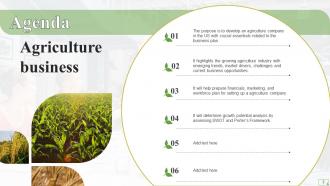
Slide 2: This slide displays the title Agenda.
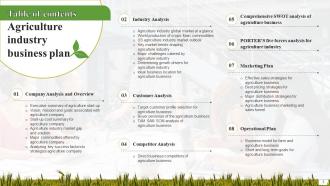
Slide 3: This slide exhibit table of content.
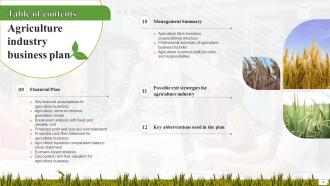
Slide 4: This slide exhibit table of content.
Slide 5: This slide exhibit table of content that is to be discuss further.
Slide 6: This slide provides a glimpse of the agriculture company including a quick pitch that describes the current market status of the industry.
Slide 7: This slide covers the agriculture company vision, mission, and goals.
Slide 8: This slide provides information about start-up expenditures that incur during the process of establishing a agriculture company.
Slide 9: This slide covers the problem associated with the agriculture industry and how the company will implement an effective service solution to overcome the existing gap.
Slide 10: This slide highlights the agriculture commodities by the company. It includes wheat (heard, soft and spring wheat), Rice (basmati, brown, sushi and jasmine rice) etc.
Slide 11: This slide covers the essential points to be considered while offering agriculture products in the market.
Slide 12: This slide exhibit table of content that is to be discuss further.
Slide 13: The purpose of this slide is to highlight the market size of the global agriculture industry.
Slide 14: The purpose of this slide is to highlight the world production of crops which includes sugar cane, maize, wheat, rice, paddy, oil palm fruit and potatoes.
Slide 15: This slide highlights the United States of America agriculture industry outlook which includes market share by industry, average farm size etc.
Slide 16: This slide highlights the market trends that have the potential to change the current market scenario, as well as ways that the company can stay ahead of competitors.
Slide 17: This slide highlights the key market trends that have the potential to change the current market scenario.
Slide 18: This slide portrays details about various challenges faced by the agriculture industry.
Slide 19: This slide portrays details about various challenges faced by the agriculture industry.
Slide 20: This slide caters to details about various growth drivers for agriculture industry.
Slide 21: This slide portrays an ideal business location for a agriculture business which highlights that US boats the biggest consumer market in the world.
Slide 22: This slide exhibit table of content that is to be discuss further.
Slide 23: This slide covers an assessment of how the company’s service will fit into a particular market and where they will acquire the most traction with customers.
Slide 24: This slide provides a glimpse of how to better understand the target audience, to fine-tune marketing campaigns, and increase e-commerce personalization.
Slide 25: The purpose of this slide is to depict the market potential of agriculture industry in terms of TAM, SAM, and SOM to assist startups and enterprise firms.
Slide 26: This slide exhibit table of content that is to be discuss further.
Slide 27: This slide is to provide a glimpse of major participants and key competitors of the industry to gain insight into their products, sales, and marketing tactic.
Slide 28: This slide exhibit table of content that is to be discuss further.
Slide 29: The purpose of this slide is to identify the industry' strengths, weaknesses, opportunities, and threats related to the business.
Slide 30: This slide exhibit table of content that is to be discuss further.
Slide 31: The threat of substitute products or services in the agriculture industry is moderate, as there are some alternative products.
Slide 32: This slide exhibit table of content that is to be discuss further.
Slide 33: This slide highlights the top sales strategies for agriculture business which include direct sales, focus niche markets, strong distribution, partnership.
Slide 34: This slide highlights the top pricing strategies for agriculture and farming business which include volume-based pricing strategies, cost-plus pricing strategies.
Slide 35: This slide highlights the top sales strategies for agriculture business.
Slide 36: This slide highlights customer journey mapping to track users' actions and key touch points across levels.
Slide 37: This slide exhibit table of content that is to be discuss further.
Slide 38: This slide highlights the business model for farm and agriculture business which includes key partners, key activities, value propositions, customer relationships.
Slide 39: This slide highlights the short-term and long-term milestones which includes establishing the company and acquiring land.
Slide 40: This slide provides a glimpse of important financial assumptions in terms of income, expense, and balance sheet.
Slide 41: This slide exhibit table of content that is to be discuss further.
Slide 42: The slide shows the effective revenue model of the agriculture industry, which displays the cost incurred and the various sources of income.
Slide 43: The slides highlight the break-even analysis of the firm.
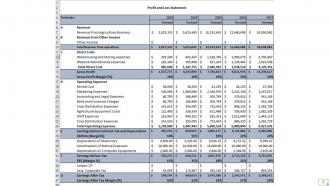
Slide 44: The slides provide a glimpse of the projected profit and loss statement to visualize the agriculture business financial performance for the next five years.
Slide 45: The slides provide a glimpse of the projected profit and loss statement to visualize the agriculture business financial performance for the next five years.
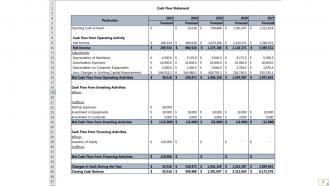
Slide 46: The slides highlight the company's cash flow statement to provide a detailed picture of what happened to a business's cash during a specified period.
Slide 47: The slides highlight the company's cash flow statement to provide a detailed picture of what happened to a business's cash during a specified period.
Slide 48: The slides cover the snapshot of the company's financial position at a specific time by showing the details of the assets of the company along with its liabilities.
Slide 49: The slides cover the snapshot of the company's financial position at a specific time by showing the details of the assets of the company along with its liabilities.
Slide 50: This slide is to examine the effects of potential future events on the company’s performance by considering different outcomes.
Slide 51: This slide is to examine the effects of potential future events on the company’s performance by considering different outcomes.
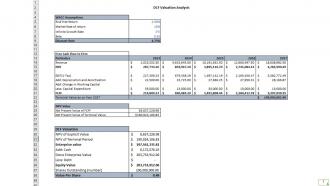
Slide 52: The purpose of this slide is to calculate the amount of money an investor would get from an investment after adjusting for the time value of money.
Slide 53: This slide exhibit table of content that is to be discuss further.
Slide 54: The slide highlights the organizational hierarchy in the company.
Slide 55: This slide highlights the founder’s biggest professional achievements and most valuable skills and the proven ways in which he will use those skills.
Slide 56: This slide highlights the job roles and responsibilities of agriculture staff to determine what kind of job has to be done and what kind of person is ideal for it.
Slide 57: This slide highlights the job roles and responsibilities of agriculture staff to determine what kind of job has to be done and what kind of person is ideal for it.
Slide 58: This slide exhibit table of content that is to be discuss further.
Slide 59: This slide represents exit strategies such as sell-offs, IPOs, mergers, and acquisitions that enable the entrepreneur to liquidate their position in a financial asset.
Slide 60: This slide exhibit table of content that is to be discuss further.
Slide 61: The purpose of this slide is to highlight the shorter version of existing words to save time and take up less space.
Slide 62: This is the icons slide.
Slide 63: This slide presents title for additional slides.
Slide 64: This slide display Venn.
Slide 65: This slide shows puzzle for displaying elements of company.
Slide 66: This slide exhibits ideas generated.
Slide 67: This slide display Our goal.
Slide 68: This slide exhibit Roadmap.
Slide 69: This slide presents your company's vision, mission and goals.
Slide 70: This is thank you slide & contains contact details of company like office address, phone no., etc.
Agriculture Business Plan Powerpoint Presentation Slides with all 75 slides:
Use our Agriculture Business Plan Powerpoint Presentation Slides to effectively help you save your valuable time. They are readymade to fit into any presentation structure.





FAQs for Agriculture Business Plan
So you'll want the basics first - executive summary, market analysis, financials. The usual stuff. For the ag-specific parts, map out your production plan (what crops/livestock, land needs, equipment). Weather's gonna be your biggest headache honestly, so definitely plan for contingencies. Supply chain and operational workflow matter too. Oh, and don't skip the regulatory compliance and sustainability sections - lenders are really into that now. Risk management is massive in farming since Mother Nature doesn't care about your timeline. I'd grab a template online and tweak it based on whether you're doing crops, livestock, or something specialty.
Look, market research sounds boring but it'll save your ass later. You need to figure out who's actually gonna buy your stuff and what they'll pay for it. Hit up some farmers markets and chat with people - way better than guessing. Check out seasonal pricing too, that stuff fluctuates like crazy. Local demand varies so much depending on where you are. Competition research is huge - see what other farms are doing nearby. Honestly, investors eat this data up because it shows you're not just winging it. Makes your whole business plan look legit instead of some random idea you had.
Definitely focus on cash flow projections first - farming's so seasonal that this part can make or break you. Then do your P&L statements for 3-5 years and map out all startup costs: land, equipment, seeds, labor, the works. Oh, and always pad those numbers because something unexpected will definitely hit you. Keep revenue projections conservative based on realistic yields and current market prices. Break-even analysis shows when you'll actually turn profitable. The seasonal stuff is honestly what makes farm business plans way trickier than regular ones.
Dude, crop selection is honestly everything - it'll make or break you. Match what you grow to your climate and soil first, then check what's actually selling locally. I made the mistake of growing stuff I loved eating instead of what people wanted to buy lol. Water needs matter too, plus how much work each crop takes. Some give you cash in like 60 days, others take forever. Labor costs can kill you if you're not careful. Start by seeing what's moving at farmers markets or stores near you, then work backwards. Don't just pick the prettiest plants!
Tech is basically everything in ag business planning now. Can't compete without it, honestly. Look at precision ag tools, automation, data platforms - all that stuff needs to be in your plan from day one. Even tiny farms are going high-tech these days, which is kinda wild if you think about it. Map out which tech you'll use and when, plus how it'll affect your bottom line. Don't get crazy with costs though - be real about what productivity gains you'll actually see. I'd start by figuring out what's driving you nuts operationally, then find tech that fixes those specific headaches.
Don't just slap sustainability onto the end - work it into everything from your mission statement down. Your operations plan should cover soil health, water conservation, that whole deal. The financial section's important too since these practices usually save money long-term (investors eat that up). Track stuff like carbon footprint and water efficiency with actual numbers. Oh, and definitely mention any certifications you're going after. Buyers expect this now anyway, so might as well make it look intentional. Create a realistic timeline for rolling everything out across your operation.
Honestly, direct sales are where you'll make real money. Farmers markets and CSAs beat wholesale every time - way better margins. Restaurants are solid too if you can handle their schedules (they're kinda demanding tbh). Instagram's surprisingly good for farms since people eat up that behind-the-scenes stuff. Word-of-mouth still crushes it though. Maybe try making jams or something to boost profits? Really depends who you're targeting - fancy local folks or people buying in bulk. I'd pick one thing first, get good at it, then add more channels.
Break it down into chunks - weather stuff, market swings, equipment breaking down, and regulations changing on you. For each one, figure out what could actually screw you over and how you'd handle it. Insurance is a no-brainer, but also think about spreading things out, keeping emergency cash around, backup suppliers. Honestly, just focus on the scenarios that would genuinely freak you out at 3am. Write down your financial cushions and what you'd do if things went sideways. Oh and update this whole thing every year - your risks aren't the same as when you started.
Ugh, the permits are honestly the worst part. Water rights and land use stuff are mandatory. Environmental compliance too - that one's a pain. Got livestock? Add animal health permits and waste management to your growing list. Organic certification takes forever if you're going that route. Your county probably has weird zoning rules about what you can actually build or grow. I'd call the county extension office first though - they know all the local requirements and will save you from running in circles. The paperwork sucks but getting it sorted early beats scrambling later.
Honestly, partnerships are a game-changer for farming businesses. Split costs and risks with the right people instead of going it alone. Equipment suppliers might cut you better deals, or you could team up with other farms for bulk buying power. Some farmers I know work directly with restaurants - cuts out all the BS middleman fees. Processing facilities are another solid option if you want to add value to your crops. The cool thing is you get access to tech and knowledge that'd cost a fortune otherwise. Just figure out what you're missing first, then find partners who actually fill those gaps.
Okay so first thing - split your expenses into fixed stuff (land payments, insurance, equipment) versus the variable costs that bounce around with how much you're actually producing. Seeds, fertilizer, fuel - that kind of thing. Agriculture's weird because you'll blow through cash in spring but won't see a dime until harvest rolls around, so track everything by season. Weather's gonna mess with you at some point, so build in a buffer of 10-15% for when stuff inevitably goes sideways. Equipment breaks, crops fail, prices tank - it happens. Oh, and don't base your numbers on best-case yields. Trust me on this one.
You definitely need a workforce section in your business plan. Map out when you'll be slammed (harvest season is brutal) and figure out if you need seasonal help or full-time people. List what skills they need and how you'll find them. Don't skip the boring stuff - pay rates, training, maybe housing for seasonal workers. Oh, and make sure those labor costs are in your financial projections or you'll be scrambling later. I'd start by writing down where you're short-staffed right now, then create a hiring timeline from there.
Honestly, focus on the basics first - revenue per acre and profit margins will tell you the most. Cash flow too, obviously. Then look at your operational stuff like crop yields and what you're spending on inputs (seeds, fertilizer, all that). If you're selling direct to customers, definitely track retention rates. Equipment utilization is huge since those machines cost a fortune - learned that one the hard way. Don't overwhelm yourself though. Pick maybe 3-5 metrics that actually matter for your goals and check them monthly. The seasonal stuff will drive you crazy if you track it too closely.
Dude, value-added stuff is where the real money is. Take your raw milk and turn it into cheese or yogurt instead of just selling it cheap. Same with apples - make cider or those fancy dried snacks people love. You're cutting out the middleman who usually takes all the profit. The markup is insane compared to commodity prices, and customers will actually pay more for local stuff. Plus you build relationships with people who care about where their food comes from. Honestly, I'd start with just one product first though. Test the waters before you go crazy with it.
Honestly, precision ag is where it's at right now - GPS tractors, drones for monitoring, soil sensors, the whole deal. Sustainability's massive too since people will pay extra for organic stuff. The weather's been absolutely crazy lately, so drought-resistant crops and better irrigation are pretty much essential now. Direct sales are killing it - farmers markets, CSAs, even selling online. Oh, and if you're close to cities, vertical farming could be worth looking into. My advice? Pick like 2-3 things that actually make sense for your budget and area. Don't try to do everything at once.
-
Awesome use of colors and designs in product templates.
-
Great product, helpful indeed!