


Food Industry Business Plan Powerpoint Presentation Slides




Try Before you Buy Download Free Sample Product
 Impress Your
 Audience
 100%
100% Editable
 Save Hours
 of Time


In the ever competitive food industry, its imperative to keep up with ever changing food and food related trends. Henceforth, to survive, the companies must be more proactive in meeting the new market demands and prepare a B Plan before taking things forward. Grab our competently designed Food Industry Business Plan PPT that covers details for market research, statistics, and secular growth trends in the food business. The food industry B Plan PPT displays information for the entity, target market, company summary, products and services offered, mission and vision, market gap, etc. Furthermore, the food industry plan presents market opportunities, industry analysis for the US food market, fast food market, organic food, mobile food, frozen food, packaged food, etc. The business plan PPT for the food industry even exhibits industry highlights showcasing tech trends, customer loyalty experience, and industry restraints illustrating details for entry barriers. Moreover, the template shows facts on the US food industry, porters five forces analysis, competitive analysis, go to market strategy details, exit strategy, etc. The efficient PowerPoint template even displays information regarding financial summary by highlighting the revenue model, economic impact, profit and loss statement, break even analysis, etc. Download the food industry B plan PPT now.
People who downloaded this PowerPoint presentation also viewed the following :
Content of this Powerpoint Presentation
Slide 1: This slide introduces Food Industry Business Plan. State your company name and begin.
Slide 2: This slide states Agenda of the presentation.
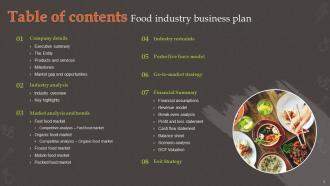
Slide 3: This slide presents Table of Content for the presentation.
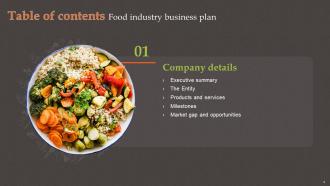
Slide 4: This slide highlights title for topics that are to be covered next in the template.
Slide 5: This slide covers a brief glimpse of what the business will be offering to the customer with market information.
Slide 6: This slide provides a detailed information about the business’s incorporation.
Slide 7: This slide provides a gist of products and services which the business will offer.
Slide 8: This slide provides a detailed information about the business’s milestone.
Slide 9: This slide highlights the market gap which industry is undergoing.
Slide 10: The slide describes the challenges which the food sector is facing.
Slide 11: This slide provides a detailed information about the market opportunity.
Slide 12: This is another slide continuing information about the market opportunity.
Slide 13: This slide highlights title for topics that are to be covered next in the template.
Slide 14: This slide showcases Overview of food market.
Slide 15: This slide provides a glimpse of industry highlights of the food market.
Slide 16: This is another slide continuing Key highlights.
Slide 17: This slide highlights title for topics that are to be covered next in the template.
Slide 18: This slide provides a glimpse of industry overview for the fast-food market.
Slide 19: This slide represents Competitive analysis - fast-food market.
Slide 20: This slide provides a glimpse of industry overview concerning with the organic food market.
Slide 21: This slide provides a glimpse of frozen food market.
Slide 22: This slide provides a competitive framework of organic food industry.
Slide 23: This slide provides a glimpse of mobile food market.
Slide 24: This slide provides a glimpse of industry overview concerning with the packed food market.
Slide 25: This slide highlights title for topics that are to be covered next in the template.
Slide 26: This slide provides a brief gist of industry restraints of the food market.
Slide 27: This is another slide continuing Industry restraints.
Slide 28: This is another slide continuing industry restraints of the food market.
Slide 29: This slide highlights title for topics that are to be covered next in the template.
Slide 30: This slide provides detailed information on porter’s framework.
Slide 31: This slide highlights title for topics that are to be covered next in the template.
Slide 32: This slide provides a brief of go-to-marketing strategies.
Slide 33: This is another slide continuing Go-to-market strategies.
Slide 34: This slide highlights title for topics that are to be covered next in the template.
Slide 35: This slide represents financial assumptions of the food business plan.
Slide 36: This slide presents revenue model of food business.
Slide 37: This slide represents breakeven analysis.
Slide 38: This slide represents breakeven graph.
Slide 39: This slide shows Financial summary - Profit and loss statement.
Slide 40: This slide represents graphs of gross profit of the business.
Slide 41: This slide showcases graphs of total revenue from operations and earnings after tax.
Slide 42: This slide represents the business’s historical and forecasted cash flow results.
Slide 43: This slide shows a graph on cash flow analysis and total assets.
Slide 44: This slide represents balance sheet statement.
Slide 45: This slide presents a graph on cash flow analysis and total assets.
Slide 46: This slide represents the different scenarios for deriving final annual profit.
Slide 47: This slide presents a scenario analysis of annual revenue break-even.
Slide 48: This slide represents the DCF valuation analysis of a business’s financials.
Slide 49: This slide highlights title for topics that are to be covered next in the template.
Slide 50: This slide represents exit strategy for stakeholders such as venture capitalists, private offerings, etc.
Slide 51: This slide contains all the icons used in this presentation.
Slide 52: This slide is titled as Additional Slides for moving forward.
Slide 53: This slide contains Puzzle with related icons and text.
Slide 54: This is a Timeline slide. Show data related to time intervals here.
Slide 55: This slide showcases Magnifying Glass to highlight information, specifications, etc.
Slide 56: This slide depicts Venn diagram with text boxes.
Slide 57: This slide shows Post It Notes. Post your important notes here.
Slide 58: This is Our Target slide. State your targets here.
Slide 59: This slide provides 30 60 90 Days Plan with text boxes.
Slide 60: This is a Thank You slide with address, contact numbers and email address.
Food Industry Business Plan Powerpoint Presentation Slides with all 65 slides:
Use our Food Industry Business Plan Powerpoint Presentation Slides to effectively help you save your valuable time. They are readymade to fit into any presentation structure.






















FAQs for Food Industry Business Plan
Look, you've got the standard business plan stuff but food's trickier. Market analysis first - who's buying and what makes you different. Operations gets messy: ingredient sourcing, how you'll actually make it, food safety (huge deal), getting it to customers. Your financials need to account for spoilage and weird food industry margins - honestly this is where most people screw up. FDA compliance isn't optional either. Marketing strategy, your team, all that. Pro tip: investors can smell BS from a mile away when it comes to food costs, so don't just wing the numbers.
Honestly, market research saves you from making huge assumptions about what people want. I learned this the hard way with my cousin's food truck - he thought gourmet grilled cheese would kill it, but nobody wanted to pay $12 for fancy bread lol. You'll figure out your real target audience, pricing that actually works, and which competitors are dominating your area. Plus it shows you distribution options and even weird stuff like packaging preferences. Survey potential customers first, then dig into local food trends before writing your business plan. Way better than just winging it and hoping for the best.
Definitely need your revenue forecasts, startup costs, and operating expenses for at least 3 years. Cash flow projections too. Food businesses are tricky - there's equipment costs, permits, ingredient sourcing, plus spoilage (seriously, this one blindsides everyone). Break-even analysis is crucial, along with profit margins for each product line. Seasonal variations matter since food sales swing throughout the year. Oh, and budget for food safety compliance costs - those add up fast. Equipment replacement schedules are smart to include. Food cost inflation is brutal right now, so factor that in or your margins will get wrecked when ingredient prices spike.
Okay so here's the thing - you've gotta figure out what actually sets you apart from all the other brands crowding the shelves. Pick one super specific thing your customers care about. Like instead of saying "fresh and natural" (ugh, everyone says that), go with something like "the only pasta sauce using tomatoes picked within 24 hours from local farms." Way more concrete, right? Here's a quick test: could your competitors make the exact same claim? If yes, you're not being specific enough. Keep digging until you find something that's uniquely yours and customers instantly get why they'd grab your product over whatever's sitting next to it.
Honestly, sustainability isn't optional anymore - consumers actually care about this stuff now and will choose brands based on it. Investors are obsessed with environmental criteria too. You've got to tackle things like sustainable sourcing, cutting waste, better packaging, reducing your carbon footprint. The regulatory stuff is only getting stricter. Pick 2-3 realistic sustainability goals you can actually measure and track. That way you'll have real numbers to show stakeholders instead of just talking in circles about being "green" (which everyone's tired of hearing anyway).
Food regulations will totally make or break your startup - they affect everything from how much cash you need upfront to your day-to-day grind. FDA compliance, health permits, HACCP plans, maybe USDA stuff too depending on your product. The paperwork is genuinely insane (I know founders who burned months just filling out forms). Build these costs into your business plan right away though, don't just wing it later. Start digging into requirements early and budget like 15-20% extra. Trust me on this one.
Honestly, sampling is everything with food. Get people tasting your stuff through demos, pop-ups, whatever - once they try it, you're golden. Social media's huge too, but skip the polished ads. Post messy behind-the-scenes content and repost customer pics. Micro-influencers in your space work way better than big names (and they're actually affordable). Oh, and make friends with store buyers early - they can make or break your shelf placement. I'd say start local first. Test what works in your backyard before burning cash on some massive campaign that might flop. Way smarter approach.
So definitely build a risk section into your plan that maps your whole supply chain - weather disasters, strikes, suppliers going under, all that fun stuff. Get backup suppliers lined up, preferably spread out geographically. Honestly, vertical integration sounds cool but it's expensive as hell unless you're already pretty established. Stock up on inventory buffers and have actual protocols written down for when things go sideways. Don't wait until you're panicking to figure this out. Keep those contact lists updated and have your backup sourcing ready to go immediately.
Skip the guesswork about who "should" want your product. Surveys and focus groups will tell you way more than assumptions ever will. Sure, age and income are useful, but honestly? Values matter more - like if they care about sustainability or just want quick meals. Find out where they actually shop and what makes them buy stuff. Social media analytics are pretty solid for this too. Create maybe 2-3 detailed customer profiles instead of trying to please everyone (trust me on this one). Test everything small-scale first before you blow your budget on big marketing campaigns.
Don't just stick tech stuff at the end - weave it throughout your whole plan. POS systems, inventory software, customer ordering apps all directly hit your operations and revenue numbers. Delivery platforms are obviously massive right now. Kitchen automation and food safety monitoring are worth considering too, plus analytics for tracking what customers actually want. Here's the thing though - investors need to see real ROI, not just cool gadgets. I'd honestly pick maybe 2-3 core technologies and really dive deep into how they'll save money or drive sales. Otherwise you just look like you're chasing trends.
Dude, food business is tough. Three major headaches: regulations are insane (food safety, labeling, licenses - prepare for paperwork hell), supply chain stuff gets messy fast, and you'll burn through cash quicker than you think. Equipment and facilities cost a fortune before you make a dime. Finding good suppliers is key but takes forever. Honestly? Start super small first. Test one product, maybe local markets or something. Build those supplier relationships early - they'll save your butt later. And seriously, triple whatever budget you think you need for all the compliance garbage. The red tape never ends.
Honestly, don't mess around with food safety - it can tank your whole business in like 24 hours. One bad Yelp review about food poisoning and you're done. I've watched places go from busy to ghost town after stuff like that hits social media. You'll need all the HACCP paperwork, staff training, proper equipment just to get permits anyway. Insurance companies are super picky about this stuff too. The annoying part? It affects everything - your kitchen design, how many people you hire, your whole budget really. Investors always ask about it upfront, so get your safety protocols figured out early.
Honestly, you need both money and operations stuff to really know what's going on. Track your revenue growth, margins, and food costs obviously. Customer metrics are huge though - repeat buyers, average order size, how much you're spending to get new people in the door. Then there's the boring but necessary operational stuff: inventory turnover, waste (ugh, so much waste in food), labor costs. Don't ignore reviews and social media either since people love posting about their meals. Maybe set up a monthly check-in with all this data? Easier to catch problems early before they totally derail you.
Honestly, partnerships are game-changers for food businesses. You get instant access to distribution channels and suppliers that would take forever to build yourself. Think local farms for ingredients, restaurants for cross-promotion, or delivery apps to reach more customers. I watched one startup absolutely explode after landing a solid retail partnership - it was wild how fast things moved. Map out what you're missing first, then find businesses where it's actually win-win. Like maybe they've got the marketing budget but need your amazing product. Don't just think about what you need though, focus on what you bring to the table too.
Honestly, branding is what stops people from walking past your product. Like, Ben & Jerry's could've just made vanilla ice cream, but instead they went with "Chunky Monkey" and slapped social causes on the carton. Now look at them. Your packaging and messaging need to hit people emotionally - not just "hey, this tastes good." Figure out what makes your food different from everyone else's first. Then build everything around that story. Price and flavor matter, but if you don't have that connection, you're just another option on a crowded shelf.
-
“One of the best experiences with SlideTeam for my presentation.Everything on time, communication is efficient and price is reasonable. All good in one place.”
-
Great product with effective design. Helped a lot in our corporate presentations. Easy to edit and stunning visuals.