

Landscaping Business Plan Powerpoint Presentation Slides





Try Before you Buy Download Free Sample Product
 Impress Your
Audience
 100%
Editable
 Save Hours
of Time


Check out our professionally designed Landscaping Business Plan PowerPoint that covers all the crucial elements required for writing a B plan. This Landscaping and Gardening PPT includes various sections, including a company summary with entity details, mission and vision, goals and objectives, etc. Also, the Landscaping Services template covers the executive summary section and highlights a detailed industry analysis segment comprising all the facts and trends related to the hotel and hospitality industry. Furthermore, the Hardscaping presentation also portrays a financial plan that includes a Profit and loss statement, revenue model, cash flow analysis, balance sheet statement, DCF valuation, etc. Lastly, Lawn Care PowerPoint also covers possible exit options for the stakeholders. Download the landscaping B plan PowerPoint presentation now.
People who downloaded this PowerPoint presentation also viewed the following :
Content of this Powerpoint Presentation
Slide 1: The slide represents LANDSCAPING Business Plan.
Slide 2: This is an Agenda slide. State your agendas here.
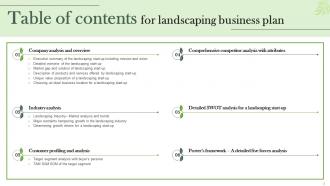
Slide 3: The slide displays Table of contents for presentation.
Slide 4: The slide continues Table of contents further.
Slide 5: The slide shows another Table of contents.
Slide 6: The slide is to provide a broader overview of the landscaping industry.
Slide 7: The slide continues to portray organization details including name, incorporation date, web address, start-up investment, services etc.
Slide 8: The purpose of the slide is to portray organization details including name, incorporation date, web address, start-up investment, services etc.
Slide 9: The slide is to highlight market gap and focus on devising solution to overcome those challenges.
Slide 10: The slide is to express the benefits the firm provides to its customers or clients.
Slide 11: The slide is to highlight the key success factors of the landscaping start-up which leverage them with a competitive edge in the market.
Slide 12: This slide portrays an ideal business location for landscaping start-up company start-up that minimize the risk of failure.
Slide 13: The slide renders title of contents.
Slide 14: The purpose of this slide is to conduct a thorough assessment of the landscaping industry in addition to its market trends.
Slide 15: The slide continues to conduct a thorough assessment of the landscaping industry in addition to its market trends.
Slide 16: The slide again shows how to conduct a thorough assessment of the landscaping industry in addition to its market trends.
Slide 17: The slide is to guide stakeholders about the problems prevailing in the industry.
Slide 18: This slide caters to details about various growth drivers resulting in the firm’s progress.
Slide 19: The slide renders another title of contents.
Slide 20: This slide covers an assessment of how the firm’s products and services will fit into a certain market.
Slide 21: This slide continues an assessment of how the firm’s products and services will fit into a certain market.
Slide 22: The slide is to depict the market potential of the landscaping industry in terms of TAM, SAM, and SOM.
Slide 23: The slide displays title of contents further.
Slide 24: The slide is to provide a glimpse of key competitors in the industry to gain insight into their products, services, sales, and marketing tactic.
Slide 25: The slide continues to provide a glimpse of key competitors in the industry to gain insight into their product, services, sales, and marketing tactic.
Slide 26: The slide represents title of contents which is to be discussed further.
Slide 27: The slide includes the strengths, weaknesses, opportunities, and threats analysis of the landscaping start-up.
Slide 28: The slide again displays title of contents.
Slide 29: The slide highlights porter’s framework and its implications in the landscaping industry.
Slide 30: The slide presents title of contents further.
Slide 31: The slide is to implement an effective go-to-market strategy for bringing landscaping business services to an end customer.
Slide 32: The slide continues to implement an effective go-to-market strategy for bringing landscaping business services to an end customer.
Slide 33: The slide again displays to implement an effective go-to-market strategy for bringing landscaping business services to an end customer.
Slide 34: This slide highlights customer journey mapping to track users' actions and key touch points across levels.
Slide 35: The slide showcases title of contents which is to be discussed further.
Slide 36: The slide presents to facilitate managers to convey project progress updates to stakeholders and get their approvals.
Slide 37: The slide displays title of contents further.
Slide 38: This slide provides a glimpse of important financial assumptions that are to be made while setting up the firm.
Slide 39: The slide shows the effective revenue model of the landscape start-up, which displays the cost incurred and the various sources of income.
Slide 40: The slides highlight the break-even analysis of the firm.
Slide 41: The slides provide a glimpse of the projected profit and loss statement to visualize the platform’s financial performance for the next five years.
Slide 42: The slides continues a glimpse of the projected profit and loss statement to visualize the platform’s financial performance for the next five years.
Slide 43: The slides highlight the cash flow statement of the company.
Slide 44: The slides continues the cash flow statement of the company.
Slide 45: The slides cover the snapshot of the company's financial position at a specific time.
Slide 46: The slides continues the snapshot of the company's financial position at a specific time.
Slide 47: The slide is to examine the effects of potential future events on the landscaping start-up performance.
Slide 48: The slide continues to examine the effects of potential future events on the landscaping start-up performance.
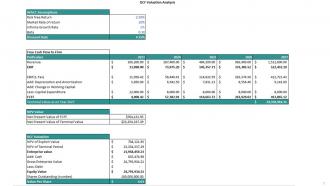
Slide 49: The slide is to calculate the amount of money an investor would get from an investment after adjusting for the time value of money.
Slide 50: The slide displays title of contents further.
Slide 51: The slide is to craft a successful hierarchical framework for the firm to ensure smooth operations.
Slide 52: The slide is to highlight key job roles and responsibilities of the staff to ensure effectiveness and efficiency in the operations.
Slide 53: The slide continues to highlight key job roles and responsibilities of the staff to ensure effectiveness and efficiency in the operations.
Slide 54: The slide depicts another title of contents.
Slide 55: This slide represents exit strategy for stakeholders such as IPO, Mergers, Acquisitions, Private offerings, and Venture Capital.
Slide 56: This slide continues exit strategy for stakeholders such as IPO, Mergers, Acquisitions, Private offerings, and Venture Capital.
Slide 57: The slide highlights title of contents further.
Slide 58: The slide is to represent the shorter version of existing words to save time and take up less space.
Slide 59: This slide shows all the icons included in the presentation.
Slide 60: This slide is titled as Additional Slides for moving forward.
Slide 61: This slide provides Clustered Column chart with two products comparison.
Slide 62: This is a Timeline slide. Show data related to time intervals here.
Slide 63: This slide contains Puzzle with related icons and text.
Slide 64: This slide shows Post It Notes. Post your important notes here.
Slide 65: This slide provides 30 60 90 Days Plan with text boxes.
Slide 66: This slide depicts Venn diagram with text boxes.
Slide 67: This is a Thank You slide with address, contact numbers and email address.
Landscaping Business Plan Powerpoint Presentation Slides with all 75 slides:
Use our Landscaping Business Plan Powerpoint Presentation Slides to effectively help you save your valuable time. They are readymade to fit into any presentation structure.















FAQs for Landscaping Business Plan
You need five main things for your landscaping business plan: figure out your competition and who you're targeting, nail down your services and what you'll charge, crunch the financial numbers (startup costs, cash flow stuff), plan how you'll get customers, and work out the logistics like equipment and hiring. The money part honestly screws people over the most. Landscaping's all about seasons, so your income's gonna be all over the place depending on weather. Don't forget insurance and equipment repairs either - that stuff adds up way faster than you'd think. I'd start super simple with just one page, then build it out once you know what actually works.
Look, market analysis is basically your roadmap to figuring out where the money is. You'll see what services people actually want - could be xeriscaping if you're in a drought area, or maybe everyone's obsessed with outdoor kitchens right now. Check what your competition charges and where they're screwing up. This research can be a real eye-opener, trust me. You'll find those sweet underserved spots and nail down your pricing. Oh, and it helps you figure out who your dream customers are. Start by asking 20-30 people in neighborhoods you want to work in - their answers will basically write your service menu for you.
Look, your USP is what stops you from being just another lawn guy with a truck. Maybe you're the drought-resistant plant expert, or you do same-day estimates, or you're obsessed with native species - whatever. The point is having something that lets you charge what you're worth instead of racing everyone to the bottom on price. I learned this the hard way when I started freelancing honestly. Write it down somewhere and make sure everything else in your business plan actually backs up that angle. Marketing, pricing, services - it all needs to connect to why someone would pick you over Bob's Mowing Service.
Look, you're gonna need the basics first - mower, trimmer, hand tools. Budget around $3-8K for decent stuff that won't die on you every other week. I'd say maybe 15-20% of your startup cash should go to equipment, possibly more if you want commercial gigs since they expect fast work. Buying used is honestly your friend here - saved me a ton when I was researching this stuff. Just gotta know what you're looking at. Don't forget the boring essentials like rakes, shovels, safety gear, and obviously a truck or trailer. Make a wishlist of fancy equipment for later when money's actually coming in regularly.
Dude, photos are everything in landscaping. Post those crazy before/after shots on Instagram and Facebook - people eat that stuff up. Get your happy customers to refer friends (maybe throw them a small discount for it). Also, make sure you show up when people Google "landscaping near me" because that's literally how everyone searches now. Oh, and don't laugh but those old-school door flyers actually work great, especially right after you finish someone's yard. Their neighbors always notice. Try partnering with nurseries and real estate agents too - they'll send people your way. Just pick one thing first though, get good at it, then add more later.
Dude, seasonal stuff will absolutely destroy your cash flow if you're not ready for it. Your busy months are spring/summer with all the lawn work and installations. Winter though? Brutal. I'd plan for like 60-80% revenue drops during the slow months - better to expect the worst honestly. Some guys switch to snow plowing or holiday lights to stay busy. Really helps bridge that gap. Build up cash during peak season and maybe offer winter discounts to keep your best clients around. Oh and don't just look at yearly numbers - you need monthly projections for at least 18 months out.
So first thing - grab a business license from your city/county. Basic requirement. Liability insurance is huge too since you're messing with equipment and other people's stuff. Workers' comp kicks in once you hire anyone. Depending what services you offer, might need a contractor license from the state. Tree work and pesticide stuff usually requires special permits. Oh and if you're starting from home, double-check your HOA doesn't have weird rules about it - some are super picky. Honestly just call your local small business office. They've got checklists for everything.
Start by figuring out who you're actually going after - residential folks, commercial buildings, HOAs, or city contracts. Each group works totally differently. Homeowners want seasonal stuff or weekly cuts, but businesses need to look good constantly (can't have a crappy-looking office, right?). Income matters too. Luxury estates vs regular suburban houses need completely different approaches and pricing. Once you know if you're chasing the high-end market or middle-class neighborhoods, you'll know where to find them and what they'll actually pay for.
Look for partners who can send you clients or help you offer more services. Nurseries and garden centers are obvious ones for plant sourcing. Real estate agents are great since their clients are always doing property upgrades. Pool companies are honestly some of the best partnerships - those customers need constant maintenance work. You could also team up with contractors for hardscaping stuff, property management companies for commercial gigs, and irrigation people so you don't have to hire more staff. I'd start by calling three potential partners this week and see what happens.
Honestly, don't just tack sustainability onto what you're already doing - weave it right into your main services. Native plants are huge right now, plus xeriscaping saves people tons on water bills. Rain gardens too - clients eat that stuff up. I'd gradually swap out your gas equipment for electric when things break down anyway. Organic fertilization programs work great as premium offerings. Oh, and integrated pest management beats dumping chemicals everywhere. The trick is selling these as money-savers over time, not just feel-good eco stuff. Maintenance costs drop significantly with the right approach.
Dude, start with scheduling software - seriously makes a huge difference with routing and cutting down drive time. You can track all your clients' weird preferences in a CRM (like Mrs. Peterson who hates when you edge too close to her roses). GPS tracking is clutch for keeping tabs on equipment - no more "mysterious" disappearing mowers. For bigger properties, drone mapping is pretty sick but maybe overkill if you're just starting out. Mobile apps let customers book stuff themselves, which honestly saves you from playing phone tag all day. Once you see how much time you save, you'll want to automate your billing too.
Honestly, start by calling around to see what everyone else charges - their websites sometimes have ballpark figures too. Add up your materials, labor time, overhead costs, plus whatever profit you want. Then compare that to local rates. Here's the thing though - don't be the cheapest guy out there. That's just gonna hurt you long-term. Figure out what makes you different instead. Maybe you show up on time or your work lasts longer, whatever. Price somewhere in the middle range to start. Oh and definitely adjust for busy seasons - learned that one the hard way! Track what's working and tweak as you go.
Dude, reviews are everything in landscaping. People won't hire you without seeing your work first - I wouldn't either, honestly. Most folks hit up Google reviews or bug their neighbors for recommendations before calling anyone. You'd be crazy not to showcase those testimonials right on your website. After you finish a job, just ask if they'd mind leaving a quick review. Sounds pushy but it's not really. Good reviews bring in way more business than any fancy marketing stuff you could write yourself. Oh and display them prominently - don't bury them on some random page nobody visits.
Yeah, definitely build in contingency plans for the obvious stuff - seasonal cash flow dips, equipment dying on you, weather delays. Honestly, the cash flow thing will probably stress you out the most since landscaping is so seasonal. Winter months can be brutal. Make sure you've got backup suppliers lined up and know where to rent equipment when your mower craps out (and it will). Peak season staff shortages are another headache to plan for. Weather delays? Just part of the game unfortunately. Don't just write "we'll adapt" - actually map out scenarios with real numbers and timelines.
Dude, training your crew makes a huge difference. You'll notice faster work and way fewer screwups. When they actually know what they're doing with new equipment or techniques, they're not fumbling around looking clueless. Keeps them from getting bored too - nobody wants their best guys jumping to the competition because they're stuck doing the same stuff forever. Focus on whatever you're seeing gaps in - plant ID, irrigation, even basic customer skills. Happy clients mean fewer callbacks, which honestly saves you more headaches than you'd think. Start with like one session monthly.
-
The slides come with appealing color schemes and relevant content that helped me deliver a stunning presentation without any hassle!
-
I was confident and well prepared for my presentation for the first time ever. With SlideTeam’s templates, I could deliver one of my best presentations. Will be coming back for more!