


Agriculture Company Pitch Deck Ppt Template




Try Before you Buy Download Free Sample Product
 Impress Your
 Audience
 100%
100% Editable
 Save Hours
 of Time


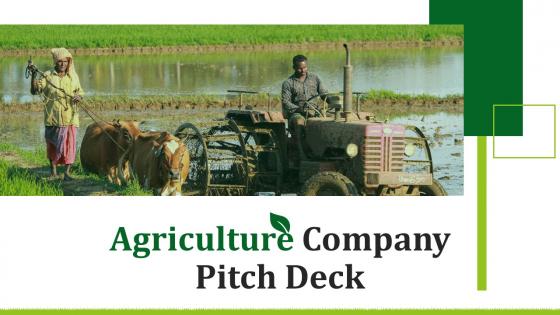
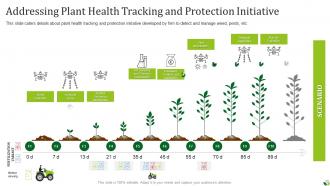
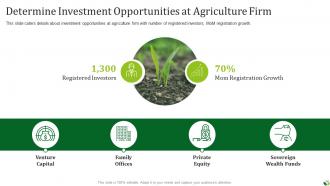
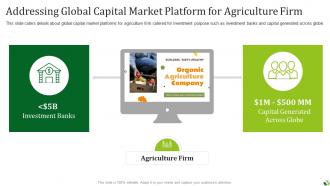
The agriculture pitch deck caters to capital raising initiatives for one of the pioneers in the agriculture industry with a focus on serving farming communities. Its prime focus is maintaining balance among the latest technology, production processes, and material usage. Here is a competently designed Agriculture Company Pitch Deck, effectively attracting investors by distilling the company in a condensed and marketable message for potential investors. This deck grabs investors attention through slides depicting the importance of investment in agriculture, the possible market opportunity in apple, market growth in the agriculture sector, problems existing at present, addressing reasons for soil yield loss, and the competitive advantage of agriculture firms. Grab investors attention through slides depicting salient features of agriculture products offered by the firm, essential services offered, plant health tracking, and protective initiative. It also describes investment opportunities, the global capital market platform for a firm, a profitable business model, impressive financial highlights, and a competitive assessment of major players existing. Lastly, it concentrates on key people involved, the board of directors associated, and future initiatives by agriculture firms to manage potential stakeholders. Get access to this powerful template now.
People who downloaded this PowerPoint presentation also viewed the following :
Content of this Powerpoint Presentation
“Investments” is the core element required to run or set up a business. Having a smart and unique vision for a business is not enough to get things started. The same is the case with an agricultural company. Generally, the best way to gain investments is to seek third-party investors. However, convincing investors to fund your business can be a mountain to climb.
If you wish to gain investments for your agriculture business, you need to showcase that you have a viable and profitable business idea. For this task, you can take the help of an investment pitch. The investment pitch you use should be extensive, inclusive of true facts, detailed, well-versed, and well-reasoned. However, designing such a business pitch is a complicated task.
Thankfully, SlideTeam’s agricultural business company pitch template is here to help you. This pitch is 100% customizable and thorough as it includes facts and data related to the competition, your business idea, profitability, investment opportunities, and more.
Let’s have a look at some slides included in the template and answer your queries related to the agriculture company pitch.
Take the help of the IoT Implementation For Smart Agriculture And Farming template to enlighten your audience about the overall benefits of using IoT in the agriculture business.
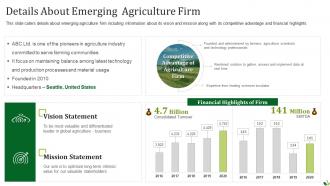
Template 1: Details About Emerging Agriculture Firm

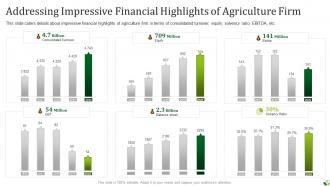
If you want to convince investors about investing in an agricultural business, the first thing you should do is enlighten them about the vision and mission of the business. This slide allows you to showcase details related to your business like its name, year of incorporation, current performance, financial highlights, and more. This information will help the investors in making an informed decision related to the investments. For ease of representation, you can also take the help of a financial highlight chart to showcase your consolidated turnover and EBITDA.
Template 2: Why Investment in Agriculture is Essential?

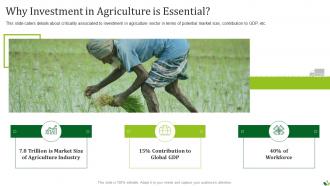
An investor may be reluctant to be interested in your business if he is unaware of the benefits and requirements of the agricultural sector. Hence, you can take the help of this slide to showcase why it's so important for more and more individuals to invest in this industry. For this, you can state that the market size of the sector sums up to $7.8 trillion, which is high and substantial. You can also inform the investors that this sector alone contributes 15% of the total GDP of the country.
Template 3: Addressing Potential Market Opportunity in Agriculture

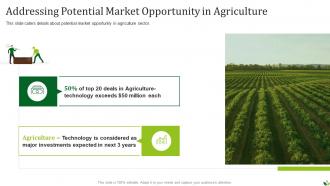
Now that you have showcased the performance of the sector to the investors, it's time to enlighten them about the benefits of investing in the agriculture business. You can use this slide to inform the investors that around half of the average top 20% deals in the sector surpass around $50 million each. Also, you can state that the experts believe that investments in technology would constitute a major part of this sector’s investment patterns.
Template 4: Determine the Market Growth in the Agricultural Sector

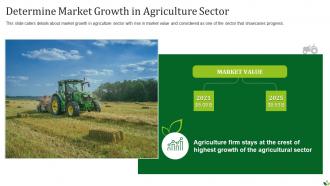
To offer fuel to your motive, you can take the help of this slide and showcase some information related to the market growth patterns in the agriculture sector. For this, you can take the help of a small tree chart that includes the market value in 2021 at $5.09 billion and then showcase the growth in the form of projected market value in 2025 at $9.53 billion. This equals 87% growth.
Template 5: Addressing Various Problems Existing at Present
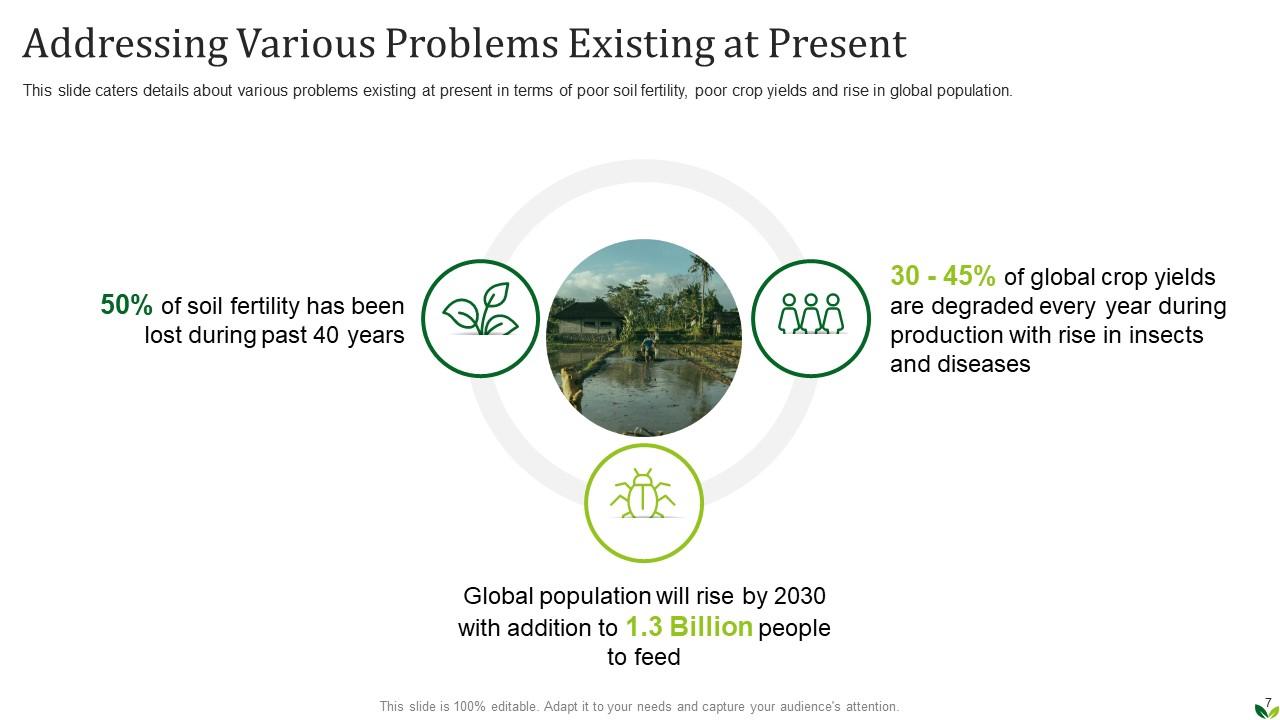
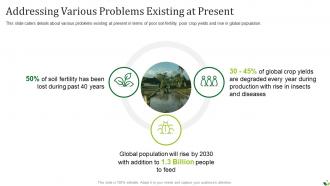
For enlightenment of the potential investors and audience, you can use this slide to add common and most important problems that exist in the agricultural sector presently. You can state that the fertility of around half of the cultivable land has been reduced in over a span of 40 years. Another problem is that the projected growth in population of around 1.3 billion people who would be required to be fed.
Template 6: Determine Reasons for Soil Yield Loss
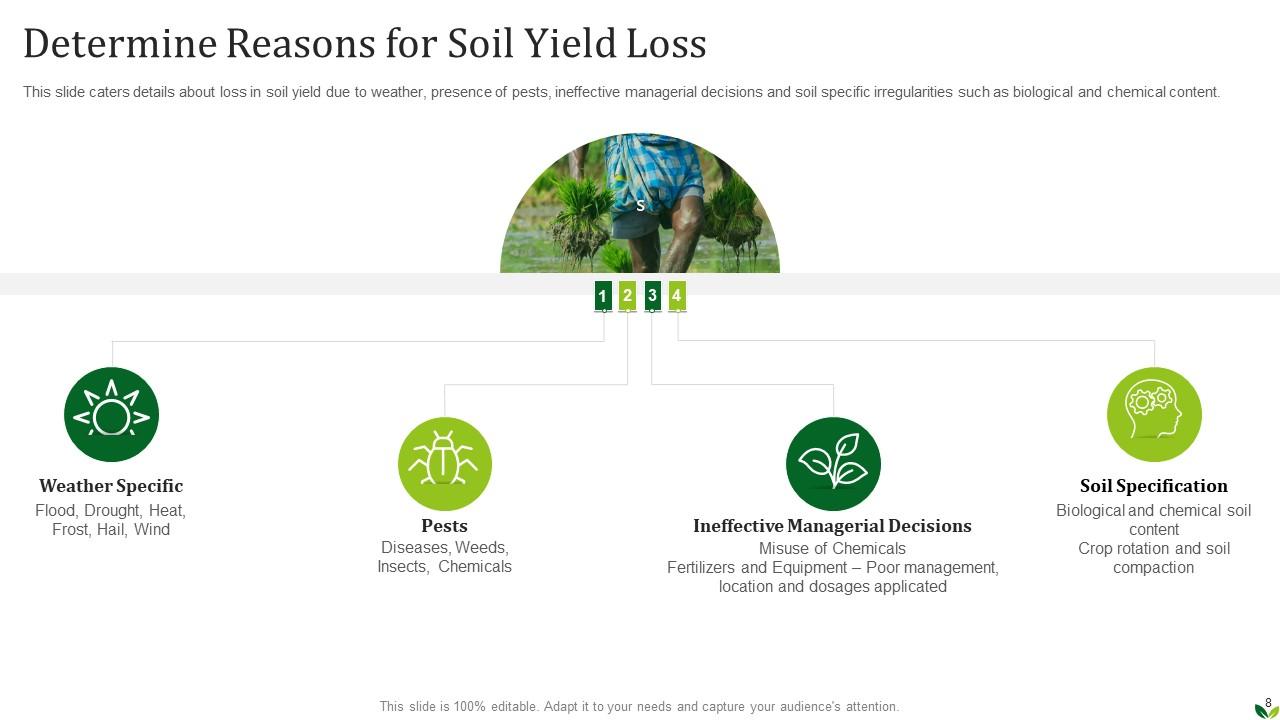
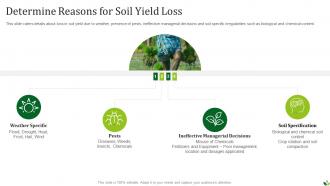
This slide showcases the reasons, that many others may not know, behind the soil yield loss over the past few years. The reasons can be Weather Specific (floods, draughts, heat, wind, frost, hail, and others), Pests Infestation (mice, rats, locusts, insects, chemicals, and others), Ineffective Managerial Decisions (overuse of chemicals, reluctancy to solid testing, and others), and Soil Specification (biological/chemical soil content, crop rotation, crop compaction, and others.)
Template 7: Determine Competitive Advantage of Agricultural Firm
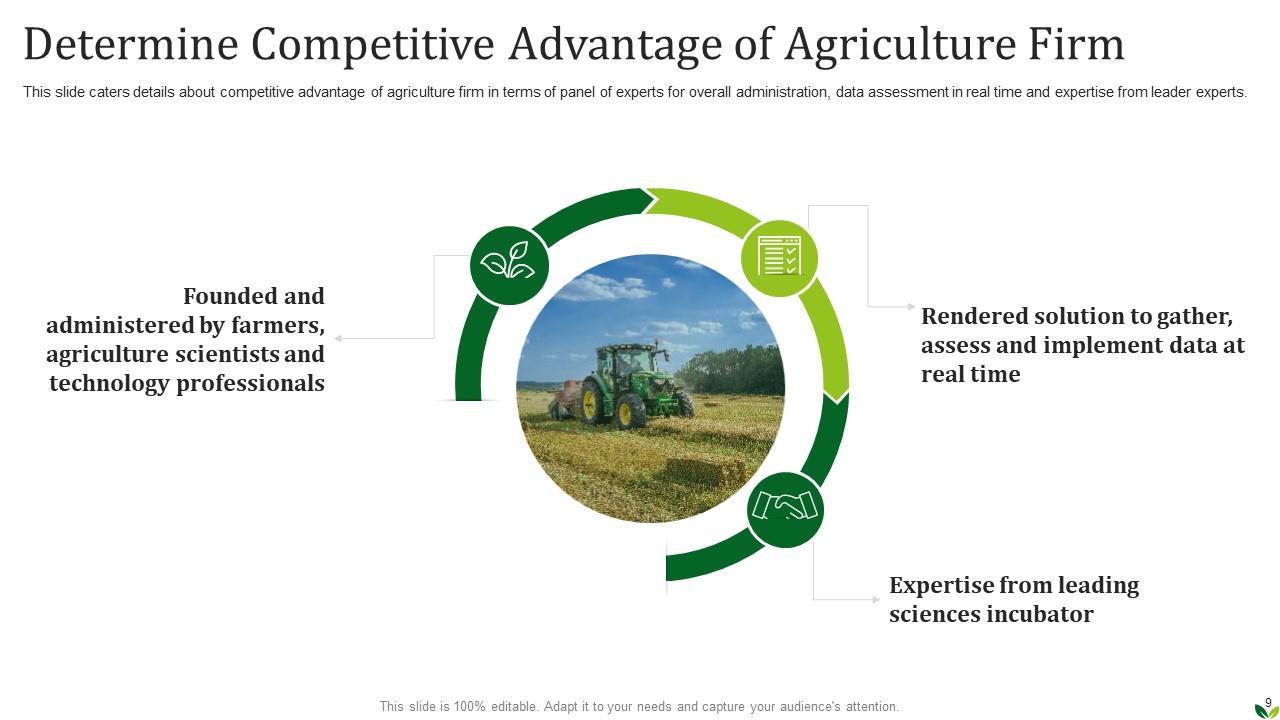
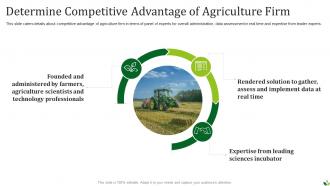
Now that you have showcased the problems and advantages of the sector, it's your turn to enlighten the investors directly about the competitive advantages that an agricultural business brings. To make your case, you can state that regular tasks would be executed by the farmers, scientists, and technicians associated with the agricultural sector. Moreover, you can also state that help from a leading sciences incubator will help the business.
Template 8: Determine Salient Features of Agriculture Product Rendered by Firm

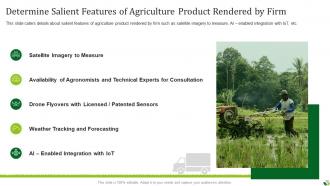
To enlighten your audience about how your products and services will address and tackle the problems faced by the agricultural sector, you can use this slide. Here, you can showcase that the business will use satellite imagery to measure the land, there is a team of technical experts to offer opinions on urgent matters, drones flyovers are available for fertilizing and other activities, weather tracking and forecasting services available, AI enabled integration with internet of things for better approach, etc.
Template 9: Determine Essential Features of Agriculture Product Rendered by Firm
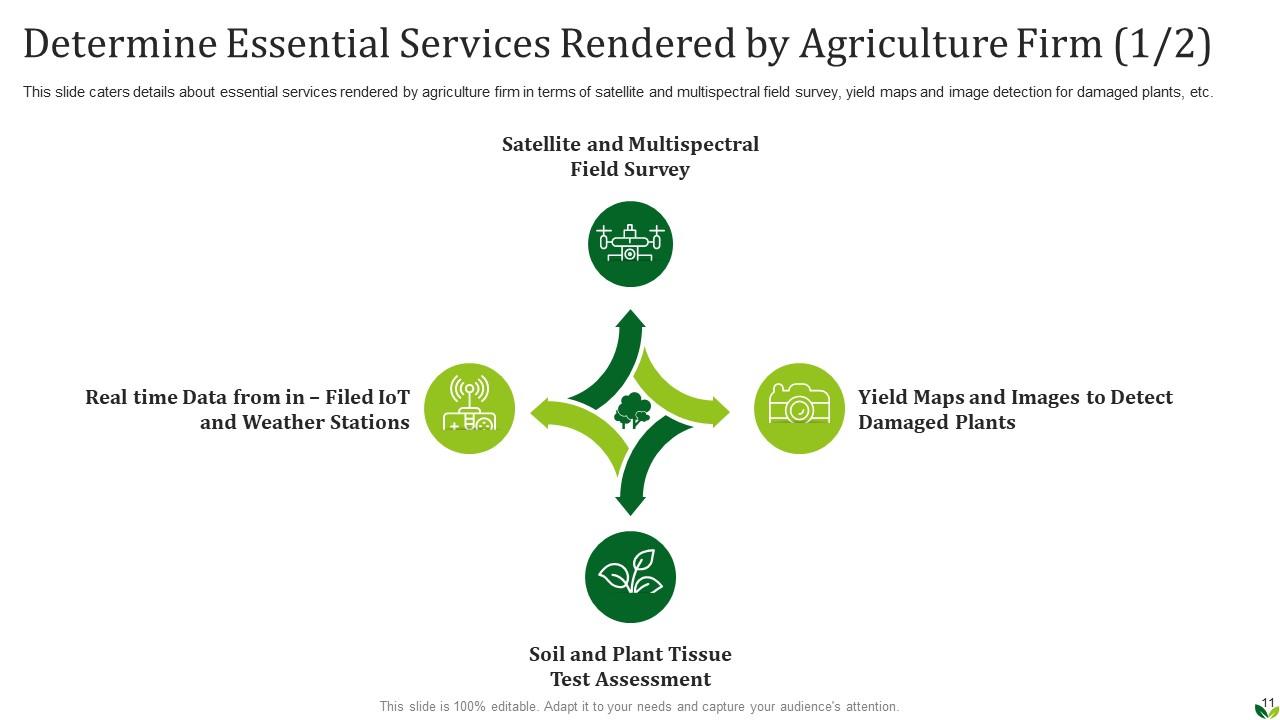
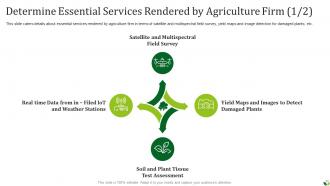
If the above template was not sufficient to provide the desired information or if you want to try a new approach, you can take the help of this slide. Here, you can showcase features of the firm like satellite and multispectral field survey, real data collection and transformation using IoT and weather stations, thorough yield maps and images to figure out the damaged plants, and soil plant tissue assessment practices.
Template 10: Determine Essential Features of Agriculture Product Rendered by Firm

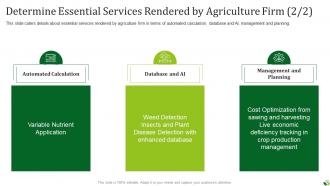
To bifurcate the offerings of the previous slide, you can use this one. This slide showcases the essential services the company offers in the field of automated calculation, database management and AI integration, and effective management and planning. Within the automated calculation front, you can showcase that you use a variable nutrition application method. Similarly, you can showcase that your business uses AI and Database to find out the weed-infested plants and more.
Here’s yet another template to help you showcase some insights related to your agriculture business feasibly and smartly.
Get the Required Fuel For Your Agriculture Business
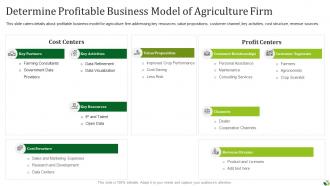
The template provided to you above is highly-comprehensive and straightforward. The contents of this template would suffice if you wish to seek investments from your audience by enlightening them about your agriculture business plan, its competitive analysis, information related to the agricultural sector, and facts and figures to enlighten them about the benefits of investing and connecting your business.
Showcase your food and agriculture business profile smartly and accurately using this highly-inclusive and infographic template.
Agriculture Company Pitch Deck Ppt Template with all 39 slides:
Use our Agriculture Company Pitch Deck Ppt Template to effectively help you save your valuable time. They are readymade to fit into any presentation structure.









FAQs for Agriculture Company Pitch
Honestly, cover cropping is where I'd start - way cheaper than the fancy tech stuff and you'll actually see your soil improve pretty fast. GPS precision agriculture is cool but expensive, though it cuts fertilizer waste by like 20-30% if you can swing it. IPM is smart too - mixing biological controls with targeted spraying instead of just nuking everything. Oh, and cover crops do a ton of work between seasons, preventing erosion and boosting nitrogen naturally. The water retention alone makes them worth it. I'm probably biased toward cover crops since they're so straightforward, but seriously, start there.
Dude, farming tech is insane right now. GPS tractors basically drive themselves, and drones can spot crop problems before you'd even notice walking through the field. Soil sensors tell you exactly which spots need water or fertilizer - saves you from dumping chemicals everywhere blindly. Real-time data on moisture, pests, all that stuff. Machine learning even predicts the best planting times, though honestly I'm still wrapping my head around that part. It's wild how precise everything's gotten. If you're thinking about trying it, maybe start with basic soil sensors? Way cheaper than going all-in on drone mapping right away.
Cover crops are like insurance for your soil. When you're between seasons, toss in some clover, rye, or radishes - their roots grab onto dirt so it doesn't blow away or wash out. The plants break down and feed all the good microbes living in there. Winter rye's probably your safest bet if you're just starting out, super hard to mess up. My neighbor swears by crimson clover but honestly that's more work than I'd want. The whole thing just keeps building better soil structure over time. Way better than leaving fields bare.
So basically farmers are switching to drought-resistant crops and getting way smarter about water use. Precision agriculture tech is pretty cool - it lets you adjust everything based on real conditions instead of just guessing. Healthy soil makes a huge difference too since it holds more water and carbon. Honestly, crop rotation and mixing in some trees (agroforestry) builds way more resilience than just growing the same thing over and over. The whole trick is diversification - different crops, different methods, maybe even side income streams. Climate's unpredictable now, so you can't rely on just one approach. Pick one thing to try first though, don't overwhelm yourself.
Yeah, so upfront you'll definitely spend more - certification fees, new equipment, different pest control stuff. Your yields will probably suck for the first couple years while the soil adjusts, not gonna lie. But organic stuff sells for like 20-40% more than regular produce, which is pretty solid. Over time your input costs usually drop as the soil gets healthier too. Honestly, I'd test it on just part of your farm first - see how the numbers work out before you commit to the whole operation. The premium prices are real though, consumers definitely pay extra for organic.
So basically when you buy from local farmers, that money stays in your community instead of going to some big corporation. The farmer spends it at local shops, those shops hire locals - it's this whole ripple effect that actually works. During Covid when everything went nuts with shipping, places with local food systems didn't get hit as hard. Honestly, shorter supply chains just make sense. If you want to help this happen, figure out what farms are already around you and maybe see if your kid's school would be interested in buying from them.
So CRISPR is basically revolutionizing everything right now. You can edit crops for disease resistance and drought tolerance without adding foreign DNA like old-school GMOs do. There's also this RNA interference thing that's pretty cool - it silences genes in harmful insects for pest control. The whole field is moving crazy fast, honestly. Companies like Corteva and Bayer have some interesting CRISPR projects going if you want to see what's actually happening. Oh, and don't sleep on bioengineered microbes - they're doing wonders for soil health and root protection. Worth looking into for sure.
Dude, water management will literally make or break you out there. Most farmers don't realize how much they're pissing away through crappy distribution systems - seriously, go check yours first. Drip irrigation is a game changer. Mulching helps too. Pick drought-resistant crops if you can swing it. These smart techniques can bump your productivity up 40-60% compared to just winging it with traditional methods. You've gotta squeeze every drop while avoiding that nasty salt buildup. Oh, and honestly? Stop gambling with the weather - you'll lose every time.
So mixing livestock and crops is pretty cool - the animals give you free fertilizer while eating your leftover plant stuff. Win-win situation. Your soil gets healthier, nutrients cycle better, and you're not dropping cash on expensive feeds or fertilizers all the time. But honestly? It's a lot more work juggling both systems. Disease can jump between your animals and plants too, which gets messy fast. I'd say start with maybe chickens or goats if you're thinking about it. Don't go crazy right away.
So basically, you can track soil moisture, weather, crop growth, pest stuff - it's like having a farm fortune teller. GPS and sensors let you map out which field sections need what treatment. Super helpful for timing when to water or fertilize without wasting resources. Oh, and it'll predict when equipment might crap out on you (trust me, you don't want your harvester dying mid-season). Honestly I'd start with just irrigation scheduling. Once you see how much it helps, you'll want to track everything else too. The data stuff really does pay for itself pretty quick.
So basically start with whatever's bleeding you the most money right now. Better cold storage and packaging can cut your losses by like 30-40% - honestly it's wild how much stuff just rots in crappy storage. Speed up your transport routes or maybe try selling direct to skip the whole distribution nightmare. There's tracking software that helps you figure out exactly when to harvest based on demand, which is pretty clutch. Oh and the packaging thing - investing in stuff that actually keeps produce fresh longer is a game changer. Pick one area first though, don't try to fix everything at once.
So basically, the government throws money at farmers who go sustainable - subsidies for organic stuff, tax breaks for cover crops, grants for conservation equipment. The Farm Bill is where the real action happens since it decides what gets funded. There's also regulations that kinda force the environmental standards thing, but honestly most farmers are already buying in anyway. One thing though - if you're helping farmers out, definitely dig into what programs are available. There's usually cash they don't even know exists just sitting there waiting.
So with GMOs, you've got three big issues people fight about. Safety's the obvious one - nobody really knows the long-term health stuff yet. Then there's the environmental angle where beneficial bugs might get screwed over. Honestly, the economic part pisses me off the most though. These big corporations patent seeds and small farmers get stuck paying crazy fees or switching their whole operation around. Some folks throw around the "playing God" thing but that's more philosophical BS. If you're thinking about it for your farm, definitely look at independent studies first - not the company research. And seriously calculate those long-term costs, not just what yields look like.
So agroforestry is basically when you mix trees with your regular crops and maybe some animals too. Creates way better habitat than those boring monoculture fields - birds nest up top, beneficial bugs hang out in the middle layers. Tree roots stop your soil from washing away, plus you get natural pest control since predator insects have more spots to chill. Oh and it captures more carbon too, which is cool I guess. Honestly, I'd just start small with some windbreaks or try alley cropping. You'll see the biodiversity changes pretty quick, like within a season.
Urban agriculture does help with food security, though it's pretty complex. Fresh produce becomes way more accessible in food deserts. Transportation costs drop. Local food systems get stronger when supply chains go haywire - which seems to happen a lot these days, honestly. Don't expect it to feed entire cities though. The yields just aren't there yet. But vulnerable communities see real benefits, plus you get job creation and educational perks. Community-driven programs work way better than top-down stuff if you're looking at what actually succeeds long-term.
-
I discovered this website through a google search, the services matched my needs perfectly and the pricing was very reasonable. I was thrilled with the product and the customer service. I will definitely use their slides again for my presentations and recommend them to other colleagues.
-
Love the template collection they have! I have prepared for my meetings much faster without worrying about designing a whole presentation from scratch.