

Iot Implementation For Smart Agriculture And Farming Powerpoint Presentation Slides




Try Before you Buy Download Free Sample Product
 Impress Your
 Audience
 100%
100% Editable
 Save Hours
 of Time


Grab our insightfully designed IoT Implementation for Smart Agriculture and Farming report. It offers a comprehensive overview of the industry, including market size and growth, key industry segments, major application categories, and much more. Our IoT in Smart Farming deck covers the latest technologies in the agriculture IoT market, including sensor-based farming, smart livestock management, greenhouse automation, etc. Further, it shows the application of sensors and devices, the companys initiatives, major developments, etc. Additionally, our Industrial Internet of Things PPT covers applications of IoT agriculture which includes precision farming, livestock monitoring, smart agriculture, and smart irrigation. Further, it showcases the global market overview, market dynamics, trends, key developments, applications, regions, types, etc. Also, the precision farming market includes remote sensor monitoring system architecture and impacts. Moreover, our Smart Farming module captures the global IoT agriculture market by components like hardware, software, connectivity and and services, and market share by geography. Lastly, it shows company profiles of Trimble Inc., Deere and Company, and Raven Industries, along with different case studies. Get instant access.
People who downloaded this PowerPoint presentation also viewed the following :
Content of this Powerpoint Presentation
Slide 1: This slide introduces IoT Implementation for Smart Agriculture and Farming. Commence by stating Your Company Name.
Slide 2: This slide depicts the Agenda of the presentation.
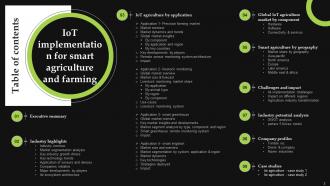
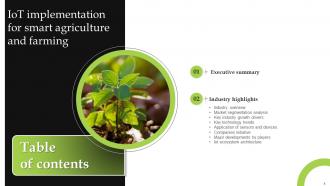
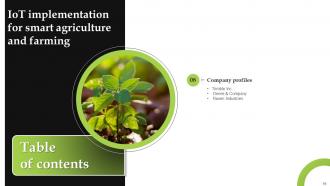
Slide 3: This slide includes the Table of contents.
Slide 4: This slide highlights the Title for the Topics to be covered further.
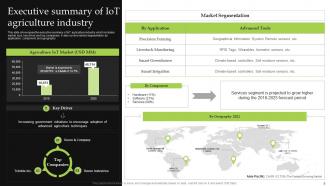
Slide 5: This slide showcases the executive summary of IoT agriculture industry which includes market size, key driver and top companies.
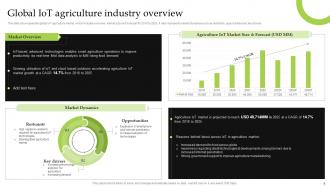
Slide 6: This slide reveals the Global IoT agriculture industry overview.
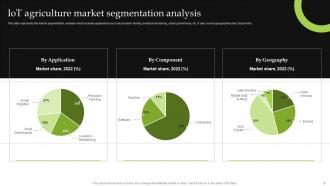
Slide 7: This slide states the IoT agriculture market segmentation analysis.
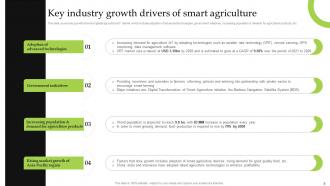
Slide 8: This slide depicts the Key industry growth drivers of smart agriculture.
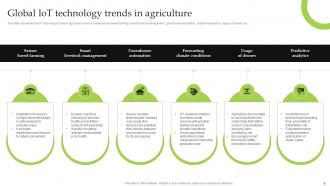
Slide 9: This slide portrays the Global IoT technology trends in agriculture.
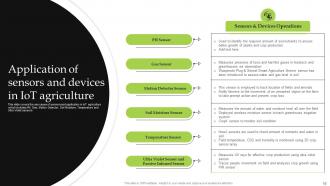
Slide 10: This slide covers the use cases of sensors and application in IoT agriculture.
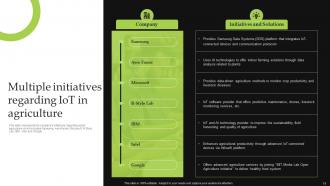
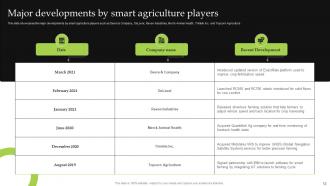
Slide 12: This slide highlights the Major developments by smart agriculture players.
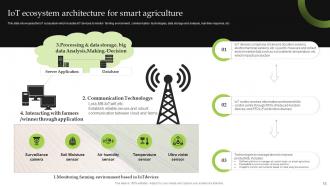
Slide 13: This slide exhibits the IoT ecosystem architecture for smart agriculture.
Slide 14: This slide includes the Heading for the Contents to be discussed further.
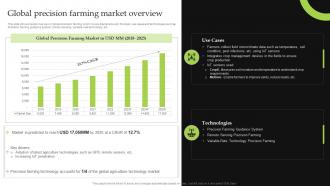
Slide 15: This slide represents the Global precision farming market overview.
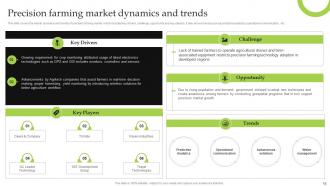
Slide 16: This slide covers the Precision farming market dynamics and trends.
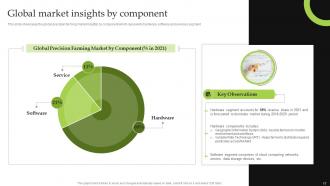
Slide 17: This slide displays the Global market insights by component.
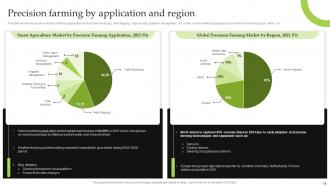
Slide 18: This slide reveals the Precision farming by application and region.
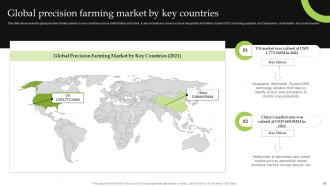
Slide 19: This slide talks about the Global precision farming market by key countries.
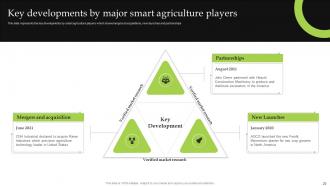
Slide 20: This slide highlights the Key developments by major smart agriculture players.
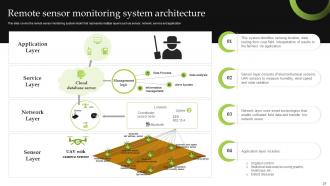
Slide 21: This slide covers the Remote sensor monitoring system architecture.
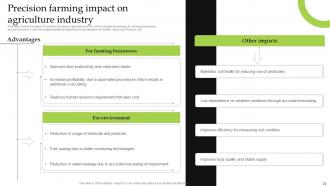
Slide 22: This slide states the Precision farming impact on agriculture industry.
Slide 23: This slide includes the Title for the Ideas to be covered next.
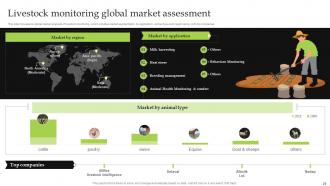
Slide 24: This slide focuses on global market analysis of livestock monitoring.
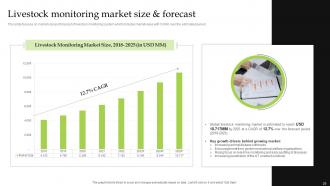
Slide 25: This slide indicates the Livestock monitoring market size & forecast.
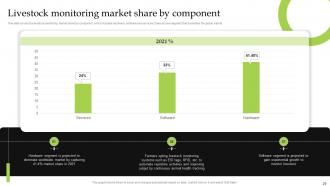
Slide 26: This slide covers the livestock monitoring market share by component which includes hardware, software and services.
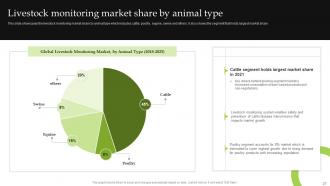
Slide 27: This slide showcases the livestock monitoring market share by animal type which includes cattle, poultry, equine, swine and others.
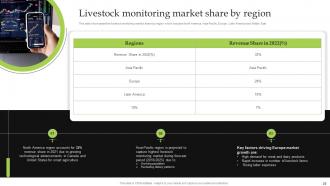
Slide 28: This slide displays the Livestock monitoring market share by region.
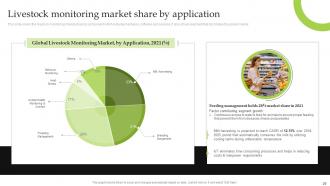
Slide 29: This slide covers the livestock monitoring market share by component which includes hardware, software and services.
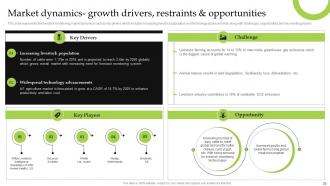
Slide 30: This slide represents the livestock monitoring market dynamics.
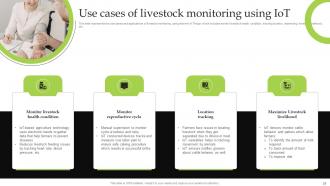
Slide 31: This slide portrays the Use cases of livestock monitoring using IoT.
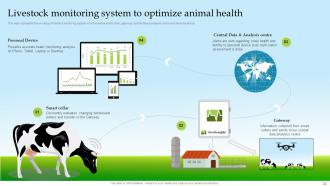
Slide 32: This slide presents the Livestock monitoring system to optimize animal health.
Slide 33: This slide includes the Heading for the Ideas to be discussed in the upcoming template.
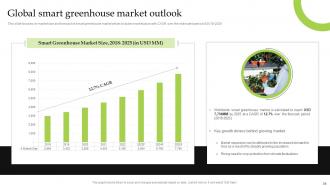
Slide 34: This slide focuses on the Global smart greenhouse market outlook.
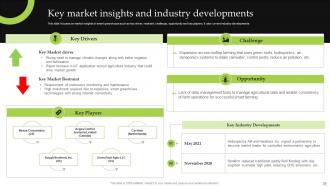
Slide 35: This slide states the Key market insights and industry developments.
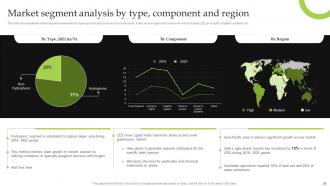
Slide 36: This slide showcases the market segment assessment by type such as hydroponic and non-hydroponic.
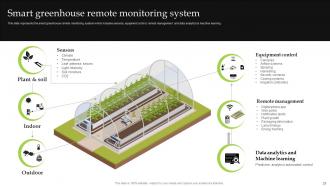
Slide 37: This slide highlights the Smart greenhouse remote monitoring system.
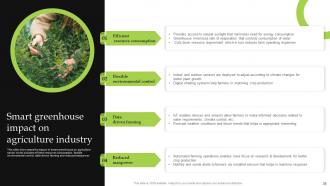
Slide 38: This slide showcases the impact of smart greenhouse on agriculture sector.
Slide 39: This slide contains the Title for the Contents to be covered further.
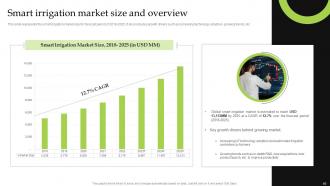
Slide 40: This slide represents the smart irrigation market size for forecast period of 2018-2025.
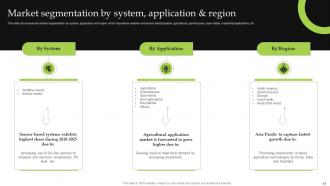
Slide 41: This slide showcases the market segmentation by system, application and region.
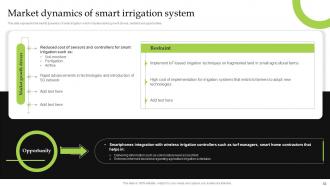
Slide 42: This slide portrays the Market dynamics of smart irrigation system.
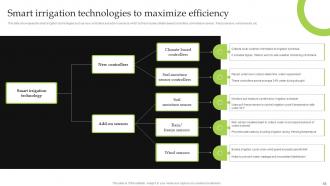
Slide 43: This slide highlights the Smart irrigation technologies to maximize efficiency.
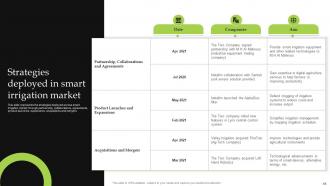
Slide 44: This slide talks about the Strategies deployed in smart irrigation market.
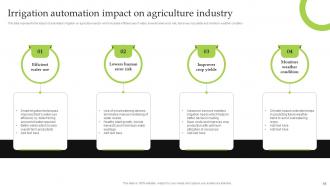
Slide 45: This slide reveals the Irrigation automation impact on agriculture industry.
Slide 46: This slide includes the Heading for the Topics to be discussed next.
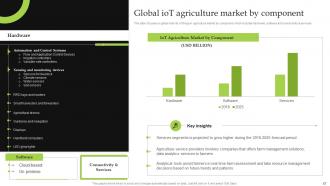
Slide 47: This slide focuses on the Global ioT agriculture market by component.
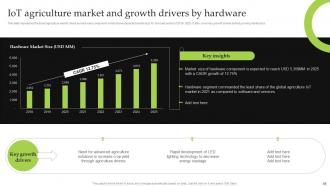
Slide 48: This slide reveals the IoT agriculture market and growth drivers by hardware.
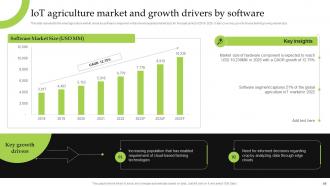
Slide 49: This slide shows the IoT agriculture market and growth drivers by software.
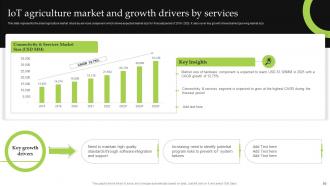
Slide 50: This slide represents the smart agriculture market share by services component.
Slide 51: This slide indicates the Title for the Topics to be covered in the forthcoming template.
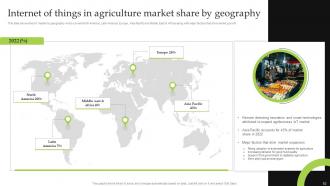
Slide 52: This slide shows the IoT market by geography.
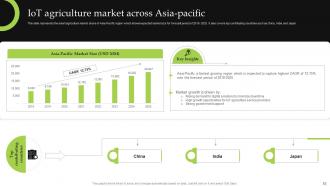
Slide 53: This slide represents the smart agriculture market share of Asia-Pacific region.
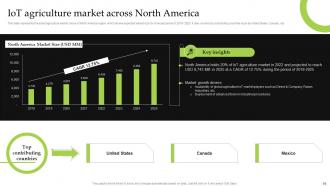
Slide 54: This slide reveals the IoT agriculture market across North America.
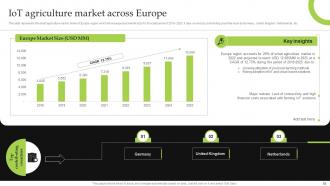
Slide 55: This slide talks about IoT agriculture market across Europe.
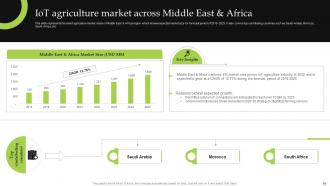
Slide 56: This slide presents the IoT agriculture market across Middle East & Africa.
Slide 57: This slide displays the portrays the Heading for the Contents to be discussed next.
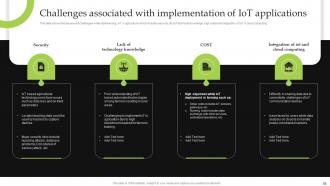
Slide 58: This slide exhibits the Challenges associated with implementation of IoT applications.
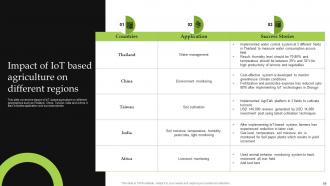
Slide 59: This slide highlights the Impact of IoT based agriculture on different regions.
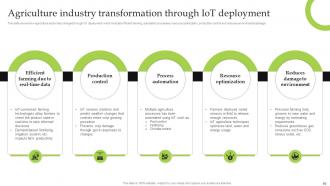
Slide 60: This slide shows the Agriculture industry transformation through IoT deployment.
Slide 61: This slide depicts the Heading for the Contents to be coveerd next.
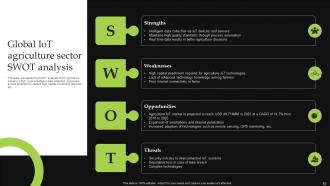
Slide 62: This slide displays the Global IoT agriculture sector SWOT analysis.
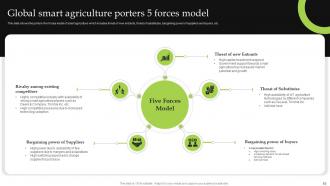
Slide 63: This slide shows the porters five forces model of smart agriculture.
Slide 64: This slide includes the Title for the Ideas to be discussed in the upcoming template.
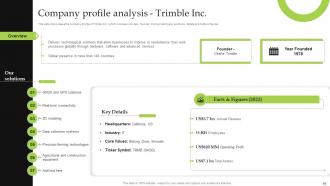
Slide 65: This slide showcases the company profile of Trimble Inc.
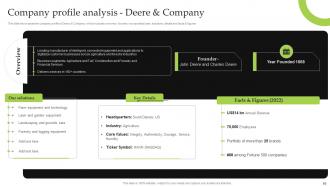
Slide 66: This slide presents the company profile of Deere & Company.
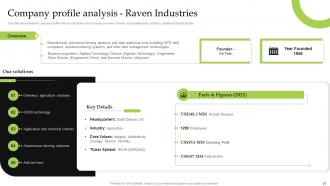
Slide 67: This slide showcases the company profile of Raven Industries.
Slide 68: This slide indicates the Heading for the Ideas to be coveerd in the forthcoming template.
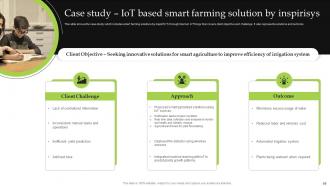
Slide 69: This slide shows the case study which includes smart farming solutions by inspiriSYS through Internet of Things.
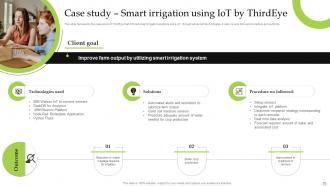
Slide 70: This slide represents the case study of ThirdEye that offered smart irrigation solutions using IoT.
Slide 71: This is the Icons slides containing all the Icons used in the plan.
Slide 72: This slide is used for depicting some Additional information.
Slide 73: This is Our team slide. State your team-related information here.
Slide 74: This is the 30 60 90 days plan slide for effective planning.
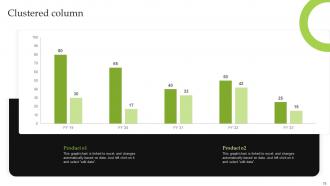
Slide 75: This is the Clustered column slide.
Slide 76: This is the Magnifying Glass slide for minute details.
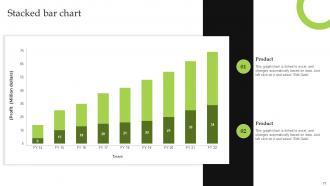
Slide 77: This slide represents the Stacked bar chart.
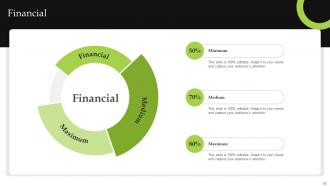
Slide 78: This slide elucidates information related to the Financial topic.
Slide 79: This is the Thank you slide for acknowledgement.
Iot Implementation For Smart Agriculture And Farming Powerpoint Presentation Slides with all 84 slides:
Use our Iot Implementation For Smart Agriculture And Farming Powerpoint Presentation Slides to effectively help you save your valuable time. They are readymade to fit into any presentation structure.






FAQs for Iot Implementation For Smart Agriculture And Farming
So IoT in farming is pretty wild - you get live data on soil moisture, temps, crop health, all that stuff right on your phone. Honestly feels like sci-fi sometimes. The coolest part? Precision irrigation that cuts water use by 30-40%. Plus early pest spotting and way less manual checking. Better yield predictions too, and you won't waste fertilizer. My advice though - just start with soil sensors in one field first. Don't go crazy trying to automate everything at once or you'll hate yourself.
Honestly, IoT sensors are a game changer for this stuff. They track soil moisture, temperature, humidity, nutrients - all in real time across your fields. No more walking around for hours checking everything manually (my back hurts just thinking about it). The data feeds into analytics that predict your yield based on growth patterns and conditions. You'll catch diseases way earlier, nail your irrigation timing, and know the perfect harvest window. Disease detection alone probably pays for itself. I'd test it on a few fields first to see your ROI, then expand from there.
So basically you're using sensors all over your field to get crazy detailed data on soil moisture, nutrients, crop health - the whole deal. Instead of dumping the same amount of water and fertilizer everywhere, you only hit the spots that actually need it. The precision is honestly wild when you see it in action. You can slash your resource use by like 20-30% and still get better yields somehow. My buddy started with just moisture sensors in one corner of his field - maybe try that first? Way cheaper than going all-in right away, and you'll see if it's worth the investment.
So basically you set up these IoT sensors that track soil moisture, temp, and humidity - they'll ping your phone with all the data. Then your irrigation system only kicks in when crops actually need water. Saves you a crazy amount on water bills, honestly. Plus your plants get exactly what they need so yields go up too. The precision is pretty wild once you see it in action. I'd definitely test it on just one section first though - my cousin went all-in right away and it was kind of a headache troubleshooting everything at once.
Ugh, the worst part? None of your IoT stuff talks to each other properly. Soil sensors dump data every 5 minutes, weather stations maybe once an hour - and don't even get me started on timestamps being all over the place. Each device has its own weird format and protocol. Honestly, I learned this the hard way - get a decent data management platform from day one. It'll handle all that syncing and formatting mess. Way better than trying to duct-tape everything together later when you're pulling your hair out.
Dude, these IoT sensors are game-changers for soil monitoring. They track pH, moisture, nutrients, temperature - all that stuff in real time so you're not just guessing anymore. Way better than doing manual tests every few weeks, honestly. You'll get alerts on your phone when something's off, plus you can spot trends before they become problems. Makes decisions about fertilizer and watering so much easier when you actually have data backing you up. Oh and the remote access thing is clutch - I can check my fields from literally anywhere now.
Dude, IoT is a game changer for catching pests early. Instead of walking fields all day, you can drop sensors that monitor temp, humidity, soil moisture - even snap photos of trouble spots. There's also these pheromone traps that ping your phone, which honestly blew my mind when I first saw them. The real magic? You'll spot problems 2-3 weeks sooner than manual checks. That early warning can literally save thousands in crop damage. I'd say start with just a few wireless sensors in your riskiest areas first, then expand once you get a feel for the data patterns.
So IoT is basically like having eyes on your animals 24/7 without camping out in the field. Wearable sensors track their health in real-time, plus you get automated feeding that adjusts for each animal. GPS tells you where everyone's wandering - honestly super helpful if you've got cattle that like to explore. The sensors catch illness early, monitor breeding cycles, even spot stress patterns before things go sideways. My buddy saved thousands just catching one sick cow early. If you're thinking about trying it, I'd start with health monitoring sensors first. Game changer for preventing expensive disasters.
Dude, your farm's IoT stuff is basically a hacker's playground. Most agricultural sensors have garbage security - I'm talking default passwords that nobody changes. Hackers could totally mess with your irrigation or steal all your crop data. Worst case? They lock you out and demand ransom money. Change those default passwords right away and actually update your firmware when prompted. Also watch out for data getting intercepted when it transmits between devices. The whole setup is way more vulnerable than people realize, honestly.
So basically these IoT sensors create like a digital trail for your crops - they're constantly logging temp, humidity, location, all that stuff as products move through the supply chain. Pretty wild how detailed it gets, honestly. Your tomatoes literally get their own data passport from field to grocery store. The real game-changer is when something goes wrong - contamination, quality issues, whatever - you can pinpoint exactly which field and when within minutes. Used to take forever to trace that stuff back. I'd probably start with just one crop type first though, see how the whole system works before you go crazy with it.
Honestly, the predictive analytics stuff is getting crazy - AI can spot plant diseases way before you'd see them. 5G will make your whole farm talk to itself instantly, which is pretty wild when you think about it. Edge computing means decisions happen in real-time instead of waiting around. Those sensor technologies are getting so much better too. Drone swarms will probably be everywhere soon (kinda like how everyone has smartphones now). Oh, and blockchain's becoming a real thing for tracking where food comes from. My advice though? Don't go nuts right away. Pick one part of your operation and try some IoT tech there first.
Dude, IoT stuff is a game-changer for small farms. Real-time data on soil moisture and weather beats guessing every time. Your yields go up while you're not wasting money on fertilizer and water you don't actually need. Honestly, it's one of the few ways smaller farms can compete with the big guys - same insights, way cheaper than before. I'd say grab a couple sensors for whatever crops matter most first. No point going crazy with the whole setup right away, you know? Even just monitoring one field will show you how much you were probably overdoing things.
John Deere's doing some cool stuff with sensors and GPS for precision farming - farmers are getting like 20-30% better efficiency. Israel's Netafim cut water usage by 40% with their smart irrigation while actually increasing yields, which is wild. Blue River Technology (John Deere bought them) created this computer vision thing that can target individual plants and slash herbicide use by 90%. Honestly, the key seems to be picking one problem and absolutely crushing it before you try to do everything. These companies didn't try to revolutionize farming overnight - they just got really good at solving specific pain points first.
Dude, IoT is a game changer for sustainable farming. You get crazy precise data on everything - water, fertilizer, energy usage. Soil sensors tell you exactly when to irrigate (no more guessing), which cuts water waste by like 30%. Same with fertilizers - you can target specific spots instead of just spraying everything. Weather stations help time your planting perfectly too. Honestly, the nutrient tracking stuff blew my mind when I first saw it. You'll save money while being way better for the environment. Start with soil sensors - they're cheap and you'll see results immediately.
Yeah so the upfront costs are pretty brutal - we're talking hundreds to thousands per acre depending on what you go with. Hardware, software subscriptions, installation, the whole deal. Plus you need decent internet which is honestly a nightmare in most rural areas. But most farmers I know hit their ROI in like 2-3 years from cutting water costs and getting better yields. My cousin started with just his back forty to test it out before going all in - probably smart to do something like that first instead of betting the farm, literally.
-
“Thanks to SlideTeam. Now I can make smart presentations in a fraction of time without any hassle.”
-
Incredibly beautiful designs that will help you get noticed! These eye-catching templates are perfect for corporate presentations that can be altered to fit any occasion or taste.