


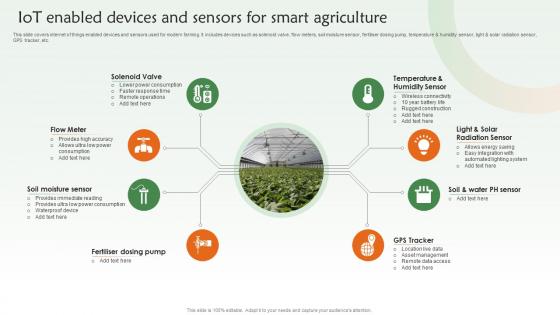
IOT Enabled Devices And Sensors For Smart Agriculture




Try Before you Buy Download Free Sample Product
 Impress Your
 Audience
 100%
100% Editable
 Save Hours
 of Time


This slide covers internet of things enabled devices and sensors used for modern farming. It includes devices such as solenoid valve, flow meters, soil moisture sensor, fertiliser dosing pump, temperature and humidity sensor, light and solar radiation sensor, GPS tracker, etc.
People who downloaded this PowerPoint presentation also viewed the following :
IOT Enabled Devices And Sensors For Smart Agriculture with all 6 slides:
Use our IOT Enabled Devices And Sensors For Smart Agriculture to effectively help you save your valuable time. They are readymade to fit into any presentation structure.





FAQs for IOT Enabled Devices And Sensors
IoT sensors are basically the backbone - they track soil moisture, weather patterns, all that stuff in real-time. GPS tractors and drones handle the precision work. Then you've got AI crunching the data to figure out optimal watering schedules and fertilizer amounts. Satellite imagery is honestly pretty crazy - farmers can spot problems from space before they even see them on the ground. Oh, and there's tons of automation now for planting and harvesting. Even livestock gets monitored automatically. My cousin's been dabbling in this - I'd say start with IoT sensors since everything else kinda builds from there.
So basically these sensors get scattered around your fields and track stuff like soil moisture, temp, nutrients - all the important bits. Your phone buzzes when something's weird instead of you having to trudge around checking everything. Pretty neat setup honestly. When soil gets too dry, the system can automatically kick on irrigation. You end up saving water and using way less fertilizer since you're not just guessing anymore. Plus you catch issues before they wreck your crops. It's like having a bunch of little weather stations that actually work 24/7.
Honestly, drones are like having superpowers for your farm. You'll spot pest problems and diseases weeks before you'd notice them walking around - which saves you so much headache later. They map out exactly where issues are happening, so instead of treating your whole field, you only hit the problem areas. Way more efficient and cheaper in the long run. My neighbor got one last year and now he's obsessed, always showing me these detailed heat maps of his corn. Pretty neat stuff actually. I'd say figure out what's bugging you most about monitoring your crops, then find a drone that tackles that specific problem first.
Look, data analytics turns all those farm sensors and old records into stuff you can actually act on. No more guessing when to water - you get solid recommendations based on soil moisture, weather, crop stages. Honestly, it's pretty wild how accurate it gets. The algorithms predict pest problems and optimize irrigation before you even realize there's an issue. Catches expensive disasters early too. I'd start small, maybe just irrigation data first? Once you see how much more efficient things get, you'll probably want to use it everywhere else on the farm.
Smart agriculture is mostly great for the environment, honestly. Water usage drops big time with precision irrigation. Targeted fertilizers mean way less chemical runoff too. Your soil health improves from all the data-driven decisions. Carbon footprint usually goes down since you're not wasting fuel or resources. There's some upfront environmental cost from manufacturing sensors and stuff, but it balances out pretty fast. Oh, and if you're thinking about trying it - start with water management systems first. Those show results you can actually see right away.
Dude, smart farming is wild - basically you use sensors and GPS stuff to give crops exactly what they need instead of just dumping fertilizer everywhere. Traditional farming wastes SO much water and chemicals it's crazy. The tech tells you precisely where to water and fertilize, so you get better yields while actually using less resources. GPS tractors, soil sensors, AI analyzing everything. Honestly didn't realize how inefficient regular farming was until I looked into this. You don't need to go full tech-farm right away though. Even cheap soil sensors will show you improvements pretty quick.
Honestly, the money is probably gonna hit you first - all that sensor and software stuff adds up fast. Learning curve's pretty rough too if you're not already into tech. Rural internet is still trash in a lot of places, which makes everything harder. Plus half these systems don't even talk to each other properly, which is super annoying. Data management becomes this whole thing you didn't expect. But seriously, just start with something basic like soil monitoring. Get that down first, then add more stuff when you're ready. Don't try to do everything at once or you'll burn out.
Look, the upfront costs are rough - sensors, drones, all that tech stuff hits your wallet hard. But here's the thing: your day-to-day expenses drop like crazy once you're using actual data instead of just winging it with water and fertilizer. Most people see yields jump 10-30% while spending way less on inputs. Honestly, I think the 3-5 year payback timeline scares some folks off. Short-term pain though. You just can't expect it to pay for itself immediately - that's not how any of this works.
Dude, AI crop prediction is honestly a game changer for farm planning. Instead of guessing, you're getting solid forecasts by combining weather data, soil conditions, satellite images, and your past harvest records. Pretty wild how it crunches all that stuff instantly. You can nail your planting timing, fix irrigation schedules, and catch problems like pests before they wreck everything. My buddy started with just one test field last season - way smarter approach than going all-in. Makes resource planning so much easier when you're not flying blind.
Moisture sensors are probably your best bet to start with - they're super easy to set up and you'll see results right away. Most of them work by measuring electrical conductivity since wet soil conducts electricity way better than dry stuff. For the fancier soil health tracking, there are chemical probes that sit in the dirt and monitor pH, nutrients, temperature, all that good stuff. Everything syncs to your phone every few minutes so you're not playing catch-up with problems. Honestly the wireless thing is a game changer - no more trudging out there with a moisture meter like some kind of cave person.
So blockchain basically creates this permanent record that tracks your food from the farm all the way to someone's plate. Can't be tampered with either, which is pretty neat. Every single step gets logged - planting, harvesting, all that stuff. When there's a contamination scare, you can trace it back instantly instead of playing detective for weeks. Your customers can actually verify if something's really organic too, not just take your word for it. Honestly, the transparency aspect is what sells me on it. If you're trying to build trust with people who care about where their food comes from, it's worth looking into.
Dude, smart farming is actually pretty cool - sensors track soil moisture and temperature to catch problems early. Drones fly over your fields spotting disease or pest issues way before you'd notice them on foot (beats wandering around playing plant detective). The AI crunches all that data and tells you exactly where to spray, so you're not dousing everything in pesticides. Saves money and works better honestly. If you're thinking about trying it, maybe start small with just some basic soil sensors first?
Honestly, you'll need to buddy up with pretty much everyone in ag tech. Tech companies are obvious - sensors, data stuff. But also hit up researchers and extension services early for the actual science. Equipment manufacturers will save you a headache since retrofitting everything yourself is brutal. Banks help with funding (this stuff gets pricey fast). Oh, and telecom providers - rural internet is still sketchy in a lot of places. Government grants are worth checking out too. Build these relationships now, not when you're scrambling later. Trust me on that one.
So there's actually tons of money floating around for this stuff right now. USDA has smart agriculture grants, EU's doing digital farming programs - they'll cover like 50-70% of the tech costs which is honestly pretty generous. Some places are setting up these demo farms where farmers can see the tech in action before committing. Tech companies are partnering with ag universities too, which makes sense since they need local solutions that actually work. Oh and definitely check what's available in your area - seems like every region has something different going on. The funding landscape changes pretty frequently though, so you'll want to stay on top of it.
Dude, the AI stuff is gonna be insane - like predicting crop diseases weeks out. Those robot harvesters are getting crazy advanced too. Precision agriculture will hit another level with better sensors and satellite integration. But honestly? The real money's in platforms that connect everything. Your drones, soil sensors, weather data, market prices - all chatting with each other seamlessly. I'd definitely start looking into which IoT platforms are picking up steam in your area. My cousin's farm went from guessing to basically having a crystal ball once they got everything synced up.
-
Fantastic and innovative graphics with useful content. The templates are the best and latest in the industry.
-
I was confident and well prepared for my presentation for the first time ever. With SlideTeam’s templates, I could deliver one of my best presentations. Will be coming back for more!