


Smart Agriculture Using IoT System powerpoint presentation slides IoT CD V




Try Before you Buy Download Free Sample Product
 Impress Your
 Audience
 100%
100% Editable
 Save Hours
 of Time


Our Smart Agriculture Using IoT System powerpoint presentation slides IoT CD V are topically designed to provide an attractive backdrop to any subject. Use them to look like a presentation pro.
People who downloaded this PowerPoint presentation also viewed the following :
Content of this Powerpoint Presentation
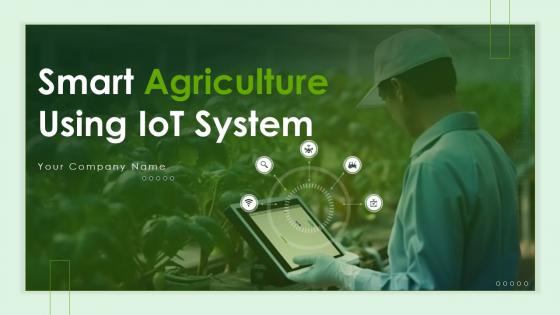
Slide 1: This slide introduces Smart Agriculture Using IoT System. State your company name and begin.
Slide 2: This is an Agenda slide. State your agendas here.
Slide 3: This slide shows Table of Content for the presentation.
Slide 4: This slide continues showing Table of Content for the presentation.
Slide 5: This slide shows title for topics that are to be covered next in the template.
Slide 6: This slide showcases brief introduction to Internet of Things (IoT). The slide also provides information about key benefits of using IoT for businesses.
Slide 7: This slide presents overview of smart agriculture along with its key features such as collecting data from soil moisture, remotely analyzing crop or livestock conditions etc.
Slide 8: This slide showcases various benefits of using Internet of Things (IoT) technology in agriculture. It covers information about improving production rates, optimizing production quality etc.
Slide 9: This slide highlights various trends which are associated with e-farming. Usage of drones, smart livestock management, predicting weather conditions etc.
Slide 10: This slide outlines various statistics associated with precision agriculture. Information covered in this slide is related to smart farming trend etc.
Slide 11: This slide showcases various Internet of Things (IoT) devices used in smart farming. The slide covers information about soil moisture sensors, weather stations etc.
Slide 12: This slide displays top companies providing Internet of Things (IoT) based services in smart farming.
Slide 13: This slide showcases cloud-based Internet of Things (IoT) platform for e-agriculture. It covers information about control modules, query services, computation, and analytics.
Slide 14: This slide highlights comparative analysis of traditional and smart farming. The comparison is drawn on basis of overview, technology usage, data collection etc.
Slide 15: This slide shows title for topics that are to be covered next in the template.
Slide 16: This slide outlines brief introduction about agricultural drones. Information covered in this slide is related to overview, major advantages, and use cases such as crop monitoring etc.
Slide 17: This slide outlines various use cases of drone in crop monitoring. The slide covers information use cases such as aerial imaging, growth assessment, and nutrient deficiency.
Slide 18: This slide highlights different use cases of drone in livestock monitoring. Information covered in this slide is related to location tracking, health monitoring etc.
Slide 19: This slide delineates different drone applications in environmental monitoring. The slide covers information about temperature monitoring, air quality evaluation etc.
Slide 20: This slide showcases UAV (Unmanned Aerial Vehicle) use cases in irrigation management. Water distribution mapping, scheduling and automation, water conservation etc.
Slide 21: This slide showcases comprehensive illustration of farm drone in irrigation management. It covers information about high payload capacity, different spray models etc.
Slide 22: This slide shows title for topics that are to be covered next in the template.
Slide 23: This slide provides brief information about smart robots. Information covered in this slide is related to key benefits of using robots in farms and its various use cases.
Slide 24: This slide showcases farm drone use cases in dairy farming which can assist farmers in improving efficiency and make real-time decisions.
Slide 25: This slide highlights agricultural drone use cases in crop seeding. Information covered in this slide is related to precision seed placement, automation, and data-driven decision making.
Slide 26: This slide outlines smart drone use cases in harvesting which can assist farmers in improving crop efficiency and enhance yield.
Slide 27: This slide presents various agricultural drone uses cases through which farmers can reduce environmental impact and improve soil management.
Slide 28: This slide outlines various examples of agribots used in precision agriculture. These include Weeding robots, harvesting robots, and livestock monitoring robots.
Slide 29: This slide shows title for topics that are to be covered next in the template.
Slide 30: This slide outlines brief introduction to precision farming along with key benefits such as reduction in input cost, improving environmental sustainability, etc.
Slide 31: This slide showcases use cases of smart farming in variable rate application (VRA). It covers detailed information about water conservation, improved nutrient efficiency etc.
Slide 32: This slide exhibits digital agriculture use cases in automated irrigation system. Information covered in this slide is related to water efficiency, yield optimization, and remote monitoring.
Slide 33: This slide delineates hi-tech farming use cases in precision planting. The use cases mentioned in slide are seed placement accuracy, row-by-row planting, and seed monitoring
Slide 34: This slide outlines precision agriculture use cases in automated farming equipment. The use cases mentioned in slide are precision spraying, precision weeding, and automated harvesting.
Slide 35: This slide presents example of precision farming through which farmers can increase crop yield and reduce cost.
Slide 36: This slide shows title for topics that are to be covered next in the template.
Slide 37: This slide showcases brief introduction to environmental monitoring and its benefits.
Slide 38: This slide outlines various use cases of environmental monitoring in greenhouse climate management.
Slide 39: This slide showcases multiple use cases of environmental monitoring in radiometric monitoring. It covers information about light intensity optimization, energy efficiency etc.
Slide 40: This slide exhibits environmental monitoring use cases in air quality monitoring. The use cases mentioned in slide are associated with crop growth optimization, pollution control etc.
Slide 41: This slide delineates various use cases of environmental monitoring applications in climate risk management.
Slide 42: This slide outlines comprehensive illustration of environmental monitoring in smart agriculture. Information covered in this slide is related to use of sensors, data collection etc.
Slide 43: This slide shows title for topics that are to be covered next in the template.
Slide 44: This slide outlines brief introduction to cattle monitoring and key benefits.
Slide 45: This slide showcases livestock monitoring use cases in health monitoring. The slide covers information about heat stress management, early disease identification, and medication.
Slide 46: This slide displays livestock monitoring use cases in health monitoring. The slide covers information about heat stress management, early disease identification, and medication.
Slide 47: This slide highlights multiple herd monitoring use cases in feeding management. It provides information about feed waste reduction, feeding automation etc.
Slide 48: This slide outlines livestock monitoring use cases in location tracking. The slide covers information about cattle security, lost cattle location, stray animal management etc.
Slide 49: This slide also outlines livestock monitoring use cases in location tracking. The slide covers information about cattle security, lost cattle location, stray animal management etc.
Slide 50: This slide shows title for topics that are to be covered next in the template.
Slide 51: This slide display graphical representation of total market size for Internet of Things (IoT) in agriculture.
Slide 52: This slide outlines various growth drivers of Internet of Things (IoT) in agriculture. The major drivers are increasing adoption of modern technologies etc.
Slide 53: This slide provides information about market share of Internet of Things (IoT) in agriculture by different regions along with key insights.
Slide 54: This slide shows title for topics that are to be covered next in the template.
Slide 55: This slide displays graphical representation of IoT agriculture market size by hardware. Information covered in this slide is related to period from 2018-2025.
Slide 56: This slide exhibits graphical representation of IoT agriculture market size by various types of software.
Slide 57: This slide displays statistical representation of IoT agriculture market size by various services.
Slide 58: This slide shows title for topics that are to be covered next in the template.
Slide 59: This slide displays statistical representation of IoT agriculture market size across Asia-Pacific region.
Slide 60: This slide displays graphical representation of IoT agriculture market size across North America.
Slide 61: This slide displays graphical representation of IoT agriculture market size across Latin America. Information covered in this slide is related to period from 2018-2025.
Slide 62: This slide presents statistical representation of IoT agriculture market size across Europe. Information covered in this slide is related to period from 2018-2025.
Slide 63: This slide displays graphical representation of IoT agriculture market size across Middle East & Africa. Information covered in this slide is related to period from 2018-2025.
Slide 64: This slide shows title for topics that are to be covered next in the template.
Slide 65: This slide showcases various issues faced by farmers in successfully implementing Internet of Things (IoT) system.
Slide 66: This slide display statistical representation of various challenges faced by farmers in implementing Internet of Things (IoT) system.
Slide 67: This slide outlines various solutions which can assist farmers in successfully overcoming challenges related to implementing IoT technology.
Slide 68: This slide shows title for topics that are to be covered next in the template.
Slide 69: This slide showcases infrastructure requirement for successfully implementing smart agriculture system.
Slide 70: This slide showcases comparative assessment of various farm management software. The comparison is drawn on the basis of crop planning, field mapping etc.
Slide 71: This slide outlines comparative evaluation of livestock management tools. Information covered in this slide is related to features such as animal record management etc.
Slide 72: This slide showcases comparison of various weather forecasting management software tools. The comparison is drawn on basis of real-time weather data, localized forecasting etc.
Slide 73: This slide delineates comparative assessment of different crop monitoring software. It covers information about major features such as crop health assessment, remote sensing etc.
Slide 74: This slide shows title for topics that are to be covered next in the template.
Slide 75: This slide showcases smart farming dashboard that can be used to monitor crop performance and productivity.
Slide 76: This slide presents smart space greenhouse performance KPI dashboard. The dashboard include major metrics such as soil moisture level, air temperature, humidity, pH level, etc.
Slide 77: This slide showcases performance key performance indicator (KPI) dashboard which can be used to make data-drive decision making related to agriculture operations.
Slide 78: This slide shows title for topics that are to be covered next in the template.
Slide 79: This slide showcases comprehensive case study of Third Eye Data. The slide covers information about client, company goals, solutions provided, technologies used etc.
Slide 80: This slide presents comprehensive case study of Urban Crop Solutions. Information covered in this slide is related to company overview, problem statement etc.
Slide 81: This slide shows all the icons included in the presentation.
Slide 82: This slide is titled as Additional Slides for moving forward.
Slide 83: IoT enabled framework for smart farming
Slide 84: Various IoT applications in smart agriculture
Slide 85: Best drones available for smart farming
Slide 86: This slide contains Puzzle with related icons and text.
Slide 87: This is an Idea Generation slide to state a new idea or highlight information, specifications etc.
Slide 88: This slide shows Post It Notes for reminders and deadlines. Post your important notes here.
Slide 89: This is a financial slide. Show your finance related stuff here.
Slide 90: This is a Thank You slide with address, contact numbers and email address.
Smart Agriculture Using IoT System powerpoint presentation slides IoT CD V with all 98 slides:
Use our Smart Agriculture Using IoT System powerpoint presentation slides IoT CD V to effectively help you save your valuable time. They are readymade to fit into any presentation structure.










FAQs for Smart Agriculture Using IoT System powerpoint presentation slides
Dude, IoT for farming is actually pretty sick. Sensors track everything - soil moisture, temps, how your crops are doing. Water gets used way more efficiently since irrigation happens automatically when needed. You're not trudging through fields constantly checking on stuff, which honestly sounds exhausting. The predictive stuff catches diseases early before they wreck your harvest. Labor costs drop because machines handle the boring monitoring work. I'd probably start with just soil sensors in one field first, see how it goes. Bottom line: better yields, less waste, smoother operations overall.
So basically you're turning your whole farm into this massive data collection system - sounds nerdy but it actually works. Soil sensors track moisture and pH levels in real time. Drones can spot problem areas way before you'd notice them walking around. Weather stations let you get ahead of storms or droughts instead of just reacting. Honestly, the analytics are where it gets interesting - the software picks up on patterns like early disease signs that you'd totally miss. I'd start with just soil sensors in your worst fields first, see how it goes.
Honestly, sensors are what make the whole smart farming thing actually work - they're like having eyes everywhere on your farm. Soil moisture ones tell you exactly when to water (start here, they're game changers). Temperature and humidity sensors keep tabs on growing conditions, pH sensors check if your soil's happy, and light sensors help dial in greenhouse settings. It's pretty wild tech when you think about it. All that data goes to your IoT system, which then does stuff automatically - turns on sprinklers, sends alerts to your phone, whatever you set up. Don't overthink it at first though.
Honestly, IoT sensors are a game changer - they track soil moisture, weather, crop health, all that stuff in real time. No more guessing when to water or fertilize. My buddy started with just soil sensors in one field (way cheaper to test it out first) and now he waters only when crops actually need it. The predictive stuff is wild too - it'll warn you about pest problems or equipment breaking down before you're screwed. You can automate responses to weather changes, predict yields better. Way better than the old "spray and pray" method most farmers still use.
Honestly, the money hits first - sensors and data platforms aren't cheap. Rural internet is trash most places, which kills the whole thing since IoT needs decent connectivity. Learning curve's pretty steep too, especially if tech isn't your thing. Getting different systems to actually talk to each other? Total headache. Plus there's the whole security thing - basically putting your entire operation online makes some people nervous, understandably. My take? Don't go crazy trying to digitize everything at once. Pick one or two things that'll actually help and start there. Way less stressful, and you'll figure it out as you go.
Basically, smart irrigation uses IoT sensors to check soil moisture and weather data instead of just running sprinklers on some random schedule. Way smarter than the old timer systems. If the soil's already wet or rain's expected, it won't water at all. Some farms cut water use by 30-50% this way - which is honestly pretty impressive. You'll actually get better crop yields too since plants get exactly what they need when they need it. Plus your water bills drop and you're not being wasteful, so it's a win-win situation.
So IoT is pretty game-changing for livestock monitoring. Instead of wandering around trying to figure out if your animals are okay, you get real-time data on everything - vital signs, how much they're moving, eating patterns, the works. Honestly the coolest part is catching illness super early, way before you'd normally notice anything's wrong. All the info goes straight to your phone so you're not doing as many pasture walks (though let's face it, you probably still will). Start with sensors on just your best animals first - test it out before going all in. Healthier livestock plus lower vet bills? Win-win.
Start with strong passwords and firmware updates - sounds boring but seriously, most farms totally ignore this stuff. Encrypted data transmission is huge too. Pick vendors with solid cloud storage and proper access controls. Oh, and only collect data you'll actually use, not everything just because the sensors can grab it. I'd audit what you're collecting first and where it all goes, then secure those connections. The password thing alone will fix like 80% of your problems honestly.
Look, smart agriculture IoT typically bumps yields 10-30% through better monitoring and decisions. Real-time data on soil moisture, nutrients, weather, and crop health helps you nail the timing on irrigation and fertilization. No more guessing games - though the initial setup can feel overwhelming. You'll create zones based on actual soil data instead of treating everything the same. Honestly, it's wild how precise you can get with pest control timing now. My advice? Start with just a couple sensors to test ROI first, then expand once you see results.
Honestly, drones with IoT sensors are pretty sick for farming. Real-time data on plant health, soil moisture, pest problems - all across your fields without walking miles. The precision spraying alone saves tons of money since you're only hitting problem spots instead of spraying everything. Plus they're solid for checking on livestock and mapping conditions. All that data syncs straight to your management system too, which is nice. I'd probably start with crop monitoring if I were you - gives you the biggest bang for your buck right away. My buddy started there and hasn't looked back.
So these IoT weather stations basically give you temp, humidity, rainfall and wind data straight from your actual fields - way better than those regional forecasts that are usually wrong anyway. You can nail the timing on irrigation, fertilizing, all that stuff. Everything syncs to your phone automatically, which is honestly pretty slick. The data helps you catch problems early too, like frost coming or drought stress building up. I'd probably put one station in each major field area you've got. Oh and tracking patterns over time? That's where it gets really useful for planning ahead.
Dude, smart farm tech is actually game-changing for the environment. Water usage drops like crazy when irrigation systems only run when crops are thirsty. Same with fertilizers - you're not dumping excess that ends up polluting rivers. Pesticide use goes way down too since sensors catch pest problems early, so no more spraying entire fields "just in case." My cousin started with just soil moisture sensors and swears by them now. Oh, and fewer tractor passes means less fuel burning. It's honestly one of those rare things that saves money AND helps the planet.
So basically these IoT sensors create this crazy detailed digital record of your crops - from planting all the way to when they hit the store shelves. They're constantly monitoring soil, weather, when you spray stuff, harvest dates, how things are stored during shipping. Honestly feels a bit Big Brother-ish but buyers love it. You can prove exactly how everything was handled without keeping a million paper logs. Temperature and humidity sensors for transport are probably your best starting point - not too expensive and it'll make buyers way more confident they're getting quality stuff. Pretty game-changing for smaller farms.
So basically the mobile app is where all the magic happens - it's your command center for everything. You can check soil moisture, control irrigation, get weather updates, all that stuff right from your phone. Honestly it's pretty wild that you can manage an entire farm while sitting on the couch lol. The data analysis part is huge too - you'll see patterns over time that help with planting and harvest decisions. Oh and definitely make sure whatever system you're looking at has a decent app because that's literally where you'll be living. Some of them are pretty clunky which gets old fast.
So basically you feed all your sensor data - soil moisture, weather, crop health stuff - into machine learning models. They start recognizing patterns, like when certain humidity levels usually lead to disease outbreaks. Pretty neat how it works. Once the system learns these connections, it'll ping you before problems actually hit. Like if temperature and humidity are trending toward pest-friendly conditions, you get a heads up. Honestly I'd start with just one thing, maybe disease prediction since that's usually the biggest headache. You can always add more models later once you've got the hang of it.
-
The designs by SlideTeam are honestly the best I have seen so far. Will be definitely coming back for more.
-
A fantastic collection of templates. I'll likely use this as my go-to resource for future templates and support.