


IoT In Education To Transform Way Of Learning Powerpoint Presentation Slides IoT CD




Try Before you Buy Download Free Sample Product
 Impress Your
 Audience
 100%
100% Editable
 Save Hours
 of Time


The IoT Internet of Things in Education Solution is a cutting edge technological platform designed to transform the way educational institutions operate and deliver knowledge. Our insightfully developed deck titled, IoT in Education to Transform Way of Learning integrates IoT devices, sensors, and data analytics, empowering educators, students, and administrators to develop effective, interactive, and engaging learning environments. This Smart Education PowerPoint Presentation covers the benefits of implementing IoT such as sustainability, improved and engaging learning experience, etc. Furthermore, our IOT in classrooms guide includes applications for smart and sustainable learning such as smart boards, adaptive learning systems, and smart attendance systems assuring campus management. Lastly, this Smart Learning Module showcases budget, impact, and case studies that revolutionize the educational landscape, making learning more personalized, efficient, and secure. Get access now.
People who downloaded this PowerPoint presentation also viewed the following :
Content of this Powerpoint Presentation
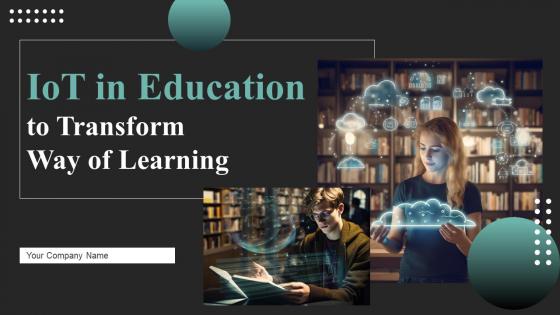
Slide 1: This slide introduces IoT in Education to Transform Way of Learning. State Your Company Name and begin.
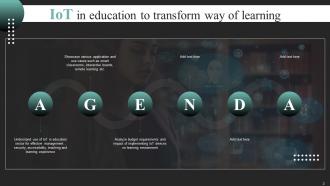
Slide 2: This slide is an Agenda slide. State your agendas here.
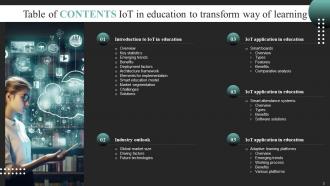
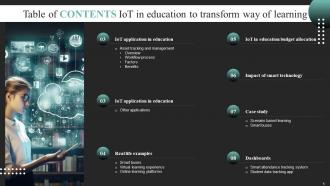
Slide 3: This slide shows a Table of Contents for the presentation.
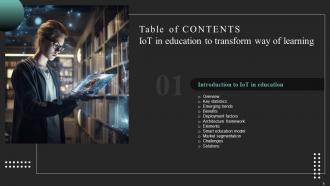
Slide 4: This is in continuation with the previous slide.
Slide 5: This slide is an introductory slide.
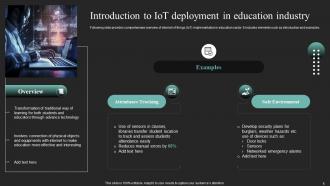
Slide 6: This slide provides comprehensive overview of internet of things (IoT) implementation in education sector.
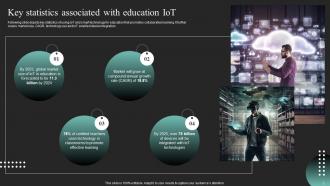
Slide 7: This slide depicts key statistics of using IoT and smart technology for education that promotes collaborative learning.
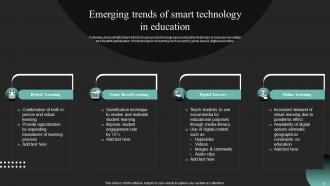
Slide 8: This slide exhibits future trends focusing on technology based education that helps to increase innovation and student participation.
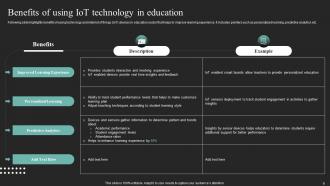
Slide 9: This slide highlights benefits of using technology and internet of things (IoT) devices in education sector.
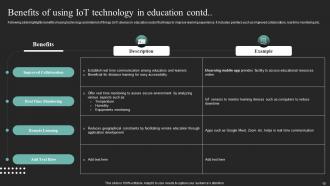
Slide 10: This slide represents benefits of using technology and internet of things (IoT) devices in education sector.
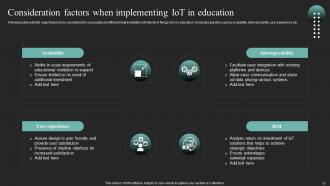
Slide 11: This slide exhibits major factors to be considered for successful and efficient implementation of internet of things (IoT) in education.
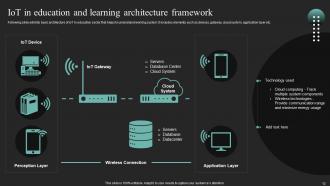
Slide 12: This slide entails basic architecture of IoT in education sector that helps to understand working system.
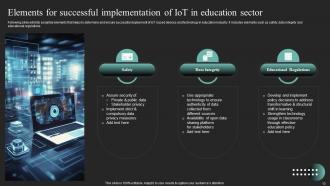
Slide 13: This slide entails essential elements that helps to determine and ensure successful deployment of IoT based devices and technology in education industry.
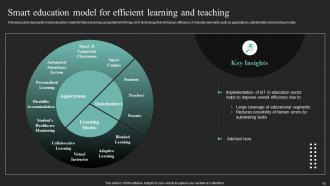
Slide 14: This slide represents smart education model for future learning using internet of things (IoT) technology that enhances efficiency.
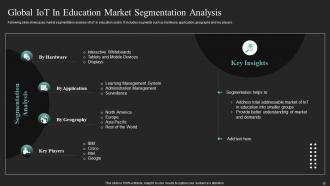
Slide 15: This slide showcases market segmentation analysis of IoT in education sector.
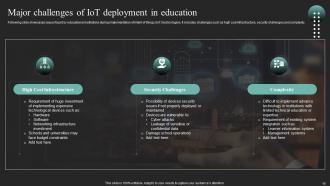
Slide 16: This slide illustrates issues faced by educational institutions during implementation of intent of things (IoT) technologies.
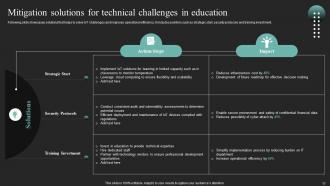
Slide 17: This slide contains solutions that helps to solve IoT challenges and improves operational efficiency.
Slide 18: This slide is an introductory slide.
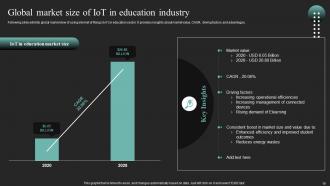
Slide 19: This slide exhibits global market view of using internet of things (IoT) in education sector.
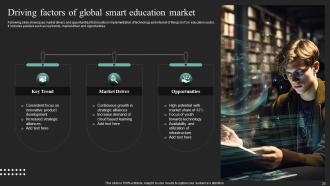
Slide 20: This slide showcases market drivers and opportunities that results in implementation of technology and internet of things (IoT).
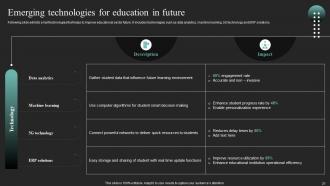
Slide 21: This slide caters to smart technologies that helps to improve educational sector future.
Slide 22: This slide is an introductory slide.
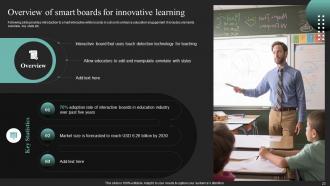
Slide 23: This slide provides introduction to smart interactive white boards in school to enhance education engagement.
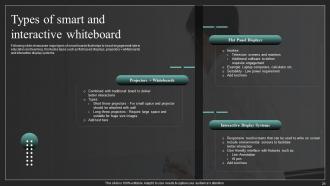
Slide 24: This slide shows major types of smart boards that helps to boost engagement rate in education and learning.
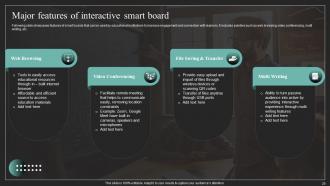
Slide 25: This slide presents features of smart boards that can be used by educational institutions to increase engagement and connection with learners.
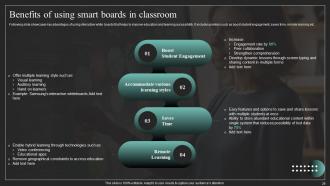
Slide 26: This slide entails key advantages of using interactive white boards that helps to improve education and learning accessibility.
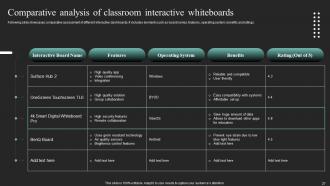
Slide 27: This slide illustrates comparative assessment of different interactive dashboards.
Slide 28: This slide is an introductory slide.
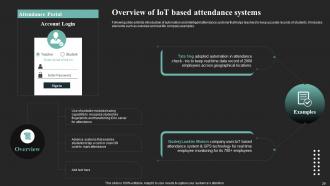
Slide 29: This slide exhibits introduction of automation and intelligent attendance systems that helps teachers to keep accurate records of students.
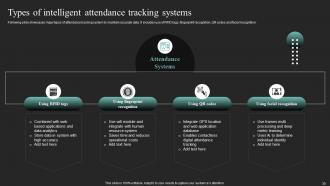
Slide 30: This slide refers to major types of attendance tracking system to maintain accurate data.
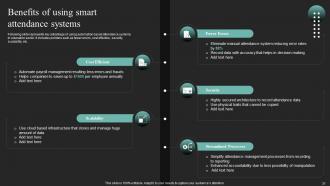
Slide 31: This slide represents key advantage of using automation based attendance systems in education sector.
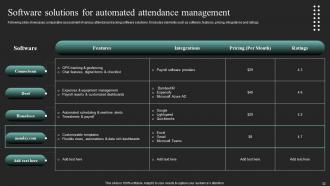
Slide 32: This slide showcases comparative assessment of various attendance tracking software solutions.
Slide 33: This slide is an introductory slide.
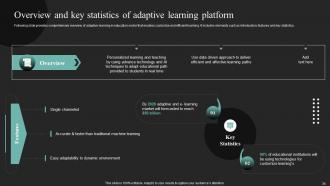
Slide 34: This slide provides comprehensive overview of adaptive learning in education sector that enables customize and efficient learning.
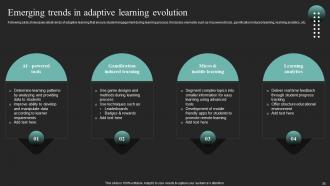
Slide 35: This slide showcases latest rends of adaptive learning that ensure student engagement during learning process.
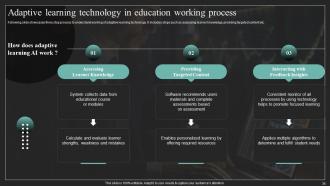
Slide 36: Thia slide reflects three step process to understand working of adaptive learning technology.
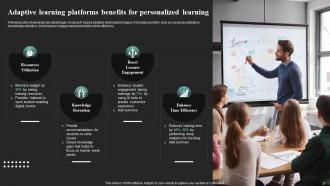
Slide 37: This slide presents key advantages of using AI based adaptive learning techniques.
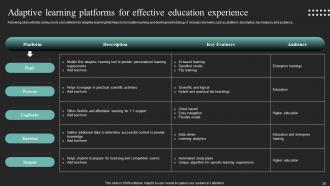
Slide 38: This slide exhibits various tools and software for adaptive learning that helps to formulate learning and development strategy.
Slide 39: This slide is an introductory slide.
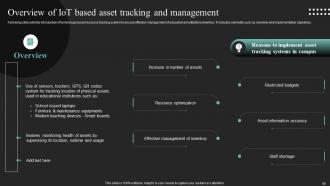
Slide 40: This slide exhibits introduction of technology based resource tracking system to ensure effective management of educational institutions inventory.
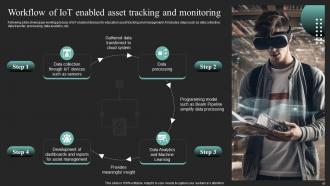
Slide 41: This slide presents working process of IoT enabled devices for education asset tracking and management.
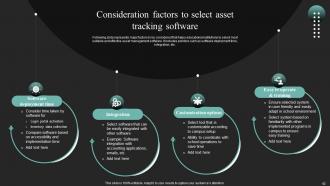
Slide 42: This slide represents major factors to be considered that helps educational institutions.
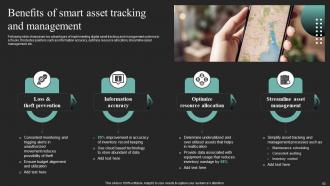
Slide 43: This slide illustrates key advantages of implementing digital asset tracking and management systems in schools.
Slide 44: This slide is an introductory slide.
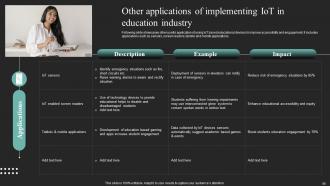
Slide 45: This slide entails other useful application of using IoT based educational devices to improve accessibility and engagement.
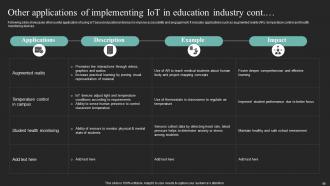
Slide 46: This slide showcases other useful application of using IoT based educational devices to improve accessibility and engagement.
Slide 47: This slide is an introductory slide.
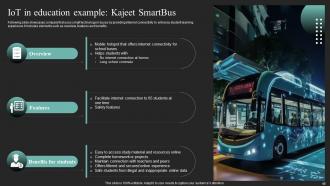
Slide 48: This slide illustrates company that uses smart technology in buses by providing internet connectivity to enhance student learning experience.
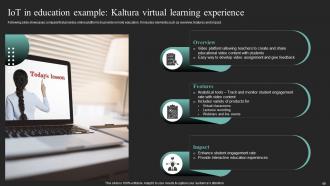
Slide 49: This slide showcases company that provides online platforms to provide remote education.
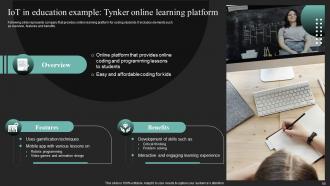
Slide 50: This slide entails company that provides online learning platform for coding students.
Slide 51: This slide is an introductory slide.
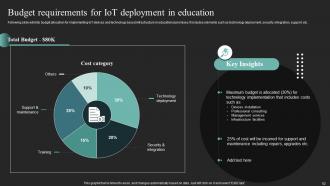
Slide 52: This slide exhibits budget allocation for implementing IoT devices and technology based infrastructure in educational premises.
Slide 53: This slide is an introductory slide.
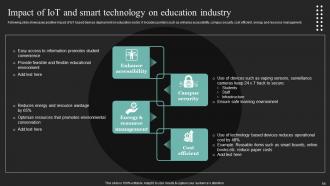
Slide 54: This slide presents positive impact of IoT based devices deployment on education sector.
Slide 55: This slide is an introductory slide.
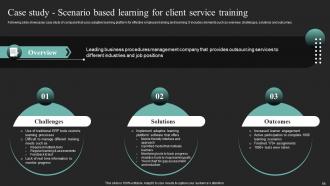
Slide 56: This slide perviews case study of company that uses adaptive learning platform for effective employee training and learning.
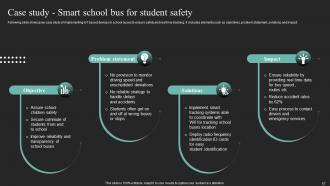
Slide 57: This slide showcases case study of implementing IoT based devices in school buses to ensure safety and real time tracking.
Slide 58: This slide is an introductory slide.
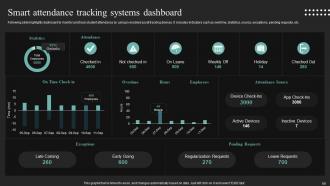
Slide 59: This slide highlights dashboard to monitor and track student attendance by using Io enabled asset tracking devices.
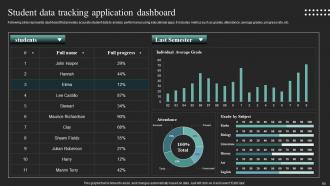
Slide 60: This slide represents dashboard that provides accurate student data to analyze performance using educational apps.
Slide 61: This slide shows all the icons included in the presentation.
Slide 62: This slide is titled Additional Slides for moving forward.
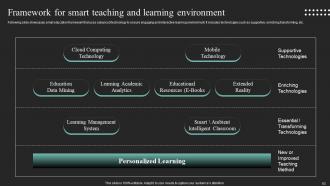
Slide 63: This slide showcases smart education framework that uses advanced technology to ensure engaging and interactive learning environment.
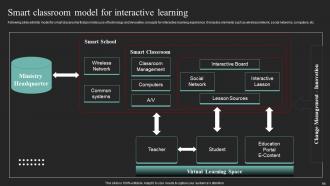
Slide 64: This slide exhibits model for smart classrooms that promotes use of technology and innovative concepts for interactive learning experience.
Slide 65: This slide depicts a Venn diagram with text boxes.
Slide 66: This slide shows Post-It Notes. Post your important notes here.
Slide 67: This slide displays Mind Map with related imagery.
Slide 68: This slide is Our Target slide. State your targets here.
Slide 69: This slide is a thank-you slide with address, contact numbers, and email address.
IoT In Education To Transform Way Of Learning Powerpoint Presentation Slides IoT CD with all 77 slides:
Use our IoT In Education To Transform Way Of Learning Powerpoint Presentation Slides IoT CD to effectively help you save your valuable time. They are readymade to fit into any presentation structure.









FAQs for IoT In Education To Transform Way Of Learning Powerpoint Presentation
So basically these devices track how your kids are actually learning in real-time - like their engagement levels, progress, even physical responses to different lessons. Pretty wild when you think about it. Smart sensors can tell if students are paying attention, and the tech adjusts content difficulty based on how each kid performs. You'll be able to spot struggling students way earlier and customize lesson plans automatically. Honestly, don't try to overhaul everything at once though - just start with one or two tools and see how it goes.
Honestly, IoT stuff can make remote learning way more engaging for your kids. Smart sensors track if students are actually paying attention (which is huge), and tablets plus interactive whiteboards let them jump into activities from home. The coolest part? You can set up virtual science experiments with connected lab equipment - my friend does this and her students love it. All that data helps you spot who's struggling so you can switch up your approach. Oh, and gamified learning beats boring Zoom calls every day. I'd say start with just one or two devices first, see what clicks with your teaching style.
RFID badges automatically ping when kids walk into class, so no more manual attendance taking. Wearable sensors can track if students are actually engaged too - kinda wild how detailed it gets. Smart desks and whiteboards capture performance stuff like response times during activities. Real-time dashboards show who's there, participation levels, even stress indicators. Honestly, it feels very futuristic but super practical. The best part? It flags kids who might be struggling before they actually fall behind, so teachers can jump in early instead of playing catch-up later.
Start with encrypted transmission and device authentication - can't skip those. Regular security audits are huge, plus you gotta stay on top of firmware updates. Network segmentation is clutch too - don't let IoT stuff touch your student data networks. Honestly, tracking all these devices gets messy fast, but centralized management platforms help a ton. Oh, and nail down your data policies early - what you're collecting, retention periods, access controls. The governance piece always feels boring but it'll save your butt later when someone asks questions.
Money's gonna be tight, obviously. Most schools are stuck with ancient systems that can't handle new tech anyway. IT will freak out about security risks - can't blame them though. Teachers are already swamped so good luck getting them trained on more stuff. Oh and don't get me started on all the privacy laws around student data. That's a whole nightmare. Honestly? Try one classroom first. Prove it actually works before you pitch it to the whole district or they'll shut you down fast.
So IoT basically makes your classroom smart - everything talks to each other. Smart boards sync with tablets, sensors automatically fix the lighting when it's too dim, desks can even track if kids are paying attention (which is honestly kind of wild). The cool part is connecting it all together - attendance, displays, analytics giving you real-time data on who's getting it and who's lost. Students get content that actually fits them while you see instant feedback. Don't go crazy though - start with smart whiteboards or tablets first, then build from there.
Honestly, IoT is a game-changer for managing resources. Real-time data shows you what's actually happening - which classrooms sit empty, how much energy you're wasting on HVAC, when equipment's about to fail. Once you see the usage patterns, you'll be shocked at how much you can cut back. Smart sensors handle everything from lighting to inventory tracking. My advice? Start small with just a few high-traffic areas first. The cost savings pile up fast, then you can expand from there. Way easier than trying to do everything at once.
So you could start with the boring stuff like air quality sensors and temperature monitors - way less sketchy than tracking actual kids. Smart water bottles bug students to drink more water, which honestly they probably need. Wearable devices can check stress levels and sleep patterns, but good luck getting parents on board without a privacy battle. Some schools track handwashing at sanitizer stations too. Posture sensors catch back problems early. I'd definitely go with environmental monitoring first since it doesn't feel as invasive, then maybe work up to personal health stuff if you can convince everyone it's not creepy.
Oh man, Singapore's doing some wild stuff - they've got IoT sensors in classrooms that automatically adjust air quality and apparently kids' focus improved big time. RFID attendance systems are crushing it too, like 30% better accuracy in US schools. Arizona State has these connected emergency buttons everywhere for safety. Honestly the ROI numbers look solid if you need to convince anyone with a budget. Most of these places publish their case studies online which is clutch - you can basically steal their playbook for implementation ideas.
Dude, IoT sensors are a game changer for campus stuff. Real-time data on energy use, room occupancy, HVAC maintenance alerts - the works. Smart lighting that adjusts itself is honestly kind of magical to watch. You'll figure out which spaces get used when, so scheduling becomes way easier. The energy monitoring thing shows cost savings pretty quick too. Oh and maintenance alerts before things actually break? That's huge for avoiding those random "heat's out in January" disasters. I'd start with just energy tracking in your biggest buildings first.
So basically IoT lets kids work together using connected stuff like smart whiteboards and tablets. Picture this - students can collect data with sensors from different spots, then automatically combine their findings. Pretty neat, right? They can brainstorm together, edit the same documents, even control lab equipment remotely. The physical classroom walls don't matter anymore. I'd honestly just pick one collaborative tool to start with (don't go crazy with everything at once). You'll see how quickly they start working across traditional boundaries. Real-time collaboration becomes second nature to them.
Honestly, you don't need to be some coding wizard or anything. Basic tech literacy helps - like understanding how IoT devices connect and grab data. The real trick is rethinking your lessons around live data and hands-on stuff. Data interpretation is key, plus project management skills for when everything breaks (because it will). Start with something simple - temperature sensors worked great for me - and just build from there. Trial and error becomes your best friend. Oh, and get ready to troubleshoot constantly. But once you nail that first project, you'll feel way more confident tackling bigger IoT experiments.
Dude, IoT sensors are a game changer for getting kids actually excited about experiments. Instead of just reading boring textbook stuff, they're watching live data stream right to their phones - temperature, pH, motion, whatever you're measuring. My cousin's a teacher and she started with basic temp sensors in chemistry class. The kids went crazy tracking patterns and making graphs from real measurements they collected themselves. Honestly way more engaging than I expected it to be. Once you see how pumped they get about analyzing their own data, you'll probably want to add more sensors.
Smart classrooms are gonna be everywhere soon - sensors adjusting lights and temperature based on how focused kids are. Wearable tech will track learning patterns and health stuff in real-time. VR/AR will let students actually walk through ancient Rome during history (honestly, way cooler than textbooks). Edge computing makes everything faster, and 5G means remote learning won't suck anymore. Your school should probably start planning infrastructure upgrades now. This stuff's happening quicker than most places think, so don't get caught scrambling later.
Honestly, kids get so much more pumped about data when they're collecting it themselves with sensors they built. Start with something basic like an Arduino measuring classroom temperature - then watch them come up with crazy ideas for what to monitor next. Plant growth, air quality, you name it. They're basically learning programming and problem-solving without realizing it. Plus when their sensor breaks (and it will), the troubleshooting process teaches them way more than any worksheet ever could. It's messy but that's kind of the point, you know?
-
I was mind-blown by the services that SlideTeam provided me. Thanks a ton!
-
Innovative and attractive designs.