


IoT Fleet Management Transforming Future Of Transportation IoT CD Powerpoint Presentation Slides




Try Before you Buy Download Free Sample Product
 Impress Your
 Audience
 100%
100% Editable
 Save Hours
 of Time


Check out our professionally designed IoT Fleet Management Transforming Future of Transportation PowerPoint Presentation. Internet of Things IoT integration into fleet management revolutionizes vehicle operations and administration through cutting edge technology. Discover the advantages of this transformative approach by exploring our expertly crafted PowerPoint presentation, which enables companies to slash vehicle related costs, enhance visibility, and elevate the customer experience. It commences with a comprehensive IoT fleet management overview, providing insights into the invaluable benefits it offers your organization. Additionally, the Fleet Monitoring PPT Template delves into the core technologies driving this transformation and gain a clear understanding of the roles and responsibilities of fleet managers. Subsequently, the presentation delves into the industrys outlook, offering a glimpse into the global fleet management markets scale and potential. Furthermore, the Vehicle Management Slides address the myriad applications of fleet management, including real time vehicle tracking, process automation, delivery management, and passenger satisfaction, among others. It also provides a detailed exploration of emerging trends poised to reshape the fleet industry. Lastly, youll find Key Performance Indicator KPI dashboards that empower organizations to gauge the efficiency of their vehicle operations. Get access to this 100 percentage editable template now.
People who downloaded this PowerPoint presentation also viewed the following :
Content of this Powerpoint Presentation
Slide 1: This slide introduces IoT Fleet Management: Transforming Future of Transportation. State your company name and begin.
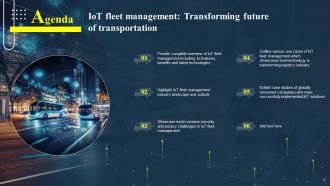
Slide 2: This is an Agenda slide. State your agendas here.
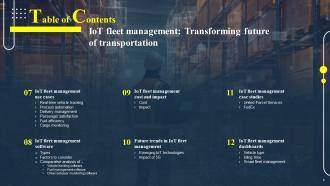
Slide 3: This slide shows Table of Content for the presentation.
Slide 4: This slide continues showing Table of Content for the presentation.
Slide 5: This slide shows title for topics that are to be covered next in the template.
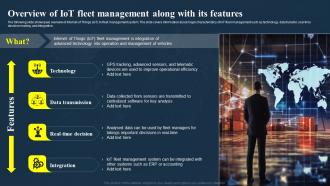
Slide 6: This slide showcases overview of Internet of Things (IoT) in fleet management system.
Slide 7: This slide outlines major benefits of using Internet of Things (IoT) in fleet management system.
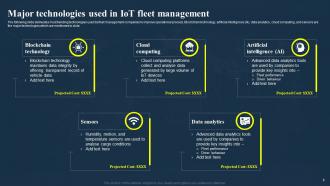
Slide 8: This slide delineates most trending technologies used by fleet management companies to improve operational process.
Slide 9: This slide exhibits five step process of successfully implementing Internet of Things (IoT) fleet management process to reduce operational expenditure.
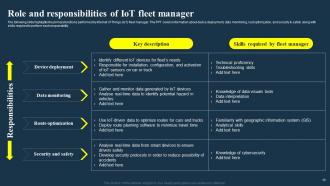
Slide 10: This slide highlights the primary functions performed by Internet of Things (IoT) fleet manager.
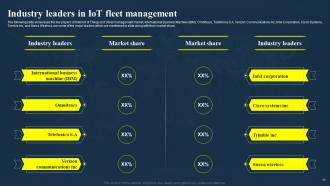
Slide 11: This slide showcases the key players of Internet of Things (IoT) fleet management market. International Business Machine (IBM), Omnitracs etc.
Slide 12: This slide shows title for topics that are to be covered next in the template.
Slide 13: This slide display graphical representation of total Internet of Things (IoT) devices usage from 2020-2023.
Slide 14: This slide outlines various issues which are associated with traditional fleet management system.
Slide 15: This slide presents the consequences of traditional fleet management system on business performance.
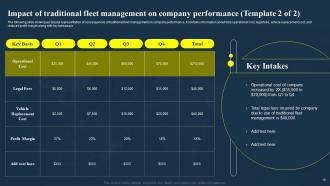
Slide 16: This slide showcases tabular representation of consequences of traditional fleet management on company performance.
Slide 17: This slide shows title for topics that are to be covered next in the template.
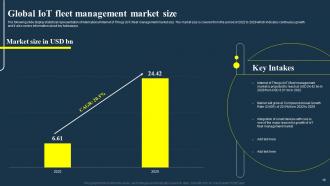
Slide 18: This slide display statistical representation of international Internet of Things (IoT) fleet management market size.
Slide 19: This slide presents statistical representation of Internet of Things (IoT) fleet management market size by different regions.
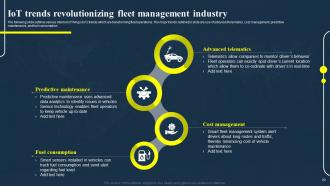
Slide 20: This slide outlines various Internet of Things (IoT) trends which are transforming fleet operations.
Slide 21: This slide produces emerging opportunities available for organizations involved in Internet of Things (IoT) fleet industry.
Slide 22: This slide shows title for topics that are to be covered next in the template.
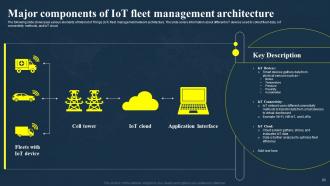
Slide 23: This slide showcases various elements of Internet of Things (IoT) fleet management network architecture.
Slide 24: This slide outlines diagrammatic representation of data flow in Internet of Things (IoT) fleet management.
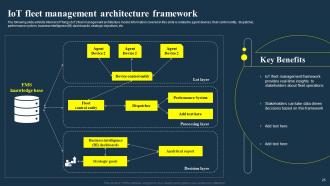
Slide 25: This slide exhibits Internet of Things (IoT) fleet management architecture model. Information covered in this slide is related to agent devices, fleet control entity etc.
Slide 26: This slide shows title for topics that are to be covered next in the template.
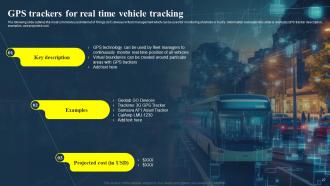
Slide 27: This slide outlines the most commonly used Internet of Things (IoT) devices in fleet management which can be used for monitoring of vehicle or trucks.
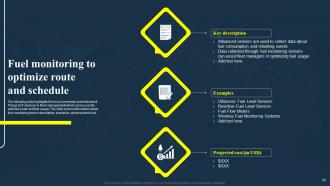
Slide 28: This slide highlights the most commonly used Internet of Things (IoT) devices in fleet management which can be used to optimize route and fuel usage.
Slide 29: This slide showcases the most commonly used Internet of Things (IoT) devices in fleet management through which fleet management companies minimize road accidents.
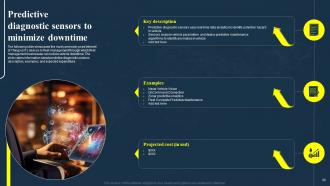
Slide 30: This slide displays the most commonly used Internet of Things (IoT) devices in fleet management through which fleet management businesses can reduce vehicle downtime.
Slide 31: This slide shows title for topics that are to be covered next in the template.
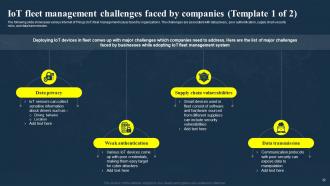
Slide 32: This slide showcases various Internet of Things (IoT) fleet management issues faced by organizations.
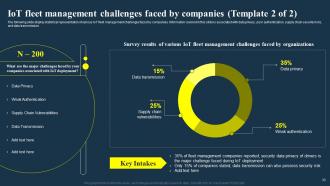
Slide 33: This slide display statistical representation of various IoT fleet management challenges faced by companies.
Slide 34: This slide showcases the consequences of Internet of Things (IoT) fleet management challenges on businesses.
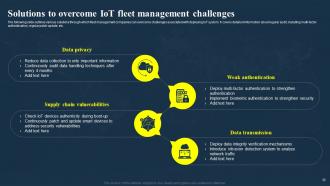
Slide 35: This slide outlines various solutions through which fleet management companies can overcome challenges associated with deploying IoT system.
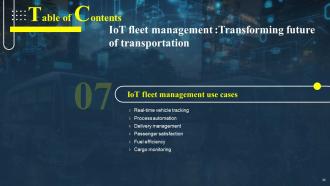
Slide 36: This slide shows title for topics that are to be covered next in the template.
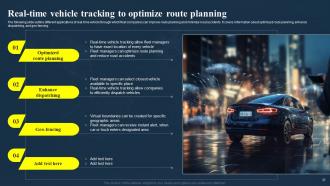
Slide 37: This slide outlines different applications of real-time vehicle through which fleet companies can improve route planning and minimize road accidents.
Slide 38: This slide various applications of process automation through which fleet management companies can optimize.
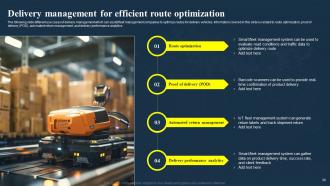
Slide 39: This slide different use cases of delivery management which can assist fleet management companies to optimize routes for delivery vehicles.
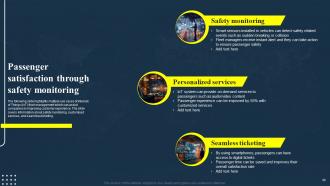
Slide 40: This slide highlights multiple use cases of Internet of Things (IoT) fleet management which can assist companies in improving customer experience.
Slide 41: This slide exhibits different use cases of fuel efficiency which can assist companies in cost savings and reducing carbon emissions.
Slide 42: This slide delineates different use cases of cargo monitoring through which organizations can reduce risk of cargo theft or damage.
Slide 43: This slide shows title for topics that are to be covered next in the template.
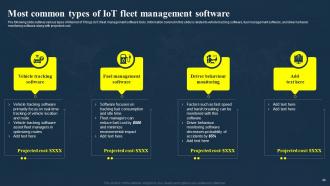
Slide 44: This slide outlines various types of Internet of Things (IoT) fleet management software tools.
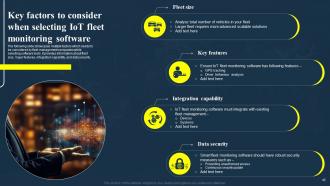
Slide 45: This slide showcases multiple factors which needs to be considered by fleet management companies while selecting software tools.
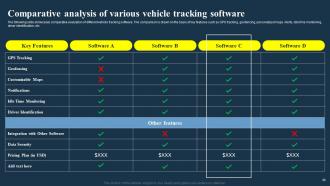
Slide 46: This slide displays comparative evaluation of different vehicle tracking software.
Slide 47: This slide showcases comparison of different fuel management software. The comparison is drawn on the basis of major features such as fuel tracking etc.
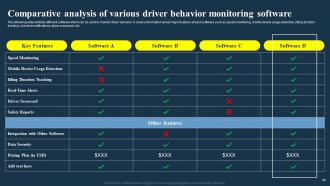
Slide 48: This slide exhibits different software which can be used to monitor driver behavior.
Slide 49: This slide shows title for topics that are to be covered next in the template.
Slide 50: This slide showcases budget to successfully deploy Internet of Things (IoT) in fleet management system.
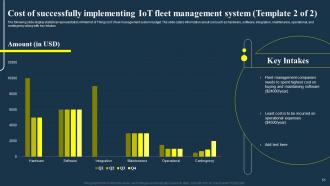
Slide 51: This slide display statistical representation of Internet of Things (IoT) fleet management system budget.
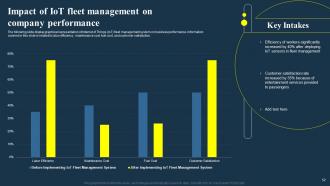
Slide 52: This slide presents graphical representation of Internet of Things (IoT) fleet management system on business performance.
Slide 53: This slide shows title for topics that are to be covered next in the template.
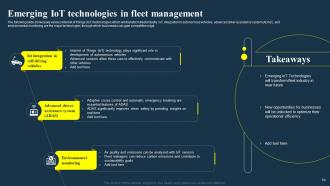
Slide 54: This slide showcases various Internet of Things (IoT) technologies which will transform fleet industry.
Slide 55: This slide delineates the impact of 5G technology on fleet industry. Information covered in this slide is related to improving navigation etc.
Slide 56: This slide shows title for topics that are to be covered next in the template.
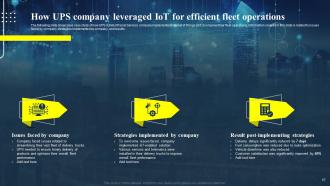
Slide 57: This slide showcases case study of how UPS (United Parcel Service) company implemented Internet of Things (IoT) to improve their fleet operations.
Slide 58: This slide outlines case study of how FedEx company implemented Internet of Things (IoT) technology to improve their supply chain operations.
Slide 59: This slide shows title for topics that are to be covered next in the template.
Slide 60: This slide delineates Key performance indicator (KPI) dashboard which can assist fleet managers in tracking business operations.
Slide 61: This slide showcases performance key performance indicator (KPI) dashboard which can assist fleet management companies in managing fleet operations.
Slide 62: This slide delineates smart fleet management dashboard through which fleet companies can take data-driven decisions in real-time.
Slide 63: This slide is titled as Additional Slides for moving forward.
Slide 64: This slide shows all the icons included in the presentation.
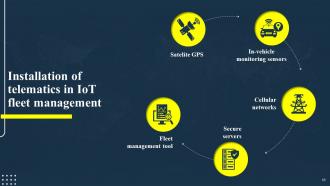
Slide 65: This slide displays installation of telematics in IoT fleet management with additional textboxes and related imagery.
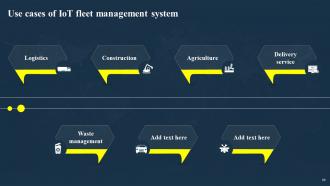
Slide 66: This slide presents use cases of IoT fleet management system with additional textboxes.
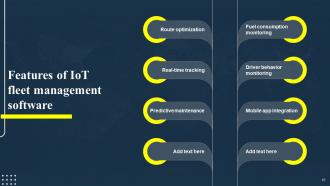
Slide 67: This slide displays features of IoT fleet management software with additional textboxes.
Slide 68: This slide shows Post It Notes for reminders and deadlines. Post your important notes here.
Slide 69: This is an Idea Generation slide to state a new idea or highlight information, specifications etc.
Slide 70: This slide contains Puzzle with related icons and text.
Slide 71: This is Our Goal slide. State your firm's goals here.
Slide 72: This slide depicts Venn diagram with text boxes.
Slide 73: This is a Thank You slide with address, contact numbers and email address.
IoT Fleet Management Transforming Future Of Transportation IoT CD Powerpoint Presentation Slides with all 81 slides:
Use our IoT Fleet Management Transforming Future Of Transportation IoT CD Powerpoint Presentation Slides to effectively help you save your valuable time. They are readymade to fit into any presentation structure.


































FAQs for IoT Fleet Management Transforming Future Of Transportation IoT CD
Real-time tracking is huge - you'll cut fuel costs by like 10-15% just from better routing. Maintenance becomes way easier too since you catch problems before trucks break down. Your drivers get safer routes and honestly, the data gets pretty addictive once you start seeing all the patterns. Customer service improves big time because you can actually give accurate arrival times. Most companies see ROI within 12-18 months, which isn't bad. Oh, and definitely try a pilot first - maybe start with 20% of your fleet instead of going all in right away.
Dude, IoT sensors are game-changers for vehicle maintenance. You get real-time data on everything - engine performance, tire pressure, brake wear, all that stuff. No more guessing games or following those rigid maintenance schedules that never make sense anyway. The sensors actually predict when something's about to fail, so you can fix it during downtime instead of being stuck with a breakdown at the worst possible moment. Honestly, it's like having a mechanic babysitting your whole fleet 24/7. I'd start small though - just throw some basic diagnostic sensors on your most important vehicles first.
So real-time data basically shows you what's happening with your fleet right now instead of finding out later. You can spot fuel waste, see if drivers are speeding or idling too much, and actually fix routes while trucks are still on the road. Maintenance issues pop up before they turn into those nightmare $5K breakdowns - honestly saved my buddy's company last month when they caught an engine problem early. The whole thing beats the hell out of making decisions based on week-old reports. I'd start with whatever's costing you the most money first.
So basically IoT sensors track all the stuff that wastes gas - like when drivers slam on the brakes or sit there idling forever. Route optimization is probably the biggest win though, can cut fuel costs by 10-15% just from better pathfinding. The sensors also catch engine problems early before they murder your fuel economy. You can set alerts for aggressive driving and excessive idling too. Oh, and definitely start with your worst trucks first - that's where you'll actually notice the savings. Real-time data makes a huge difference once you see the patterns.
Dude, IoT fleet security is a nightmare - you've got device vulnerabilities, data breaches, network attacks, the whole mess. Each connected vehicle and sensor basically gives hackers another way in. Most of these devices have garbage authentication and send data without encryption. Updates? What updates lol. If someone breaks in, they could track your vehicles, steal driver info, or mess with vehicle controls. Scary stuff. You'll want strong encryption everywhere, regular security checks, and multi-factor authentication on everything. Oh, and maybe invest in some good coffee because you'll be losing sleep over this.
So predictive analytics is basically like having a crystal ball for your fleet. Your trucks tell you when they're about to break down through sensor data - way better than getting stranded on the highway at 2am, trust me. You can spot maintenance issues early, optimize routes based on traffic patterns, and even predict fuel needs. The whole point is switching from "crap, now what?" to actually planning ahead. Oh, and demand forecasting helps you position vehicles where they'll be needed. I'd start with whatever's burning the most money - usually breakdowns or fuel waste - then build your predictive models around that specific problem first.
GPS trackers and telematics units are your bread and butter - they pull data straight from the vehicle's systems. Dash cams are getting huge too. For sensors, you've got fuel monitoring, engine diagnostics, driver behavior tracking. Tire pressure sensors are honestly a lifesaver, prevent so many roadside disasters. Temperature sensors matter if you're doing cold chain stuff, plus smart locks for cargo security. My buddy runs a small fleet and swears by starting simple - just GPS and basic telematics first, then build from there. Don't overcomplicate it right out the gate.
Honestly, IoT makes compliance tracking way less painful. Your sensors automatically monitor driver hours, maintenance schedules, emissions - basically everything regulators want to see. No more scrambling to pull reports together manually (seriously, who has time?). The data just sits there collecting itself. Come audit time, you export clean datasets that show you've been following rules. Here's the real win though - you spot issues before they become actual violations. Set up alerts when you're getting close to limits. Way better than playing catch-up after something goes wrong. Trust me on this one.
Dude, IoT is a game-changer for driver safety. Your system watches for stuff like hard braking, speeding, and when drivers are getting drowsy - then sends you alerts right away. The fatigue sensors are wild now, they can actually detect micro-sleep before someone crashes. Insurance companies love this because you're proving you manage risk, so your rates drop. Here's the thing though - don't use the data to just bust people's chops. Frame it as helping drivers stay safe, not spying on them. They'll actually listen that way. Plus the analytics show you exactly who needs extra training.
So basically you'd put IoT sensors in your trucks to track traffic, weather, how the vehicles are running - all that stuff. Then route optimization software takes that data and figures out the best paths. Pretty neat how it switches routes automatically when things change! Your fuel costs drop, deliveries get faster, less wear on trucks too. Oh and you get analytics on how your drivers are doing. Honestly I'd start small - just GPS and telematics on a couple vehicles first. Once you see it working, roll it out to the whole fleet. The results are usually worth it.
Hardware costs hit you first - sensors, GPS, telematics boxes. Then there's monthly stuff like data plans and software subscriptions. Budget around $50-500 per vehicle depending on what bells and whistles you want. Honestly, the fancy features look cool but you probably don't need half of them starting out. Connectivity fees add up quick though, especially if you've got a big fleet. Oh and integration with whatever system you're already using might cost extra. I'd definitely test it on like 10-20 trucks first before going all-in. Way easier to pivot if something's not working right.
So basically, IoT sensors track your fuel usage, engine stuff, and how drivers are actually driving - then flag inefficiencies right away. Route optimization cuts down pointless miles too. Honestly the fuel savings usually cover what you spent on the system pretty fast. Oh and it helps you stay on top of maintenance before things break, which keeps everything running cleaner longer. If I were you, I'd focus on fuel and route tracking first - that's where you'll see the biggest environmental wins. Makes sense to start there anyway since it's the most obvious cost saver.
Alright, so first thing - map out what data you're already working with and see which APIs your current system can handle. Trust me on this one, it'll save you so much pain down the road. For connecting everything, stick with MQTT or REST APIs since they play nice with most IoT setups and fleet software. The integration stuff is honestly not as scary as it sounds once you get your data formats talking to each other properly. Start small though - pick like 5-10 vehicles to test with before you go crazy and roll it out everywhere. Oh, and don't forget decent error handling because things will break. Test everything thoroughly first, obviously.
So logistics companies are all about tracking routes and fuel costs. Construction folks focus more on equipment - when stuff needs maintenance, how much it's being used, that kind of thing. Food and pharma get super paranoid about temperature control during shipping, which honestly makes total sense when you think about it. Ride-share companies use it to monitor how their drivers are doing and catch car problems early. But here's the thing - you really gotta figure out what's actually hurting your business first, then find IoT tools that fix those specific problems instead of just buying whatever sounds cool.
Predictive analytics is getting crazy good - we're talking systems that'll spot breakdowns weeks out instead of just a few days. Edge computing means your trucks will crunch data on-site rather than constantly hitting the cloud. Real-time monitoring will actually be real-time once 5G stops being overhyped and starts delivering. Autonomous tech is sneaking into commercial fleets way faster than anyone expected too. Your dashboard's basically turning into a fortune teller for fleet health. Honestly, start setting money aside for these upgrades now because scrambling to catch up later? That's gonna hurt your wallet.
-
The PPTs are extremely simple to modify. Thank you for providing the slides that are ready to be used. They assist me in saving a lot of time.
-
The way SlideTeam professionals work is exceptional. Thanks for being so helpful!