

Enabling Smart Shipping And Logistics Through Iot Powerpoint Presentation Slides





Try Before you Buy Download Free Sample Product
 Impress Your
Audience
 100%
Editable
 Save Hours
of Time


Logistics management through IoT refers to integrating smart systems to handle supply chains, warehousing, transportation, etc. Its main purpose is to provide these operations efficiency, compliance, and security. Check out our professionally designed presentation on Enabling Smart Shipping and Logistics through IoT. It provides a general overview, significance, spending trends, use cases, architecture, etc., which can be referred by manufacturing or warehouse managers. This PowerPoint presentation offers access to multiple strategies which can help logistics businesses in optimizing and upgrading their operations, these include IoT technology implementation, fleet management, warehousing and packaging, IoT infrastructure, blockchain logistics, etc. Furthermore, the complete deck includes slides that can help the logistics department through roles and responsibilities, workflow, and training program. Moreover, it also provides costs and software selection related to implementing IoT in logistics. Lastly, the PPT deck can help assess the performance of the above strategies through impact analysis, KPIs, and dashboards. Get access to this powerful template now.
People who downloaded this PowerPoint presentation also viewed the following :
Content of this Powerpoint Presentation
Slide 1: This slide introduces Enabling Smart Shipping and Logistics Through IoT. State your company name and begin.
Slide 2: This slide states Agenda of the presentation.
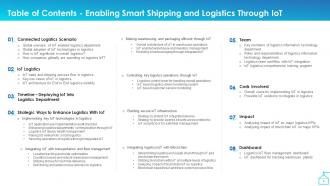
Slide 3: This slide presents Table of Content for the presentation.
Slide 4: This slide highlights title for topics that are to be covered next in the template.
Slide 5: This slide shows Global Overview of IoT in Logistics Department.
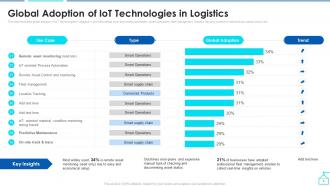
Slide 6: This slide presents Global Adoption of IoT Technologies in Logistics.
Slide 7: This slide displays How is IoT Significant in Overall Logistics.
Slide 8: This slide represents How Companies Globally are Spending on Logistics IoT.
Slide 9: This slide highlights title for topics that are to be covered next in the template.
Slide 10: This slide showcases IoT Trade and Shipping Process Flow in Logistics.
Slide 11: This slide shows Key Use Cases of IoT in Logistics.
Slide 12: This slide presents IoT Architecture for End to End Logistics Visibility.
Slide 13: This slide highlights title for topics that are to be covered next in the template.
Slide 14: This slide depicts logistics internet of things (IoT) deployment timeline.
Slide 15: This slide highlights title for topics that are to be covered next in the template.
Slide 16: This slide displays IoT Application Pre Implementation Audit Checklist.
Slide 17: This slide represents Enhancing Logistics Departments Communication Through IoT.
Slide 18: This slide showcases Logistics IoT Device Health Management.
Slide 19: This slide shows Pairing 5G Network for Smart Logistics.
Slide 20: This slide presents Securing Operations of Logistics Through Integrated IoT.
Slide 21: This slide highlights title for topics that are to be covered next in the template.
Slide 22: This slide displays Efficient Location Tracking and Route Optimization.
Slide 23: This slide represents Condition Based and Vehicle Breakdown Management.
Slide 24: This slide showcases Utilizing Drones for Last Mile Deliveries.
Slide 25: This slide shows Self Driving and Autonomous Vehicles for Logistics.
Slide 26: This slide highlights title for topics that are to be covered next in the template.
Slide 27: This slide presents Overall Architecture of IoT in Warehouse Operations.
Slide 28: This slide displays IoT Enabled Warehouse and Inventory Management.
Slide 29: This slide represents Enabling Smart Packaging Through Integrated IoT.
Slide 30: This slide highlights title for topics that are to be covered next in the template.
Slide 31: This slide showcases Logistics Control Tower for Handling Overall Operations.
Slide 32: This slide shows IoT Based Logistics Driver Monitoring System.
Slide 33: This is another slide continuing IoT Based Logistics Driver Monitoring System.
Slide 34: This slide presents IoT Based Customer Service Monitoring.
Slide 35: This slide highlights title for topics that are to be covered next in the template.
Slide 36: This slide displays Strategy to Protect IoT Integrated Devices.
Slide 37: This slide represents Strategy to Provide Layered Security Across Networks.
Slide 38: This slide showcases IoT Security Lock for Safe Fleet Management.
Slide 39: This slide highlights title for topics that are to be covered next in the template.
Slide 40: This slide shows Streamlining Logistics and Supply Chain Through IoT and Blockchain Framework.
Slide 41: This slide presents Utilizing Blockchain With IoT at Multiple Levels of Logistics.
Slide 42: This slide displays Analyzing Impact of Blockchain IoT on Logistics.
Slide 43: This slide represents Blockchain Based Track and Trace System Process Flow.
Slide 44: This slide highlights title for topics that are to be covered next in the template.
Slide 45: This slide showcases Key Members of Logistics Information Technology Department.
Slide 46: This slide shows Roles and Responsibilities of Logistics Information Technology Department.
Slide 47: This slide presents Logistics Team Workflow with IoT Integration.
Slide 48: This slide displays IoT Logistics Comprehensive Training Program.
Slide 49: This slide highlights title for topics that are to be covered next in the template.
Slide 50: This slide represents Overall Costs for Implementing IoT in Logistics.
Slide 51: This slide showcases Possible IoT Solutions to Integrate in Logistics.
Slide 52: This slide highlights title for topics that are to be covered next in the template.
Slide 53: This slide shows Analyzing Impact of IoT on Major Logistics KPIs.
Slide 54: This slide presents Analyzing Impact of Blockchain IoT on major KPIs.
Slide 55: This slide highlights title for topics that are to be covered next in the template.
Slide 56: This slide displays Logistics IoT Fleet Management Dashboard.
Slide 57: This slide represents IoT Dashboard for Tracking Warehouse Pallets.
Slide 58: This slide showcases Icons for Enabling Smart Shipping and Logistics Through IoT.
Slide 59: This slide is titled as Additional Slides for moving forward.
Slide 60: This slide presents Bar chart with two products comparison.
Slide 61: This slide presents Roadmap with additional textboxes.
Slide 62: This is an Idea Generation slide to state a new idea or highlight information, specifications etc.
Slide 63: This is a Timeline slide. Show data related to time intervals here.
Slide 64: This slide provides 30 60 90 Days Plan with text boxes.
Slide 65: This slide contains Puzzle with related icons and text.
Slide 66: This is a Financial slide. Show your finance related stuff here.
Slide 67: This is a Thank You slide with address, contact numbers and email address.
Enabling Smart Shipping And Logistics Through Iot Powerpoint Presentation Slides with all 72 slides:
Use our Enabling Smart Shipping And Logistics Through Iot Powerpoint Presentation Slides to effectively help you save your valuable time. They are readymade to fit into any presentation structure.











FAQs for Enabling Smart Shipping And Logistics Through Iot
Dude, the visibility alone is worth it - you can see everything happening with your shipments in real time. Temperature, location, if something got dropped, all that stuff. Honestly feels like cheating compared to the old days of just hoping packages arrived okay. Your customers will love you because way less stuff shows up damaged. IoT sensors are crazy good at catching problems early too, like before your whole shipment goes bad. Costs go down since you're not always scrambling to fix disasters. Oh, and predictive maintenance is a game changer. Start with your expensive or cold-chain stuff first - you'll see results immediately.
Honestly, those IoT sensors are game-changers for tracking shipments. You'll see exactly where everything is in real-time, plus get alerts about temperature, humidity, shock - all that stuff that can mess up your cargo. When problems pop up, you can actually fix them before they turn into disasters. Your customers will finally stop blowing up your phone asking about their orders (thank god). The data's pretty useful too - you start noticing which routes have bottlenecks and can tweak them. I'd say test it out on your most important shipments first, then watch how your delivery accuracy improves and complaints drop.
So predictive analytics looks at all your IoT data - trucks, containers, sensors, whatever - and figures out what'll happen before it does. Traffic patterns, weather, port delays, fuel usage. It's like having a crystal ball that actually works since it runs on real data from thousands of trips. Pretty neat stuff, honestly. Over time it gets better as it processes more info. I'd say start by finding your worst route problems first - that's where you'll see the biggest savings in time and fuel costs. Way more practical than trying to fix everything at once.
So basically these IoT sensors turn your cargo into this smart device that's constantly checking in with you. Temperature, humidity, location, vibration - even if someone opens the container when they shouldn't. It's like having eyes on your shipment 24/7, which honestly is pretty cool tech. The data goes straight to your phone or dashboard in real-time. You can set up alerts too, so if something goes wrong - like temps getting too hot - you'll get pinged immediately. Way better than finding out about problems after it's too late to fix anything.
Dude, the security stuff is honestly a nightmare. Weak authentication is huge - so many shipping devices still run on default passwords which is just insane to me. Then you've got unencrypted data flying around and firmware that's like 5 years out of date on sensors everywhere. Remote locations make it worse since you can't easily monitor or update anything. Hackers love targeting GPS and cargo tracking because one hit can mess up entire supply chains. My advice? Get strong authentication going first, then set up some kind of regular update schedule for all your connected gear.
Honestly, IoT shipping stuff is a game changer for cutting costs. Real-time tracking means way fewer lost packages - and you can actually fix problems before they blow up. Temperature sensors are clutch for anything that spoils easily (learned that the hard way with a client once). Route optimization saves serious money on fuel since drivers aren't sitting in traffic forever. You'll also catch maintenance issues before trucks die on you. My advice? Start small with basic tracking on your priciest routes first, then expand from there.
Dude, IoT is a game-changer for fleet stuff. You get live data on where your vehicles are, how the engines are doing, fuel usage, driver habits - basically everything. The cool part? Sensors actually tell you when parts are about to crap out instead of you just crossing your fingers and hoping. Schedule maintenance before things break and you'll cut costs by like 20-30%. Trust me, beats having trucks dead on the highway. Oh, and if you're starting from scratch, just do GPS tracking and basic engine diagnostics first. Those two will solve most of your problems honestly.
So shipping companies are basically drowning their fleets in sensors now - tracking fuel, emissions, engine stuff, you name it. The data gets crazy detailed. They're using it to find better routes and cut fuel waste, plus it spits out all those compliance reports automatically. Some are getting fancy with predictive stuff to catch problems early. Honestly, the companies killing it right now are the ones that can pull all these different data streams into one clean dashboard. That's where you see the real results. Much easier than juggling five different systems.
Honestly, ML is a game-changer for IoT shipping data - it cuts through all that sensor noise to find what actually matters. Predictive algorithms can spot equipment failures before they hit, plus optimize your routes using real-time conditions. Temperature and humidity anomalies? Caught automatically. The algorithms get smarter over time too, learning from historical patterns to predict delays and fuel consumption better. Way better than drowning in thousands of manual sensor readings. I'd say start small though - pick one thing like predictive maintenance first instead of going crazy with everything at once.
So IoT basically turns all your cargo tracking into one big shared data stream. Your sensors automatically update everyone who needs to know - customers, port people, logistics teams, whatever. No more endless emails or phone tag, which honestly is a lifesaver. You can set alerts for when stuff hits major checkpoints or gets delayed. Dashboards show each person exactly what they care about tracking. We've seen those "where's my shipment?" calls drop by like 80% once people can just check everything themselves. Way better than the old system of everyone calling around for updates.
So predictive maintenance with AI sensors is huge right now. Real-time cargo monitoring tracks temperature, shock damage, all that stuff. Autonomous ships are coming too, though that's still pretty early stage honestly. Digital twins - basically virtual ship copies for route optimization - are everywhere now. IoT gives you complete supply chain visibility which customers love. What's cool is these aren't separate anymore, they're all connecting together. My buddy in logistics swears by starting with cargo monitoring since you'll see results fast and it builds your foundation for everything else.
GPS tracking is a game changer - start there for your priciest stuff. Motion sensors and geofencing will blow up your phone the second something's wrong, like if someone cracks open a container or your truck goes rogue. Thieves hate knowing they're being watched constantly, so that alone cuts down on theft. Environmental sensors catch problems early too. Oh, and tamper-proof seals are clutch. Honestly, even basic tracking makes a huge difference. You'll wonder how you shipped anything before without knowing exactly where it was every minute.
Pick one thing first - container tracking or temp monitoring, whatever. Don't go crazy trying to solve everything right away. Cellular backup is clutch when GPS craps out (which it will). The security stuff is honestly the biggest deal since your competition would kill for that supply chain data. Oh, and saltwater ruins literally everything so get sensors that can actually handle being on a boat. Plan your system integration early or you'll hate yourself later. Nail one problem really well, then expand from there.
So edge computing processes your IoT data right there on the ship instead of sending it all to cloud servers. Way faster response times - milliseconds vs seconds for stuff like route changes or equipment warnings. Satellite bandwidth costs are brutal when you're out at sea, so this saves serious money. Your systems keep working even with crappy connectivity, which happens more than you'd think. You get real-time cargo monitoring and can catch maintenance issues before they blow up. Start by figuring out what data needs instant processing vs what can wait until you're back in port.
Look, regulatory bodies are total gatekeepers for IoT in shipping. IMO's pushing digital compliance hard, FCC controls spectrum stuff, and ports want their own data formats. Such a headache tbh. But here's the thing - they're actually forcing some cool innovations like real-time cargo tracking. Don't wait for new rules to hit, get ahead of them. I learned this the hard way on a project last year. Check what your target ports actually need before you deploy anything, and definitely follow IMO's digitalization roadmap. Trust me, playing catch-up sucks way more than being prepared.
-
I took a chance with SlideTeam. I never looked back. Great products and great service.
-
SlideTeam never fails to surprise me with its amazing PPT designs. Thanks team for providing me with your constant support!