


Smart Water Management Using IoT Powerpoint Presentation Slides IoT CD




Try Before you Buy Download Free Sample Product
 Impress Your
 Audience
 100%
100% Editable
 Save Hours
 of Time


Explore the paradigm shift in water management with our Smart Water Management Using IoT PowerPoint on IoT water management. Beginning with an overview and industry outlook, we assess market trends and growth projections. Practical applications, from smart irrigation to asset management, are showcased next. Security challenges such as data privacy and network vulnerabilities are addressed, along with robust solutions like encryption protocols. A compelling case study underscores real-world success, illustrating benefits like reduced waste and enhanced efficiency. Finally, our ROI projection quantifies financial gains, providing stakeholders with a clear investment roadmap. By integrating IoT devices and analytics, organizations can optimize resource allocation and drive sustainability. This presentation equips stakeholders with knowledge and tools to navigate the transformative potential of IoT water management, fostering smarter, more efficient practices. Grab the PPT right now.
People who downloaded this PowerPoint presentation also viewed the following :
Content of this Powerpoint Presentation
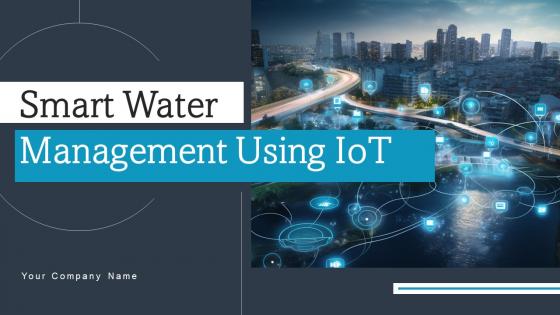
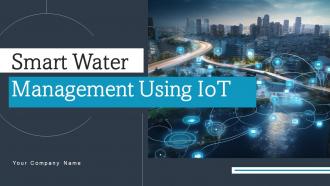
Slide 1: This slide showcase title Smart Water Management Using IoT. State Your Company Name.
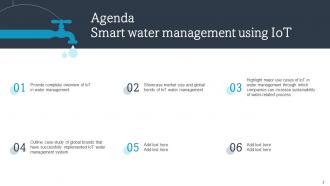
Slide 2: This slide showcase title Agenda.
Slide 3: This slide exhibit Table of Content.
Slide 4: This slide exhibit Table of Content: Overview of IoT in Water Management.
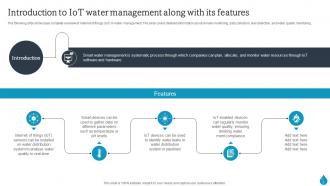
Slide 5: This slide showcases complete overview of internet of things (IoT) in water management.
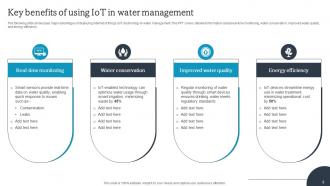
Slide 6: This slide showcases major advantages of deploying internet of things (IoT) technology in water management.
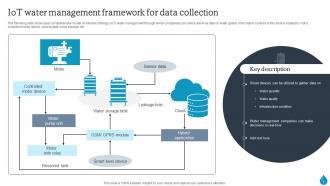
Slide 7: This slide showcases comprehensive model on internet of things (IoT) water management through which companies can collect real-time data on water quality.
Slide 8: This slide showcases multiple short and long term goals of internet of things (IoT) water management.
Slide 9: This slide exhibit Table of Content: IoT Water Management Industry Outlook.
Slide 10: This slide showcases market snapshot of internet of things (IoT) water management across globe.
Slide 11: This slide showcases global trends which are associated with smart water management.
Slide 12: This slide showcases statistical representation of smart water management market size.
Slide 13: This slide showcases graphical representation of internet of things (IoT) water management market size.
Slide 14: This slide showcases map of smart water management market size according to multiple regions.
Slide 15: This slide showcases most prominent players offering smart water management solutions to companies.
Slide 16: This slide exhibit Table of Content:Key Application Areas of IoT in Water Management.
Slide 17: This slide showcases various use cases of internet of things (IoT) in wastewater management.
Slide 18: This slide showcases multiple use cases of smart irrigation through which companies can enhance crop productivity and minimize cost.
Slide 19: This slide showcases different use cases of internet of things (IoT) in dam management.
Slide 20: This slide showcases multiple use cases of (IoT) in asset management through which companies can improve asset performance and minimize operational cost.
Slide 21: This slide exhibit Table of Content: Sensors and Technologies Used in IoT Water Management.
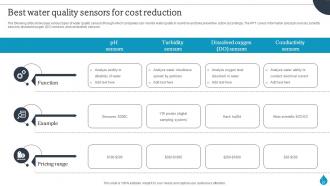
Slide 22: This slide showcases various types of water quality sensors through which companies can monitor water quality in real-time and take preventive action accordingly.
Slide 23: This slide showcases multiple water level sensors through which companies can analyse water level in real-time.
Slide 24: This slide showcases multiple types of weather sensors through which water management companies can predict weather patterns and streamline water distribution level.
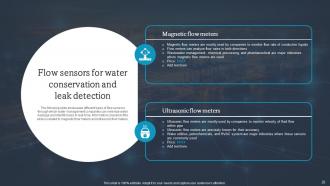
Slide 25: This slide showcases different types of flow sensors through which water management companies can minimize water wastage and identify leaks in real-time.
Slide 26: This slide exhibit Table of Content: Technologies.
Slide 27: This slide showcases multiple benefits of using blockchain technology in internet of things (IoT) water management.
Slide 28: This slide showcases major benefits of using cloud computing technology in Internet of Things (IoT) water management.
Slide 29: This slide showcases positive impact of using Artificial Intelligence (AI) in water conservation and management.
Slide 30: This slide exhibit Table of Content: IoT Water Management System.
Slide 31: This slide showcases different parameters while considering Internet of Things (IoT) water management tool.
Slide 32: This slide showcases comparative analysis of different Internet of Things (IoT) water management tools.
Slide 33: This slide showcases pricing plan of Internet of Things (IoT) water management tool.
Slide 34: This slide exhibit Table of Content: Security Challenges and Solutions.
Slide 35: This slide showcases various security challenges which can be faced by companies while deploying Internet of Things (IoT) water management system.
Slide 36: This slide showcases graphical representation of multiple security challenges which can be faced by companies while deploying (IoT) water management system.
Slide 37: This slide showcases various security challenges which can be faced by companies while deploying Internet of Things (IoT) water management system.
Slide 38: This slide exhibit Table of Content: Case Study and ROI Projection.
Slide 39: This slide showcases comprehensive case study on how AquaTech Solutions company transform client’s water distribution operations.
Slide 40: This slide showcases tabular representation of Return on Investment (ROI) post implementing IoT technology in smart water management.
Slide 41: This slide exhibit Table of Content: Dashboards.
Slide 42: This slide showcases comprehensive key performance indicator (KPI) dashboard through which companies can measure water consumption level.
Slide 43: This slide showcases Internet of Things (IoT) water management key performance indicator (KPI) dashboard.
Slide 44: This slide shows all the icons included in the presentation.
Slide 45: This slide is titled as Additional Slides for moving forward.
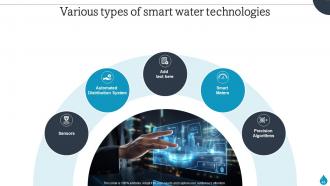
Slide 46: This slide showcase title Various types of smart water technologies.
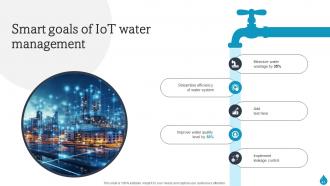
Slide 47: This slide showcase title Smart goals of IoT water management.
Slide 48: This slide showcase title IoT-Enabled water management system framework.
Slide 49: This slide showcase title Solutions offered by company for smart water management.
Slide 50: This is an Idea Generation slide to state a new idea or highlight information, specifications etc.
Slide 51: This is a Timeline slide. Show data related to time intervals here.
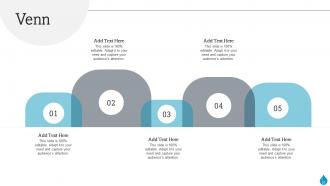
Slide 52: This slide depicts Venn diagram with text boxes.
Slide 53: This is a Thank You slide with address, contact numbers and email address.
Smart Water Management Using IoT Powerpoint Presentation Slides IoT CD with all 61 slides:
Use our Smart Water Management Using IoT Powerpoint Presentation Slides IoT CD to effectively help you save your valuable time. They are readymade to fit into any presentation structure.
-
Smart Water Management Using IoT
-
Smart water management using IoT
-
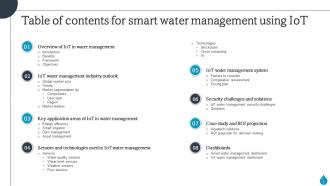
Table of contents for smart water management using IoT
-
Smart water management using IoT
-
Introduction to IoT water management along with its features
-
Key benefits of using IoT in water management
-
IoT water management framework for data collection
-
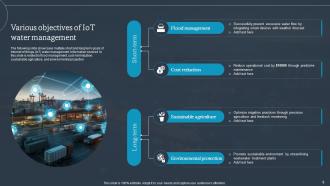
Various objectives of IoT water management
-
Smart water management using IoT
-
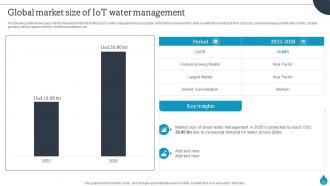
Global market size of IoT water management
-
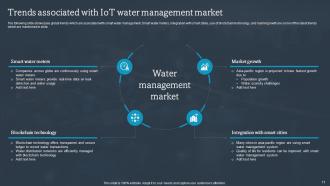
Trends associated with IoT water management market
-
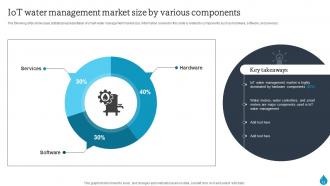
IoT water management market size by various components
-
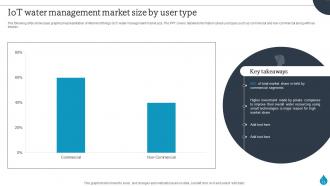
IoT water management market size by user type
-
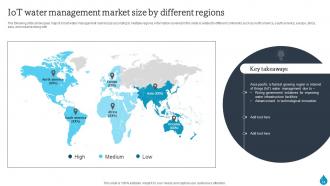
IoT water management market size by different regions
-

Key market leaders of IoT water management
-
Smart water management using IoT
-
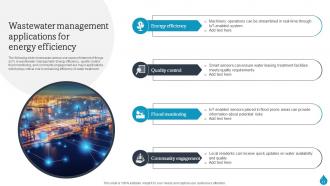
Wastewater management applications for energy efficiency
-
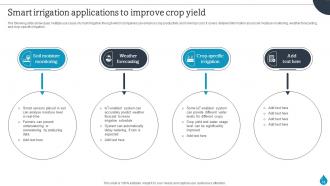
Smart irrigation applications to improve crop yield
-
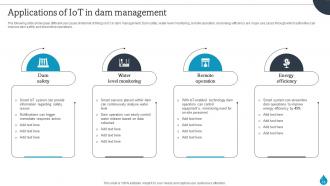
Applications of IoT in dam management
-
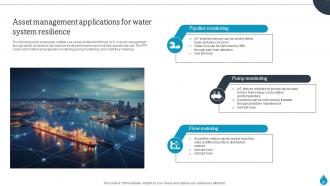
Asset management applications for water system resilience
-
Smart water management using IoT
-
Best water quality sensors for cost reduction
-

Water level sensors with their key benefits
-

Various types of weather sensors for forecasting and planning
-
Flow sensors for water conservation and leak detection
-
Smart water management using IoT
-
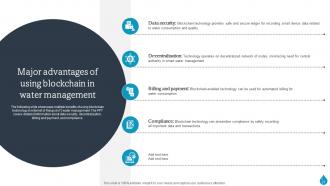
Major advantages of using blockchain in water management
-

Overview of cloud computing in smart water management
-
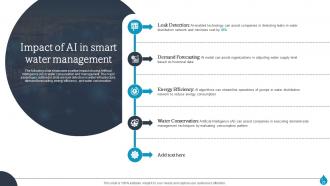
Impact of AI in smart water management
-
Smart water management using IoT
-
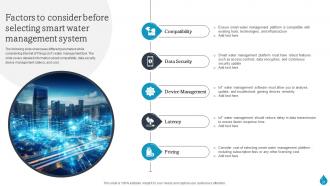
Factors to consider before selecting smart water management system
-
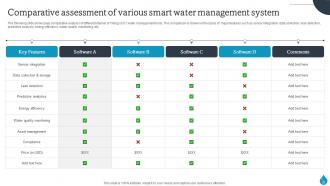
Comparative assessment of various smart water management systems
-
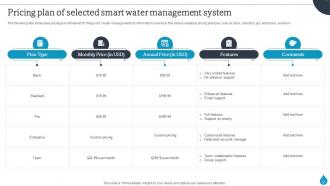
Pricing plan of selected smart water management system
-
Smart water management using IoT
-
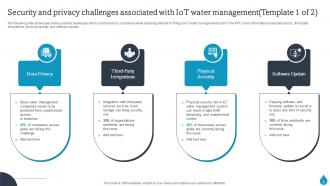
Security and privacy challenges associated with IoT water management Template 1 of 2
-
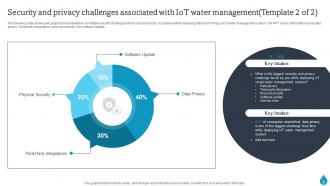
Security and privacy challenges associated with IoT water management Template 2 of 2
-
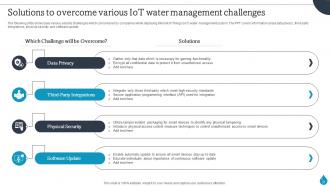
Solutions to overcome various IoT water management challenges
-
Smart water management using IoT
-
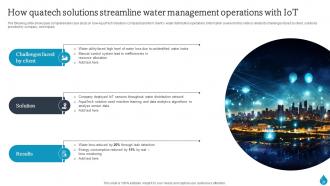
How quatech solutions streamline water management operations with IoT
-
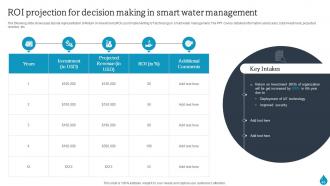
ROI projection for decision making in smart water management
-
Smart water management using IoT
-
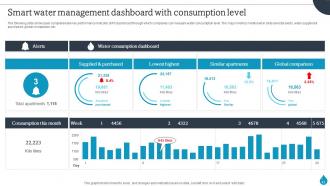
Smart water management dashboard with consumption level
-
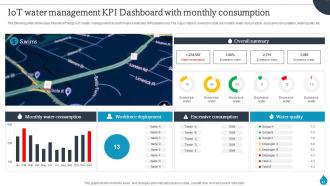
IoT water management KPI Dashboard with monthly consumption
-
Icons slide for Smart water management using IoT
-
Additional slides
-
Various types of smart water technologies
-
Smart goals of IoT water management
-
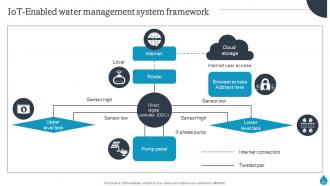
IoT Enabled water management system framework
-
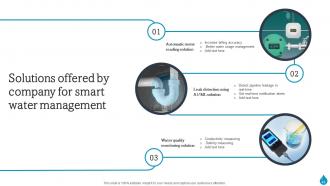
Solutions offered by company for smart water management
-
Idea generation
-

Timeline
-
Venn
-

Thanks for watching
-

-

-

-

-

-

-

-

FAQs for Smart Water Management Using IoT Powerpoint Presentation
So you'll need IoT sensors to track water quality and flow rates, plus automated valves and pumps. Leak detection sensors are honestly a no-brainer - they'll save you tons when they catch big leaks early. Don't forget a central platform to crunch all that data in real-time. Oh, and make sure everything actually connects properly because nothing's worse than systems that can't talk to each other. I'd start by looking at your current setup first. Figure out where you're bleeding the most water or having quality problems, then build from there.
So basically, IoT sensors track everything happening in your water system - leaks, pressure drops, flow rates, all that stuff. You catch issues way before they turn into disasters like burst mains. Smart meters are actually pretty sweet because they show exactly how much water different areas use, so you can adjust pressure zones and predict when demand spikes. Your crews won't be driving around checking meters manually anymore, which honestly saves a ton of time. Best part? You can fix the stuff that matters most first instead of just guessing what's urgent. I'd definitely test it in one zone first though - see if the numbers make sense before going all-in citywide.
So data analytics is basically your crystal ball for water systems. You'll spot consumption patterns - like how everyone cranks up usage on scorching days (no surprise there). The cool part? Algorithms can actually predict demand spikes by crunching weather data, population trends, seasonal stuff, even economic factors. Pretty accurate too. Instead of scrambling when problems hit, you can plan ahead. Honestly, the key is getting consistent data from your meters first - that's what feeds everything else. Once you have that foundation, forecasting supply issues becomes way more manageable.
You know how much water just gets wasted without us even realizing? Smart management catches that stuff early - sensors pick up leaks right away and only water plants when the soil actually needs it. I was shocked when I learned you can cut usage by 20-30% without anyone changing their habits. Real-time data shows exactly when and where water's needed instead of just guessing. Honestly, the tracking part is kinda cool - you start seeing all these patterns you never noticed. I'd say pick your biggest water-wasting spots first and throw some basic monitors there.
Honestly, you're gonna hit three big walls: crappy infrastructure, expensive setup costs, and nobody knows how to fix the stuff when it breaks. Most places don't even have steady power or decent internet - which is pretty much a disaster when your whole system depends on both. Budget-wise, governments would rather spend money getting people basic water than fancy monitoring gadgets. Makes sense, I guess. Once you do get systems running, good luck finding local techs who can maintain them. I'd say start small with pilot projects that show quick wins, then build up from there while training people locally.
Dude, real-time monitoring is a game changer for catching water contamination before it hits the fan. When bacteria levels spike or weird chemicals show up, you get alerts instantly instead of waiting days for lab results. Your health teams can blast out boil-water notices right away and actually prevent people from ending up in the ER. The old way was basically damage control after everyone was already sick. Honestly, the automated alerts are clutch - your team knows within minutes what's happening. Way better than finding out the next morning when it's too late.
You should check out Singapore's NEWater program - they recycle wastewater so well it covers 40% of their water needs. Pretty wild for an island that size. Barcelona's doing cool stuff with smart meters and AI to catch leaks early, cut their water loss by 25%. Cape Town almost ran completely dry but their "Day Zero" campaign mixed smart tech with getting citizens involved to dodge disaster. Amsterdam has sensors everywhere optimizing pressure and flow. Honestly, I'd start with Singapore's approach since it's the most complete system. Their sensor network setup could probably work for your project too.
So basically these smart irrigation setups use sensors to check soil moisture and weather data, then only water when plants actually need it. Game changer honestly. You can cut water waste by like 20-50% and your crops do better too since they're getting the exact right amount. The whole thing connects to your phone so you can monitor everything - which is pretty cool but also kind of addictive once you start checking it constantly. Weather forecasts automatically adjust your watering schedule too. I'd say start with just a few soil sensors in one area first to test it out.
Honestly, climate change is screwing with water management in a big way. The old playbook doesn't work anymore since weather patterns are getting wild - like crazy droughts then sudden floods. Your infrastructure needs to be way more flexible now. Smart sensors and real-time monitoring become super important because you can't just look at last year's data and call it good. My cousin works in water management and says the unpredictability is intense. Short answer: build adaptive systems that can actually respond to whatever gets thrown at them, because rigid setups are basically useless now.
Ultrasonic meters are where it's at - they use sound waves so no moving parts to break. AMI systems are pretty cool too, giving you live data through cellular or LoRa. The AI leak detection stuff is honestly getting scary good at catching weird usage patterns before you get hit with a massive bill. Battery life has gotten way better lately which is huge since you're not swapping them out constantly. Some cities are testing pressure sensors that work with the meters too. Oh, and definitely check what your local utility is trying out first - you don't want compatibility headaches later.
Honestly, getting people involved is like the magic ingredient for water management. Residents actually change their behavior when they understand their usage patterns and feel like they're part of the solution. Quick leak fixes happen way more often when people feel invested, you know? Short, punchy dashboards showing neighborhood metrics work great - though I'd probably skip anything too technical. Town halls are clutch too since people love seeing how their efforts make a real difference. Plus you'll catch infrastructure problems that fancy sensors totally miss. Start simple with the data sharing and build from there.
First thing - map out what you've already got and find where stuff's breaking down. Leaks, weird pressure, areas that flood constantly. Don't try to do everything at once though, that's expensive and people hate it. Add the smart sensors and meters when you're already fixing pipes anyway. Your planning, utilities, and IT folks need to actually talk to each other from day one (shocking concept, I know). Pick one neighborhood to test everything first. Honestly, collecting tons of data is pointless if it doesn't help you make better decisions. Once you've proven it works and saves money, then you can expand citywide. Way less risky that way.
So ML basically becomes your 24/7 water treatment guy. Constantly watching pH, turbidity, chemical levels, flow rates - then tweaking everything automatically. Honestly, it's pretty cool how the algorithms start learning patterns and can predict equipment failures before they happen. You'll cut down on chemical waste and energy costs while getting way more consistent water quality. Oh, and maintenance headaches become way less frequent. I'd start by figuring out which variables in your system bounce around the most - that's where you'll see the biggest wins right away.
So these smart water systems are actually pretty neat - they monitor everything in real-time and catch leaks before you're dealing with a massive water bill. The irrigation part only kicks in when your soil actually needs it, which honestly makes so much sense. There's this predictive stuff that figures out when demand spikes so water gets distributed better across the whole network. Oh, and they can do dynamic pricing during busy periods to get people to conserve more. I'd start by just looking at where you're using the most water right now - that'll show you the best places to optimize first.
So basically you need policies with both carrots and sticks. Tax breaks, grants, cheap loans - that stuff helps utilities actually afford the upgrades. Data sharing rules are huge too since these systems need to work together (proprietary nonsense drives me crazy). Set some baseline standards for monitoring and efficiency targets. Oh and privacy policies since they're collecting tons of info on usage patterns. Honestly though, start by seeing what programs exist already - states have random incentive stuff you'd never think to look for. Regulatory framework sounds boring but it's what makes everything actually happen.
-
Love how there are no boring templates here! The design is fresh and creative, just the way I like it. Can't wait to edit and use them for my extended projects!
-
Time saving slide with creative ideas. Help a lot in quick presentations..