


Comprehensive Guide For Applications Of IoT In Defense And Military Powerpoint Presentation Slides IoT CD




Try Before you Buy Download Free Sample Product
 Impress Your
 Audience
 100%
100% Editable
 Save Hours
 of Time


The Military and defense undergo continuous evolution, with technology as a pivotal force in driving transformation. One of the most noteworthy technological advancements is the integration of the Internet of Things IoT into the military and defense sectors. Check out our professionally designed Comprehensive Guide for Applications of IoT in Defense and Military PowerPoint Presentation. This presentation introduces and analyzes the market outlook and explores emerging trends in implementing IoT solutions for military battlefield awareness and security. Additionally, the IoT Army PPT slides delve into the diverse applications of IoT devices across various defense areas, encompassing surveillance, logistics management, communication, connectivity, training and simulation. Furthermore, the Internet of Military Things PPT templates highlight how IoT enabled devices and technologies enhance operational efficiency and situational awareness. To provide a comprehensive understanding, the deck also features a case study, shedding light on how IoT is reshaping the future of the military sector. Download this 100percentage editable and customizable PowerPoint, compatible with Google Slides, to streamline your presentation process.
People who downloaded this PowerPoint presentation also viewed the following :
Content of this Powerpoint Presentation
Slide 1: This slide introduces Comprehensive Guide for Applications of IoT in Defense and Military. State your company name and begin.
Slide 2: This is an Agenda slide. State your agendas here.
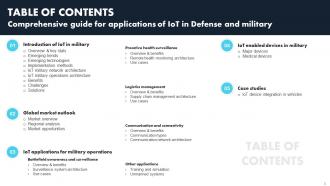
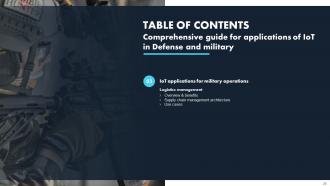
Slide 3: This slide shows Table of Content for the presentation.
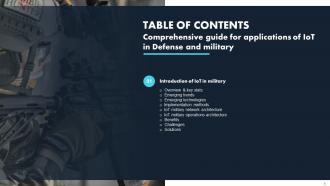
Slide 4: This slide shows title for topics that are to be covered next in the template.
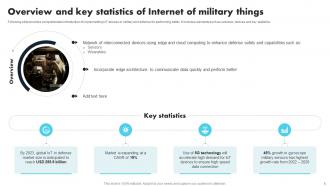
Slide 5: This slide provides comprehensive introduction of implementing IoT devices in military and defense for performing better.
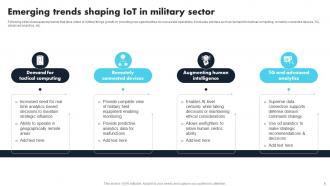
Slide 6: This slide showcases top trends that drive intent of military things growth by providing new opportunities for successful operations.
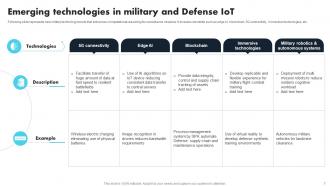
Slide 7: This slide represents new military technology trends that enhances computational reasoning for surveillance missions. It includes elements such as edge AI, blockchain etc.
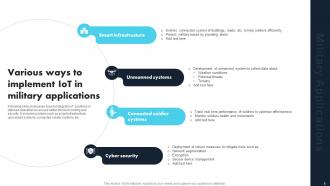
Slide 8: This slide showcases ways to integrate IoT solutions in defense operations to ensure better decision making and security.
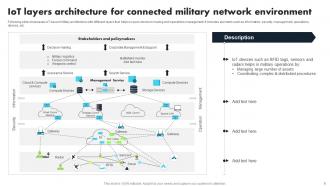
Slide 9: This slide displays IoT based military architecture with different layers that helps in quick decision making and operations management.
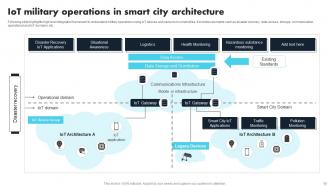
Slide 10: This slide highlights high level integration framework to understand military operations using IoT devices and sensors in smart cities.
Slide 11: This slide showcases various benefits of using IoT devices and solutions that helps to improve operational efficiency and situational awareness.
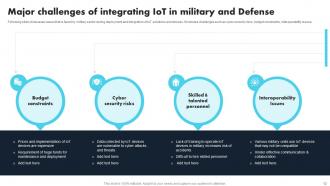
Slide 12: This slide displays issues that is faced by military sector during deployment and integration of IoT solutions and devices.
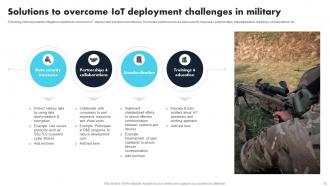
Slide 13: This slide represents mitigation solutions to overcome IoT deployment solutions and devices. It includes pointers such as data security measures, partnerships etc.
Slide 14: This slide shows title for topics that are to be covered next in the template.
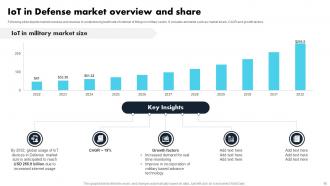
Slide 15: This slide depicts market overview and revenue to understand growth rate of internet of things in military sector. It includes elements such as market share etc.
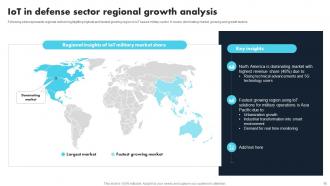
Slide 16: This slide represents regional outlook highlighting highest and fastest growing region in IoT based military sector.
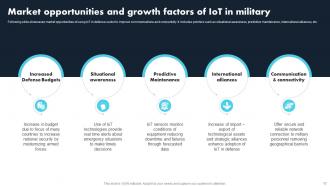
Slide 17: This slide showcases market opportunities of using IoT in defense sector to improve communications and connectivity. It includes pointers such as situational awareness etc.
Slide 18: This slide shows title for topics that are to be covered next in the template.
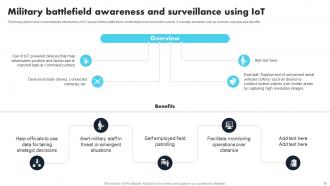
Slide 19: This slide provide comprehensive introduction of IoT based military battle fields monitoring to improve border security. It includes elements such as overview etc.
Slide 20: This slide represents framework to understand working process of smart surveillance system on military borders that helps to reduce external threats.
Slide 21: This slide showcases use cases for IoT in military and defense that provides proactive and data driven approach to perform operations.
Slide 22: This slide shows title for topics that are to be covered next in the template.
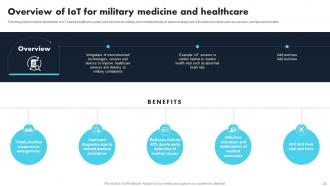
Slide 23: This slide provides introduction of IoT based healthcare system and services for military personnel that helps to enhance diagnosis.
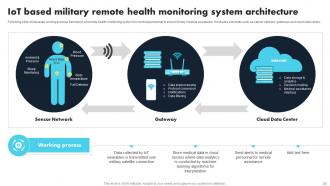
Slide 24: This slide showcases working process framework of remote health monitoring system for medical personnel to ensure timely medical assistance.
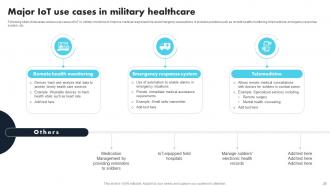
Slide 25: This slide displays various use cases of IoT in military medicine to improve medical response time and emergency evacuations.
Slide 26: This slide shows title for topics that are to be covered next in the template.
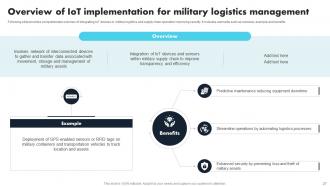
Slide 27: This slide provides comprehensive overview of integrating IoT devices in military logistics and supply chain operation improving security.
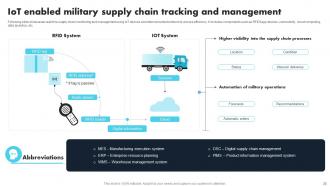
Slide 28: This slide showcases real time supply chain monitoring and management using IoT devices and interconnected network to ensure efficiency.
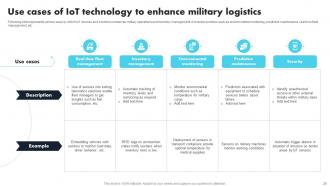
Slide 29: This slide represents various ways by which IoT devices and solutions enhances military operations and inventory management.
Slide 30: This slide shows title for topics that are to be covered next in the template.
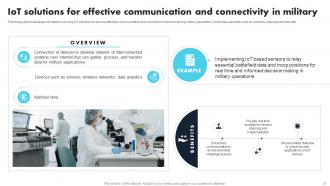
Slide 31: This slide showcases introduction of using IoT solutions to ensure effective communication and connection of devices during military operations.
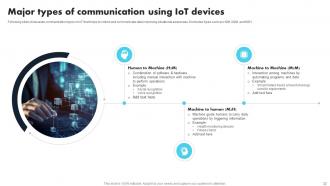
Slide 32: This slide displays communication types in IoT that helps to collect and communicate data improving situational awareness. It includes types such as H2M, M2M and M2H.
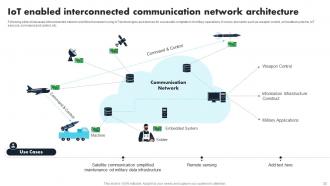
Slide 33: This slide showcases interconnected network workflow framework using IoT technologies and devices for successful completion of military operations.
Slide 34: This slide shows title for topics that are to be covered next in the template.
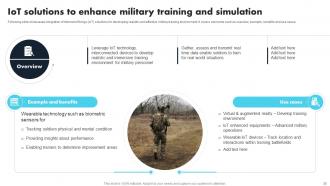
Slide 35: This slide showcases integration of internet of things (IoT) solutions for developing realistic and effective military training environment.
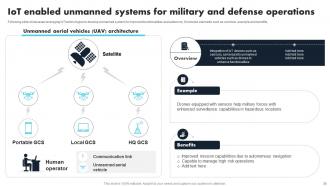
Slide 36: This slide displays leveraging IoT technologies to develop unmanned system for improved functionalities and autonomy. It includes elements such as overview etc.
Slide 37: This slide shows title for topics that are to be covered next in the template.
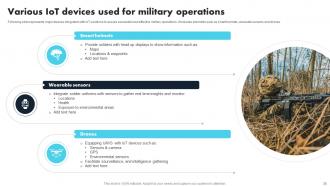
Slide 38: This slide represents major devices integrated with IoT solutions to assure successful and effective military operations.
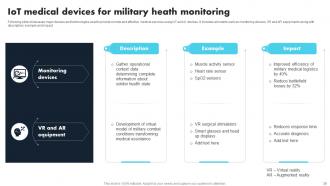
Slide 39: This slide showcases major devices and technologies used to provide remote and effective medical services using IoT and AI devices.
Slide 40: This slide shows title for topics that are to be covered next in the template.
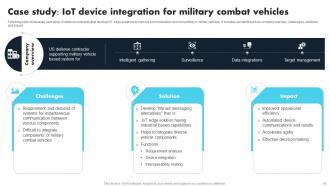
Slide 41: This slide showcases case study of defense contractor that develop IoT edge solutions to improve communication and connectivity in military vehicles.
Slide 42: This slide shows all the icons included in the presentation.
Slide 43: This slide is titled as Additional Slides for moving forward.
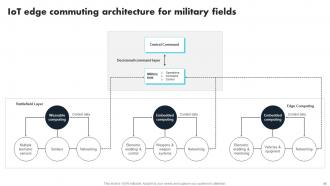
Slide 44: This slide displays IoT edge commuting architecture for military fields.
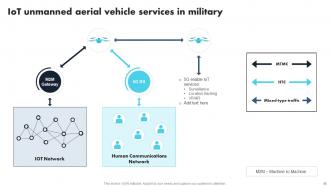
Slide 45: This slide presents IoT unmanned aerial vehicle services in military.
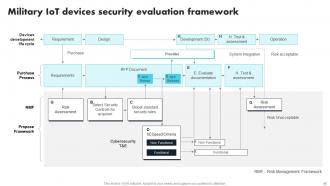
Slide 46: This slide describes Military IoT devices security evaluation framework.
Slide 47: This slide presents IoT based defense warfare scenario framework.
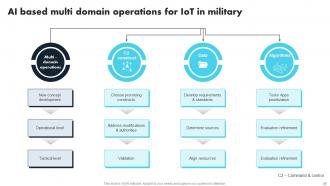
Slide 48: This slide displays AI based multi domain operations for IoT in military.
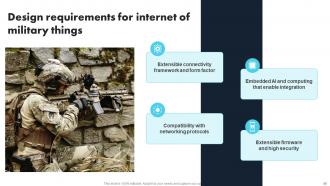
Slide 49: This slide presents Design requirements for internet of military things.
Slide 50: This slide provides 30 60 90 Days Plan with text boxes.
Slide 51: This slide depicts Venn diagram with text boxes.
Slide 52: This is Our Target slide. State your targets here.
Slide 53: This slide contains Puzzle with related icons and text.
Slide 54: This is a Thank You slide with address, contact numbers and email address.
Comprehensive Guide For Applications Of IoT In Defense And Military Powerpoint Presentation Slides IoT CD with all 62 slides:
Use our Comprehensive Guide For Applications Of IoT In Defense And Military Powerpoint Presentation Slides IoT CD to effectively help you save your valuable time. They are readymade to fit into any presentation structure.

















FAQs for Comprehensive Guide For Applications Of IoT In Defense And Military Powerpoint Presentation
Dude, the big wins are getting real-time intel and way less equipment failures. IoT sensors on your vehicles and gear feed you instant data, so decisions happen faster in the field. Predictive maintenance is honestly a game-changer - saves crazy money and stops critical stuff from breaking at the worst possible moment. You've got eyes everywhere without risking actual people. Plus logistics planning gets so much easier with all that connected data flowing in. My advice? Start with some pilot programs on less critical systems first, see how it goes from there.
Dude, you're basically building a digital nervous system across the whole battlefield. Connected drones, ground sensors, soldier wearables - all that stuff streams live intel back to command. Environmental data, enemy movement, supply levels, you name it. It's honestly pretty insane how much visibility you get. All those data points hit centralized dashboards so commanders can catch patterns and threats way faster than old-school recon. Oh, and definitely start with your biggest blind spots first - that's where you'll see the most immediate payoff from connected sensors.
Dude, IoT devices basically turn your whole defense setup into one giant target. Every sensor and drone becomes another way in for bad actors. Most of these things have garbage authentication and don't encrypt their communications properly. Plus the firmware? Good luck getting regular updates on that stuff. Here's the thing - a lot of IoT gear was built for consumers, not military use, so you're stuck with all those weak security features. Honestly, just assume everything's already compromised and build your network with zero-trust from the start. It's the only way that makes sense anymore.
So IoT basically gives you eyes on everything in real-time - ammunition, vehicles, fuel levels, the works. Sensors automatically track inventory as stuff moves around, and your equipment reports back on its condition constantly. The cool part? You can predict maintenance issues before things break down in the field. Honestly, it beats the old days of manually hunting down missing gear. Connected vehicles tell you exactly where they are and how they're running. Bottom line - you'll waste way less time on logistics busywork and can focus on what actually matters for the mission.
So basically, you stick IoT sensors on your defense gear to track things like vibration and temperature patterns. The data feeds into AI that predicts when stuff's about to break - which honestly beats waiting for your tank engine to die mid-mission. Real-time monitoring means you can schedule maintenance during downtime instead of dealing with surprise failures. They're saying it cuts unexpected breakdowns by like 70%, though I'd probably start small and just outfit your most critical equipment first. The cost savings alone make it worth it.
So IoT connects all these defense sensors and devices so they can actually talk to each other instantly. Think radar, weapons, vehicles - everything sharing data in real-time instead of working in silos. It's honestly pretty wild how fast information flows now. Sensors automatically pick up threats and positioning without anyone having to manually check everything. Commanders get the full picture immediately, which means way quicker response times. Instead of piecing together fragments from different systems, you're seeing the whole battlefield at once. Makes situational awareness so much better when everything's connected like that.
Dude, IoT analytics is huge for military ops. Your sensors and drones feed you real-time intel instead of waiting around for reports to climb the ladder. Pretty wild how fast it processes everything compared to doing it manually. The predictive stuff catches equipment about to fail and spots threat patterns you'd probably miss. Honestly, it's like having superpowers but for data. Here's the thing though - don't get lost in all the fancy tech. Use it to handle the boring monitoring tasks so your people can tackle the big strategic decisions that actually need a human brain.
Look, the big issues are privacy invasion and data misuse - you're basically hoovering up tons of personal info from regular people when you compromise all those connected devices in cities. Autonomous systems can make targeting calls faster than any human can step in, which is terrifying honestly. Data oversight? What oversight - there's rarely proper deletion protocols or governance. It's pretty much chaos right now. My advice? Set up solid rules of engagement and data frameworks before you deploy anything. Don't try to figure it out afterwards when everything's already gone sideways.
Dude, these IoT drones are completely changing how wars work. They're getting real-time intel and can coordinate with each other automatically - no human needed. Hundreds of cheap connected drones can swarm together, share targets, and adapt on the fly. Way more unpredictable than the old expensive jets. Honestly, it's kinda terrifying how fast this stuff is moving. If you're in defense tech, you better start rethinking your whole threat assessment because autonomous coordination is a total game-changer. The sci-fi stuff we used to watch? Yeah, it's here now.
So the military's been crushing it with IoT for predictive maintenance on aircraft - catching problems before they get crazy expensive. NATO's got these smart sensor networks doing perimeter security that auto-detect intrusions. Israel's Iron Dome is basically IoT heaven for real-time threat stuff. Even boring supply chain inventory management has saved ridiculous amounts of money. Oh, and smaller bases are using it for readiness tracking too. When you're pitching this, definitely hammer the cost savings angle hard. That's literally the only thing that gets budget people excited these days.
Honestly, IoT stuff could be huge for keeping soldiers safer. You'd have wearables tracking heart rates, spotting injuries, maybe even detecting chemical threats in the air. Smart gear that actually tells you when it's about to fail? That's pretty cool. Real-time health monitoring means medics know what's happening before things get bad. Logistics gets way easier too - equipment basically talks to you about maintenance needs. Only downside is cybersecurity becomes a nightmare since you're adding so many connection points that hackers could potentially exploit.
Look, you'll definitely run into NIST's Cybersecurity Framework and DoD's RMF first. Start with NIST 800-53 controls as your foundation - honestly, everything else just references it anyway. DoD has their own IoT requirements through DFARS plus Section 889 (the "no sketchy Chinese hardware" thing). NATO's got NISP guidelines for international stuff, and don't forget FedRAMP if you're touching cloud components. The classification level determines which DoD requirements get layered on top. It's a lot but NIST makes a solid starting point.
IoT sensors are honestly amazing for disaster response. Real-time data when everything's falling apart? Yes please. Drop them from drones into dangerous zones to monitor air quality, find structural damage, track survivors. They even work for locating people under rubble - which still blows my mind how that's possible. Military uses them constantly since they function when normal infrastructure fails. Oh, and mesh networking is clutch here because you can't rely on centralized systems when cell towers are down. The sensors talk to each other instead of needing some central hub.
So there's tons of partnerships happening right now. AWS has this huge Pentagon cloud deal, and Microsoft's Azure handles a lot of the military IoT data stuff. Lockheed Martin teams up with smaller tech companies for sensor networks. Boeing's doing drone swarm projects with startups too - which honestly sounds pretty wild. The cybersecurity side is where things get really interesting though. That's where you'll see the actual breakthroughs happening. I'd watch who's landing those big defense contracts if you want to track where this is all headed.
You'll want to focus on three main areas: cybersecurity, data analytics, and systems integration. Cybersecurity's probably the biggest one since all those connected devices are basically potential entry points for attacks. Then there's data analytics - without it, you're just swimming in a sea of sensor data that doesn't mean anything. Oh, and systems integration matters too because everything needs to play nice with whatever defense systems are already in place. The learning curve's pretty steep, not gonna lie. I'd start with cybersecurity basics and maybe some simple data viz tools, then work your way up as things get more complicated.
-
Huge collection of high-quality templates. Worth each penny.
-
Been using SlideTeam for some time now…can’t imagine why I wasted all that time in front of the screen trying to make the perfect presentation.