


Role Of IoT In Enhancing Waste Management System Powerpoint Presentation Slides IoT CD





Try Before you Buy Download Free Sample Product
 Impress Your
 Audience
 100%
100% Editable
 Save Hours
 of Time


IoT in waste management employs technology to automate waste collection and processing tasks. It effectively bridges the gap between traditional and modern sustainable practices. This deck Role of IoT in Enhancing Waste Management System covers the introduction, highlights key benefits, components and architecture and addresses challenges related to traditional waste management systems. This PPT dives into the market outlook, offering insights into market size, market players, and growth drivers. It also provides insights into various types of smart waste management systems such as garbage monitoring systems, waste collection vehicle tracking systems and more. This presentation explores key applications of IoT in waste management such as smart bins, fleet tracking, pneumatic sewer pipe and waste sorting and recycling. Additionally, it covers emerging smart waste management technologies. Furthermore, this PPT covers the impact of IoT technology on operational costs and recycling management operations with a dashboard to effectively manage smart bins. It also includes case studies to illustrate the practical implications. Download it now.
People who downloaded this PowerPoint presentation also viewed the following :
Content of this Powerpoint Presentation
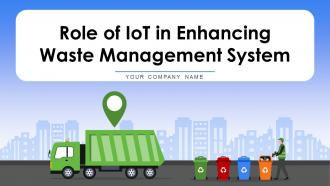
Slide 1: This slide showcase title Role of IoT in Enhancing Waste Management System. State your Company name.
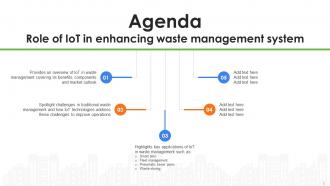
Slide 2: This slide showcase the title Agenda.
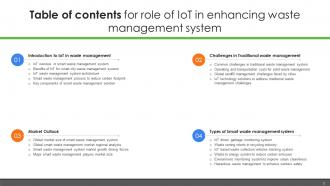
Slide 3: This slide exhibit table of content.
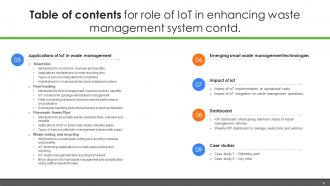
Slide 4: This slide exhibit table of content.
Slide 5: This slide exhibit table of content: Introduction to IoT in waste management
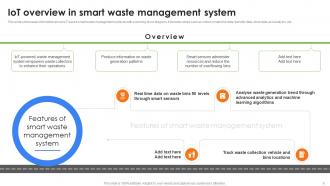
Slide 6: This slide showcases information about IoT-based smart waste management systems with a working block diagram.
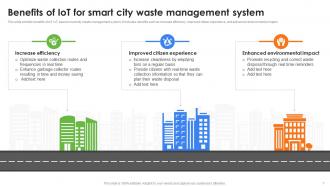
Slide 7: This slide exhibits benefits of IoT IoT-based smart city waste management system.
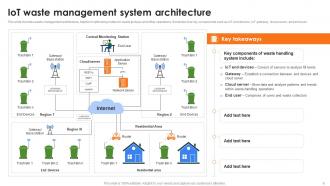
Slide 8: This slide includes waste management architecture, helpful in optimizing routes for waste pickups and other operations.
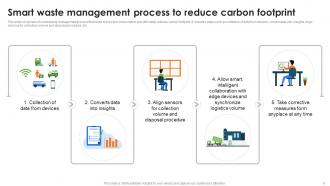
Slide 9: This slide comprises of smart waste management process that leads to less fuel consumption and ultimately reduces carbon footprint.
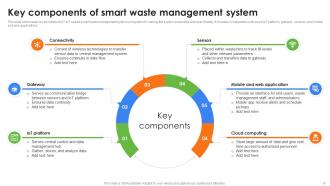
Slide 10: This slide showcases key elements of IoT IoT-based smart waste management system ecosystem for making the system accessible and user-friendly.
Slide 11: This slide exhibit table of content- Challenges in Traditional waste management.
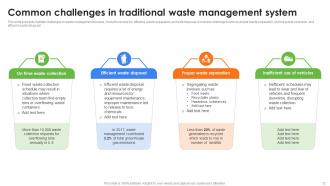
Slide 12: This slide presents multiple challenges in waste management process, crucial to resolve for effective waste separation, and safe disposal.
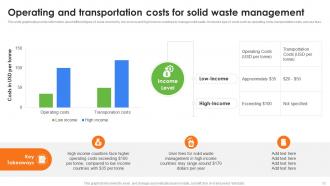
Slide 13: This slide graphically provide information about different types of costs incurred by low income and high income countries to manage solid waste.
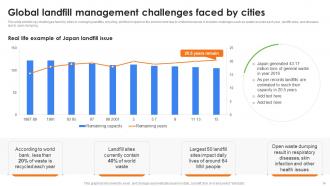
Slide 14: This slide exhibits key challenges faced by cities in managing landfills, recycling, and their impact on the environment due to limited resources.
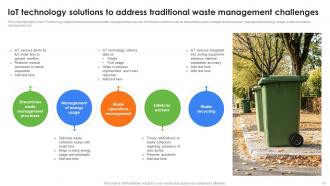
Slide 15: This slide highlights how IoT technology streamlines and enhances waste management processes.
Slide 16: This slide exhibit table of content: Market Outlook.
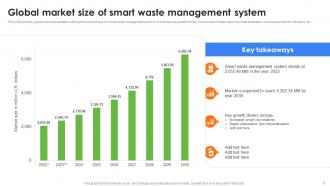
Slide 17: This slide exhibits a graphical representation of the global market size of smart waste management systems.
Slide 18: This slide showcases smart waste management system growth analysis in various geographical regions.
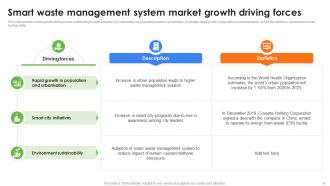
Slide 19: This slide exhibits market growth driving forces contributing to rapid adoption of smart waste management system in smart cities.
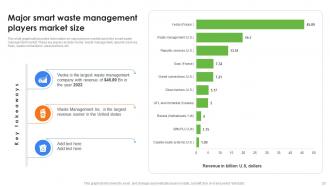
Slide 20: This slide graphically provides information on major players market size in the smart waste management market.
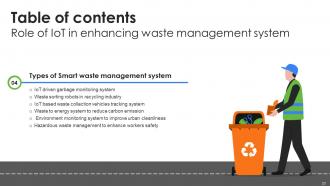
Slide 21: This slide exhibit table of content: Types of Smart waste management system.
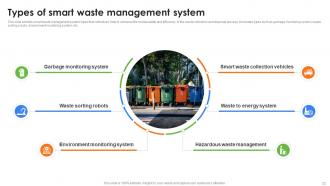
Slide 22: This slide exhibits smart waste management system types that collectively help to enhance the sustainability and efficiency of the waste collection.
Slide 23: This slide exhibit table of content: Types of Smart waste management system.
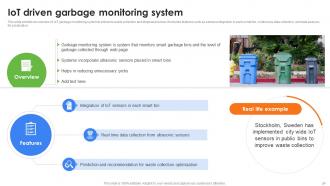
Slide 24: This slide exhibits an overview of IoT garbage monitoring system to enhance waste collection and disposal process.
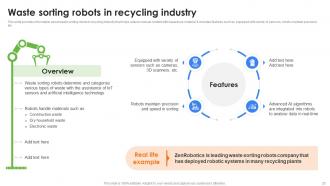
Slide 25: This slide provides information about waste sorting robots in recycling industry that helps reduce manual content with hazardous material.
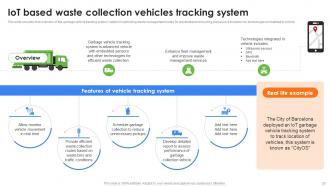
Slide 26: This slide consists of an overview of the garbage vehicle tracking system, helpful in optimizing waste management routes for residential and recycling purposes.
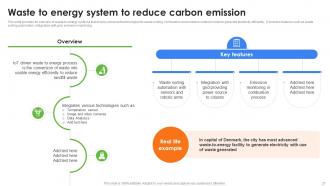
Slide 27: This slide provides an overview of waste-to-energy systems that employ advanced technologies for waste sorting, combustion and emission control.
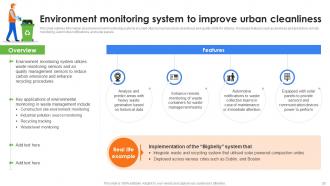
Slide 28: This slide outlines information about environment monitoring systems in smart cities to improve urban cleanliness and quality of life for citizens.
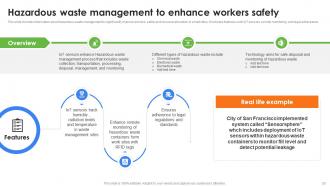
Slide 29: This slide includes information about hazardous waste management to significantly improve workers’ safety and resource allocation in smart cities.
Slide 30: This slide exhibit table of content: Applications of IoT in waste management
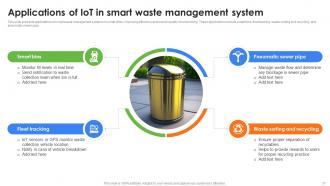
Slide 31: This slide presents applications of smart waste management systems in smart cities, improving efficiency and overall quality of urban living.
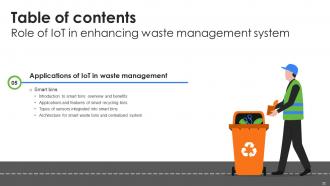
Slide 32: This slide exhibit table of content- Smart bins.
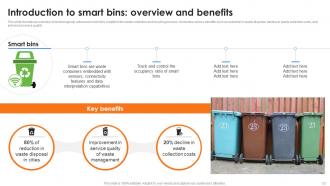
Slide 33: This slide includes an overview of technologically advanced smart bins, helpful in the waste collection and recycling process.
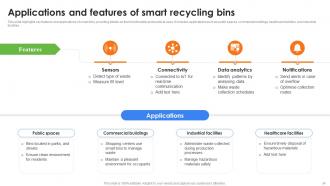
Slide 34: This slide highlights key features and applications of smart bins, providing details on their functionality and practical uses.
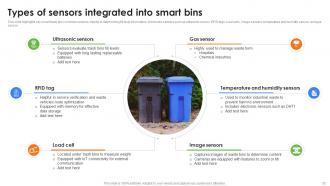
Slide 35: This slide highlights key smart trash bins common sensors, helpful in determining fill level information.
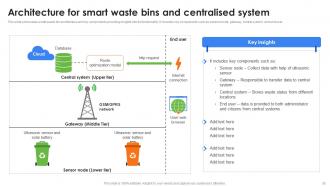
Slide 36: This slide showcases smart waste bin architecture and key components providing insights into its functionality.
Slide 37: This slide exhibit table of content- Fleet tracking.
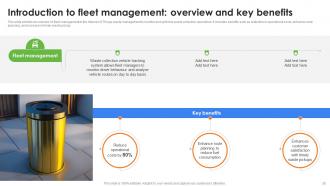
Slide 38: This slide exhibits an overview of fleet management in the Internet of Things waste management to monitor and optimize waste collection operations.
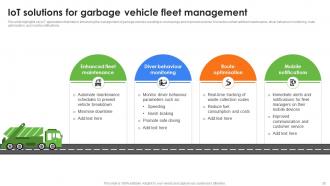
Slide 39: This slide highlights key IoT applications that help in enhancing the management of garbage vehicles resulting in cost savings and improved services.
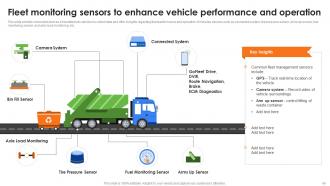
Slide 40: This slide exhibits connected devices embedded into vehicles to collect data and offer insights regarding fleet performance and operation.
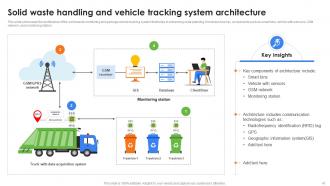
Slide 41: This slide showcases the architecture of the solid waste monitoring and garbage vehicle tracking system that helps in enhancing route planning.
Slide 42: This slide exhibit table of content- Pneumatic Sewer Pipe.
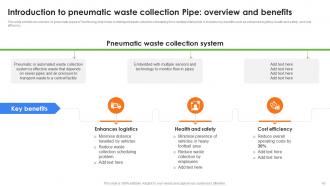
Slide 43: This slide exhibits an overview of pneumatic pipes IoT technology that helps in intelligent waste collection scheduling from multiple inlet points.
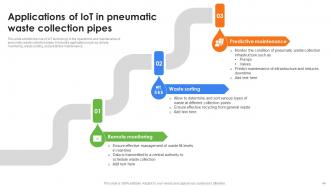
Slide 44: This slide exhibits the role of IoT technology in the operations and maintenance of pneumatic waste collection pipes.
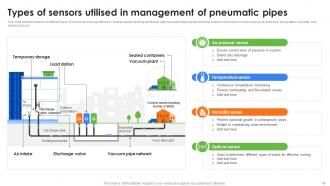
Slide 45: This slide exhibits features of different types of sensor technology utilized by central waste handling facilities to optimize automated waste collection systems.
Slide 46: This slide exhibit table of content- Waste sorting and recycling.
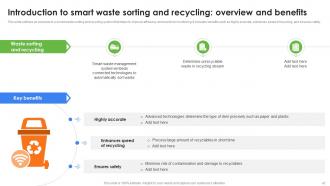
Slide 47: This slide outlines an overview of a smart waste sorting and recycling system that helps to improve efficiency and real-time monitoring.
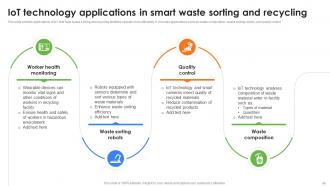
Slide 48: This slide exhibits applications of IoT that help waste sorting and recycling facilities operate more efficiently.
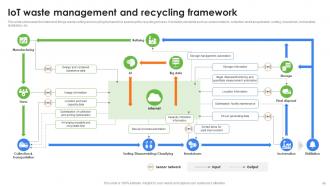
Slide 49: This slide showcases the Internet of things waste sorting and recycling framework to speed up the recycling process.
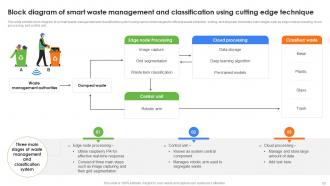
Slide 50: This slide exhibits block diagram of a smart waste management and classification system using various technologies.
Slide 51: This slide exhibit table of content: Emerging smart waste management technologies
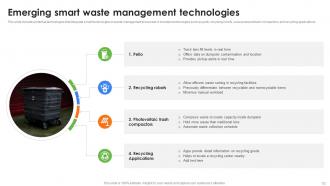
Slide 52: This slide includes potential technologies that integrate smart technologies in waste management processes.
Slide 53: This slide exhibit table of content: Impact of IoT.
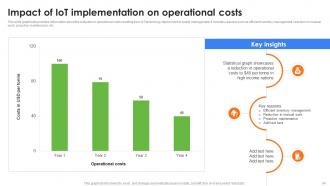
Slide 54: This slide graphically provides information about the reduction in operational costs resulting from IoT technology deployment in waste management.
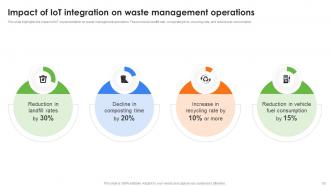
Slide 55: This slide highlights the impact of IoT implementation on waste management operations.
Slide 56: This slide exhibit table of content: Dashboard.
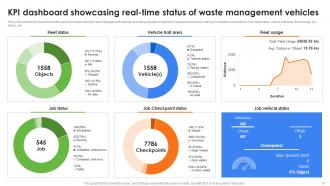
Slide 57: This slide exhibits the real-time performance of waste collection and management vehicles providing valuable insights for operational decision making.
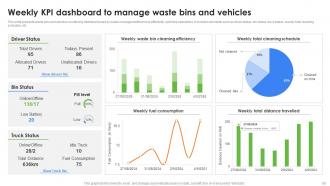
Slide 58: This slide presents waste bins and vehicles monitoring dashboard used by waste management teams to effectively optimize operations.
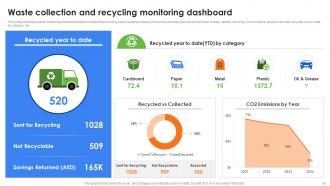
Slide 59: This slide presents a waste monitoring dashboard helpful in optimising recycling rate of waste produced.
Slide 60: This slide exhibit table of content: Case studies.
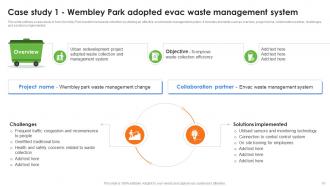
Slide 61: This slide outlines a case study of how Wembley Park transformed waste collection by utilizing an effective smart waste management system.
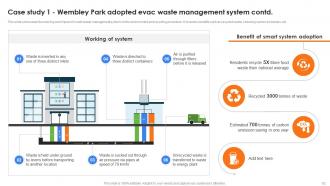
Slide 62: This slide showcases the working and impact of smart waste management system on the environment and recycling procedure.
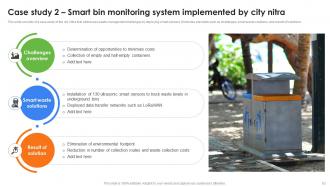
Slide 63: This slide consists of a case study of the city Nitra that addresses waste management challenges by deploying smart sensors.
Slide 64: This slide shows all the icons included in the presentation.
Slide 65: This slide is titled as Additional Slides for moving forward.
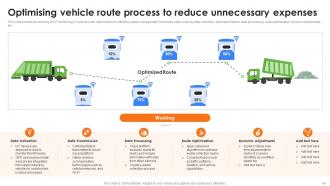
Slide 66: This slide exhibits the working of IoT technology in vehicle route optimization for effective waste management.
Slide 67: This slide provides 30 60 90 Days Plan with text boxes.
Slide 68: This slide contains Puzzle with related icons and text.
Slide 69: This slide shows Post It Notes for reminders and deadlines. Post your important notes here.
Slide 70: This is Our Vision, Mission & Goal slide. Post your Visions, Missions, and Goals here.
Slide 71: This slide depicts Venn diagram with text boxes.
Slide 72: This is a Thank You slide with address, contact numbers and email address.
Role Of IoT In Enhancing Waste Management System Powerpoint Presentation Slides IoT CD with all 80 slides:
Use our Role Of IoT In Enhancing Waste Management System Powerpoint Presentation Slides IoT CD to effectively help you save your valuable time. They are readymade to fit into any presentation structure.














FAQs for Role Of IoT In Enhancing Waste Management System Powerpoint Presentation
Look, the biggest win is real-time monitoring - you'll get sensors tracking fill levels so trucks only come when bins are actually full. No more pointless trips on fixed schedules. That alone cuts fuel costs 30-40%. You can catch problems early too - overflows, missed pickups, broken equipment. The route optimization is pretty sweet, and it helps predict when stuff needs maintenance. My buddy's city tried it and was kicking themselves for waiting so long. Oh, and definitely start small - pilot one district first before going all-in citywide. Way less headaches that way.
So basically these smart sensors go in waste bins and tell you exactly how full they are. Your trucks only hit the bins that actually need it instead of driving around on some random schedule - saves a ton on gas. The sensors ping you when bins hit like 70-80% full, so you've got time to map out the best routes. No more overflowing garbage everywhere, which honestly gets gross fast. Start with your busiest spots first since that's where you'll see the biggest difference. Way better than the old "drive around and check everything" approach if you ask me.
So basically, data analytics takes all that sensor info from your smart bins and actually makes sense of it. Without it, you're just drowning in random numbers about fill levels and pickup times. The algorithms predict when bins'll be full, figure out the most efficient collection routes, and can even spot weird patterns that might mean something's broken. Way better than the old "wait until someone complains about an overflowing dumpster" approach, you know? You can actually plan ahead instead of constantly putting out fires. Plus the route optimization saves a ton on fuel costs - that part's pretty sweet.
So basically these smart bins have sensors that track how full they're getting and ping your system when it's time to empty them. No more guessing or sticking to some random schedule that doesn't make sense. You'll catch bins before they overflow and create a mess everywhere - honestly the overflow thing is such a headache to deal with. Plus you can map out better collection routes based on real data instead of just winging it. I'd probably test a few in your busiest spots first to see if it's actually worth the investment.
Legacy infrastructure is the worst - you're basically slapping smart sensors onto garbage trucks from the 90s. Budget's always tight too. Your IT people probably have no clue about hardware integration, and suddenly you've got thousands of sensors pumping out data 24/7. Training crews while they're still running routes? Good luck with that. Upfront costs are painful, though you'll save money later. Honestly, just pilot it in one neighborhood first. Trust me, going citywide right away is asking for trouble.
So these IoT sensors can actually tell you what people are tossing and how much of each type. Real-time contamination data shows you exactly where folks are messing up recycling - which honestly is everywhere at first. The sensors catch people dumping wrong stuff immediately. You'll get way better at targeting education where it's actually needed instead of just guessing. Plus route optimization becomes way easier when you know which areas generate more of what waste. I'd definitely start small though - maybe just a few busy spots to see what weird patterns your community has.
IoT sensors totally transform how you track hazardous waste - honestly it's pretty incredible. Real-time GPS shows you exactly where containers are, plus you get constant monitoring of temps and handling conditions. If something goes wrong, boom - instant alerts. No more wondering if your waste actually made it to the right facility. The sensors catch leaks or weird temperature spikes too, which is huge for safety. For compliance audits, you'll have bulletproof documentation that regulators love. I'd start small though - pick your scariest waste streams first and test it there before rolling out everywhere.
So you basically turn waste management into this weird community competition thing. People get obsessed when they can see their neighborhood's recycling stats - contamination rates, how efficient pickups are, all that stuff. Honestly reminds me of those electricity apps that make everyone bizarrely competitive about their power usage! You can send personalized feedback to households and set up leaderboards between different streets. Even better - instant alerts when someone dumps pizza boxes in recycling (ugh, why do people do that?). Start simple though. Maybe just a community dashboard showing weekly scores and contamination rates first.
Honestly, those smart bins are pretty invasive when you think about it. They can track when you're home based on when you toss stuff, figure out your routines, even analyze your consumption habits from what you throw away. It's like having a little spy in your trash can lol. Data breaches are obviously a concern too - imagine that info getting leaked. Sometimes the sensors pick up more than they should, like conversations happening nearby. I'd definitely check with your waste company about what they're actually collecting and see if you can opt out of some features.
So basically, you can hook up ML algorithms to IoT sensors in waste bins to sort materials way better than doing it by hand. The sensors pick up weight, what stuff looks like optically, density - all that data. Then the ML models start recognizing patterns and can tell you if something's plastic, metal, organic waste, whatever. Pretty neat how they actually get better over time too. You'd want automated sorting arms that react to these predictions instantly. Oh, and definitely start with just one type of material to train everything, then add more types later. Way easier that way.
So IoT devices are pretty cool for this - they turn your waste into actual useful data. Smart bins and sensors track what you're throwing away and where it's going. Then that info gets fed back into supply chains so materials can be reused instead of dumping everything in landfills. Honestly, the predictive stuff is where it gets interesting. You can optimize pickup routes and timing, which cuts down on emissions. Plus you'll spot patterns in what's being wasted - sometimes it's surprising what companies throw out! I'd start by figuring out where your biggest waste streams are happening first. That's where you'll see the most impact from adding sensors.
Look at what Barcelona and Amsterdam did with their smart bin networks - those became the gold standard basically overnight. Cities are seeing 30-40% cost reductions, which honestly blew my mind when I first heard it. The bins automatically optimize collection routes and schedules, and the data is so solid that regulatory bodies now require similar efficiency metrics. Standards organizations jumped on this too - they're turning these approaches into official protocols for everything from sensor placement to performance measurement. Barcelona's setup is particularly slick, though I can't remember all the technical details off the top of my head. Bottom line: study these cases before you start your project. You'll save yourself tons of headaches.
So basically IoT sensors track all your waste stuff automatically - fill levels, contamination, emissions, whatever. Real-time monitoring means you're not guessing about compliance anymore. The best part? Digital logs beat handwritten records every time (seriously, auditors eat that up). You'll get alerts before hitting regulatory limits instead of dealing with violations later. Honestly, the automated dashboards are clutch - when inspectors show up, you've got everything ready to go. Way less stressful than the old manual tracking we used to do.
Most cities see around 20-30% savings on collection costs, which honestly adds up fast with municipal budgets. Route optimization is where the magic happens - trucks aren't wasting gas on empty bins anymore. Labor hours drop too since drivers aren't making pointless stops. Vehicle maintenance costs go down as well. Cities with those old fixed-schedule systems (what were they thinking?) sometimes hit even higher savings. The data helps you figure out if you actually need all those trucks and crews. I'd definitely test it in one neighborhood first though - get your own numbers before going citywide.
Dude, IoT waste management is seriously changing how cities work. Smart bins tell you when they're full, which cuts down on unnecessary truck trips - saves fuel and reduces traffic. Cities get real-time data dashboards so mayors can actually see what's happening instead of just guessing. The whole system connects everything together, which sounds nerdy but looks pretty amazing when mapped out live. Better recycling rates, cleaner streets, less pollution. Oh and if you're doing any smart city stuff, definitely check how waste IoT plays with your other systems - it integrates surprisingly well.
-
It's always a delight to see new templates from you! I am extremely pleased with the fact that they are easy to modify and fit any presentation layout in seconds!
-
Nothing beats the well-formatted and professionally designed templates offered. Kudos to SlideTeam for their amazing collection of PPT slides.