


Best Uses Of Artificial Intelligence In Agriculture




Try Before you Buy Download Free Sample Product
 Impress Your
 Audience
 100%
100% Editable
 Save Hours
 of Time


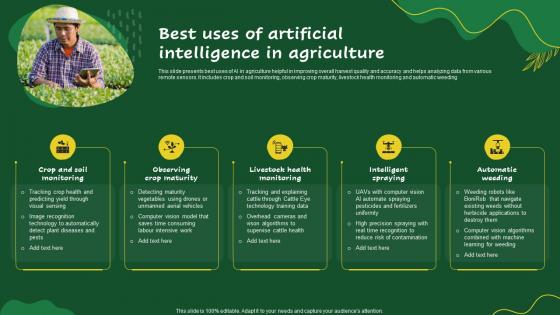
This slide presents best uses of AI in agriculture helpful in improving overall harvest quality and accuracy and helps analyzing data from various remote sensors.It includes crop and soil monitoring, observing crop maturity, livestock health monitoring and automatic weeding.
People who downloaded this PowerPoint presentation also viewed the following :
Best Uses Of Artificial Intelligence In Agriculture with all 6 slides:
Use our Best Uses Of Artificial Intelligence In Agriculture to effectively help you save your valuable time. They are readymade to fit into any presentation structure.





FAQs for Best Uses Of Artificial
Honestly, the precision stuff is where you'll see the biggest difference - like catching pest problems before they blow up or nailing your irrigation timing perfectly. Soil analysis gets way more accurate than the old-school methods. The predictive side is pretty sweet too, helps you plan harvests and cut down on waste big time. Real-time monitoring with drones? Total game changer for keeping tabs on everything. Resource savings are legit impressive once you get it dialed in. I'd probably start with automated irrigation in just one section - easier to wrap your head around the impact that way.
Dude, AI analytics for crops is actually insane - it processes way more data than you could ever handle manually. Weather patterns, soil conditions, satellite imagery, historical yields... it combines everything to predict what'll happen. The crazy part? It catches tiny patterns humans totally miss, like slight moisture changes or early pest signs that mess with yields weeks down the line. Honestly feels like cheating sometimes lol. Start with whatever data you're already tracking on your farm, then find a platform that can pull it all together and analyze it. The accuracy these models get now is pretty wild.
So machine learning is basically like having a super smart assistant for your farm. It crunches data from sensors, drones, satellites - all that tech stuff - to help you figure out when to water, where to add fertilizer, that kind of thing. The cool part? It gets better at reading your specific soil and conditions over time. I'd honestly just pick one area where you're struggling most - maybe irrigation or pest issues - and try an ML tool for that first. Don't go crazy trying to automate everything at once. The pattern recognition is actually pretty impressive once you see it in action.
Honestly, the AI imaging stuff is getting really good at catching pest problems before you'd even notice them. You can mount cameras on drones or just use your phone - there are apps now where you snap a pic of a sketchy-looking plant and it tells you what's wrong. Way better than waiting until half your field looks like garbage. The drone setups are pricier but they'll scan everything automatically. I'd probably test it on just one field first though, see how it handles your specific crops. My buddy swears by it but he grows corn, so who knows if it works as well for other stuff.
Honestly, the biggest issues are job displacement and data privacy. Farmers are freaking out about automation taking over traditional work. Then there's this whole mess about who controls all the agricultural data getting collected - like yield info, financials, farming methods. Nobody wants competitors seeing that stuff or having it used against them. Smaller farms might get screwed over differently than big operations too because of AI bias. Oh, and some of these tech companies are way too focused on their own profits instead of actually helping farmers. Just be upfront about what data you're collecting and make sure your solutions genuinely help the people using them.
Dude, start with basic soil sensors - they're game changers for tracking moisture and nutrients. You'll only water and fertilize exactly where it's actually needed instead of guessing. The drone tech is getting crazy affordable too, tracks crop health from above. Weather prediction helps you stay ahead of problems rather than scrambling after. Honestly the chemical runoff reduction alone makes it worth it. My neighbor cut his water use by like 30% last season. It's not just hippie stuff anymore - this precision farming actually saves money while being way better for the environment.
So there's actually a bunch of ways AI can help clean up your supply chain mess. Better demand forecasting cuts down on waste big time. You get real-time tracking from farm to shelf, plus route optimization that saves money on transport costs. Storage monitoring happens automatically now - prevents spoilage before it starts. Oh, and it predicts when equipment's about to break down, which honestly saves so much headache. Supply and demand matching across markets gets way more accurate too. I'd start with basic tracking systems first though - that's where you'll see results fastest and prove it's worth the investment.
So you've got four main types of tech working with AI in farming. IoT sensors are probably the most useful - they track soil moisture, temperature, all that crop health stuff in real time. Drones do aerial monitoring which is honestly pretty sick to watch. GPS lets farmers get super precise with where they plant and fertilize instead of just spraying everything. Then there's robots doing the actual grunt work like harvesting based on what the AI tells them. Oh and if you're thinking about getting into this, I'd figure out what sensors would actually help your specific crops first rather than going crazy with all the fancy stuff.
So basically, you set up soil moisture sensors and the AI reads those plus weather data to figure out exactly when your crops need water. Pretty wild how it can predict demand days ahead. I've seen farmers cut water use by 20-30% while getting better yields - sounds backwards but it works. The whole thing runs automatically and adjusts based on weather patterns coming up. Honestly beats guessing when to water. Just start small with sensors in one field first, see how it goes. Way better than over-watering everything like most people do.
Honestly, the main issues are cost and how complicated everything is - this stuff isn't cheap and most farmers don't have massive tech budgets. Learning how to actually use it is a real pain too since you need some technical skills. Then there's the whole mess of getting different systems and sensors to talk to each other. Internet in rural areas can be pretty terrible, which sucks because most AI solutions need cloud connectivity. Oh, and don't even get me started on trying to do everything at once - definitely pick one specific problem first and go from there.
Yeah, AI's totally changing farm work right now. Robots are doing harvesting and planting stuff that used to need tons of manual workers. Honestly, the tech is moving crazy fast - sometimes feels like sci-fi. But here's the thing: farms still need people, just different people. They want folks who can fix the machines and run all the automated systems. Way less backbreaking labor, way more computer skills needed. Oh, and my cousin who manages a farm says finding good tech people is actually harder than finding regular farmhands these days. You should probably look into retraining programs if this affects your area.
Honestly, we're nowhere close - maybe like 20% there at best. Sure, you've got some cool automated harvesters and spraying tech, but everything still needs someone babysitting it. The robots just can't handle weird weather or make those split-second calls that good farmers do without thinking. Costs are insane too, especially for smaller farms. My buddy tried some fancy weeding bot last year - worked great until it rained, then it was useless. I'd say start super small, maybe just monitoring stuff first. The hybrid thing where you mix AI with what you're already doing? That's where the real potential is.
Dude, this space is exploding - we're talking 25% growth yearly through 2030. Labor shortages and climate stuff are pushing farmers toward AI hard. Precision farming and autonomous tractors are gonna be everywhere soon. What's crazy is how AI already optimizes planting and harvest timing better than humans. Developing countries will see the biggest boom since food security is make-or-break there. Oh, and if you're looking to invest or whatever, target smaller farms - everyone's obsessed with industrial operations but that's not where the real opportunity is.
Honestly, it's way more doable than you'd think. Download some crop monitoring apps first - they can spot diseases from photos and most are free or like $10/month max. Weather predictions, irrigation timing, all that stuff. The smart move though is joining up with other farmers nearby to split costs on the pricier equipment like drones. My buddy's co-op does this and it works great. Agricultural extension programs are also jumping on this bandwagon with training and discounts. Start small with a basic crop health app and see if it actually helps your situation before going bigger.
Dude, farm data is super sensitive stuff - we're talking yield maps, financials, all your operational secrets. These AI systems basically know everything about your farm, which honestly freaks me out a little. Make sure whatever platform you pick has good encryption and clear policies about who owns your data. Some sketchy companies will sell your info to traders or suppliers behind your back. You gotta read that fine print carefully. Ask them straight up who's getting access before you sign anything - trust me on this one.
-
“Thanks to SlideTeam. Now I can make smart presentations in a fraction of time without any hassle.”
-
Wide collection of templates available. SlideTeam has made it easier to create presentations in just a few minutes.