


Use Cases Of Artificial Intelligence In Education Training Ppt




Try Before you Buy Download Free Sample Product
 Impress Your
 Audience
 100%
100% Editable
 Save Hours
 of Time


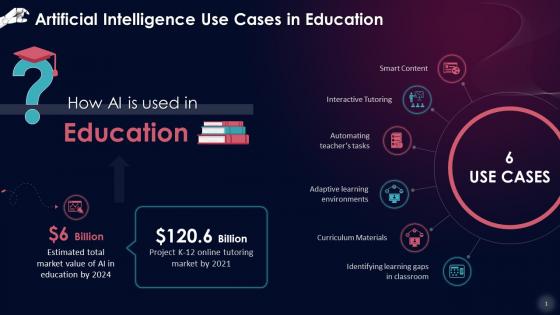
This slide lists use cases of Artificial Intelligence within the education industry.
People who downloaded this PowerPoint presentation also viewed the following :
Use Cases Of Artificial Intelligence In Education Training Ppt with all 17 slides:
Use our Use Cases Of Artificial Intelligence In Education Training Ppt to effectively help you save your valuable time. They are readymade to fit into any presentation structure.







FAQs for Use Cases Of Artificial Intelligence In
Artificial intelligence personalizes learning by analyzing student performance data, adapting content difficulty, identifying knowledge gaps, and recommending targeted resources in real-time. Through AI-powered platforms, educational institutions deliver customized learning paths, automated assessments, and individualized feedback, with many schools and universities finding that these systems significantly improve student engagement, learning outcomes, and educational efficiency.
AI tools assist teachers by automating grading, analyzing learning patterns, identifying knowledge gaps, and generating personalized feedback reports. Through machine learning algorithms, these systems can track individual student progress, highlight areas needing improvement, and suggest targeted interventions, ultimately enabling teachers to focus more time on instruction while delivering more precise, data-driven support to each student.
Ethical considerations include data privacy protection, algorithmic bias prevention, transparency in decision-making processes, student consent protocols, and maintaining human oversight in learning assessments. These frameworks ensure responsible implementation by safeguarding personal information, promoting equitable outcomes, and preserving educator autonomy, with many institutions finding that balanced AI integration enhances educational fairness while protecting student rights.
AI-driven adaptive learning technology enhances student engagement and outcomes by personalizing content delivery, adjusting difficulty levels in real-time, and providing immediate feedback based on individual learning patterns. Through machine learning algorithms, educational institutions streamline curriculum customization, minimize learning gaps, and accelerate knowledge retention, with many schools and universities finding that students achieve measurably better performance while maintaining higher motivation levels.
AI can bridge educational gaps through personalized learning platforms, multilingual content translation, remote tutoring systems, adaptive assessment tools, and affordable mobile learning applications. These technologies enable marginalized communities to access quality education regardless of geographic location or economic constraints, while AI-powered analytics help identify learning difficulties early, ultimately delivering equitable educational opportunities and improved academic outcomes.
Educators can effectively integrate AI tools by starting with pilot programs in specific subjects, providing comprehensive teacher training, aligning AI applications with learning objectives, and gradually scaling successful implementations. Through platforms like adaptive learning systems and automated grading tools, schools streamline administrative tasks, personalize student experiences, and enhance instructional efficiency, with many educational institutions finding that strategic AI integration ultimately delivers improved learning outcomes and operational effectiveness.
AI enhances student motivation through personalized learning paths, adaptive feedback systems, gamified experiences, and real-time progress tracking that responds to individual learning styles. These technologies enable students to take greater ownership of their education by providing immediate support, customized challenges, and clear goal visualization, with many educational institutions finding that AI-driven platforms significantly increase student engagement and autonomous learning behaviors.
AI-based tutoring systems differ from traditional methods by providing personalized learning paths, 24/7 availability, instant feedback, and adaptive content delivery based on individual student performance patterns. These systems leverage machine learning algorithms to identify knowledge gaps and learning preferences, enabling educational institutions to scale personalized instruction while delivering consistent, data-driven support that traditional one-on-one tutoring cannot match.
Potential risks include reduced human interaction, over-dependence on technology, data privacy concerns, algorithmic bias in assessments, and diminished critical thinking skills. While AI streamlines administrative tasks and personalizes learning, educational institutions must balance automation with human oversight, ensuring teachers remain central to student development and that technology enhances rather than replaces meaningful educational relationships.
AI facilitates collaborative learning in virtual environments by enabling intelligent group formation, real-time peer feedback systems, and adaptive project management tools that match students with complementary skills and learning styles. Through machine learning algorithms, educational platforms can create dynamic study groups, facilitate cross-cultural exchanges, and provide personalized collaboration frameworks, ultimately enhancing engagement while developing essential teamwork skills for increasingly digital academic landscapes.
AI analyzes learning data through pattern recognition, performance tracking, engagement metrics, knowledge gap identification, and predictive modeling to enhance teaching strategies. These technologies streamline instruction by revealing which concepts students struggle with most, identifying optimal learning sequences, and recommending personalized interventions, ultimately delivering more effective educational outcomes and improved student success rates.
Natural language processing enables AI-powered language learning through speech recognition, pronunciation feedback, conversational practice, grammar correction, and personalized content delivery. These technologies streamline language acquisition by providing real-time feedback, adaptive learning paths, and immersive conversational experiences, with many educational institutions finding that NLP-driven platforms significantly accelerate student progress and engagement.
AI will revolutionize higher education through personalized learning paths, automated assessment systems, intelligent tutoring platforms, and predictive analytics for student success. Universities and professional training organizations are increasingly leveraging these technologies to deliver customized curricula, streamline administrative processes, and enhance student engagement, ultimately creating more accessible, efficient educational experiences that adapt to individual learning styles and career demands.
Educators should develop AI literacy, data interpretation skills, prompt engineering abilities, ethical decision-making frameworks, and adaptive curriculum design capabilities. These competencies enable teachers to seamlessly integrate AI tools for personalized learning, automate administrative tasks, and enhance student engagement, while maintaining pedagogical expertise and human connection, ultimately delivering more effective and efficient educational experiences.
AI assists in identifying and supporting students with learning disabilities by analyzing learning patterns, tracking performance metrics, and detecting early warning signs through adaptive assessments and behavioral monitoring. These technologies enable personalized learning paths, real-time interventions, and customized content delivery, with many educational institutions finding that AI-driven platforms significantly improve outcomes while reducing diagnostic time and enhancing targeted support strategies.
-
The PPTs are extremely simple to modify. Thank you for providing the slides that are ready to be used. They assist me in saving a lot of time.
-
They helped us design the pamphlets for our church’s food drive! The people loved the design, and I’m happy to say it was successful. Thank you, SlideTeam!