


Robotics As An Application Of Artificial Intelligence Training Ppt




Try Before you Buy Download Free Sample Product
 Impress Your
 Audience
 100%
100% Editable
 Save Hours
 of Time


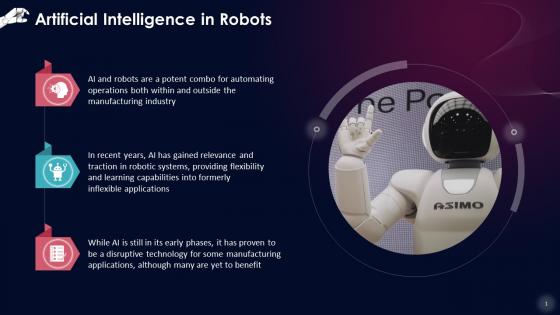
This slide illustrates that AI and robots are potent for automating operations both within and outside the manufacturing industry. In recent years, AI has gained relevance and traction in robotic systems, providing flexibility and learning capabilities into formerly inflexible applications.
People who downloaded this PowerPoint presentation also viewed the following :
Robotics As An Application Of Artificial Intelligence Training Ppt with all 17 slides:
Use our Robotics As An Application Of Artificial Intelligence Training Ppt to effectively help you save your valuable time. They are readymade to fit into any presentation structure.









FAQs for Robotics As An Application Of Artificial
Dude, the robot stuff is getting insane lately. Boston Dynamics has their bots navigating actual environments now, and Tesla's Optimus is doing warehouse work alongside Figure's robots. But honestly? The AI integration is what's blowing my mind - they understand normal speech and adapt without needing new code every time. Six months ago I would've said this was still years out. If you're looking at this for work though, check out cobots first. Way more realistic for smaller setups and they're actually affordable now.
Oh man, robots are literally taking over hospitals! The surgical ones like da Vinci get all the hype - they let surgeons work through tiny cuts with insane precision. But honestly? The boring delivery bots might be the real MVPs. They're hauling meds, lab samples, and supplies around so nurses don't have to play fetch all day. There's also rehab robots helping stroke patients walk again, plus UV bots zapping germs in rooms. My cousin's hospital just got some and she says it's wild. If you're thinking about getting them, just figure out what repetitive stuff is eating up your staff's time first.
Dude, robots are honestly a game changer for manufacturing. They don't get tired or mess up like we do - super consistent work every time. Your production speed goes way up, and yeah the upfront cost sucks but you save on labor long-term. The really cool part? They can do all the sketchy dangerous stuff - toxic chemicals, crazy hot temps, whatever. I'd probably look at your most boring repetitive tasks first, or anywhere workers might get hurt. Quality control gets so much better too. My buddy's factory saw results pretty quick once they figured out which processes to automate.
Honestly, it's pretty complicated. Job loss is the big one - robots doing tasks means fewer jobs for people. Privacy's another mess since these things are basically data vacuum cleaners, tracking everything you do. Then there's this weird psychological thing where people get too attached to their robot buddies or forget how to do basic stuff themselves. I mean, imagine forgetting how to cook because your kitchen robot does everything! The trick is using them to help you get better at things, not replacing actual human relationships. Just ask yourself what info they're grabbing and if you're cool with that trade-off.
So basically these robots combine sensors with AI algorithms to figure out where they're going. Cameras, lidar, ultrasonic stuff - sometimes GPS too. They build maps while tracking their own location (SLAM is what engineers call it, sounds way cooler than it actually is). The decision-making happens super fast - we're talking milliseconds. All that sensor data gets processed to pick the best path based on what the robot's supposed to do and safety rules. Oh, and if you're working on this stuff - sensor fusion is key. That's where most navigation problems happen first.
So basically AI and ML are what make robots actually smart instead of just following basic commands. They process all that sensor data so robots can navigate around, spot objects, adapt to new situations - the usual stuff. Computer vision lets them "see" things, and NLP helps with understanding what you're telling them to do. The coolest part? Robots can actually get better at tasks over time rather than being stuck with whatever you originally programmed. I'd say look at which parts of your project could use pattern recognition or need to adapt on the fly.
Dude, robotics is a game-changer for kids. They're building stuff, coding, actually problem-solving instead of just memorizing random facts. Honestly, watching them get excited when their robot finally moves is the best part of teaching - way better than those blank stares during regular lectures. It sneaks in all the STEM learning without them realizing it. Math and physics just happen naturally. Most projects need teamwork too, so they're learning to work together. Oh, and obviously it's great prep for tech jobs later. Start with simple programmable bots though - don't go crazy with the fancy stuff right away.
Honestly, healthcare and manufacturing are gonna be huge for robotics in the next 10 years. Surgical robots are already getting crazy advanced, plus they're automating drug discovery and patient logistics stuff. Manufacturing's obvious but it's way beyond just cars now - food, textiles, even custom small-batch stuff. Amazon already proved how insane warehouse automation can get, and agriculture is quietly going full robot mode too. Agriculture's actually pretty wild if you look into it. Career-wise or investment-wise, I'd definitely watch companies building robots for these areas - that's where the money's gonna be.
Honestly, trust is the biggest pain point - people just don't feel comfortable with robots doing complex stuff yet. Safety's obviously huge when you're sharing workspace with a machine that could accidentally hurt someone. Communication is tricky too because robots miss all those subtle human cues we take for granted, like when someone's frustrated or confused. Oh, and getting robots to actually understand what we want them to do? Way more complicated than you'd think. If you're diving into this stuff, I'd focus on making interactions feel natural and give users constant feedback so they know what's happening.
So here's the deal - Japanese culture is way more open to robots as companions. They've got this whole "mono no aware" thing where they show empathy to objects, which honestly explains a lot. Western countries? Total opposite. We're all paranoid about robot takeovers thanks to Hollywood. Europeans are somewhere in the middle but obsess over regulations (classic Europe, right?). Point is, if you're making robots for different markets, you can't just assume what works everywhere. Tokyo loves something? Frankfurt might hate it.
Dude, robotic caregiving is about to explode for elderly care. Japan's already all over this because their population is aging like crazy - makes me worry about my own parents tbh. We're talking companion robots, med reminders, fall detection, basic physical help. All coming in the next 5-10 years. Tech keeps getting cheaper and better too. Here's the thing though - robots will handle the routine stuff while human caregivers do the emotional heavy lifting and complex medical care. If you're thinking investments or planning for family, definitely watch companies working on this now.
Honestly, robots are pretty amazing for sustainability stuff. They cut energy waste and handle all the nasty cleanup jobs we can't do safely. In farming, they're reducing pesticide use by like 90% - which is insane when you think about it. Manufacturing gets way more precise too, so less material waste. Ocean cleanup, nuclear sites, that kind of dangerous work? Perfect robot territory. Oh and they monitor air quality 24/7 better than humans ever could. If you're working on any green initiatives, definitely look at where robots could help with your most wasteful processes first.
Honestly, you're gonna need both technical stuff and people skills. Python and C++ are must-haves for programming. Math matters too - linear algebra especially, plus control theory if you get into that. Hardware will mess with you constantly, so learn some mechanical basics even if you think you're just doing software. The debugging never ends, which is kinda fun but also exhausting. What surprises people is how much you'll be explaining complex stuff to managers who don't get it. I'd start with some online programming courses, then just build random projects to figure out what breaks.
Dude, farming robots are getting wild these days. Autonomous tractors and harvesting bots can pick fruit without bruising it, which is honestly impressive. Drones map out crop health and spray pesticides with crazy GPS precision. There's even robotic milking systems - cows just walk up whenever they feel like it (kinda weird but whatever works, right?). You're looking at 30% lower labor costs plus better yields since everything gets applied more precisely. If you're thinking about it, I'd start small - figure out what repetitive stuff you do daily and see if there's a bot for that first.
So basically they're putting tons of sensors on these things now - collision avoidance, emergency stops, the works. Robots can spot people and dodge them in real-time, which is pretty cool actually. There's also this whole certification process starting up before they can even deploy them publicly. Honestly, the "killer robot" fear is kinda ridiculous. Most of it comes down to predictable movement patterns and fail-safes that just shut everything down if things get weird. Oh, and if you're working on any of this stuff, definitely look into ISO 13482 standards - that's becoming the gold standard everyone's using.
-
I was confident and well prepared for my presentation for the first time ever. With SlideTeam’s templates, I could deliver one of my best presentations. Will be coming back for more!
-
“Thank you to the SlideTeam. Your presentations look really skillful and have made my life so much easier.”