


Importance Of Artificial Intelligence Training Ppt




Try Before you Buy Download Free Sample Product
 Impress Your
 Audience
 100%
100% Editable
 Save Hours
 of Time


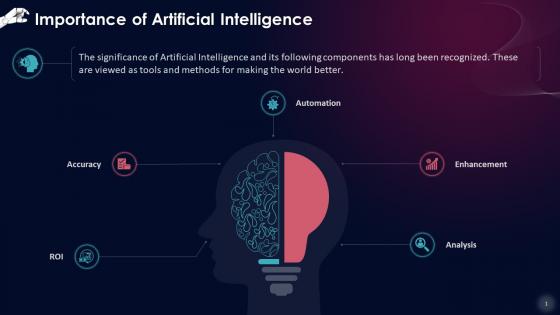
This slide discusses what makes Artificial Intelligence so important and useful. These benefits include automation, enhancement, analysis, accuracy, and ROI.
People who downloaded this PowerPoint presentation also viewed the following :
Importance Of Artificial Intelligence Training Ppt with all 17 slides:
Use our Importance Of Artificial Intelligence Training Ppt to effectively help you save your valuable time. They are readymade to fit into any presentation structure.











FAQs for Importance Of Artificial
Honestly, it comes down to three main things. First, get good data - clean it up, make sure it represents what you're actually trying to solve, and get enough of it. Bad data = bad results, period. Pick the right algorithm or network structure for your specific problem too. Then set up solid testing so you can catch when it's memorizing instead of learning (overfitting is such a pain). Oh and make sure you've got decent processing power - learned that one the hard way! Start by nailing down exactly what problem you're solving first though.
So basically you need to customize everything for whatever industry you're working in. Get datasets that actually match what you'll see in the real world - like patient data for healthcare or financial transactions for banking. Feature engineering is honestly where most of the work happens, even though it's kind of boring. You're pulling out the metrics that matter for that specific field. Also tweak your loss functions to match what the business actually cares about. I learned this the hard way on a project last year. Generic models rarely work well - you've got to fine-tune with industry-specific data and find someone who knows the domain inside out.
Honestly, data quality will make or break your whole project. Garbage in, garbage out - doesn't matter how fancy your algorithms are. It's like trying to learn Spanish from a book with half the pages ripped out and tons of typos. You'll just pick up terrible habits. Your AI needs clean, unbiased data that actually represents what you're trying to solve. Otherwise it won't learn anything useful. I'd start by checking your datasets super early - way before you get attached to any models. Trust me on this one.
So basically, biased training data screws up your AI model big time. It learns whatever patterns are in there - even the crappy ones. Like if you're building a hiring algorithm using data from some old boys' club company, guess what? It'll probably be sexist too. Super annoying, right? The model just can't perform well on groups that weren't represented much in the original data. You'll want to check your dataset beforehand for this stuff. Test it across different groups regularly. Oh, and make sure you've got diverse representation - that part's huge.
So the big thing is making sure your data actually represents what you'll see in the real world. Don't just download the first dataset you find - I've made that mistake before, trust me. Quality beats quantity every time. Clean everything thoroughly, check for duplicates, and watch out for bias that'll mess with your results. Oh, and make sure you can legally use whatever data you're working with. Short version: spend way more time on data prep than feels reasonable. Your model can only be as smart as the data you're training it on, so it's worth getting obsessive about this part upfront.
So transfer learning is basically cheating in the best way possible - you grab a model that's already been trained on tons of data and just tweak it for your specific thing. Like if you already know how to drive, learning to drive a motorcycle isn't starting from zero, you know? You keep all the foundational stuff and just adjust the final layers. Way less data needed, way less computing power. Honestly saved my butt on my last project. Just pick something that was pre-trained on similar stuff to what you're doing and you'll probably get better results than training from scratch anyway.
Dude, the bias thing is massive - your training data can totally screw you over if it's full of stereotypes. Also make sure you've got proper consent for people's personal info. Privacy's another huge headache because data can leak or get misused in ways you didn't expect. Being upfront about how your model actually works helps too, instead of keeping it all black-box mysterious. Oh, and don't wait until the end to think about ethics - bake that stuff in from day one or you'll be scrambling later.
Track completion rates and test scores first - those are your obvious wins. But honestly, the retention piece is where most programs fall apart. People learn the stuff, then completely forget it exists two months later. I'd send out confidence surveys and do follow-up skills checks around 30-60 days. Are they actually building better AI stuff or just making the same dumb mistakes? That's what really matters. Oh, and don't try to measure everything at once - you'll go crazy. Pick maybe 2-3 metrics that actually align with what you're trying to accomplish.
So there's some cool stuff happening with AI training right now. Federated learning is probably the biggest game-changer - lets you train models without moving sensitive data around, which is perfect if you're working with stuff spread across different locations. Neural architecture search is automating the whole model design process, which honestly saves so much time. Edge computing means you can train right on devices now too. Oh and quantum computing could be insane for speeding things up, but that's still pretty far off realistically. I'd definitely look into federated learning first if privacy's a concern for you.
Honestly, the algorithm you pick makes or breaks everything. Adam's solid for accuracy but takes forever - SGD runs faster but might miss the sweet spot entirely. If you're doing neural networks, backpropagation is your go-to, though I've seen people crash and burn with bad optimizers. Here's the thing though - for regular structured data? Skip the deep learning drama. XGBoost or random forests will probably work better anyway. Start with whatever's proven for your specific data type, then mess around with optimization later once you know what actually works.
So basically you can team up with other companies to share datasets and split the computing costs - way smarter than going solo. There's this thing called federated learning that's pretty cool, where everyone trains models on their own data without actually sharing the sensitive stuff. Or you just swap anonymized datasets and compare notes. Honestly the best part is getting access to data you'd never see otherwise, which makes your models way less biased. I'd probably start with just one partner you trust and do a small test project first. It's kind of like a study group but for nerds building AI systems.
Latency is gonna be your biggest headache - you need responses in milliseconds, so forget those huge models that work great offline. Memory's another pain point, especially on mobile where users will uninstall if you're hogging resources. Speed usually means sacrificing accuracy too, which sucks but that's the tradeoff. Edge cases become way more critical since there's no time for do-overs in real-time scenarios. Oh, and honestly? Start with your latency requirements first, then figure out what architecture can actually hit those numbers. Working backwards saves you from building something that'll never perform.
Honestly, just go with AWS, Google Cloud, or Azure for GPU clusters. Way better than dropping serious cash on hardware that'll just collect dust when you're not training models. Auto-scaling is where it gets good though - spins up when you need it, shuts down when you don't. Only pay for actual usage. Google's TPUs are pretty sick if you can get access without the crazy upfront costs. Oh, and definitely start with something small first. Pick one platform, run a quick proof-of-concept to see how it performs and what you'll actually spend before going all-in.
So basically it comes down to your data type. Supervised learning needs labeled examples - like feeding an AI tons of "cat" and "dog" photos so it can sort new ones. Unsupervised learning is different though - it hunts for patterns in messy, unlabeled data without any hints. Then there's reinforcement learning, which honestly reminds me of training my dog. The AI tries stuff, gets rewarded for wins and smacked down for failures (that's how AlphaGo got so crazy good). If you're new to this, I'd start with supervised since your data's already organized and won't make you want to pull your hair out.
So basically your AI models will turn into garbage if you don't keep updating them with new data. It's like how your phone gets weird and glitchy when you ignore those iOS updates for months. Model drift is real - your accuracy just tanks over time as the world changes around your static model. I'd honestly focus on your most business-critical models first since you can't do everything at once. Set up some automated retraining pipelines so you're not manually babysitting this stuff. Oh, and definitely monitor your performance metrics constantly. Fresh data keeps everything running smooth.
-
I was really impressed with the presentation I created with their templates. I’ll be using their services moving forward.
-
Incredibly beautiful designs that will help you get noticed! These eye-catching templates are perfect for corporate presentations that can be altered to fit any occasion or taste.