

Comparison Between AI And Human Intelligence Training Ppt




Try Before you Buy Download Free Sample Product
 Impress Your
 Audience
 100%
100% Editable
 Save Hours
 of Time


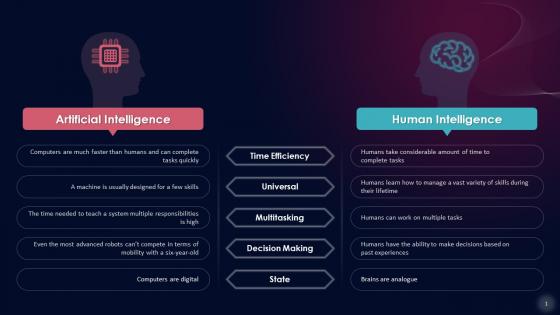
This slide lists the differences between Artificial Intelligence and human intelligence. The parameters for comparison are multitasking, decision making, time efficiency, and state.
People who downloaded this PowerPoint presentation also viewed the following :
Comparison Between AI And Human Intelligence Training Ppt with all 17 slides:
Use our Comparison Between AI And Human Intelligence Training Ppt to effectively help you save your valuable time. They are readymade to fit into any presentation structure.







FAQs for Comparison Between AI And Human
Honestly, it comes down to how we process stuff differently. You learn by connecting emotions and past experiences - like, your brain automatically ties new info to things you already know. AI just crunches through massive datasets looking for patterns. We're weirdly good at picking up concepts from maybe one or two examples, but AI needs thousands of data points to get remotely decent. Plus humans naturally transfer knowledge between totally different areas, which AI still sucks at. If you're building training programs, tap into that experiential side instead of just dumping information on people.
Look, we still crush AI when it comes to emotional stuff. You've actually *felt* heartbreak, anxiety, joy - that real experience matters. Sure, AI can spot emotional patterns and give decent responses, but it's basically fancy pattern matching. Think about it - there's a huge difference between someone who's been through a messy breakup giving you advice versus someone just reciting relationship tips they memorized. Your emotional intelligence comes from all the weird, messy situations you've lived through. AI hasn't dealt with a passive-aggressive coworker or comforted a crying friend at 2am. Trust your gut on the emotional stuff.
AI crushes stuff like data analysis and pattern recognition - chess, protein folding, fraud detection. It's honestly pretty insane watching it work sometimes. Repetitive tasks? Perfect for AI, especially when you need consistency over creativity. Medical imaging, supply chain optimization, that kind of thing. The catch is it needs well-defined problems with clear rules. If you've got tons of data to crunch or want to automate structured decisions, that's when you'll want AI. Otherwise you might be forcing it where it doesn't belong.
Bias is probably the biggest headache you'll face - AI just amplifies whatever prejudices are already baked into your data. Plus there's that whole "black box" thing where you can't figure out how it reached certain decisions, which gets messy fast in stuff like healthcare or legal cases. Accountability is weird too, like when something goes wrong, who actually takes the blame? The person who built it, used it, or deployed it? Honestly feels like everyone just points fingers. You definitely want to test for bias regularly and keep humans in the loop for big decisions.
Look, human creativity hits different because it comes from real shit we've lived through - heartbreak, joy, whatever. We connect ideas that actually mean something to us. AI just spots patterns in huge datasets and mixes them together. Sure, it can make cool stuff, but there's no real feeling behind it. Like, you write a sad song because you're actually devastated. AI writes one because it "learned" what sad songs sound like from analyzing thousands of them. That said, AI's pretty solid for bouncing ideas around - let it throw out concepts, then you add the human stuff that matters.
Your gut feeling is actually your brain doing crazy fast pattern matching in the background - pulling from all your experiences and emotions to spot things before you consciously realize what's happening. Like when a deal feels sketchy or you just know someone's bullshitting you? AI can't replicate that messiness yet. It's stuck analyzing only the data you feed it directly. Meanwhile, your intuition is connecting dots from random memories, body language, tone shifts - stuff that's way too subtle and interconnected for current tech to catch. Honestly, I'd trust those instincts over most algorithms right now.
Honestly, we're just way better at weird situations than AI is. Your brain connects random stuff - like remembering how you solved that thing as a kid when facing a work crisis, or using a credit card to jimmy open a door. AI crushes pattern recognition but totally chokes when something falls outside what it learned. I mean, it's improving fast, but still. Short version: use AI when you need speed and consistency, but trust your gut when things get genuinely strange or you're in uncharted territory.
Honestly, AI just learns from data patterns instead of actually living through stuff, you know? So it misses all the subtle things - like humor, unwritten social rules, why certain jokes are actually super offensive in some contexts. It might technically know a cultural reference but completely whiff on the deeper meaning. We grow up soaking in culture through relationships and real experiences that AI can't replicate. Oh, and definitely get a human who knows that culture to check anything sensitive before using it!
Think of AI like having a research assistant who never gets tired. It'll crunch through data and spot patterns while you focus on the creative stuff and big decisions. What's wild is how much headspace it frees up - no more getting bogged down in repetitive analysis. You still make all the important calls though, especially anything involving company culture or ethics (AI is pretty clueless there). Set up a workflow where it prepares the options, then you pick what actually makes sense. Maybe start small? Find one boring analytical task you do weekly and see if AI can handle it.
Honestly, AI works best when you treat it like a really smart intern. It's crazy good at crunching numbers and spotting patterns you'd never catch, but you still need to tell it what to look for. Like with data analysis - the AI can process tons of info super fast, but you're the one figuring out what actually matters for your business. Content's similar too. Let it handle the boring research and rough drafts while you focus on strategy and making it sound human. Oh, and customer service is perfect for this - AI answers the basic stuff around the clock, so you can deal with the messy problems that need actual empathy.
Look, we're both biased but in different ways. Your brain picks up biases from life experiences and culture - usually without you realizing it. Actually helps with quick decisions sometimes. AI gets biased from whatever data it learned from, so if that data has society's prejudices baked in... well, garbage in, garbage out. Here's what's sneaky though - AI bias feels more "trustworthy" because it looks like pure math. But really it's just amplifying human bias on steroids. At least with AI you can theoretically go back and fix the training data. Good luck rewiring your own brain! Just don't assume your AI tools are neutral.
Yeah, AI's changing things for sure, but it's not like some sci-fi movie where robots just take over. Some jobs will disappear - mostly the boring, repetitive stuff. But new ones are popping up too, like people who train AI systems or figure out the ethics part. Really depends on what field you're in though. Companies are moving faster with this than I expected, honestly. My advice? Start learning to work *with* AI instead of against it. Focus on stuff humans are actually good at - being creative, reading people, solving weird complex problems. Those skills aren't going anywhere.
Honestly, I'd focus on the stuff AI can't do well - critical thinking, creativity, emotional intelligence. Then show kids how to actually use AI tools for research and boring tasks. It's pretty cool when you think about it, right? Instead of fighting against AI, we're teaching them to work with it. My sister's a teacher and she says this approach makes way more sense for their future jobs anyway. Start by figuring out which parts of your curriculum could use AI help versus what needs pure human brainpower. Students need both skills.
Honestly, I think AI will just push us toward the stuff we're naturally better at - creativity, reading people, complex problem-solving. Schools are already starting to care less about memorizing facts and more about critical thinking. It's kinda like how calculators changed math but didn't kill it, you know? We just focus on different parts now. Your brain will basically learn to team up with AI instead of trying to beat it. The trick is getting good at things that still need that human touch - intuition, creative thinking, all that messy human stuff that AI struggles with.
Your gut reaction when AI output feels weird? Trust it. Even if you can't pinpoint exactly what's wrong, that instinct usually catches stuff that data analysis misses. I've seen people ignore that feeling and regret it later. You're also way better at reading context and thinking through "wait, what could go wrong here?" - things that don't always show up during testing. Sometimes AI just overcomplicated things when the simple solution was staring everyone in the face. Use your sense of ethics and human behavior to decide what problems AI should even be solving. Don't second-guess those instincts.
-
Great product with effective design. Helped a lot in our corporate presentations. Easy to edit and stunning visuals.
-
Thank you SlideTeam for such an excellent service.