


Comparison Of AI ML And DL Training Ppt




Try Before you Buy Download Free Sample Product
 Impress Your
 Audience
 100%
100% Editable
 Save Hours
 of Time


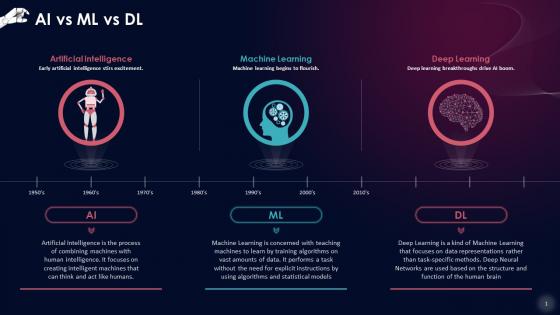
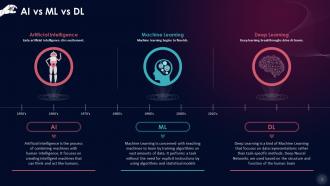
This slide states a comparison between Artificial Intelligence AI, Machine Learning ML, and Deep Learning DL. Artificial Intelligence is the process of combining machines with human intelligence. Machine Learning is concerned with teaching machines to learn by training algorithms on reams and reams of data. Deep Learning is a kind of Machine Learning that focuses on data representations rather than task-specific methods.
People who downloaded this PowerPoint presentation also viewed the following :
Comparison Of AI ML And DL Training Ppt with all 17 slides:
Use our Comparison Of AI ML And DL Training Ppt to effectively help you save your valuable time. They are readymade to fit into any presentation structure.










FAQs for Comparison Of AI ML And
So AI is just the catch-all term for anything that acts smart like humans do. Machine learning is where it gets more specific - that's when computers actually learn from data rather than someone coding every single rule. Deep learning? That's ML but with these crazy layered neural networks that spot patterns we'd never catch. Picture those Russian dolls - AI's the biggest one, ML fits inside that, DL fits inside ML. Honestly, most "AI" companies are really just doing ML work. Marketing teams love throwing around "AI" though. Figure out what you actually need first before getting caught up in the buzzwords.
So AI is like the big umbrella - any system that acts smart like humans do. Machine learning sits underneath that, where computers learn from data instead of you having to code every single rule. Then deep learning goes even deeper (see what I did there?) with those neural network things that have tons of layers. Picture Russian dolls, each one more specific than the last. When you're talking to your stakeholders, I'd start with the broad AI concept first. Then get into whether you're actually dealing with basic ML stuff or the fancy deep learning models. Makes it way less confusing for everyone.
So basically, ML learns patterns from your data automatically instead of you having to code every single rule. Like, imagine writing if-then statements for literally every edge case - nightmare fuel, right? Traditional programming stays the same unless you update it manually, but ML actually gets smarter as you throw more data at it. Plus it can handle new situations it's never seen before, which is pretty wild when you think about it. Honestly saved me so much time on my last project. Worth considering if you're dealing with complex pattern stuff!
So here's the deal - ML works fine with smaller datasets, like maybe hundreds to a few thousand examples you'd keep in a spreadsheet. Deep learning? Totally different story. It's super data-hungry and wants thousands or even millions of examples, especially for stuff like images or text. The problem is DL models have so many parameters they'll just memorize your tiny dataset instead of actually learning anything useful (which is honestly pretty frustrating). If you're working with limited data, I'd definitely start with regular ML algorithms first. You can always move to deep learning once you've got more data to throw at it.
Honestly, deep learning is just way more mathematically intense than regular ML. We're talking millions of parameters vs maybe a few thousand in something like linear regression. The calculus behind backpropagation alone made my head spin when I first learned it - all those partial derivatives and chain rules. Traditional ML uses pretty straightforward math by comparison. Linear algebra, some basic probability stuff. Sure, DL can do crazy things like recognize faces or translate languages, but you'll need tons of data and serious computing power. I'd start with simpler ML algorithms first. Build that math foundation, then tackle the neural network madness later.
Honestly, most "AI" stuff isn't even machine learning. Chess programs? Just really smart rules. Those old spam filters were pure logic - no learning involved. Your GPS finds routes using search algorithms, not neural networks. Medical expert systems follow decision trees. Even some recommendation engines today skip the fancy ML and use basic collaborative filtering instead. Industrial robots mostly run on programmed logic too. It's kinda wild how much gets labeled "AI-powered" when it's really just sophisticated if-then statements. Rule-based systems are everywhere, they just don't sound as sexy in marketing.
So with traditional ML, you're basically doing tons of manual work upfront - picking which features matter, scaling stuff, handling categorical data, all that tedious preprocessing. Deep learning? Totally different story. The networks figure out what features to use on their own from the raw data, which honestly feels like magic sometimes. You'll still need to do some prep work like normalizing inputs or data augmentation, but it's way less hands-on than ML. Either way though, spend time actually understanding your dataset first - that part never gets old.
Honestly, deep learning is way more demanding than regular ML. First off, you'll need huge datasets - like thousands or millions of examples vs. a few hundred. Training times are brutal too, sometimes weeks even with decent GPUs while ML wraps up in minutes. The worst part? These models are complete black boxes, so good luck explaining anything to your boss. Debugging becomes this endless maze since there's so many layers to dig through. I learned this the hard way lol. Just stick with simpler ML first until you've got serious data and infrastructure.
Oh man, the training time difference is brutal. Deep learning models can take hours or even weeks while traditional ML wraps up in minutes to hours. All those neural network layers and millions of parameters just eat up computational power like crazy. Random forests and SVMs? Way more efficient since they skip that complexity entirely. I learned this the hard way during my last project - prototyping becomes such a drag when you're waiting forever for results. My advice: start with simpler ML models first to test your ideas, then jump to deep learning if you actually need it.
So neural architecture is just the blueprint for how your deep learning model gets built - all the layers, connections, how data flows through. Traditional ML makes you engineer features by hand and pick algorithms like SVMs. Deep learning is different though. The architecture itself learns complex patterns automatically through those stacked layers. It's like Legos vs stone carving, honestly. CNNs work great for images, RNNs handle sequences, transformers crush language tasks. Don't just chase whatever's hot right now - match your architecture to what problem you're actually solving first.
Honestly? It all comes down to how much data you have. Got millions of records? Deep learning will destroy traditional methods - it picks up on crazy complex patterns. But with smaller datasets, stick to random forests or SVMs. They're way less greedy with data and won't overfit like mad. Deep learning models are basically data hogs that need huge amounts to work properly. My general rule (though I break it sometimes): under 100K samples means go traditional ML. Above that, try experimenting with deep learning, especially for images, text, or audio stuff.
Biggest things to watch out for? Bias in your training data is huge - your model will basically learn whatever prejudices are baked into the data. Privacy stuff gets messy fast when you're using people's personal info for training. Job displacement is obviously a big deal too. Oh, and the whole "black box" thing where nobody can explain why the AI decided something? That's getting worse as models get more complex, which honestly freaks me out sometimes. I'd start by really digging into your datasets to spot bias patterns and set up solid data policies upfront.
Yeah totally! Old school ML can handle messy data just fine. You just need to do feature engineering first - like using TF-IDF for text stuff or SIFT features for images. More work upfront than deep learning, but honestly? It runs way faster and often works just as well. Deep learning basically just does that feature extraction for you automatically, which is nice but kinda overkill for simple problems. I'd start with classical methods first - might save you a headache. Plus your laptop won't sound like it's about to take off.
So it really comes down to what you're trying to measure. Business-focused AI stuff? Look at user satisfaction and whether people can actually complete tasks. ML models get more technical - accuracy, precision, recall, F1 scores based on your specific problem. Deep learning is similar but you'll also be staring at training curves and validation loss constantly (trust me, it becomes an obsession). The main difference is scope honestly. AI metrics tend to be business-oriented while ML/DL stay in the weeds technically. Start with what success looks like to your users first, then work backwards to find the technical metrics that'll get you there.
So multimodal AI is huge right now - basically ChatGPT handling images, video, audio, everything at once. ML models are getting way more efficient too, like actually running on your phone instead of needing massive servers. The robotics stuff is pretty insane if you've seen the latest demos. We're also finally getting explainable AI so we know why these things make decisions (thank god). Oh and smaller models performing better than the giant ones from last year? Wild. Honestly, just start playing with this stuff now because it's moving from "cool tech" to absolutely necessary for work. The AGI timeline keeps shrinking too.
-
Wow, never been this impressed with any online service provider. Really appreciate the customer support all along from the navigation to purchasing the right products.
-
SlideTeam’s readymade presentations have landed my unique images with my bosses in the past and it continues to reward me.