


Artificial Intelligence Machine Learning Deep Learning Ppt Powerpoint Presentation Slide Templates





Try Before you Buy Download Free Sample Product
 Impress Your
 Audience
 100%
100% Editable
 Save Hours
 of Time


Choose our Artificial Intelligence Machine Learning Deep Learning PPT PowerPoint Presentation Slide Templates to understand this popular branch of computer science. Acquaint your audience with the process of building smart, capable machines that can perform intelligent tasks with the help of this neural network PPT presentation. Exhibit the difference between AI, machine learning, and deep learning through this informative robotics PPT design. Elaborate on the wide range of areas that can benefit from artificial intelligence like supply chain, customer experience, human resources, fraud detection, research, and development by taking the aid of this computer science PPT slideshow. Highlight the booming rate of AI business and its future revenue forecast by downloading this thought-provoking and indulging information technology PowerPoint graphics. Save your time and efforts with these pre-ready and professionally crafted content-specific slides. It will educate your audience about this complex process in an easy yet efficient way. Download our artificial intelligence presentation to create a roadmap for the growth and expansion of your business.
People who downloaded this PowerPoint presentation also viewed the following :
Content of this Powerpoint Presentation
Slide 1: This slide introduces Artificial Intelligence, Machine Learning, and Deep Learning. State your Company Name and begin.
Slide 2: This slide highlights the Table of Contents i.e., Introduction to AI, Machine Learning, Deep Learning, along with the Difference between AI vs ML vs DL
Slide 3: This slide further provides continuation to the Table of Contents i.e., Supervised Machine Learning, Unsupervised Machine Learning, Reinforcement Learning, Back Propagation Neural Network in AI, and Expert System in Artificial Intelligence
Slide 4: This slide gives you a brief overview of the Artificial Intelligence and the most pressing questions related with the same like What is AI?, Introduction to AI Levels?, Types of Artificial Intelligence?, Where is AI used?, Difference between AI, DL, & ML?, AI Usecases?, Why is AI booming now?, and AI trend in 2020?
Slide 5: This slide acquaints you with the widely renowned definition of Artificial intelligence (AI), Deep Learning, and Machine Learning to get you started.
Slide 6: This slide informs you about the various levels of AI, such as Artificial Narrow Intelligence, Artificial General Intelligence, and Artificial Super Intelligence.
Slide 7: This particular slide displays the wide range of Deep Learning, Machine Learning, and Artificial Intelligence.
Slide 8: The following slides provide you detailed information about Artificial Intelligence and the various elements associated with it.
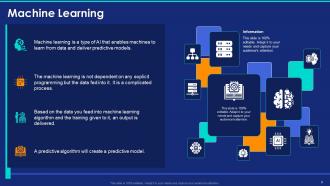
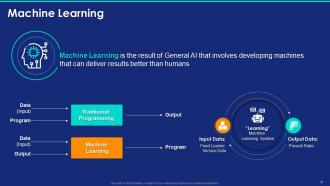
Slide 9: This slide titled - Machine Learning, provides you with deep insights into the concept of AI and its types.
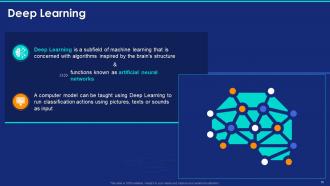
Slide 10: The following slide showcases the information on Deep Learning and its key functions known as artificial neural networks.
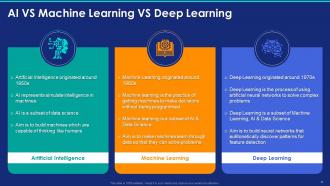
Slide 11: This slide is designed to clearly demarcate the difference between the three concepts in a well-structured 'AI VS Machine Learning VS Deep Learning' format.
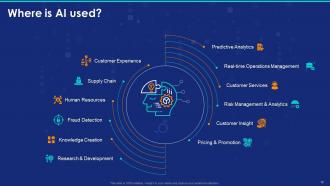
Slide 12: This slide answers the crucial question of the uses of AI with Customer Experience, Supply Chain, Human Resources, Fraud detection, Knowledge creation, Research & Development, Risk Management & Analytics, Predictive Analytics, Real-time operations management, customer services, customer insights, Pricing & promotion.
Slide 13: The following slide displays the AI Usecase in HealthCare like Research, Training, Keeping well, Early detection, Diagnosis, Decision Making, Treatment, and End of Life Care.
Slide 14: This slide focuses on the uses of Artificial Intelligence in the Human Resource department that includes learning, Selection, Recruitment, engagement, and onboarding.
Slide 15: This slide covers how banking gets benefits from AI for Fraud Detection using a Neural network engine and a Scoring engine.
Slide 16: The following slide illustrates the role of AI in the Supply Chain that includes logistics, procurement, manufacturing, customers, and service.
Slide 17: This slide introduces you to all the AI Chatbots in Healthcare such as search engines, social platforms, smartphones, health bots, artificial intelligence, messenger apps, and the app ecosystem.
Slide 18: This slide discusses the reason for Why AI is booming now, with proper logistics and statistics.
Slide 19: This slide goes on to exhibit the top 10 AI trends in 2020. This includes AI in Retail, Robotic process automation, Aerospace and flight operations controlled by AI, Advanced cybersecurity, AI mediated media, and entertainment, data modeling, AI in healthcare, B2B, AI-powered chatbots, and automated business process.
Slide 20: This slide mentions the burning questions related to Machine Learning like What is ML, 7 steps of machine learning, machine learning vs traditional programming, How does machine learning work, machine learning algorithms, machine learning usecases, how to choose ML algorithm, why to use decision tree algorithm learning, challenges and limitations of machine learning, applications of machine learning, and Why is machine learning important?
Slide 21: The following slide is designed to display the working mechanism of Machine Learning and its input as well as output data.
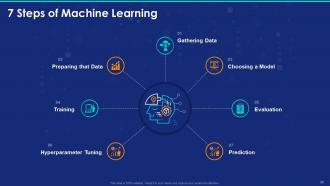
Slide 22: This next slide defines the key seven Steps of Machine Learning that are gathering data, choosing a model, preparing the data, evaluation, prediction, hyperparameter tuning, training.
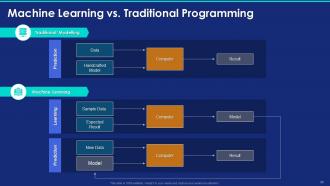
Slide 23: This slide draws a comparison between machine learning and traditional programming.
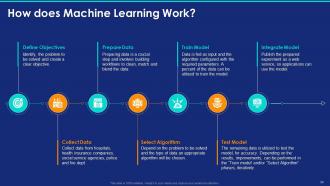
Slide 24: The following slide describes how Machine Learning Work includes - defining Objectives, preparing data, train Model, integrate Model, Collecting data, Selecting algorithm, and test Model.
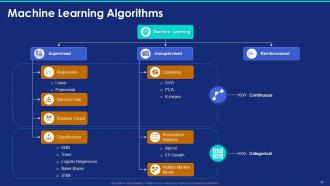
Slide 25: This slide visually represents the Machine Learning Algorithms including supervised, unsupervised, and reinforcement in an organized format.
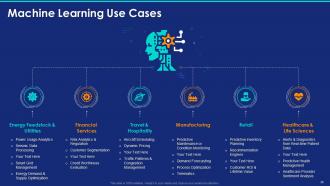
Slide 26: The following slide highlights the Machine Learning Use Cases by emphasizing important elements like energy feedback & utilities, financial services, travel & hospitality, manufacturing, retail, healthcare & life sciences, etc.
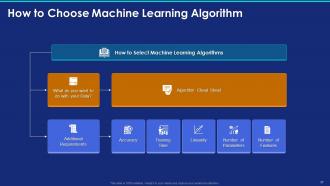
Slide 27: This slide educates you on How to Choose a Machine Learning Algorithm, algorithm cheat sheet, and additional requirements like accuracy, training time, linearity, parameters, and the number of features.
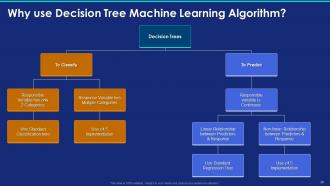
Slide 28: This slide goes on to mention the reasons for using Decision Tree Machine Learning Algorithm like to classify or to predict, and further their uses.
Slide 29: This slide highlights to Challenges and Limitations of Machine learning.
Slide 30: This slide showcases the essential components in the Application of Machine Learning like Automatic Language Translation, Medical Diagnosis, Stock market trading, online fraud detection, Virtual Personal Assistant, email spam and malware fittering, self driving cars. Product Recommendations, Traffic Prediction, Speech Recognition, image recognition.
Slide 31: The purpose of this slide is to explain the importance of Machine Learning along with the key phases of learning and prediction.
Slide 32: This slide is curated to address all the critical questions with regards to the concept of Deep Learning like what is deep learning, deep learning process, classification of neural networks, types of deep learning networks, feed-forward neural networks, recurrent neural networks, convolutional neural networks, reinforcement learning, examples of deep learning applications, why is deep learning important, and limitations of deep learning.
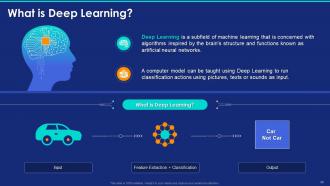
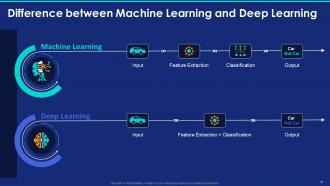
Slide 33: This next slide further provides a brief understanding of Deep Learning; its input, feature extraction & classification, and output.
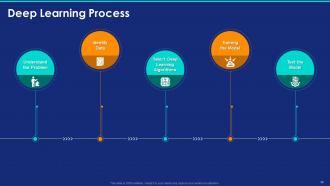
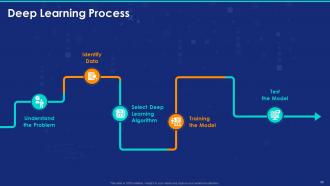
Slide 34: This slide gives you a glimpse of the complex Deep Learning Process which includes understanding the problem, identifying data, selecting deep learning algorithms, training the model, and testing the model.
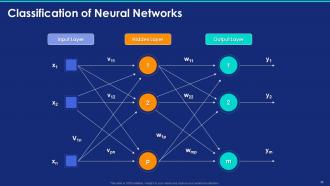
Slide 35: The following slide gives you the Classification of Neural Networks that consists of Input Layer, Hidden Layer, and Output Layer.
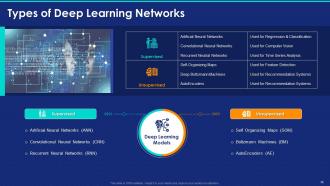
Slide 36: This slide provides information on the various types of Deep Learning Networks that are Artificial, Convolutional, Recurrent, Self Organizing Maps, Boltzmann Machines Neural Networks.
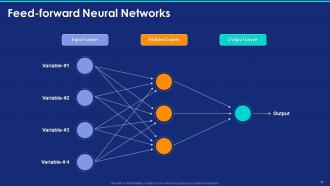
Slide 37: This slide elaborates on the Feed-forward Neural Networks and their input layer, hidden layer, and output layer.
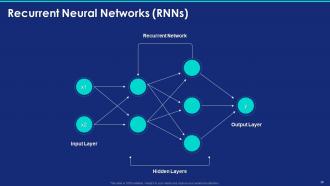
Slide 38: This slide elucidates the Recurrent Neural Networks thoroughly.
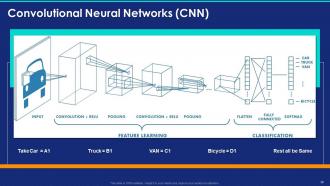
Slide 39: This slide gives a detailed explanation of the Convolutional Neural Networks.
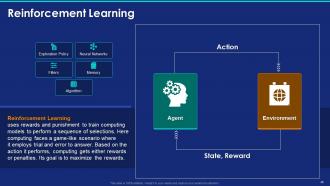
Slide 40: This slide explains how Reinforcement Learning goes on to maximize the rewards.
Slide 41: This slide provides you with a wide range of Examples of Deep Learning Applications like image recognition, natural language processing, speech recognition, portfolio management & prediction of stock price movements, drug discovery & better diagnostics of diseases in healthcare, robots, and self-driving cars.
Slide 42: This slide shows Why Deep Learning is Important?
Slide 43: This slide presents the Limitations of Deep Learning that are Interpretability, Statistical Reasoning, and Amount of Data.
Slide 44: The following slide demonstrates the Difference between AI vs ML vs DL and the burning questions related to them like What is aI, What is ML, What is Deep learning, Machine learning process, deep learning process, the difference between machine learning and deep learning, and which is better to start - AI, ML, or deep learning?
Slide 45: This slide goes on to visually represent the Difference between AI vs ML vs DL in an attractive yet informative manner.
Slide 46: This slide provides you detailed information about Artificial Intelligence.
Slide 47: The current slide gives you an introduction to the Machine Learning and how it learns, predicts, and improves the ordinary system.
Slide 48: This slide will take you through the concept of Deep Learning in detail.
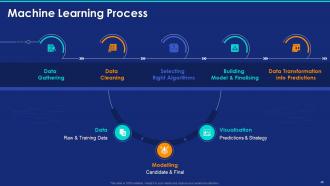
Slide 49: This slide explains the Machine Learning Process that consists of steps like Data Gathering, Data Cleaning, Selecting Right Algorithms, Building Model & Finalising, and Data Transformation into predictions
Slide 50: This slide takes you through the Deep Learning Process that includes understanding the problem, identifying data, selecting deep learning algorithms, training the model, and testing the model.
Slide 51: The purpose of this slide is to highlight the difference between Machine Learning and Deep Learning.
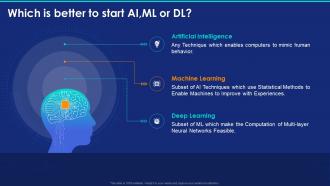
Slide 52: This slide explains which one is better to start with - Artificial intelligence(AI), Marchine learning(ML), or Deep learning(DL).
Slide 53: This slide titled Supervised Machine Learning focuses on explaining the concept by addressing questions like types of machine learning, what is supervised machine learning, gow supervised learning works, types of supervised machine learning algorithms, supervised vs unsupervised learning techniques, advantages of supervised learning, and disadvantages of supervised learning.
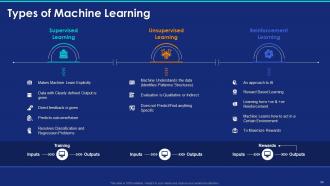
Slide 54: The following slide provides you with various types of Machine Learning like supervised learning, unsupervised learning, and reinforcement learning.
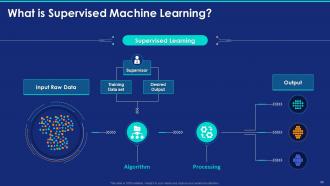
Slide 55: This slide defines What Supervised Machine Learning is?
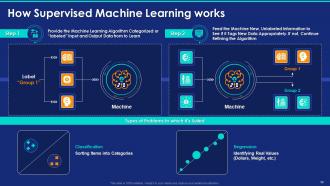
Slide 56: This slide mentions the mechanism of How Supervised Machine Learning works and all the steps it entails like classification and regression.
Slide 57: This slide brings various Types of Supervised Machine Learning Algorithms to the fore like classification that includes fraud detection, email spam detection, diagnostics, and image classification. Also, regression, that includes risk assessment and score prediction.
Slide 58: This slide calls attention to Supervised (classification, regression) vs. Unsupervised Machine Learning Techniques (clustering, association).
Slide 59: This slide emphasizes the Advantages of Supervised Learning.
Slide 60: This slide argues about the Disadvantages of Supervised Learning.
Slide 61: This slide addresses the concept of Unsupervised Machine Learning and the questions associated with it like what is unsupervised machine learning, how unsupervised machine learning works, types of unsupervised learning, and disadvantages of unsupervised learning.
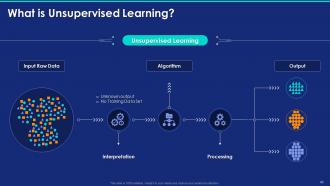
Slide 62: This slide focuses on What Unsupervised Learning is and its input data, algorithms as well as output.
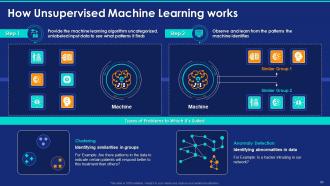
Slide 63: This slide underlines How Unsupervised Machine Learning works and the problems it solves like clustering and anomaly detection.
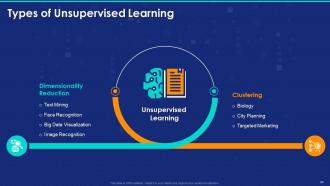
Slide 64: This slide explores the various Types of Unsupervised Learning such as dimensionality reduction and clustering.
Slide 65: The following slide displays the Disadvantages of Unsupervised Learning.
Slide 66: This slide is titled reinforcement learning and it highlights the questions related to the concept like what is reinforcement learning, how reinforcement learning works, types of reinforcement learning, advantages, and disadvantages of reinforcement learning.
Slide 67: This slide highlights the concept of Reinforcement Learning and its key steps like input, response, feedback, learning, and reinforcement response.
Slide 68: This slide elaborates on the functioning of Reinforcement Learning and the environment as well as the agent it deals with.
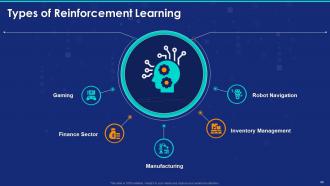
Slide 69: This slide showcases the Types of Reinforcement Learning like Gaming, Finance Sector, Inventory Management, Manufacturing, and Robot Navigation.
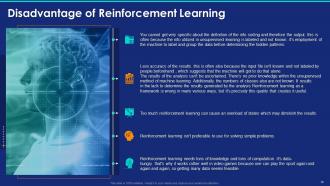
Slide 70: This slide highlights the Disadvantage of Reinforcement Learning.
Slide 71: The purpose of this slide is to talk about Back Propagation Neural Network in AI and the questions related to it such as backpropagation neural network in AI, what is artificial neural networks, what is backpropagation, why we need backpropagation, what is a feed forward network, types of backpropagation networks, and best practice backpropagation.
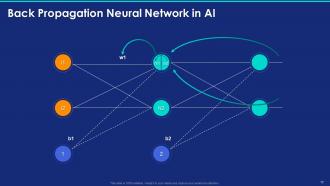
Slide 72: This slide illustrates the role of Back Propagation Neural Network in AI.
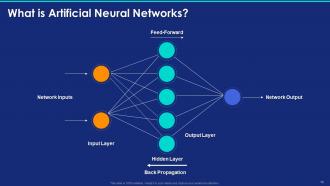
Slide 73: This slide showcases the meaning of Artificial Neural Networks and their key elements like feed-forward, network output, an output layer, hidden layer, input layer, and network inputs.
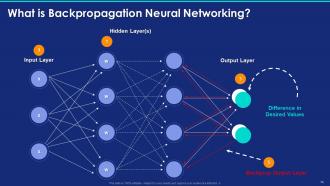
Slide 74: The purpose of this slide is to explain What is Backpropagation Neural Networking and its input layer, hidden layer, and output layer.
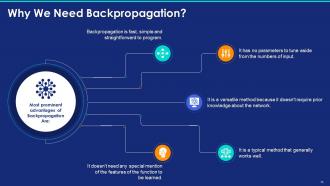
Slide 75: This slide talks about Why We Need Backpropagation?
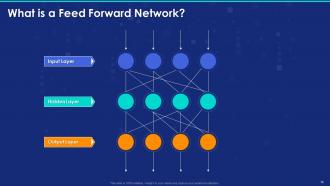
Slide 76: The following slide explains What a Feed Forward Network is and its input layer, hidden layer, and output layer.
Slide 77: This slide display the two types of Backpropagation Networks that are static back-propagation and recurrent back-propagation.
Slide 78: This current slide highlights the Best Practice Backpropagation.
Slide 79: This slide discusses the key questions related to Expert System in Artificial Intelligence which are - what is an expert system, examples of expert system, characteristics of expert system, components of the expert system, conventional system vs expert system, human expert vs expert system, benefits of expert system, limitations of the expert system, and applications of the expert system.
Slide 80: This slide shows the Expert System in Artificial Intelligence and how it utilizes knowledge base, inference engine, and user interface.
Slide 81: This slide provides you with a wide range of Examples of Expert Systems, including high expertise, right on time reaction, good reliability, flexible, effective mechanism, and capable of handling challenging decisions & problems.
Slide 82: The purpose of this slide is to address the important Characteristics of an Expert System that are high-level performance, domain specificity, good reliability, understanding, adequate response time, and symbolic representations.
Slide 83: The following slide provides the list of essential Components of the Expert System that entails inference engine, acquisition facility, user interface, knowledge base.
Slide 84: This slide gives the difference between Conventional systems and Expert systems.
Slide 85: This slide gives you a proper Human Expert vs. Expert System information.
Slide 86: This slide mentions the Benefits of Expert Systems such as Fast Response, Easy to Develop and Modify, Low Accessibility Cost, low Error Rate, and Data Warehousing.
Slide 87: The following slide goes through all the Limitations of the Expert System.
Slide 88: This slide talks about the Applications of Expert Systems such as knowledge domain, finance/commerce, repairing, warehousing optimization, shipping, design domain, medical domain, monitoring system, and process control system.
Slide 89: This slide gives icons with reference to Artificial Intelligence, Machine Learning, and Deep Learning.
Slide 90: The purpose of this slide is to give an introduction to additional slides.
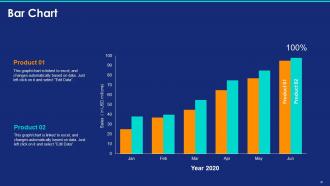
Slide 91: This slide exhibits the Bar Chart for comparison of your products.
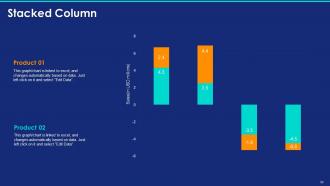
Slide 92: The following slide displays the graph of Stacked Columns for comparing your products.
Slide 93: This slide is titled Welcome to Our Agenda and acquaints the audience with your targets.
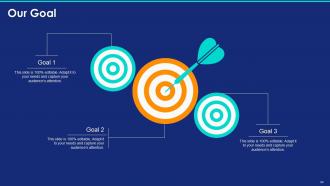
Slide 94: This slide conveys the goals of a company or its projects.
Slide 95: This slide shows the Idea Generation process.
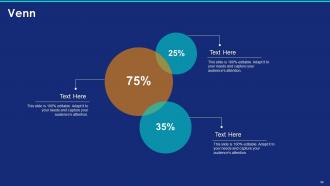
Slide 96: This is a slide demonstrating Venn chart for focusing on the interrelationship between various elements.
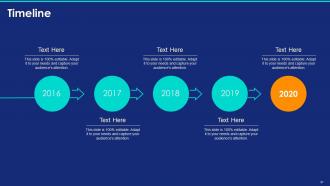
Slide 97: The following slide displays the Timeline to carry out a project efficiently.
Slide 98: This slide is titled Post It Notes for highlighting key information.
Slide 99: This is a Thank You slide with contact, address, and email details.
Artificial Intelligence Machine Learning Deep Learning Ppt Powerpoint Presentation Slide Templates with all 99 slides:
Use our Artificial Intelligence Machine Learning Deep Learning Ppt Powerpoint Presentation Slide Templates to effectively help you save your valuable time. They are readymade to fit into any presentation structure.
-
Artificial Intelligence Machine Learning Deep Learning PPT
-
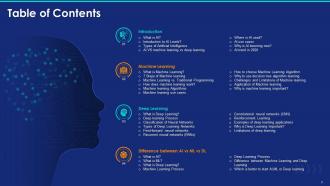
Table of Contents
-
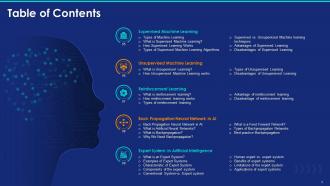
Table of Contents
-
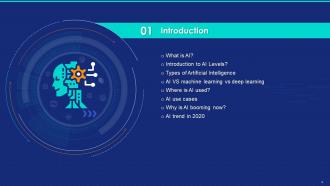
Introduction to Artificial Intelligence
-
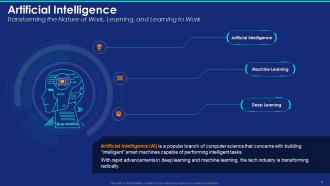
Artificial Intelligence
-
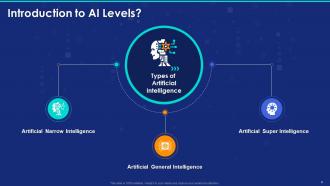
Introduction to AI Levels
-
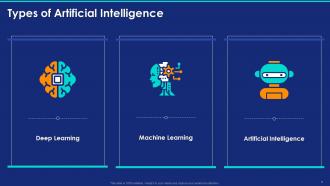
Types of Artificial Intelligence
-

Artificial Intelligence
-
Machine Learning
-
Deep Learning
-
AI VS Machine Learning VS Deep Learning
-
Where is AI used
-
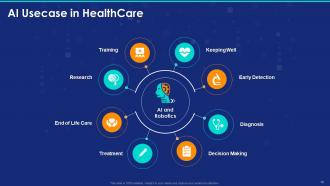
AI Use Case in Healthcare
-
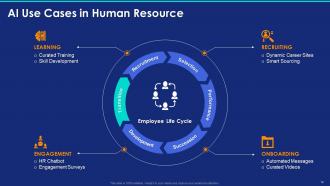
AI Use Cases in Human Resource
-
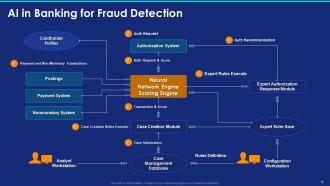
AI in Banking for Fraud Detection
-
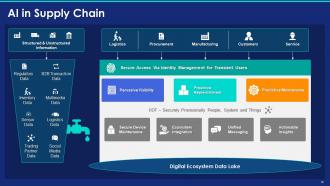
AI in Supply Chain
-
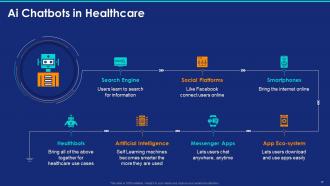
AI Chatbots in Healthcare
-
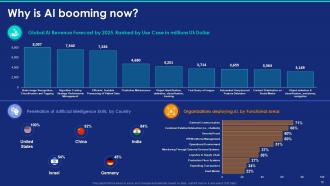
Why is AI booming now
-
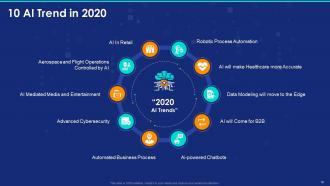
10 AI Trends in 2020
-
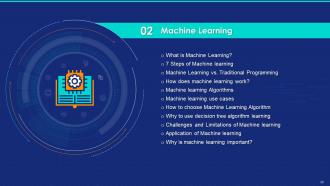
Machine Learning
-
Machine Learning
-
7 Steps of Machine Learning
-
Machine Learning vs Traditional Programming
-
How does Machine Learning Work
-
Machine Learning Algorithms
-
Machine Learning Use Cases
-
How to Choose Machine Learning Algorithm
-
Why use Decision Tree Machine Learning Algorithm
-
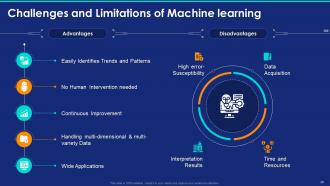
Challenges and Limitations of Machine Learning
-
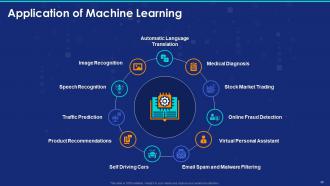
Application of Machine Learning
-
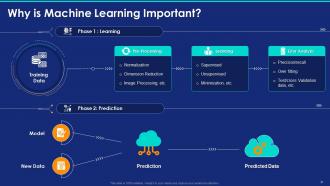
Why is Machine Learning Important
-
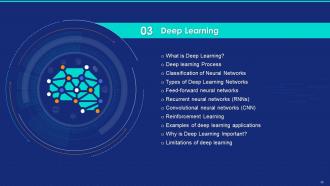
Deep Learning
-
What is Deep Learning
-
Deep Learning Process
-
Classification of Neural Networks
-
Types of Deep Learning Networks
-
Feed forward Neural Networks
-
Recurrent Neural Networks RNNs
-
Convolutional Neural Networks CNN
-
Reinforcement Learning
-
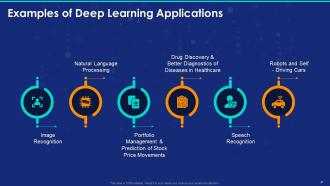
Examples of Deep Learning Applications
-
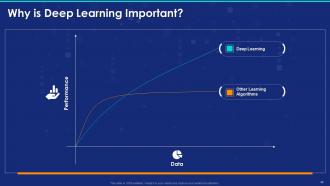
Why is Deep Learning Important
-
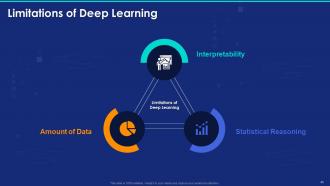
Limitations of Deep Learning
-
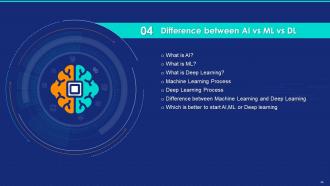
Difference between AI vs ML vs DL
-
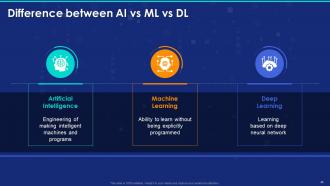
Difference between AI vs ML vs DL
-
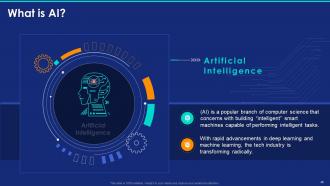
What is AI
-
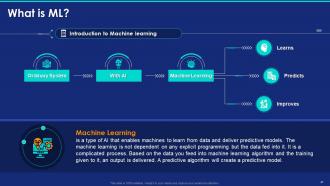
Introduction to Machine Learning
-
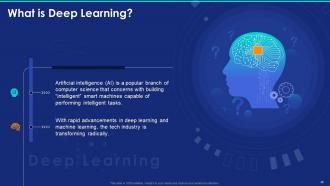
What is Deep Learning
-
Machine Learning Process
-
Deep Learning Process
-
Difference between Machine Learning and Deep Learning
-
Which is better to start AI ML or DL
-
Supervised Machine Learning
-
Types of Machine Learning
-
What is Supervised Machine Learning
-
How Supervised Machine Learning works
-
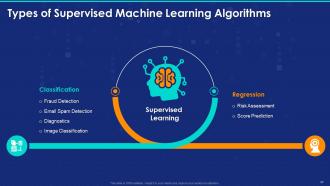
Types of Supervised Machine Learning Algorithms
-
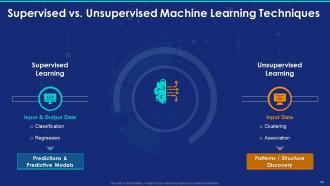
Supervised vs Unsupervised Machine Learning Techniques
-
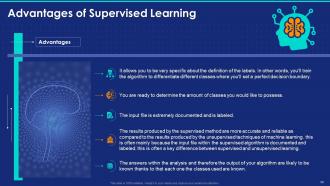
Advantages of Supervised Learning
-
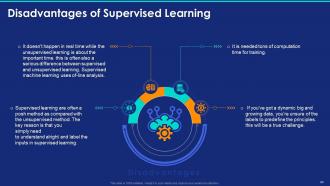
Disadvantages of Supervised Learning
-
Unsupervised Machine Learning
-
What is Unsupervised Learning
-
How Unsupervised Machine Learning works
-
Types of Unsupervised Learning
-
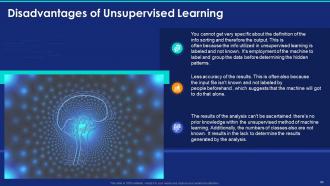
Disadvantages of Unsupervised Learning
-
Reinforcement learning
-
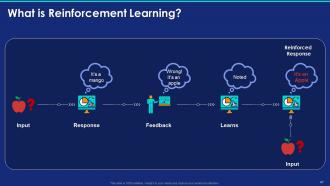
What is Reinforcement Learning
-
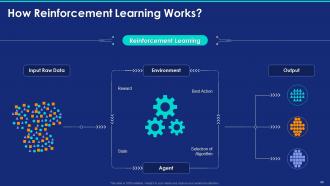
How Reinforcement Learning Works
-
Types of Reinforcement Learning
-
Disadvantage of Reinforcement Learning
-
Back Propagation Neural Network in AI
-
Back Propagation Neural Network in AI
-
What is Artificial Neural Networks
-
What is Backpropagation Neural Networking
-
Why We Need Backpropagation
-
What is a Feed Forward Network
-
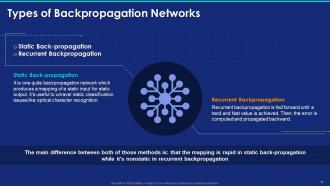
Types of Backpropagation Networks
-
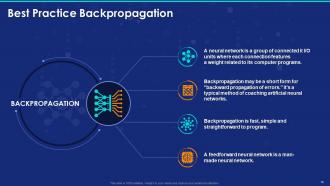
Best Practice Backpropagation
-
Expert System in Artificial Intelligence
-
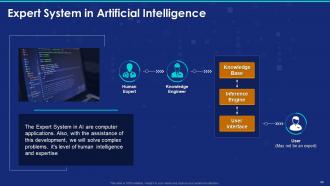
Expert System in Artificial Intelligence
-
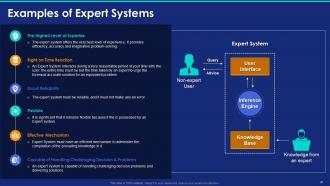
Examples of Expert Systems
-

Characteristic of Expert System
-
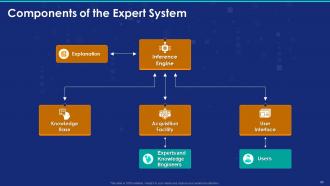
Components of the Expert System
-
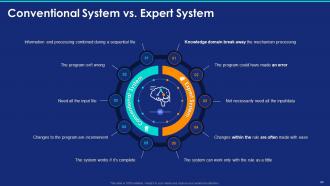
Conventional System vs Expert System
-
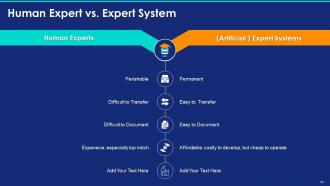
Human Expert vs Expert System
-

Benefits of Expert Systems
-
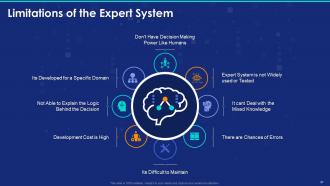
Limitations of the Expert System
-
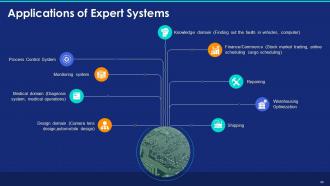
Applications of Expert Systems
-
Artificial Intelligence Machine Learning Deep Learning PPT PowerPoint Presentation slide templates Icons Slide
-
Additional Slides
-
Bar Chart
-
Stacked Column
-
Welcome to Our Agenda
-
Our Goal
-
Idea Generation
-
Venn
-
Timeline
-
Post It Notes
-
Thank You
FAQs for Artificial Intelligence Machine Learning Deep Learning Ppt Powerpoint
Bias is the biggest headache - your training data will definitely have it, so test across different groups constantly. Privacy matters too; don't hoard unnecessary data. That whole "black box" thing is annoying but try making decisions explainable, especially for serious stuff. Oh, and think about job impacts early on. Document your ethical approach from day one. Regular bias audits throughout development are clutch. Transparency's tough but worth pushing for. Honestly, most companies skip the upfront ethics work and regret it later.
So basically AI can figure out how each kid learns best and adjust everything - like how fast they go, difficulty level, all that stuff. It spots knowledge gaps instantly and throws targeted practice at them. Some platforms even switch up explanations depending if your students are visual learners or need hands-on stuff. Pretty wild how detailed it gets, honestly. The system tracks response times, common mistakes, then builds custom learning paths for each student. I'd probably start small though - maybe try one AI tool in just one subject first and see how it goes before going crazy with it.
So AI basically reads your customers like an open book - it crunches through all their purchase history, what they browse, social media stuff, the works. You can actually predict what'll be hot next season and which products will bomb before you even launch them. The personalization part is where it gets really interesting though - like tailoring recommendations to each person's weird little preferences. I swear some of these algorithms know people better than they know themselves! Start digging into whatever customer data you've got sitting around. Even basic purchase patterns can reveal some pretty surprising trends you'd never spot manually.
Dude, AI's basically everywhere now and it's crazy how much time it's saving people. Manufacturing companies use it to predict when machines will break down - way better than waiting for stuff to actually fail. Doctors are using it for reading scans and figuring out schedules. Retail's gotten really good at knowing what'll sell and when. Banks catch fraud automatically now, which honestly makes me feel better about online shopping. Look for anything repetitive in your work first - that's where you'll see the biggest wins. Pattern-heavy stuff works great too.
Yeah, AI displacement is definitely happening, but it's not some sci-fi takeover situation. Repetitive stuff gets hit first - data entry, basic customer service, assembly work. Creative jobs are safer right now, though honestly nothing's bulletproof anymore. Here's the weird part: new jobs pop up too, just with totally different skill requirements. My take? Don't try to outcompete the machines - work alongside them instead. Focus on critical thinking and creativity, stuff that's still pretty uniquely human. Oh, and start learning new skills now rather than waiting.
Dude, AI in healthcare is actually insane right now. It's reading X-rays and MRIs way better than doctors sometimes - like catching cancers super early that humans miss completely. The personalized medicine stuff is cool too, where it analyzes your DNA and medical history to figure out exactly which drugs will work for you. Oh and apparently it's speeding up drug discovery by years, which honestly we need after COVID showed us how slow that process usually is. Disease outbreak predictions too. If you're in healthcare, definitely check out some of these diagnostic tools - could save you tons of time.
Honestly, data privacy with AI is huge because these systems are trained on tons of personal info. Without good protection, you're setting yourself up for disaster. There's some cool tech that helps though - differential privacy, anonymizing data, federated learning where the data stays put instead of moving around. Oh and definitely do regular audits, those catch problems early. The thing is, you can't just slap privacy measures on at the end. Build it in from the start or you'll regret it later. First step? Figure out exactly what data you're dealing with.
So traditional programming means you're basically writing out every single rule - "if this happens, do that" for like a million different scenarios. Machine learning is totally different though. You just show it a bunch of examples and it picks up on the patterns by itself. Way less tedious than coding every possible situation manually! Plus ML can handle weird edge cases that would've taken forever to think through. Quick question for your project - do you actually have enough data to train something, or would simple rules work better? Sometimes the old-school way is fine.
Honestly, just pick one of the big three first - TensorFlow, PyTorch, or scikit-learn. PyTorch is my personal favorite for deep learning stuff, way more intuitive than TensorFlow (though TensorFlow's better if you're actually deploying to production). Scikit-learn's perfect for basic ML. You'll definitely need Jupyter notebooks and pandas for data cleanup. NumPy too, obviously. Oh and get familiar with experiment tracking - MLflow or Weights & Biases will save your sanity later when you're trying to remember which model actually worked. Docker's clutch for deployment but don't stress about learning everything simultaneously. That's a recipe for burnout.
Honestly, measuring AI ROI is kinda tricky - you've got the obvious stuff like cost savings and productivity boosts, plus the squishy benefits that are harder to pin down. Customer satisfaction improvements, quicker decisions, that sort of thing. Definitely set your baseline metrics before you start so you're not guessing later. Don't forget implementation costs either - training eats up time and money. Oh, and be patient with it. These systems need like 6-12 months before you'll see real results. There's always some fumbling around at first while everyone figures it out.
Honestly, AI right now has some pretty serious blind spots. It misses context all the time and just makes stuff up - like, confidently wrong about basic facts. Most of the reasoning is just fancy pattern matching, which... isn't really reasoning at all. The bias thing is huge too since these models basically learn from all our messy human prejudices. And good luck figuring out why it made a decision - total black box half the time. My advice? Don't go all-in yet. Start with small, low-stakes stuff and always have humans double-checking the important calls. Use multiple sources to verify anything critical, and just be upfront with people about what it can't do.
Honestly, NLP is pretty solid for customer service. Your chatbots actually get what people are asking instead of just hunting for keywords - which is huge. Sentiment analysis catches angry customers early (seriously saves so many headaches). It'll auto-sort tickets to the right teams too. Oh, and you get decent 24/7 support without hiring night shifts. I'd probably start with a basic bot handling your FAQ stuff first. The complex queries can come later once you see how it performs. Way better than those old "press 1 for this" systems we all hate.
There's actually a ton happening right now with AI regulation. EU just dropped their AI Act - it's pretty massive and will probably influence everyone else. Meanwhile the US is doing their usual thing with executive orders and getting different agencies involved. China's got their own approach that's more focused on algorithmic stuff. Oh and the UN plus G7 are trying to coordinate international standards too, which honestly surprised me since governments usually take forever with tech policy. But yeah, you'll want to watch how this stuff might hit your industry, especially if you're using AI tools or handling lots of data processing.
So AI bias happens when your system picks up unfair patterns from crappy training data or bad assumptions. Really messes things up - hiring tools that skip over women, facial recognition failing on darker skin, loan systems screwing over certain groups. It's wild how common this is becoming. These biased decisions actually impact real people's careers and chances at stuff. Before you launch anything, audit your data for gaps and test across different demographics. Oh and honestly? Most companies skip this step which is... yikes.
Honestly, privacy's your biggest headache here. These systems can't tell people apart properly - minorities get misidentified way more often. Plus there's the whole creepy surveillance state vibe nobody wants. You've got algorithmic bias targeting certain groups unfairly. And good luck explaining why the AI flagged someone as "suspicious" - total black box situation. Most people don't even realize they're being watched, which feels pretty sketchy to me. I'd set up clear data rules, audit for bias regularly, and actually tell people what AI you're using. Oh, and maybe test these things thoroughly before rolling them out everywhere.
-
Great experience, I would definitely use your services further.
-
Top Quality presentations that are easily editable.
-
Perfect presentation
-
GREAT
-
This is quite informative thankyou