


Evolution Of Artificial Intelligence Training Ppt




Try Before you Buy Download Free Sample Product
 Impress Your
 Audience
 100%
100% Editable
 Save Hours
 of Time


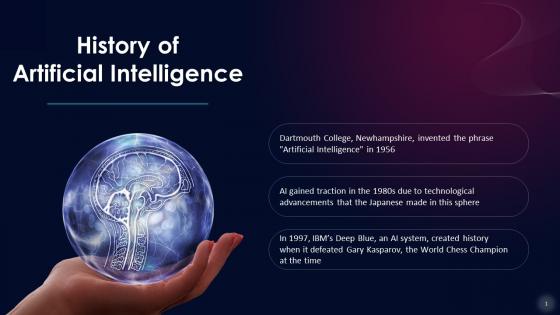
This slide illustrates the history of Artificial Intelligence. Dartmouth College invented the phrase Artificial Intelligence in 1956. AI gained attention in 1980s due to technology advancements that the Japanese made in this field.
People who downloaded this PowerPoint presentation also viewed the following :
Evolution Of Artificial Intelligence Training Ppt with all 17 slides:
Use our Evolution Of Artificial Intelligence Training Ppt to effectively help you save your valuable time. They are readymade to fit into any presentation structure.






FAQs for Evolution Of Artificial
Honestly, AI is changing everything in healthcare and finance right now. Doctors are using it to diagnose stuff faster and predict how patients will do. The finance world is crazy - it catches fraud instantly and does all that high-speed trading. What's cool is how it finds patterns in huge amounts of data that people would totally miss. My cousin works at a bank and says it's not really replacing anyone, just making everyone way better at their jobs. Both fields are kind of racing to figure this out. You should probably start learning some basic AI stuff if you're in either area.
Honestly, the bias thing is huge - AI can perpetuate discrimination in hiring, healthcare, criminal justice decisions. It's scary how much power we're giving these systems. Plus there's this whole "black box" issue where even developers can't explain why their AI picked one option over another. Accountability becomes a nightmare when things go wrong. Who do you blame, right? If you're dealing with AI in serious situations, definitely keep humans in the loop. Audit for bias regularly and document everything. Oh, and transparency is key - people deserve to understand how decisions affecting their lives get made.
Dude, AI is seriously a game-changer for retail. Personalized recommendations work like magic - customers see stuff they actually want based on what they've browsed before. Chatbots handle support 24/7 without you paying someone to sit there all night. Dynamic pricing adjusts automatically, which is honestly pretty genius. That visual search thing where people snap photos to find similar products? Mind-blowing. Plus it helps predict inventory needs and spot trends early. I'd start with chatbots and recommendation engines first - they're dead simple to set up and customers notice right away.
Privacy has to be baked in from the start - can't just bolt it on later. Only grab the data you actually need, nothing extra. Encrypt everything (both stored and moving around). Look into differential privacy or federated learning if you're feeling fancy. Anonymizing personal data sounds easy but it's honestly way harder than people realize. You'll want solid governance policies and regular check-ups. Oh, and treat privacy like it's a selling point because customers are getting pickier about this stuff. Trust me, doing it right upfront saves major headaches down the road.
So machine learning is basically what makes predictive analytics actually work. You feed it your old data and it finds patterns to predict what'll happen next - customer stuff, sales, when equipment might break, whatever. Way better than trying to code rules manually. Honestly, it's kind of wild how it catches things we'd totally miss. More data = smarter predictions over time. Oh and don't go crazy trying to predict everything right away, pick one thing first.
So NLP lets computers actually understand how we talk naturally - no more rigid commands or menu hunting. You just chat with Siri or whatever like you would a person. What blew my mind is how they handle context now. Make a typo? Use weird slang? Ask random follow-ups? They still figure out what you mean. Honestly saves so much time since you're not learning some clunky interface. Just start using voice commands more - even for basic stuff. You'll probably end up wondering why you were clicking around menus like a caveman before.
So basically AI bias is when your algorithms pick up unfair prejudices from the training data or just bad design choices. Like hiring tools that screw over certain groups, or facial recognition that can't handle darker skin properly - which is honestly ridiculous in 2024. Mix up your training data with diverse examples. Test everything across different demographics. Get diverse people reviewing your models too, not just the usual suspects. Build bias checks right into your process from the start. Way easier than trying to fix things later when you've already shipped something problematic.
So basically AI can handle energy optimization and predict environmental stuff at huge scales. Smart grids use it to cut waste, plus it analyzes satellite images to catch deforestation. Machine learning spots climate patterns we'd totally miss - which is honestly fascinating to me. Companies are using it for supply chain optimization too, lowering their emissions. Precision agriculture is another big one, using way less water and pesticides while boosting crop yields. Just gotta make sure the AI systems aren't power-hungry themselves, otherwise what's the point?
Dude, healthcare and finance are getting hit hard right now - AI's diagnosing stuff and handling trades like crazy. Transportation's next with all these self-driving cars (though honestly, I'm still skeptical about those). Retail and manufacturing are already deep in it. Customer service too - can't escape chatbots anymore, they're literally everywhere. Legal and education move slower but even they're changing with AI research tools. Oh, and personalized learning platforms are huge now. Whatever field you're in, just start messing around with AI tools today. Don't wait until everyone else figures it out first.
Look, AI's definitely changing things up. Some jobs are getting wiped out - think data entry, basic customer service stuff. Manufacturing too. But honestly? The whole "robots stealing everything" panic is kinda overblown. New roles keep popping up that didn't exist before. Data science is huge now. AI development obviously. Plus anything needing creativity or people skills is still very much human territory. I mean, you can't automate genuine empathy, right? The real move is just staying flexible and picking up skills that work WITH AI instead of trying to compete against it.
Narrow AI is basically a specialist - it's amazing at one thing, like Netflix recommendations or recognizing faces in photos. General AI would be more like having a digital person who could handle whatever you throw at them, matching human intelligence across the board. Everything we use now (Siri, ChatGPT, all that stuff) is narrow AI. True general AI doesn't exist yet and honestly might take decades to build. So when you're checking out AI tools for work, just focus on whether they actually solve your specific problem instead of expecting some magic do-everything solution.
Honestly, just start with the free stuff you probably already have. ChatGPT for writing things, Canva has AI design features now, Google Workspace has smart tools built in. Most small businesses don't even realize they're already using AI in half their apps anyway. Pick your biggest time-waster first - maybe a chatbot for customer questions or AI social media scheduling. Test one thing, see if it actually saves you time, then add more. I swear, the companies that try to do everything at once just end up overwhelmed. Start small and build from there.
Ugh, AI regulation is such a mess right now tbh. Europe's got their AI Act that sorts systems by risk levels, which actually makes sense. Meanwhile the US is doing this weird piecemeal thing - some rules for healthcare/finance, plus Biden's executive order. China's focused more on data security and algorithms. Most companies are just winging it with self-regulation since governments are way behind. My advice? Keep tabs on whatever's happening in your area and bake in ethical stuff from day one. Way easier than retrofitting later.
So basically AI can catch cyber threats way faster than old-school methods. It's constantly scanning your network data and picks up on weird patterns that might mean someone's trying to break in. The automation part is huge too - it handles all the boring stuff like log monitoring so your security people can focus on actual problems. Machine learning gets better over time, which is honestly pretty neat since hackers keep changing their tactics. I'd start with some AI threat detection tools and see how they work with what you've got already. Way better than trying to do everything manually.
Honestly, three big things are happening fast. AI's moving beyond basic stuff into actual decision-making now. Then there's this multimodal thing where it handles text, images, and voice all at once - pretty wild. AI agents can run entire workflows by themselves too. Your customers are gonna expect that Netflix-level personalization everywhere, which is kinda terrifying. Oh, and regulations are finally catching up so compliance isn't optional anymore. My advice? Audit what processes you could automate first. But seriously, just start messing around with existing tools now. Trust me, you don't want to be figuring this out when everyone else is already ahead.
-
Understandable and informative presentation.
-
Making a presentation has never been this easy for me. Thank you SlideTeam for offering a splendid template library.