

Difference between ai vs ml vs dl ppt powerpoint presentation ideas graphics





Try Before you Buy Download Free Sample Product
 Impress Your
 Audience
 100%
100% Editable
 Save Hours
 of Time


Our Difference Between AI Vs ML Vs DL Ppt Powerpoint Presentation Ideas Graphics are explicit and effective. They combine clarity and concise expression.
People who downloaded this PowerPoint presentation also viewed the following :
Difference between ai vs ml vs dl ppt powerpoint presentation ideas graphics with all 2 slides:
Give your audience a fulfilling experience. They will find our Difference Between AI Vs ML Vs DL Ppt Powerpoint Presentation Ideas Graphics elevating.
FAQs for Difference between ai vs ml vs dl ppt powerpoint
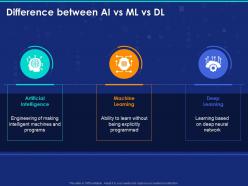
So AI is basically the whole umbrella - anything that tries to act smart like humans do. Machine learning sits under that, and it's when computers learn patterns from data instead of just following rules someone coded. Deep learning? That's just ML but with these crazy layered neural networks that work kinda like brains do. Here's the deal: all deep learning is machine learning, all ML is AI, but tons of AI isn't machine learning at all. When you're working on stuff, just think - am I coding rules (AI), feeding it data to learn (ML), or building those complex neural network things (DL)? Makes the whole thing way less confusing.
So neural networks and deep learning are pretty much the same thing. When your neural network has multiple hidden layers - like 3 or more - that's when people call it "deep." The whole "deep" thing just means it's got lots of layers stacked up. Each layer picks up more complex patterns as you go deeper. Honestly, I think the name sounds way more intimidating than it actually is. If you see "deep learning" mentioned anywhere, just picture a regular neural network but with a bunch of extra layers doing the work. That's really all there is to it.
Honestly, ML shines when you've got massive amounts of data and can't just code simple rules. Image recognition is perfect for this - like, how would you even write code to identify a cat in a photo? Traditional programming falls apart with thousands of messy variables. Fraud detection's another good example where patterns are way too complex for if-then logic. You'll want ML when your system needs to adapt and learn from real-world chaos. Also great for recommendation engines (though sometimes I wonder if Netflix really knows what I want to watch). Bottom line: good data + pattern recognition = ML territory.
Dude, AI is literally everywhere now. Your phone's camera does that auto-enhancement thing? That's AI. Netflix recommendations, Spotify playlists, even your GPS finding the fastest route - all AI. Banking apps catch fraud with it. Oh, and those annoying customer service chatbots (though some are actually helpful now). Email spam filters too. Siri obviously. Even predictive text when you're typing. Honestly, anything that seems to "get" your preferences or makes decisions for you is probably running on AI. It's kinda crazy how much we rely on it without realizing.
So basically, simple AI stuff works fine with tiny datasets or even just rules you write yourself. Machine learning gets greedier - you'll want thousands of examples to train properly. Deep learning though? That's a whole different beast, honestly. Those neural networks are ridiculously hungry and need hundreds of thousands or even millions of data points because they've got so many parameters to figure out. The fancier your model gets, the more data you need or it'll just memorize instead of learning. My advice? Start simple first, then worry about collecting massive datasets later.
Honestly, the GPU costs alone will make you cry - these models are ridiculously hungry for compute power. You'll need tons of clean data too, which is harder to find than you'd think. The worst part? Your model becomes this mysterious black box that nobody can explain to the boss. Debugging is a nightmare compared to regular code. Oh, and good luck deploying something that's massive and slow as hell. I learned this the hard way last year. Start with something simple first and make sure you actually need deep learning before diving in. Seriously, triple your time estimates.
Machine learning is crazy good at finding patterns in your old data to predict what's coming next. Sales forecasting, spotting customers about to bail, equipment breaking down - you name it. Honestly the accuracy blows my mind sometimes. Just make sure your data isn't garbage first, then pick the right algorithm. I'd say start super simple though - like monthly sales or basic customer stuff. Once you prove it works and people buy in, then go after the harder predictions. Way easier to get budget approval that way too.
Healthcare, finance, and automotive are crushing it right now with deep learning. Medical imaging and drug discovery are huge in healthcare. Finance companies are making bank with fraud detection and algorithmic trading. Obviously self-driving cars are the big automotive play. But really, any industry doing image recognition or predictive stuff will benefit. Retail, manufacturing, entertainment - everyone's getting in on this. Though I still think autonomous vehicles are overhyped timeline-wise. If you're thinking career moves or investments, I'd focus on those first three sectors. They're actually seeing real returns instead of just burning cash on AI buzzwords.
So feature engineering is where you take your messy raw data and turn it into something your ML model can actually use. You're basically creating and tweaking features so the algorithm can spot patterns easier. Most of your time gets eaten up by this step - way more than you'd expect honestly. It's like translating real-world chaos into model language. Traditional ML really needs this, but deep learning? Not so much since neural networks figure out features on their own. My advice: really dig into understanding your data first, then just try different transformations and see what works.
So here's the deal - explainability gets trickier as AI gets more complex. Rule-based systems? Easy peasy, you can follow the logic like breadcrumbs. Decision trees and linear regression are still pretty readable too. But neural networks... ugh, they're basically black boxes with millions of moving parts. I swear sometimes it feels like throwing spaghetti at a wall and seeing what sticks. Your move is planning ahead - pick simpler models when you need to explain stuff, or budget for tools like LIME if you're going the deep learning route.
Dude, bias is probably your biggest headache - if your training data sucks, your AI will discriminate like crazy. Audit that stuff hard. Privacy's another mess... don't grab data you don't actually need. The whole "black box" thing drives me nuts honestly, but you've gotta be able to explain decisions to people, especially for hiring or medical stuff. Oh, and transparency matters way more in high-stakes situations. Set up some ethical rules for your team first, then keep checking how things play out in the real world. People deserve to know how these systems affect them.
Honestly? Deep learning is way harder to interpret than regular ML models. You can actually see what's happening with decision trees or linear regression. But neural networks? Total black boxes with millions of parameters doing god knows what transformations. It's like asking why you randomly crave pizza at 2am - your brain just works in mysterious ways lol. There are some newer tools though - LIME, SHAP, attention visualization stuff. They help you peek under the hood a bit. If you really need to explain your model's decisions, maybe stick with simpler approaches or plan for extra debugging time.
Dude, the hardware situation has completely changed the game. GPUs and those fancy TPU chips let you run models with billions of parameters now - stuff that was impossible before. Training that used to take weeks? Done in hours. It's honestly crazy how fast things move. You can experiment with way bigger datasets and try different architectures without waiting forever. Oh, and definitely budget for decent hardware upfront if you're doing any deep learning work. Trust me, your timeline depends on it way more than you'd think.
Honestly, start with your data - that's where most people mess up. Clean it well and make sure it actually looks like what you'll see later. Use cross-validation and split everything properly (train/validation/test). Regularization helps with overfitting, which... yeah, catches everyone at some point. I'd also do early stopping and track more than just accuracy. Oh, and test on completely fresh data before you launch anything. Keep your model simple at first - you can always make it fancier if needed.
Set up data governance rules right from the start - accuracy, completeness, consistency standards for everything. Automated validation checks will catch errors before they spread. Trust me, bad data is like using rotten eggs in a recipe. Track where your data comes from so you're not guessing later. Get your data teams talking to business users regularly - they'll spot issues you miss. Oh, and definitely make someone own the data quality metrics. Otherwise it becomes everyone's problem but nobody's responsibility. Clean-up tools are worth the investment too.
No Reviews