


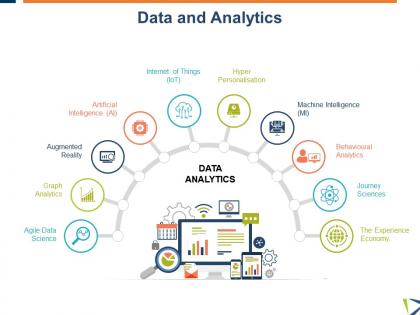
Data and analytics artificial intelligence ppt powerpoint presentation slides icons





Try Before you Buy Download Free Sample Product
 Impress Your
 Audience
 100%
100% Editable
 Save Hours
 of Time


AI and data analytics have been used interchangeably for a long time, to the point that people seldom distinguish between the two concepts. However, as data analytics and AI skills grow more prevalent and applied to various company operations such as marketing and supply, it is critical to grasp the difference between the two and what function they will play in business operations. If you’re looking for more information on data and analytics artificial intelligence, we have a wealth of resources to offer. Our data analytics PowerPoint templates are some of our most popular downloads, and they can give you a deep understanding of the topic at hand. So download them now, and get started learning about one of the most important aspects of business today.
People who downloaded this PowerPoint presentation also viewed the following :
Data and analytics artificial intelligence ppt powerpoint presentation slides icons with all 5 slides:
Use our Data And Analytics Artificial Intelligence Ppt Powerpoint Presentation Slides Icons to effectively help you save your valuable time. They are readymade to fit into any presentation structure.
FAQs for Data and analytics artificial intelligence ppt powerpoint
So basically traditional analytics just tells you what already happened - like looking in the rearview mirror. AI analytics actually predicts what's coming next and finds weird patterns you'd miss completely. With old-school methods, you have to know your exact questions beforehand. Pretty limiting, right? AI is constantly learning from your data and surfacing random insights you never thought to look for. Honestly, it's kind of wild how much it catches. I'd start with AI to see what pops up, then use traditional tools to dig deeper into anything interesting.
Honestly, AI can do some pretty cool stuff with data visualization. It'll spot weird patterns and anomalies automatically - sometimes catches things I'd totally miss. You can set up dashboards that update in real-time and show future trends without manually digging through endless spreadsheets. The natural language thing is actually game-changing though. Your team can literally just ask "what happened with Q3 sales?" and boom, instant charts. AI even picks better chart types than most people do (myself included). Oh, and automated reports save so much time. I'd start with just one dashboard first and see how much faster decisions get made.
So basically, machine learning finds all those hidden patterns in your old data that you'd never spot yourself. It builds models to predict stuff like which customers will bail or what your sales might look like next quarter. Pretty neat how it just gets better as you dump more data into it. Linear regression is probably your best starting point - nothing too crazy. I mean, you could spend months trying to figure out these correlations manually, but why torture yourself? Let the algorithms do what they're good at while you focus on the bigger picture stuff.
Get your data governance sorted before AI even sees it. Automated validation rules are clutch here - saves you from that awful garbage-in-garbage-out mess later. Regular audits and tracking where your data comes from is tedious but worth it. Version control for datasets too, trust me on this one. You'll want feedback loops so AI outputs get checked against benchmarks you know are solid. Oh and set up monitoring dashboards to catch problems early. It's annoying upfront work but treating data quality as ongoing rather than one-and-done makes everything smoother.
Oh man, data quality is gonna be your biggest headache - plus your old systems probably weren't designed for this stuff. Classic garbage in, garbage out situation. But honestly? The tech part isn't even the worst of it. Good luck getting people to trust AI over their "experience" and gut instincts. Change management becomes this whole thing because everyone hates new workflows. Your team will need training on AI tools too, which takes time. I'd definitely start with small pilot projects first - prove it works before you go crazy with it. Way less risky that way.
So NLP lets you just ask your data stuff in normal English - like "what were Q3 sales like?" and boom, you get charts instantly. No more waiting around for the tech team to run reports. It pulls insights from messy text data too, like customer reviews and social posts. Way faster than doing it manually (trust me on that one). Your survey responses are actually perfect to test this on first. The AI finds patterns in all that unstructured feedback that honestly would take forever to catch otherwise. Pretty cool how it makes data accessible to everyone.
Honestly, AI analytics has completely flipped healthcare, finance, and retail upside down. Healthcare uses it to predict patient outcomes and figure out better treatments. Banks catch fraud with it and do algorithmic trading - that stuff's pretty crazy when you think about it. Retail companies nail demand forecasting and those personalized recommendations you see everywhere. Tech companies are obviously killing it, but manufacturing is catching up super fast with predictive maintenance. Oh, and quality control too. If you're trying to get in, I'd definitely target these industries first since they're actually hiring and already have solid AI setups.
Yeah, you can totally use AI analytics without spending crazy money or hiring data nerds. Google Analytics Intelligence is solid, or Power BI if you're feeling fancy. Shopify has decent built-in stuff too if that's your thing. These platforms basically spot trends and predict customer behavior automatically - saves you from paying consultants thousands like we used to. I'd honestly just pick one burning question first, like "what tanked our sales in March?" Then see where it goes from there. Way less overwhelming that way.
So privacy and bias are your big ones here. Get consent for data use and anonymize personal stuff when you can. Bias is honestly the scariest part - whatever's baked into your training data gets amplified, which can screw people over in discriminatory ways. Transparency matters too, especially if your models impact hiring or loans or whatever. Oh, and definitely audit your datasets for bias upfront. That'll save you headaches later. Set up clear rules around data consent and make sure you can actually explain how your models work when someone asks.
Dude, AI basically turns real-time analytics into autopilot mode. It catches patterns and weird anomalies way faster than any human could - honestly saved my butt so many times. You'll get alerts before stuff actually breaks, which is clutch. The coolest part? It handles multiple data streams at once without breaking a sweat. Manual monitoring is just brutal for that kind of volume. Here's the thing though - you can actually fix problems while they're happening instead of finding out about disasters the next morning. I'd say start with anomaly detection first if you're new to this.
Honestly, AI analytics is pretty game-changing for decision making. It catches patterns in your data that would take you forever to spot manually - we're talking massive datasets processed in minutes instead of weeks. Sure, it cuts down on human bias, though the algorithms aren't perfect either. What's cool is how it predicts trends and flags risks before they become problems. You end up making choices based on actual data instead of just winging it. I'd say pick one small project in your area first and see what comes up. The insights might surprise you.
Track business stuff AND technical metrics - both matter. ROI and decision speed are huge, plus check if your predictions actually drive better outcomes like more revenue. Technical accuracy is cool but worthless if it doesn't translate to real value, you know? User adoption rates are critical too - I've seen amazing models sit unused because nobody trusted them. Pick maybe 3-4 metrics that directly connect to your business goals. Then just track consistently over time. Oh, and don't get obsessed with perfect accuracy if 85% gets you the business results you need.
AutoML is absolutely game-changing right now - you don't need to be some data science genius anymore. Cloud platforms finally scale without destroying your wallet, which is huge. Oh, and natural language querying blew my mind when I first tried it... just ask your data stuff in normal English and it works. Real-time processing got way faster too. Edge computing lets you run analytics right where your data sits instead of shipping everything around. Honestly, I'd peek at what AutoML features you've already got - might save you a bunch of headaches down the road.
So basically, AI learns what normal data looks like, then catches anything weird that doesn't fit the pattern. The speed is insane - it'll churn through millions of data points while you're still opening Excel. Isolation forests and autoencoders work really well for this stuff because they don't need you to tell them what anomalies are beforehand. They figure out the baseline themselves and spot the outliers. Oh, and if you don't have labeled examples yet, start with unsupervised methods. Way easier than trying to manually tag everything first.
Look, AI spits out insights all day long, but if you can't tell a good story with them, they're basically useless. Your job is turning those complex numbers into something people actually care about. I mean, stakeholders aren't going to get excited about raw data - they need the human angle. What does this mean for the business? Why should anyone give a damn? Sometimes I think we get so caught up in the technical stuff that we forget people make decisions with their emotions first. Connect your findings to real outcomes. Make it personal. Otherwise you're just another analyst throwing charts at the wall hoping something sticks.
-
Out of the box and creative design.
-
Top Quality presentations that are easily editable.
-
Use of different colors is good. It's simple and attractive.
-
Very unique and reliable designs.
-
Appreciate the research and its presentable format.
-
Great quality product.
-
Presentation Design is very nice, good work with the content as well.
-
Unique research projects to present in meeting.
-
Unique design & color.