


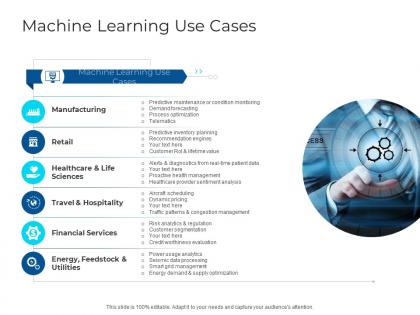
Machine learning use cases ai ppt slides




Try Before you Buy Download Free Sample Product
 Impress Your
 Audience
 100%
100% Editable
 Save Hours
 of Time


Our Machine Learning Use Cases AI PPT Slides are topically designed to provide an attractive backdrop to any subject. Use them to look like a presentation pro.
People who downloaded this PowerPoint presentation also viewed the following :
Machine learning use cases ai ppt slides with all 2 slides:
Use our Machine Learning Use Cases AI PPT Slides to effectively help you save your valuable time. They are readymade to fit into any presentation structure.
FAQs for Machine learning use cases
Medical imaging is insane right now - AI spots cancer in scans way faster than doctors can. Drug discovery's getting huge speed boosts too. Your electronic health records are becoming crazy smart, flagging complications before they actually happen. There's also solid progress in matching patients to clinical trials and personalizing treatments. Oh, and predictive analytics for when patients might crash. The radiology stuff honestly blows my mind every time I see it. Check out PathAI and Tempus if you want to see who's crushing it in this space right now.
ML has totally changed how banks catch fraud - it's honestly pretty wild. These algorithms process millions of transactions instantly, picking up on weird patterns humans would miss. Your spending in Tokyo when you live in Denver? Flagged immediately. Banks are now catching fraudulent activity like 70-80% faster than the old rule-based systems. The cool part is they actually learn from past fraud cases, so they get better over time. If you're thinking about fintech stuff, anomaly detection is where it's at. Though I still don't trust my bank's app half the time lol.
So ML is basically like having a crystal ball for your supply chain. Start with demand forecasting for your best-selling stuff - that's where you'll see results fast. It'll predict inventory needs, find better shipping routes, and honestly the accuracy is pretty crazy once you feed it enough data. The cool part? It spots problems before they hit you, like supplier delays or sudden demand spikes. Oh and it keeps getting smarter from your actual operations data, which is neat. I'd definitely begin small though, then scale up once you see what it can do.
So for personalized marketing with ML, start with recommendation engines - they're honestly the easiest win. Like how Amazon does that "people also bought" thing based on what customers browse and buy. Dynamic pricing is cool too, adjusting costs in real-time depending on demand. Your email campaigns will get way better results when ML picks the right subject lines and send times for each person. Oh and customer segmentation gets super precise, which helps target your campaigns better. I'd definitely go with product recommendations first though - you'll see ROI fastest there.
So autonomous cars use machine learning to process all that sensor data - cameras, lidar, radar, the whole setup. The AI learns to spot pedestrians, other cars, road signs, then predicts where everything's moving. It's honestly insane how much data gets processed every second. Path planning happens too, where it figures out the safest route while dealing with weather or construction zones. Waymo's pretty interesting if you want to dive deeper - they mix computer vision with reinforcement learning. Oh and the amount of real-time decision making is just nuts when you think about it.
Dude, ML is doing some crazy stuff in farming right now. Drones can spot crop diseases way before you'd notice them yourself - pretty wild tech. Irrigation systems are getting smart too, using soil sensors to know exactly when plants need water. The precision farming thing is insane though - algorithms literally tell you where to put each seed and how much fertilizer per square meter. Oh and John Deere's all over this space if you want to see what's actually happening. Blue River Technology too, though I think they got bought out? Anyway, it's basically giving farmers superpowers at this point.
So basically, ML lets chatbots actually understand what people are saying instead of just following scripts. They pick up on slang, weird phrasing, all that stuff. Pretty wild how they learn from old conversations and get smarter over time. Your customers get help 24/7 without waiting around, and the bot handles most requests automatically. Context matters too - they remember what you talked about earlier in the chat. Honestly saves your support team from dealing with basic questions so they can focus on the complicated stuff that actually needs a real person.
Anomaly detection and behavioral analysis are honestly your best bet for threat detection. I'd start with network traffic analysis - usually the quickest win you can get. Unsupervised learning catches weird patterns in traffic, logins, system stuff that doesn't look normal. Supervised learning's solid for malware and phishing too. Real-time monitoring though? Can't skip that - finding breaches weeks later sucks for everyone. Oh, and you'll need to keep retraining models constantly since attackers aren't sitting still. Clean, diverse data makes all the difference here.
Yeah, ML is doing some pretty wild stuff with climate data right now. Think massive satellite feeds and weather station info that would take forever to sort through manually. Weather prediction models are getting scary accurate, plus they're tracking deforestation in real-time. Energy grids are using it to cut emissions too - honestly didn't expect that one to work as well as it does. The tech handles all these weird climate interactions that mess up traditional models. If you're looking at this field, check out carbon tracking companies or renewable forecasting startups. That's where the money's moving.
Bias is the huge one - algorithms love picking up whatever discrimination already exists in your data. Super sneaky too. Transparency matters because people deserve to know AI's judging them. Data privacy's another headache since you're handling sensitive stuff. Plus there's that annoying "black box" thing where you can't explain the system's choices, which is awkward when someone asks why they got rejected. Honestly? Audit for bias regularly, tell candidates you're using AI upfront, and don't let the algorithm make final calls without human oversight. Trust me on that last part.
Oh dude, sports teams are totally obsessed with machine learning right now. They track every single player movement and analyze shooting patterns to figure out strategy. The injury prediction stuff is actually pretty crazy - algorithms can spot when someone's about to get hurt just from workload data. Fantasy platforms use it too for those player recommendations you see. Video analysis is huge because coaches don't have to spend forever breaking down film anymore. Check out how NBA teams handle their player tracking data if you want to see the wildest examples - that's where all the cutting-edge stuff happens first.
Dude, latency is gonna be your main headache. Your algorithm has to keep up with real-time video, so you're trading accuracy for speed whether you like it or not. Memory gets crazy tight too since video files are huge. GPU costs will make you cry a little. Oh, and if you're doing edge deployment? Good luck with those compute limits. I'd honestly profile your model's inference time first and hunt down bottlenecks before you even dream about production. Trust me on that one - learned it the hard way.
So basically, ML looks at all your equipment data - vibrations, temps, maintenance history, that stuff - and spots failure patterns way before things actually break. Way better than just doing maintenance every X months or waiting for stuff to die on you. The algorithms catch tiny changes that we'd totally miss, like bearings going bad weeks ahead of time. Honestly, emergency repairs are such a money pit. I'd start with whatever machines would screw you over most if they went down. You'll cut way back on surprise breakdowns and save a bunch on repairs.
So basically Netflix and Spotify use machine learning to stalk your habits - like what you watch at 2am versus Sunday morning. Pretty wild how they nail it sometimes. They're tracking your clicks, how long you stay on stuff, even when you pause shows. Plus they look at people with similar tastes to find things you'd never stumble across yourself. I swear Spotify knows my mood better than I do half the time. The crazy part is it just keeps getting more accurate the more you use it, which is both convenient and slightly terrifying if you think about it.
So ML is basically giving drug discovery a massive speed boost - instead of blindly testing compounds for years, you can predict what'll actually work upfront. Companies are using it to spot good drug targets, figure out how molecules behave, even guess side effects before they happen. What's wild is development times are dropping from like 10-15 years down to maybe half that in some cases. You should definitely look into DeepMind's AlphaFold stuff and Atomwise - they're doing some genuinely impressive work with protein folding and screening compounds that's worth studying.
-
Commendable slides with attractive designs. Extremely pleased with the fact that they are easy to modify. Great work!
-
Very well designed and informative templates.
-
Great product with effective design. Helped a lot in our corporate presentations. Easy to edit and stunning visuals.
-
Awesome presentation, really professional and easy to edit.