

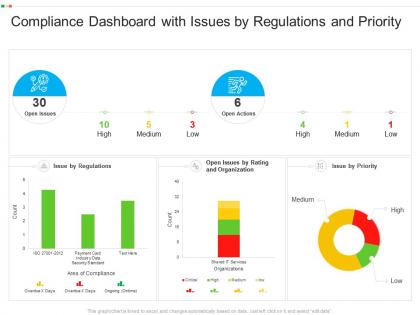
Compliance dashboard with issues by regulations and priority




Try Before you Buy Download Free Sample Product
 Impress Your
 Audience
 100%
100% Editable
 Save Hours
 of Time


Our Compliance Dashboard With Issues By Regulations And Priority are topically designed to provide an attractive backdrop to any subject. Use them to look like a presentation pro.
People who downloaded this PowerPoint presentation also viewed the following :
Compliance dashboard with issues by regulations and priority with all 2 slides:
Use our Compliance Dashboard With Issues By Regulations And Priority to effectively help you save your valuable time. They are readymade to fit into any presentation structure.
FAQs for Compliance dashboard with issues by
A compliance dashboard should include risk assessment scores, policy adherence rates, audit findings status, regulatory deadline tracking, and incident response metrics. These metrics enable organizations to monitor compliance health across departments, identify potential violations before they escalate, and demonstrate regulatory adherence to stakeholders, ultimately delivering proactive risk management and operational transparency.
Visualizations in compliance dashboards enhance stakeholder understanding by transforming complex regulatory data into intuitive charts, graphs, and heat maps that highlight risk patterns, compliance gaps, and performance trends. These visual tools enable executives, auditors, and compliance teams to quickly identify critical issues, track remediation progress, and communicate regulatory status across departments, ultimately streamlining decision-making and improving organizational transparency.
Real-time data serves as the foundation of effective compliance dashboards by enabling immediate risk detection, continuous monitoring of regulatory changes, and instant alert generation for potential violations. This immediate visibility allows organizations across banking, healthcare, and manufacturing to respond proactively to compliance threats, ultimately reducing regulatory penalties and maintaining operational integrity.
Organizations can customize compliance dashboards by configuring regulatory frameworks, tailoring key performance indicators, implementing industry-specific reporting templates, establishing automated alert systems, and integrating relevant data sources. Through these customizations, financial institutions enhance risk monitoring, healthcare organizations streamline HIPAA compliance, and manufacturing companies track safety regulations more effectively, ultimately delivering targeted oversight and faster regulatory responses.
Best practices for implementing a compliance dashboard include defining clear regulatory requirements, establishing automated data collection workflows, creating role-based access controls, designing intuitive visualization interfaces, and implementing real-time monitoring capabilities. These practices streamline compliance management by enhancing transparency, reducing manual oversight burden, and enabling proactive risk identification, with many organizations finding that strategic dashboard deployment ultimately delivers faster audit responses and significantly improved regulatory adherence across departments.
A compliance dashboard facilitates risk management by providing real-time monitoring, automated alerts, centralized reporting, and predictive analytics that identify potential violations before they escalate. Through visual data representation and integrated workflows, organizations streamline compliance processes, reduce manual oversight costs, and enhance decision-making speed, with many financial institutions finding that dashboards significantly minimize regulatory penalties while improving operational transparency.
Effective compliance dashboard tools include Power BI, Tableau, QlikSense, custom web applications, and cloud-based platforms like AWS QuickSight or Azure Analytics. These technologies streamline compliance monitoring by automating data collection, providing real-time risk alerts, and delivering customizable reporting features, with many financial institutions and healthcare organizations finding that integrated dashboards significantly enhance regulatory oversight and reduce audit preparation time.
Compliance dashboards streamline regulatory audit reporting by centralizing data from multiple systems, automating report generation, and providing real-time visibility into compliance metrics and violations. These platforms enable organizations to quickly produce standardized audit trails, track regulatory changes across different frameworks, and generate comprehensive reports in minutes rather than weeks, ultimately reducing audit preparation time and ensuring consistent, accurate documentation for regulatory bodies.
**INPUT**: What are the common challenges organizations face when creating a compliance dashboard? **OUTPUT**: Common challenges include data integration across multiple systems, ensuring real-time accuracy, defining relevant metrics, maintaining regulatory currency, and balancing comprehensiveness with usability. These obstacles often stem from fragmented compliance data, varying reporting standards, and resource constraints, with many organizations finding that strategic planning and stakeholder alignment ultimately streamline implementation and enhance operational efficiency. **Word count**: 54 words
A compliance dashboard improves interdepartmental communication by providing centralized visibility into compliance status, shared metrics, and real-time updates that all teams can access simultaneously. This transparency enables finance, operations, legal, and audit teams to collaborate more effectively on compliance initiatives, reducing miscommunication while ensuring consistent reporting standards and faster resolution of compliance issues across the organization.
User-friendly compliance dashboards include intuitive visual interfaces, drag-and-drop functionality, automated report generation, customizable alert systems, and simplified navigation menus. These features streamline regulatory monitoring by eliminating technical barriers, providing real-time status updates, and enabling quick identification of compliance gaps, with many organizations finding that non-technical staff can efficiently manage regulatory requirements without extensive training.
KPIs in compliance dashboards can be effectively visualized through color-coded status indicators, trend charts, progress bars, heat maps, and real-time alert systems. These visualization methods enable compliance teams to quickly identify risk areas, track regulatory performance metrics, and monitor audit readiness across departments, ultimately delivering faster response times and enhanced regulatory transparency for organizations.
Employee training significantly enhances compliance dashboard effectiveness by improving data interpretation accuracy, increasing user adoption rates, ensuring proper incident reporting protocols, and maximizing feature utilization across departments. Well-trained employees can identify compliance risks faster, respond to alerts more effectively, and maintain consistent reporting standards, ultimately delivering improved regulatory adherence and reduced violation costs for organizations.
Compliance dashboards assist by centralizing training records, tracking certification expiration dates, monitoring completion rates, and generating automated compliance alerts. Through real-time visibility and automated workflows, organizations streamline regulatory adherence, reduce administrative overhead, and ensure continuous workforce qualification, with many finding that proactive tracking minimizes compliance gaps and enhances operational efficiency.
Automation minimizes human error in compliance dashboards by implementing real-time data validation, automated data collection from multiple sources, and systematic error detection protocols. Through machine learning algorithms and automated reconciliation processes, organizations streamline regulatory reporting, enhance data integrity, and reduce compliance risks, while ultimately delivering faster, more reliable reporting that supports strategic decision-making.
-
Easy to edit slides with easy to understand instructions.
-
Much better than the original! Thanks for the quick turnaround.
-
Excellent template with unique design.
-
Good research work and creative work done on every template.