

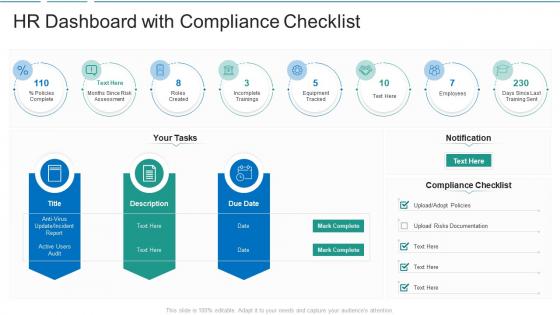
Hr dashboard with compliance checklist




Try Before you Buy Download Free Sample Product
 Impress Your
 Audience
 100%
100% Editable
 Save Hours
 of Time


Our HR Dashboard With Compliance Checklist are topically designed to provide an attractive backdrop to any subject. Use them to look like a presentation pro.
People who downloaded this PowerPoint presentation also viewed the following :
Hr dashboard with compliance checklist with all 2 slides:
Use our HR Dashboard With Compliance Checklist to effectively help you save your valuable time. They are readymade to fit into any presentation structure.
FAQs for Hr dashboard
So you'll definitely want to track training completion rates, policy acknowledgments, and incident reports. Turnover rates and diversity metrics are super useful too. Time-to-resolution for HR issues is huge - nobody wants stuff dragging on forever. If you have compliance audit results, those are honestly perfect for impressing leadership. Oh and any regulatory deadlines you're managing. The whole point is catching problems early before they blow up into major disasters. I'd start with these basics first, then layer in whatever industry-specific compliance stuff applies to your company later.
Oh man, you'll love having one of these! Basically tracks all your compliance stuff in real-time so you don't get blindsided later. Training deadlines, policy signatures, certifications - it's all there. Super clutch during audits because you're not digging through files like a maniac trying to prove someone did their harassment training. Set up alerts and you'll catch things early, like when Bob's forklift cert is about to expire or you're hitting overtime limits that could bite you legally. Honestly saved my butt more times than I can count.
Put your most critical stuff first - overdue trainings, expired certifications, policy acknowledgments that need signatures. Color coding helps but honestly don't go crazy with it or you'll create a rainbow nightmare. Group similar things together and customize what each person sees based on their role. HR needs different data than department heads, obviously. The game-changer though? Add quick action buttons so people can fix problems directly from the dashboard. Nobody wants to click through five different systems just to mark something complete. Oh and keep urgent items red, approaching deadlines yellow - basic but it works.
Honestly, daily updates hit the sweet spot for HR compliance stuff. Real-time would be amazing but daily catches most issues before they blow up - like expiring certifications or missed training deadlines. Weekly *could* work for less urgent metrics, but compliance problems spiral quickly so I wouldn't risk it. Monthly is way too slow. Set up automated daily pulls from your HRIS so you're not doing manual updates constantly (been there, it sucks). That way you'll spot red flags early enough to actually do something about them.
Figure out what compliance stuff you actually need to track first - that's key. Power BI's solid if you're already using Microsoft everything, makes pulling data way easier. Tableau's probably the best overall but yeah, it'll cost you. Google Data Studio works if budget's tight. Oh, and if you want something built for HR specifically, BambooHR and Workday have their own dashboards already baked in. Honestly though, whatever connects smoothest to your current systems is gonna save you the biggest headache later.
Okay so visual stuff is your friend here - color-coded charts, progress bars, heat maps, all that good stuff. Traffic light systems are clutch: green for compliant, yellow for at-risk, red for violations. Bar charts work great for training completion rates, line graphs for trends. Pie charts... honestly they're kinda overused but they do show demographic breakdowns well. Your executives will actually love dashboards they can understand without squinting at spreadsheets for twenty minutes. Keep it simple though - focus on metrics that matter to whoever's asking. Oh, and start with your biggest compliance headaches first.
Okay so employee feedback is basically your best early warning system for compliance stuff. Regular surveys and exit interviews give you the real story - not just what looks good on paper. I've seen places where everything seemed fine compliance-wise, but people were actually miserable and dealing with issues that could've become major problems. Track sentiment data alongside your usual metrics. Sometimes what employees tell you matters way more than the official numbers. Pulse checks are great too - they catch things before they explode. It'll totally change how you see risk.
Honestly, these dashboards are game-changers for staying on top of compliance stuff. You get everything in one spot - training rates, who's acknowledged policies, audit results - instead of hunting through a million spreadsheets (which is the worst). Real-time updates mean you can catch problems early before they cost you big money. Set up alerts for the important metrics so you're not scrambling when something goes wrong. The best part? You can actually see which departments need help and move resources around quickly. Way better than playing catch-up after violations happen.
Honestly, you'll want to keep tabs on training completion rates and policy acknowledgments - those are your bread and butter. Incident reporting frequency matters too, plus any audit findings. I'd definitely watch harassment complaints and safety violations since those can spiral fast. Certification expirations are sneaky - they'll bite you if you're not careful. Diversity metrics and pay equity are huge right now with regulators breathing down everyone's necks. Set up your dashboard to flag when completion rates tank or departments start showing weird patterns. Monthly reviews work well so you can fix things before they blow up into major headaches.
So basically an HR compliance dashboard shows you all your diversity stuff in real time - hiring ratios, who's getting promoted, pay gaps between different groups. Pretty wild how clear the patterns become when you actually see the data visualized. You'll catch things like certain demographics getting stuck at mid-level roles or your recruiters missing whole talent pools. Track your D&I goals and stay on top of legal requirements too. Oh, and definitely automate the reports - trust me, you don't want to be pulling data manually when audit season hits. Just figure out your key metrics first, then build from there.
Oh man, data silos are gonna be your worst enemy. Your HRIS and payroll systems hate talking to each other, so creating one dashboard feels impossible. Getting managers to actually use the thing? That's a whole other battle - some will love it, others will ignore it completely. Keeping everything accurate when compliance rules change every five minutes is exhausting too. Honestly, just start small with maybe 3-4 key metrics. Clean up your data sources first (trust me on this), then train people properly so they don't freak out at all the numbers.
APIs and data connectors are your best bet here. Most HRIS platforms like Workday or BambooHR have pre-built integrations that'll sync everything automatically - saves you tons of headaches. Connect your HRIS, payroll, performance systems, maybe learning management too. Real-time data flow is crucial so your dashboard actually shows what's happening now, not last month's mess. I'd start by figuring out which systems have your most critical compliance stuff. Then tackle integrations based on where you're most at risk. Honestly, the more you connect, the clearer your compliance picture gets.
So your HR folks will need training on whatever dashboard software you picked, plus they gotta understand the compliance stuff it's tracking - employment law, data privacy, safety regs, you know the drill. The tech part's usually easy since these things are built to be user-friendly. But honestly, the real magic happens when they can actually read the data and catch problems early. Don't forget to train them on who to call when alerts go off. I'd start with a hands-on workshop using real scenarios, then maybe do refreshers every quarter since rules always seem to be changing.
So basically predictive analytics flips your HR dashboard from always playing catch-up to actually seeing problems coming. You'll get alerts about stuff like certifications about to expire or which employees might violate policies soon. Way better than finding out after everything's already blown up, honestly. The system looks at past patterns and spots red flags automatically - though it took our team a bit to trust it at first. You can set different alert levels too. Short version: you're preventing headaches instead of just documenting disasters.
Dude, non-compliance issues can absolutely wreck your company. Legal penalties, lawsuits, fines - the whole mess. Your dashboard catches stuff like wage violations, safety problems, discrimination red flags, training gaps. Some of these turn into million-dollar disasters fast. Plus you'll spot patterns causing turnover or killing productivity. The cool thing? You get early warnings instead of finding out when it's too late. Someone needs to check those alerts weekly though - monthly is way too slow. I've seen companies ignore this stuff and it never ends well.
-
Great product with effective design. Helped a lot in our corporate presentations. Easy to edit and stunning visuals.
-
The Designed Graphic are very professional and classic.
-
Understandable and informative presentation.
-
The Designed Graphic are very professional and classic.