

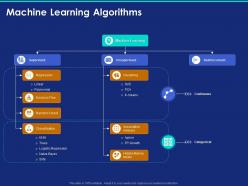
Machine learning algorithms ppt powerpoint presentation show grid





Try Before you Buy Download Free Sample Product
 Impress Your
 Audience
 100%
100% Editable
 Save Hours
 of Time


Our Machine Learning Algorithms Ppt Powerpoint Presentation Show Grid are topically designed to provide an attractive backdrop to any subject. Use them to look like a presentation pro.
People who downloaded this PowerPoint presentation also viewed the following :
Machine learning algorithms ppt powerpoint presentation show grid with all 2 slides:
Use our Machine Learning Algorithms Ppt Powerpoint Presentation Show Grid to effectively help you save your valuable time. They are readymade to fit into any presentation structure.
FAQs for Machine learning algorithms ppt powerpoint
So basically, supervised learning is when you have examples with the right answers already - like showing the algorithm a bunch of photos that are already labeled "cat" or "dog." Then it figures out how to predict new stuff. Unsupervised is messier honestly - you just dump unlabeled data on it and see what patterns it finds. Like grouping customers by shopping habits without knowing what groups you're even looking for. If you've got labeled data and know what you want to predict, go supervised. Otherwise unsupervised's better for just... discovering weird stuff you didn't expect.
So basically, decision trees are like flowcharts with yes/no questions that split your data to predict outcomes. You can actually draw them out which is pretty cool - they handle numbers and text without much prep work. The downside though? They go nuts with overfitting, especially on messy data. Plus they're weirdly unstable - tweak your training data slightly and boom, totally different tree. Honestly, I'd use them mainly to explore your data first, then move to Random Forest or something more solid. They're great for understanding what's going on before you get fancy.
So gradient descent is how ML models actually learn - it finds the best parameters by minimizing your loss function. Picture rolling a ball down a hill to find the bottom, but the hill is your error surface. The algorithm calculates gradients (basically slopes) and moves toward whatever reduces error fastest. Works for everything from basic linear regression to complex neural networks. Honestly, it's pretty satisfying when you finally get it. Oh, and mess around with the learning rate when you're tuning - makes a huge difference in how fast things converge.
So SVMs find the hyperplane that creates the biggest possible gap between your different classes. Think of it like drawing the widest "street" you can between data points. The magic happens with support vectors - those are just the closest points to your boundary line. The algorithm positions everything so it's maximally far from these key points. Way better than just any random separating line, right? This approach helps avoid overfitting since you're not getting thrown off by weird outliers. Honestly, grab a simple 2D dataset first and visualize it - makes way more sense when you actually see it working.
So ensemble methods are basically like asking multiple ML models for their opinion instead of trusting just one. Different models screw up in different ways, right? When you combine their predictions - either averaging them or letting them vote - the mistakes usually balance out. Random Forest does the averaging thing, boosting is more like voting. Honestly, I'd just start with Random Forest since it's dead simple to code up and pretty much always beats whatever single model you were using before. It's kind of the lazy person's way to better accuracy, but hey, it works.
So overfitting is basically when your model gets way too cozy with your training data - it memorizes everything instead of actually learning useful patterns. Training accuracy looks amazing but then it completely bombs on new data. Cross-validation helps catch this early. Regularization keeps your model from getting too wild, and dropout works well for neural networks. More training data is clutch if you can swing it. I always start simple first - you can make things more complex later while watching those validation scores like a hawk. Honestly, it's one of those things you get better at spotting with practice.
So neural networks are basically computers trying to copy how our brains work - they've got these connected nodes that act like neurons and learn from data. Deep learning just means you're stacking tons of these layers on top of each other. More layers = it can spot way more complex stuff. That's how you get things like ChatGPT or those Tesla cameras figuring out what's a stop sign vs a red balloon (which honestly still freaks me out sometimes). The "deep" part is what makes them so crazy good at image recognition and language stuff. I'd start simple though if you're diving into this world.
Pick metrics based on what you're solving. Classification? Go with accuracy, precision, recall, F1-score. Regression needs MAE, MSE, or R-squared. Accuracy is honestly overrated with imbalanced data - precision and recall tell you way more. Confusion matrices help tons for multi-class stuff. Think about what actually matters for your project first though. Like if missing a cancer diagnosis is catastrophic, you'd focus on recall over everything else. I usually start basic then get pickier once I see what's breaking. Makes sense?
So clustering basically takes your data and groups similar stuff together - no labels needed. The algorithm just finds patterns on its own. Think of it like sorting your Spotify playlist by vibe when you've got random songs everywhere. K-means is probably your best bet to start with, though there's hierarchical clustering and DBSCAN too if you get fancy later. People use it for customer segmentation, organizing documents, image recognition - that kind of thing. Honestly, I'd just dive in with k-means first. It's usually what I do when exploring new data anyway.
Dude, ML bias is such a huge problem. Your algorithm picks up whatever messed up patterns are in the training data - like if society's biased, your model will be too. People get screwed over in job applications, loan approvals, court decisions, you name it. Honestly makes me wonder how many algorithms are quietly discriminating right now. You've gotta check your datasets for bias upfront, test how it performs across different groups, then keep monitoring it after launch. Just because it's code doesn't mean it's fair - that's like the biggest myth in tech.
So basically, traditional ML learns from pre-labeled datasets - like cramming with answer keys before an exam. RL is totally different though. Your algorithm learns by actually doing stuff and getting feedback (rewards/penalties) based on how well it performs. Think of it like learning to ride a bike - you don't study a manual, you just hop on and figure it out through trial and error. The dog training analogy is pretty spot-on too, honestly. If you're dealing with decision-making problems where things change dynamically, RL's probably your better bet than standard supervised learning approaches.
Dude, feature selection makes such a difference for accuracy. Your model gets distracted by irrelevant stuff otherwise - it's like trying to study with music blasting. Remove the junk features and suddenly it can actually see the patterns that matter. Training goes way faster too. I learned this the hard way when I had like 200 features and my model was complete garbage. Correlation analysis is probably the easiest place to start, or try recursive feature elimination. Both work pretty well. You'll dodge overfitting issues and that whole curse of dimensionality nightmare. Honestly wish someone told me this earlier.
You've totally used NLP without realizing it. Google Translate, Siri, spam filters - all that stuff. Banks use it for fraud detection too, which is pretty smart actually. Your phone's predictive text? That's NLP learning your typing habits in real-time. Netflix analyzes reviews to suggest shows you'll like. Those annoying customer service chatbots are everywhere now. Even social media sentiment analysis happens constantly. It's crazy how much text processing goes on behind the scenes - like, we just assume our devices "get" what we're saying but there's so much tech making that possible.
So basically CNNs use these tiny filters that slide around looking for stuff like edges and textures. Early layers catch simple patterns, then deeper ones combine those into complex things like faces. It's pretty similar to how our brains work, which is cool. The sliding part means your model finds patterns anywhere in the image - way better than regular networks for this stuff. Oh and definitely visualize what each layer sees when you're debugging, that was a game changer for me understanding wtf was actually happening.
So KNN works like this - it finds similar data points that hang out together in your dataset, then predicts based on what the closest neighbors are doing. Think "birds of a feather" but for math nerds. You measure distances (Euclidean usually) between your new point and all the training data, then let the k nearest ones vote on the answer. Honestly, k=5 is a pretty solid starting point, though you'll want to tune it later. The whole thing assumes your features actually mean something for similarity - which isn't always true but works surprisingly well most of the time.
No Reviews