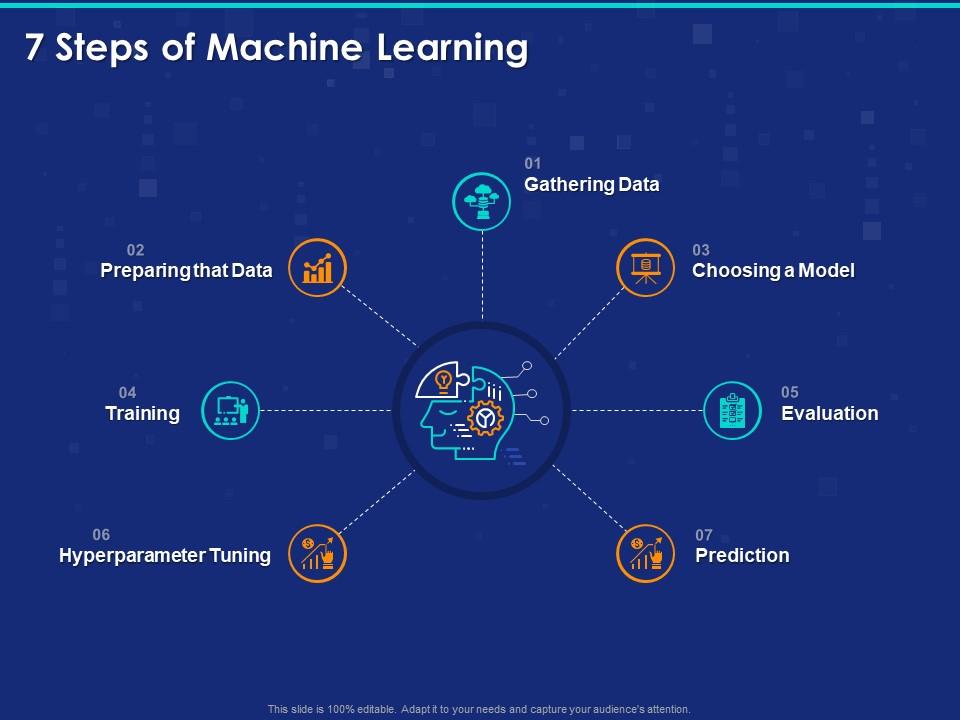
7 steps of machine learning ppt powerpoint presentation graphics
Try Before you Buy Download Free Sample Product
Audience
Editable
of Time
Our 7 Steps Of Machine Learning Ppt Powerpoint Presentation Graphics are topically designed to provide an attractive backdrop to any subject. Use them to look like a presentation pro.
People who downloaded this PowerPoint presentation also viewed the following :
7 steps of machine learning ppt powerpoint presentation graphics with all 2 slides:
Use our 7 Steps Of Machine Learning Ppt Powerpoint Presentation Graphics to effectively help you save your valuable time. They are readymade to fit into any presentation structure.
FAQs for 7 steps of machine learning ppt
So basically, supervised learning is when you've got labeled data - like input-output pairs where you know the "right" answers. You're training models to predict stuff. Unsupervised is trickier - no labels, just raw data where you're hunting for hidden patterns or groupings. Reinforcement learning? That's the fun one honestly. It learns by trial and error, getting rewarded or punished for actions (think game AIs). Picture it like: supervised = studying with answer sheets, unsupervised = detective work finding connections, reinforcement = learning to ride a bike through practice. If you've got clear targets to predict, start with supervised.
Dude, feature selection is actually super important - I used to skip it and wonder why my models sucked. Your algorithm gets confused when there's too much noise from irrelevant features. Fewer features = faster training and usually better accuracy too. Overfitting is the real killer though, where your model just memorizes instead of actually learning anything useful. Start with feature importance scores from whatever model you're using. Then try correlation analysis or recursive feature elimination to see what you can drop. Honestly, sometimes less is more with this stuff.
Dude, preprocessing is literally everything. Seriously, I've watched good models completely tank because someone couldn't be bothered to normalize their data first. Your raw data is probably a mess - missing values everywhere, weird outliers, features scaled all wrong. Clean that stuff up before you even think about algorithms. My old professor used to say spend like 80% of your time just getting your data ready, which seemed crazy at first but... yeah, he was right. Check your data quality upfront or you'll hate yourself later. Garbage in, garbage out and all that.
So basically, neural networks figure out what matters in your data without you having to spell it out first. Traditional ML? You're stuck manually picking which features to use - takes forever. Deep learning shines with messy stuff like images or text where you can't easily tell what's important. The catch is you need tons of data and serious computing power. Old-school methods just can't handle really complex patterns well. Honestly, if your data is all over the place (unstructured), deep learning frameworks are worth checking out. It's like having the model do the detective work for you.
Honestly, bias is the big one - your models can totally screw over certain groups if your training data is messed up. Then there's the whole black box thing where you can't explain why it made a decision, which is super sketchy when it affects real people's lives. Who takes the blame when things go wrong? The dev? The company? Good luck figuring that out. Also - and this might be obvious - but you gotta audit for bias regularly and actually be able to explain decisions to whoever's asking.
Honestly, you gotta build this stuff in from the start or you'll hate yourself later. Set up automated checks for duplicates, missing data, outliers - the usual suspects. But also have humans review the weird edge cases because automation misses stuff. Track where all your data comes from (data lineage is a lifesaver when things break). Oh and version your datasets like code - seriously game changing. Statistical monitoring catches drift over time. For labeling, write clear guidelines and have multiple people annotate the same samples. Catches way more inconsistencies that way.
Honestly, don't rely on just one metric - that's a rookie mistake. Accuracy works fine for balanced datasets, but if your classes are wonky, precision and recall will save you from looking stupid later. Cross-validation is non-negotiable, and confusion matrices show you exactly what's breaking. ROC curves are solid for binary stuff too. Oh, and RMSE or MAE if you're doing regression obviously. Pick maybe 2-3 metrics that actually matter for your project and stick with those. I learned this the hard way when accuracy looked amazing but my model was trash at detecting the rare cases I actually cared about.
Basically overfitting is when your model gets way too good at memorizing the training data but can't handle anything new - kinda like studying only practice tests then failing the real exam. Cross-validation helps catch this early by testing on fresh data. Regularization (L1/L2) keeps models from getting too complex, and dropout randomly turns off neurons during training which honestly sounds weird but works. I always do early stopping too - just watch your validation loss and quit when it starts going up. Main thing is saving some data your model never touches so you can spot trouble before you're screwed.
Honestly, start small with your parameter grid - don't go crazy with a massive search right off the bat. Random search usually beats grid search anyway, so try that first. Cross-validation is your friend for reliable results. I'm a huge fan of Bayesian optimization if you've got time to set it up (though it's kind of a pain initially). Write down everything you test because trust me, you'll totally forget what worked. Focus on parameters that actually move the needle for your specific problem. Found something promising? Do a tighter search around those values. Oh, and save your best configurations as you go - you'll thank yourself later!
Start with pre-trained models instead of building from scratch - they've already learned tons of useful stuff from huge datasets. Take ResNet for example, it already knows edges, textures, all that basic visual info from ImageNet. Just freeze those early layers and retrain the final ones on your data. Or fine-tune everything with a really low learning rate. Honestly, even if the pre-trained model isn't from your exact domain, it'll usually beat starting from zero. Cross-domain transfer works better than you'd think. Try to find something close to your problem first though.
Honestly, transformers like GPT are absolutely crushing it right now - they've completely changed how we think about sequential data. Multimodal models are insane too, processing text, images, and audio all at once. Graph neural networks? Super hot for recommendations and social stuff. Oh, and vision transformers are actually beating CNNs at image tasks, which is kinda crazy if you think about it. Self-supervised learning's also huge since you don't need tons of labeled data anymore. Start with attention mechanisms though - that's where everything builds from.
Dude, ML totally changes the game for NLP. Instead of just keyword matching, your apps can actually get context and nuance - like understanding sarcasm and cultural stuff. The sentiment analysis becomes way more accurate, translations don't suck anymore, and chatbots stop sounding like they're from the stone age. These models train on huge datasets so they pick up on how people really talk. Oh and they keep improving as they see more data, which is pretty cool. If you're working on anything text-heavy, just use pre-trained models like BERT or GPT. Don't reinvent the wheel.
So machine learning is pretty wild for predictions - it spots patterns in huge datasets that we'd totally miss. You'll see it everywhere now: retail companies predicting what customers will buy, manufacturers catching equipment before it breaks, hospitals forecasting patient stuff. Finance uses it for fraud detection too. The crazy part? These algorithms actually get better over time as they crunch more data. My advice would be picking one specific thing in your field first - don't go nuts trying to predict everything right away. Way easier to nail one use case then expand from there.
Honestly, data drift is gonna be your worst nightmare - your model works perfectly in testing but then real-world data shifts and suddenly you're getting garbage predictions. Scalability will bite you too. Works fine on your laptop, crashes when actual users show up. Monitoring is huge though, you need to catch problems before customers start complaining. Regulatory stuff and explainability requirements are a whole other mess I won't even get into right now. Just start with something small and get your monitoring set up from day one. Trust me on this one.
So basically you can throw ML at your customer data to group people by how they actually buy stuff, their demographics, engagement - way better than just age/gender buckets. K-means clustering is pretty standard for this. Then you personalize campaigns, spot customers who might bail, adjust pricing per segment. Gets better as you add more data too. Honestly I'd start with something simple like email targeting first - don't try to boil the ocean right away. Once that's working, expand to other areas.
No Reviews