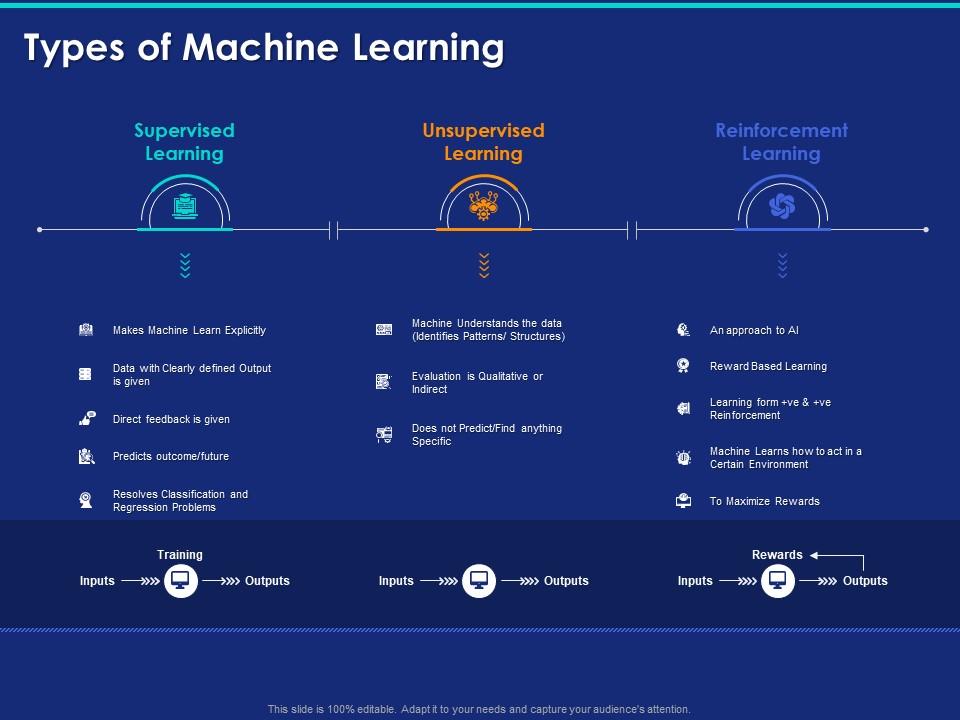
Types of machine learning ppt powerpoint presentation icon guidelines
Try Before you Buy Download Free Sample Product
Audience
Editable
of Time
Our Types Of Machine Learning Ppt Powerpoint Presentation Icon Guidelines are topically designed to provide an attractive backdrop to any subject. Use them to look like a presentation pro.
People who downloaded this PowerPoint presentation also viewed the following :
Types of machine learning ppt powerpoint presentation icon guidelines with all 2 slides:
Use our Types Of Machine Learning Ppt Powerpoint Presentation Icon Guidelines to effectively help you save your valuable time. They are readymade to fit into any presentation structure.
FAQs for Types of machine learning ppt powerpoint
Oh this is actually pretty simple! Supervised learning means you already have the "correct" answers to train with - like feeding it 1000 cat pics labeled "cat." Unsupervised is messier. You're just dumping data and saying "find something interesting I missed." I'd honestly go supervised first if you have labeled data. Way easier to work with. Unsupervised is better for discovering weird patterns - like grouping customers by shopping habits when you don't even know what groups exist yet. Both are useful but supervised gives you more predictable results.
So basically, RL is perfect when you want something to learn by just trying stuff and seeing what works. Robotics uses it all the time - robot arms figuring out how to grab things, that sort of thing. But honestly? Gaming is where it gets really cool. AlphaGo crushed those world champions, and now you've got game AI that actually learns how you play. The whole thing works because the system gets feedback and slowly gets better at making decisions. Just heads up though - you'll need a solid reward system and yeah, training takes forever.
So basically, you can borrow from models that already learned tons of stuff from huge datasets. No need to start from zero - just grab a pre-trained model and tweak it with your smaller data. It's like... someone already knows how to drive, now they're just learning stick shift, you know? These models have figured out the basic patterns that work across similar problems. You'll probably need hundreds of examples instead of millions, which is honestly pretty sweet. I'd start hunting for pre-trained models in whatever area you're working on and just mess around with fine-tuning. Way easier than building everything yourself.
So basically, discriminative models just care about drawing lines between different categories - they learn "given this input, what's the output?" Logistic regression, SVMs, that stuff. Generative models actually learn how your data is structured and can make new samples that look real. GANs are probably the most famous example, but VAEs work too. Oh, and naive Bayes is technically generative which always trips people up. Anyway, if you're trying to classify something, go discriminative. Want to create new content or really understand your data? That's when generative models shine.
So you know how labeling data costs a fortune? Semi-supervised learning is clutch when you've got mountains of unlabeled stuff but only like 100 labeled examples. Think medical scans - you can't exactly have random people labeling X-rays, you need actual radiologists. Same with text classification honestly. You might have millions of documents but can only pay to tag a few hundred. It basically finds patterns in all that unlabeled data to boost your model way beyond what you'd get from just the labeled stuff. Pretty much saves your butt when budgets are tight.
Honestly, the biggest pain is gonna be computational stuff - these models are total resource hogs. Latency is brutal too since you need millisecond responses but deep learning wants to chug along slowly. Memory's another headache because models are huge and edge devices... well, they're not exactly powerhouses. Oh and don't get me started on the accuracy vs speed tradeoff - it's like picking your poison. Profile your model super early, that'll save you headaches later. Quantization and pruning help shrink things down. If you've got budget, specialized hardware like GPUs make a real difference.
So basically you take a bunch of different models and let them "vote" on the answer - like getting multiple opinions before making a decision. Each model screws up in its own way, but when you average their predictions, the mistakes tend to cancel out while the good stuff gets reinforced. Random forests do this really well and they're everywhere for a reason. Honestly, just start with simple averaging between 3-4 models. Way less headache than trying to perfect one super complex model, and you'll probably get better results anyway. The trick is making sure your models are actually different from each other.
Honestly, it comes down to what you're trying to solve. Classification? Go with accuracy, precision, recall, F1-score. Just watch out - accuracy can totally fool you when your data's unbalanced. Regression problems need RMSE, MAE, R-squared instead. Oh, and if you're doing recommendations or ranking stuff, MAP and NDCG matter way more. Don't go crazy tracking every metric though. Pick like 2-3 that actually align with what your business people care about. I've seen too many projects get lost in metric hell when they could've just focused on what moves the needle.
So overfitting is basically when your model gets too obsessed with the training data and can't handle anything new - like that person who memorizes every practice test but bombs the real exam. You'll notice it when training accuracy looks amazing but validation accuracy sucks. Cross-validation catches this early, which is honestly a lifesaver. Also try getting more data, using regularization techniques, or just making your model simpler. Dropout works well for neural nets too. There's always this balancing act between being too complex and too basic, but you'll get the hang of it.
So clustering basically finds hidden patterns in your data that you'd totally miss otherwise. K-means forces everything into whatever number of groups you pick (kinda rigid tbh), but hierarchical clustering shows you the natural groupings at different levels. You can segment customers, spot weird data points, group similar stuff automatically - makes your analysis way sharper. Downside is you might oversimplify messy relationships or create fake divisions that aren't really there. I'd start with hierarchical first to see what emerges naturally, then switch to K-means if you need exact cluster counts for business stuff.
Bias is the big scary one - if your training data leans toward certain groups, your model will too. That screws over underrepresented people pretty badly. Can you explain how your model actually makes decisions? Black box stuff is impossible to defend when it's affecting real lives. Privacy matters too - don't accidentally leak user data (seems obvious but happens all the time). Oh, and definitely test across different demographics before you launch. I'd start by checking your training data for gaps first.
So feature selection basically keeps the good stuff and tosses what doesn't matter for predictions. Your training gets way faster since there's less junk to process. Memory usage drops too, which is clutch with big datasets. Honestly, it usually makes your model more accurate because you're cutting out noise and weird correlations. I'd start with correlation analysis - super straightforward. Recursive feature elimination works great too, though it takes a bit longer to run. Kind of like Marie Kondo for data, you know? Keep what sparks joy (or predictions).
So transformers are pretty wild - they use this self-attention thing where the model can look at ALL words in a sentence at once, instead of going through them one by one like older RNNs. What's crazy is you can train them on tons of random text without labels, just having them guess missing words or whatever comes next. BERT and GPT work this way. The magic happens when you take these pre-trained models and tweak them for your actual problem - suddenly you don't need nearly as much labeled data. It's honestly kind of insane how well they transfer to new tasks.
Okay so data preprocessing is where you'll spend most of your time - like seriously, way more than the actual modeling part. First thing: clean your data by fixing missing values and tossing duplicates. Scale your features too because neural networks basically have a meltdown when one feature is 0-1 and another is 0-10000. Oh, and convert categorical stuff to numbers since algorithms can't read "red" or "blue." Split everything into train/validation/test sets properly. I know it sounds boring but honestly? This grunt work is what makes models actually useful instead of just fancy paperweights. Trust me on this one.
ML totally depends on what industry you're dealing with. Healthcare's all about diagnostic imaging and drug discovery - super high stakes stuff where being wrong could literally kill someone. Finance does fraud detection and credit scoring (you know, deciding if you get approved for that car loan). Marketing's more fun - recommendation engines, figuring out what you'll buy next. The main thing is understanding what each sector actually cares about. Healthcare has crazy regulations, finance needs everything to happen instantly, marketing just wants to personalize everything for millions of people at once. Pick whatever approach matches your industry's biggest headaches.
No Reviews