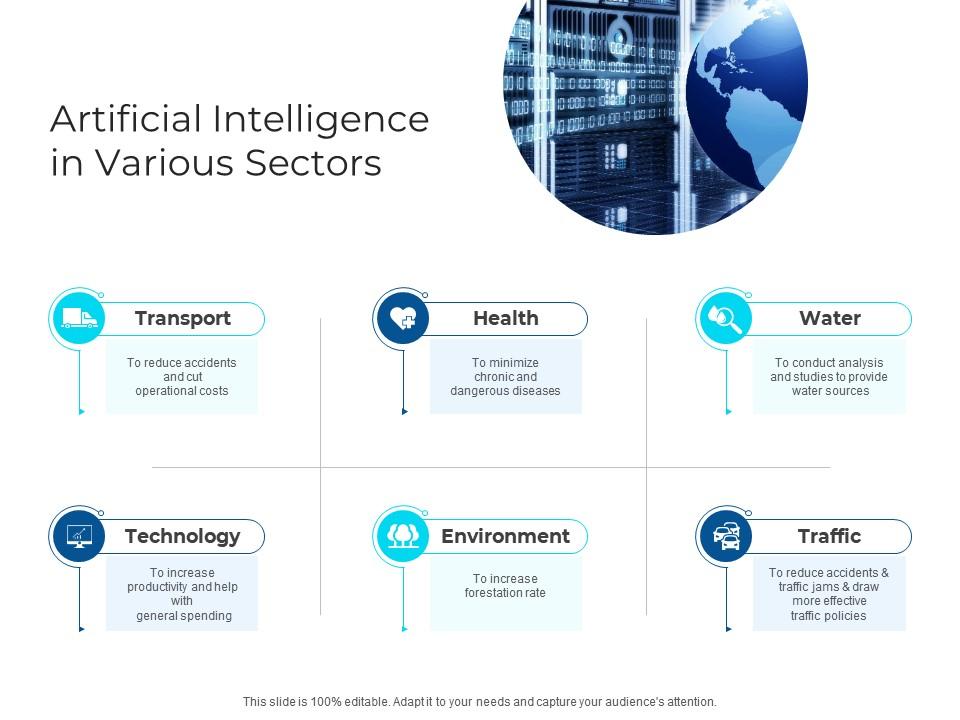
Artificial intelligence in various sectors ai ppt slides
Try Before you Buy Download Free Sample Product
Audience
Editable
of Time
Our Artificial Intelligence In Various Sectors AI PPT Slides are topically designed to provide an attractive backdrop to any subject. Use them to look like a presentation pro.
People who downloaded this PowerPoint presentation also viewed the following :
Artificial intelligence in various sectors ai ppt slides with all 2 slides:
Use our Artificial Intelligence In Various Sectors AI PPT Slides to effectively help you save your valuable time. They are readymade to fit into any presentation structure.
FAQs for Artificial intelligence in various sectors
Honestly, bias is probably the scariest part - your AI will basically amplify whatever's wrong with your training data. Privacy's another nightmare since these things hoover up everything. Can you even explain why it made that choice? Most people can't, which is terrifying for accountability. Everyone freaks out about job losses too, and rightfully so. Safety becomes critical if you're doing medical stuff or self-driving cars - one bad decision could literally kill someone. My take? Figure out your ethics first, then build. Way easier than trying to fix it later.
Pick one annoying process first - maybe data entry or support tickets. Something where you can actually see if it's working or not. I made the mistake of trying to do too much at once and it was a disaster. Map your current workflow before throwing AI at it. Your team's gonna panic about getting fired, so get them involved early. Test it out for a couple months on something that won't kill your business if it goes sideways. Honestly, the "measure twice, cut once" thing applies here. You want clear before/after numbers so you know you're not just burning money on shiny tech.
Machine learning is what makes AI actually work. So instead of coding every single possibility (which would be impossible), the system just learns patterns from tons of data. Your phone's autocorrect gets better because it's constantly seeing how you type. Same idea powers Netflix recommendations, self-driving cars, all that stuff. ChatGPT? Yep, machine learning too. Pretty much any AI project you touch will have ML running somewhere behind the scenes. It's honestly kind of crazy how well it works sometimes - like the computer is actually thinking, you know?
Honestly, AI tools are pretty clutch for decision-making. You know how you'd normally spend forever digging through data? These things crunch those numbers in minutes and actually find patterns your brain would miss. The predictive stuff is wild too - like getting a heads up on what might happen next. Sure, they help remove some of our weird human biases, but garbage in, garbage out, right? What I love most is it frees you up from the boring spreadsheet work so you can actually think strategically. My advice? Pick one decision you make regularly and test it out there first.
Yeah, AI's gonna wipe out some jobs for sure - the repetitive stuff like data entry and basic customer service will probably go first. Manufacturing too. But here's the thing - it's also creating jobs we can't even imagine yet. Some people are gonna struggle with the transition if they don't learn new skills, which honestly sucks. We've survived tech upheavals before though. My advice? Don't try to compete with AI. Focus on what humans do best - being creative, solving messy problems, reading people. That emotional intelligence stuff machines still can't touch.
Honestly, AI for customer stuff is pretty cool when you get it right. Start with a basic chatbot for common questions - that's the easy win. From there, you can get into the really good stuff like product recommendations based on what people actually do on your site. The personalization angle is where it gets interesting because suddenly every customer feels special, you know? AI can predict what someone needs before they ask, plus it'll flag customers who seem pissed off so you can jump in early. Behavior analysis, sentiment tracking - it all works together. Just don't try to do everything at once.
So narrow AI is basically what we've got right now - stuff that's really good at one thing, like recognizing faces or translating languages, but totally useless at anything else. General AI would be the sci-fi version where machines are as smart as humans at everything. We're honestly nowhere close to that yet (which might be for the best?). The narrow stuff is already shaking up tons of jobs though. That's what you should worry about for your career. General AI could maybe solve climate change someday, but it could also... well, let's just say there's a reason people are freaked out about it. I'd focus on how today's AI might mess with your specific industry first.
So AI's actually pretty solid for climate stuff. It can optimize energy grids to cut waste, predict weather for renewable planning, and crunch environmental data we'd never catch ourselves. Machine learning helps with traffic flow to reduce emissions, plus supply chain optimization. There's also cool applications like developing better solar panels and monitoring deforestation through satellites - honestly that satellite thing is kind of mind-blowing when you see it in action. The big advantage is processing climate data at massive scale. I'd check what energy optimization tools exist for your specific industry first.
Ugh, AI bias is such a nightmare - it basically takes whatever prejudices were baked into the training data and runs with them. You'll see unfair hiring choices, sketchy loan decisions, discriminatory healthcare stuff. The worst part? It's super sneaky. What helps: get diverse datasets from the start, audit regularly for bias, and honestly having a mixed team makes a huge difference since they catch things others miss. Test across different groups and keep monitoring ongoing. Don't be that company that waits until they're called out publicly - be ahead of it.
Honestly, AI right now is pretty limited - it can't really reason through stuff properly and just copies patterns from training data. Context? Forget about it. Plus the bias issues are wild. Researchers are working on systems that actually think through problems instead of just pattern-matching. Less data-hungry too, which would be nice. The whole "black box" thing is getting attention since nobody wants AI making decisions we can't understand. Oh, and if you're doing any AI projects - seriously budget extra time for testing weird edge cases. Trust me on that one.
So AI in healthcare is pretty wild right now. Doctors are using it to spot cancer way earlier than they used to, and it's getting crazy good at predicting when patients might crash before anyone sees symptoms. Drug discovery is way faster too. The whole personalized medicine thing based on your DNA is actually happening now, not just sci-fi anymore. But yeah, there's definitely downsides - privacy stuff freaks me out, and some algorithms are biased as hell. Oh, and doctors getting too dependent on tech is kinda scary. If you're thinking about implementing it, just start with small tests first.
Dude, AI security is honestly a mess right now. Adversarial attacks can completely fool these systems, and they'll leak training data if you're not careful. Don't even get me started on data poisoning - that stuff is scary. Bias amplification is another huge issue. You'll want robust testing and data encryption for sure. Regular audits help too, plus solid input validation. Oh, and set up a basic threat model first - sounds boring but it's worth it. Also make sure you've got clear rules around who can access data and update models.
Honestly, start tracking your numbers *before* you implement anything - that's huge. Look at processing time, error rates, customer conversions, how many hours your team spends on boring stuff. After you roll out AI, compare monthly. Some benefits are obvious right away, but others take like 3-4 months to really show up which is annoying but normal. Don't forget the softer stuff too - customer satisfaction scores, whether your employees seem less burned out. Document everything because you'll need to prove ROI to your boss eventually and trust me, you won't remember the specifics later.
Personalized learning is probably the biggest game-changer right now - platforms that actually adjust to how fast you learn stuff. Then you've got AI tutors available whenever (which honestly beats waiting for office hours). Automated grading gives instant feedback instead of waiting weeks. What's cool is these systems can spot when you're struggling before you even realize it. Language tools are insane now too - real-time translation, accessibility features that actually work. Khan Academy and Duolingo are killing it if you want to see this stuff in action rather than just theory.
Just grab some no-code AI tools to start. Canva has AI design stuff, Grammarly helps with writing, ChatGPT's great for content and customer replies. Most are free or like $20/month - way better than hiring people. Those expensive "AI consultants"? They're probably using the exact same tools lol. Pick whatever eats up most of your time first. Social media posts with Buffer's AI features, or QuickBooks for automatically sorting expenses. I'd honestly just try one thing, get used to it, then add more. Don't overthink it.
-
Excellent work done on template design and graphics.
-
Qualitative and comprehensive slides.
-
Professional and unique presentations.
-
Great experience, I would definitely use your services further.
-
Great designs, Easily Editable.
-
Awesome presentation, really professional and easy to edit.
-
Very unique, user-friendly presentation interface.
-
I discovered this website through a google search, the services matched my needs perfectly and the pricing was very reasonable. I was thrilled with the product and the customer service. I will definitely use their slides again for my presentations and recommend them to other colleagues.
-
Really like the color and design of the presentation.