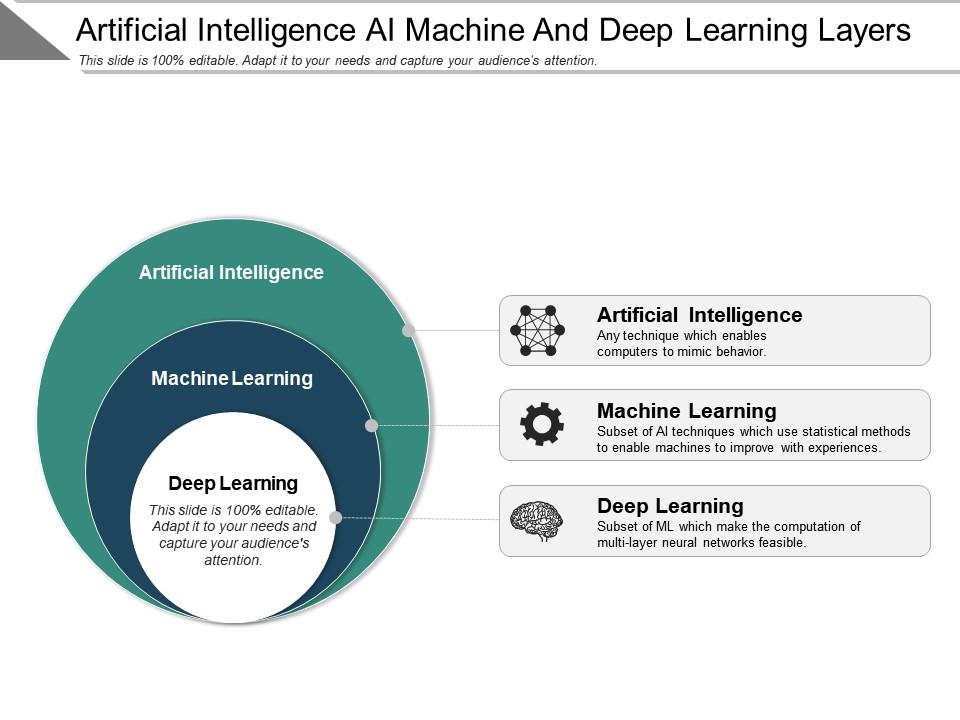
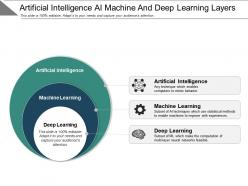
Artificial intelligence ai machine and deep learning layers powerpoint topics
Try Before you Buy Download Free Sample Product
Audience
Editable
of Time
Our Artificial Intelligence Ai Machine And Deep Learning Layers Powerpoint Topics fulfill every criteria. They contain every desirable element.
People who downloaded this PowerPoint presentation also viewed the following :
Artificial intelligence ai machine and deep learning layers powerpoint topics with all 5 slides:
Delve on inspirational experiences with our Artificial Intelligence Ai Machine And Deep Learning Layers Powerpoint Topics. Enlighten folks on jazz.
FAQs for Artificial intelligence ai machine and deep learning
Honestly, the scariest stuff is already happening - hiring algorithms screwing over women, facial recognition that can't ID people of color properly. Privacy invasion is huge too. Job displacement, obviously. But here's what really bugs me: when AI screws up badly, like an autonomous car crash or wrong medical diagnosis, who takes the blame? Your team needs to run bias audits and build in privacy protections from day one. Don't deploy anything customer-facing without solid human oversight. Trust me on this one.
Dude, AI is changing everything right now. Healthcare's probably the craziest - it can spot diseases in scans faster than most doctors, which is honestly kind of wild. Banks use it for fraud detection and those algorithmic trades you hear about. Your credit score? Yeah, that's AI too now. Education's getting these smart tutoring systems that actually adapt to how fast you learn stuff. Oh, and drug discovery is way faster with AI doing the heavy lifting. It's not killing jobs like everyone freaks out about, just making people better at what they do. Seriously though, whatever field you're in, start messing around with AI tools now.
So basically, ML is what makes AI actually learn stuff instead of just running on whatever code someone wrote. Your phone recognizing your face? That's machine learning figuring out patterns. Same with Netflix suggestions - honestly their algorithm knows me better than I know myself sometimes. Without ML, you'd just have really basic AI that can only do exactly what it's programmed for. But with it, systems can crunch through tons of data and actually get smarter. If you're building anything AI-related, you'll probably need some form of ML to make it work properly.
Ugh, AI bias is such a mess. These systems just copy whatever unfair patterns they learned from their training data. So you get hiring tools that won't consider women for tech jobs, or loan algorithms that reject people based on zip code. Criminal justice uses this stuff too, which is honestly terrifying when you think about it. Healthcare diagnostics can be biased as well. The worst part? It makes existing inequalities way worse since AI operates at massive scale. Regular audits help. Diversifying training data is crucial. Always keep humans involved in big decisions - don't let the machines run everything.
Look, AI definitely creates stuff that's genuinely creative - sometimes it comes up with things that blow my mind. But here's the thing: it's more like having this super well-read friend who's amazing at mixing ideas in weird ways. The output can be totally original and useful, just without any of the personal meaning or life experience behind it that makes your creativity special. It's creative, sure, but not in the same way humans are. Honestly? Best approach is treating it like a creative buddy rather than expecting it to think like you do.
Look, some jobs are definitely gonna get automated - manufacturing, data entry, basic customer service stuff. That's just reality. But historically tech has always created more jobs than it kills, just different types. What I'd focus on if I were you? Skills that AI sucks at - being creative, reading people, complex communication. Strategic thinking too. Manufacturing workers probably have it roughest right now, honestly. Don't try to compete with AI - work alongside it instead. Start learning complementary skills now rather than waiting. The whole "humans vs robots" thing is overblown anyway.
So basically, neural networks work like your brain does - tons of connected nodes that spot patterns in data. You know how a toddler learns what a dog is after seeing hundreds of them? Same idea. Traditional programming sucks at messy real-world stuff, but these networks actually get better with more data. They're pretty much the backbone of modern AI. Honestly, I was intimidated by the whole thing at first, but there are some decent tutorials online if you want to mess around with a simple one. Way easier than I thought it'd be.
Start with governance policies that spell out what AI can and can't do in your company. Bias audits are crucial too - this tech can get weird real fast without oversight. Be upfront with customers about your AI use (people hate surprises). Train your team on best practices because honestly, most folks don't know what they don't know. Think of it like any other risk thing you manage. Short policies nobody reads won't cut it - you need ongoing monitoring and someone actually paying attention to what's happening.
Honestly, AI is a game-changer for data stuff. You'll process everything way faster and catch patterns you'd totally miss doing it by hand. It cleans up your messy data automatically and builds models that actually get smarter over time. The seasonal trends thing is pretty neat - it handles all those weird fluctuations better than old-school methods. Machine learning keeps refining predictions as new data rolls in, so your forecasts improve. Oh, and outliers? It deals with those too. Just think about whatever repetitive analysis you're sick of doing - that's probably where you should start automating.
Okay so supervised learning is when you've got labeled data - like spam detection where you already know what's spam vs not spam. The algorithm learns from those examples. Unsupervised is different - you're basically looking for hidden patterns when you don't have the "answers" beforehand. Think clustering customers or spotting weird anomalies. Then there's reinforcement learning, which honestly reminds me of how I learned video games as a kid. It just tries stuff repeatedly and gets better through trial and error, rewards and penalties. Quick test for your project: got labeled examples? That's supervised. Looking for hidden connections? Unsupervised. Need something that improves by doing? Reinforcement learning.
Dude, NLP has gotten insane lately. Like, these models actually get context now instead of just keyword matching - totally different game. I'm sure you've messed around with ChatGPT? That's just the tip of the iceberg. Customer service bots don't completely suck anymore, real-time translation actually works, and they're doing crazy stuff in medical document analysis. Oh, and code generation too - though honestly that still feels a bit weird to me. If you want to try it out, start simple. Maybe sentiment analysis on customer feedback? You'll see results fast and it's not overwhelming to set up.
Honestly, you'll want frameworks that don't kill innovation but still keep things safe. Data protection laws, algorithmic transparency, liability rules when AI messes up - that stuff. The EU's AI Act does this pretty well actually, sorting AI by risk levels with different rules for each. Healthcare AI will probably get way stricter regulations than like, entertainment apps. Which makes sense I guess. The hard part is not crushing useful innovation while preventing actual harm. Different countries are taking totally different approaches right now, so if you're building AI products you'll need to track what applies where. Bit of a headache but whatever.
Dude, AI is completely changing how cybersecurity works. Machine learning can spot weird patterns in network traffic that would fly right past human analysts. Pretty crazy how these systems learn from old attacks to predict new ones. They can automatically block suspicious stuff before it spreads too - no waiting around for someone to notice. The speed difference is insane compared to traditional methods. Only downside? Hackers are using AI against us now too, so you've gotta keep updating your defenses constantly. It's like an arms race but with algorithms.
Honestly, AI's pretty amazing for climate stuff. Smart thermostats are just the beginning - it can optimize entire energy grids and predict when wind/solar will be most effective. The crazy part is how it processes massive datasets to spot emission patterns we'd never catch. Supply chains get way more efficient too. Climate modeling helps policymakers actually make informed decisions for once (imagine that). Oh, and if your company wants to track carbon footprint, there are some solid AI tools out there now that won't break the bank. It's genuinely one of those cases where the tech hype might actually deliver.
Honestly, it's pretty simple - AI crushes the boring stuff like data analysis while you handle the creative and judgment calls. Doctors are already doing this - they'll use AI to spot things in scans faster, but they're still the ones deciding treatment. Same with marketing teams who let AI crunch customer numbers but write the actual campaigns themselves. (Side note: AI is hilariously bad at getting sarcasm.) Manufacturing, finance, schools - everyone's figuring this out. You focus on strategy instead of mindless tasks. I'd start small though - find one repetitive thing AI could take off your plate first.
-
Easy to edit slides with easy to understand instructions.
-
Qualitative and comprehensive slides.