


Introduction to ai levels ppt powerpoint presentation model vector





Try Before you Buy Download Free Sample Product
 Impress Your
 Audience
 100%
100% Editable
 Save Hours
 of Time


Our Introduction To AI Levels Ppt Powerpoint Presentation Model Vector are topically designed to provide an attractive backdrop to any subject. Use them to look like a presentation pro.
People who downloaded this PowerPoint presentation also viewed the following :
Introduction to ai levels ppt powerpoint presentation model vector with all 2 slides:
Use our Introduction To AI Levels Ppt Powerpoint Presentation Model Vector to effectively help you save your valuable time. They are readymade to fit into any presentation structure.
FAQs for Introduction to ai levels ppt powerpoint
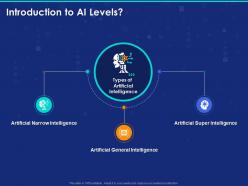
AI levels are typically classified into three categories: Artificial Narrow Intelligence (ANI), Artificial General Intelligence (AGI), and Artificial Superintelligence (ASI). ANI, currently deployed across healthcare, finance, and retail sectors, handles specific tasks like fraud detection and customer service, while AGI represents human-level cognitive abilities and ASI surpasses human intelligence, ultimately enabling organizations to streamline operations and enhance competitive advantage.
Narrow AI focuses on specific tasks like image recognition, language translation, or fraud detection, while general AI would possess human-like reasoning across multiple domains. Current narrow AI applications streamline operations in healthcare diagnostics, financial services automation, and customer support chatbots, delivering targeted efficiency gains, whereas general AI remains theoretical, ultimately requiring different development approaches and risk considerations.
Superintelligent AI presents both transformative opportunities and profound ethical challenges, including job displacement, decision-making transparency, privacy concerns, and potential concentration of power among tech leaders. While it could revolutionize healthcare, education, and scientific research, society must establish robust governance frameworks, ethical guidelines, and equitable access policies to ensure these advances benefit humanity broadly rather than exacerbating existing inequalities.
Machine learning represents narrow AI, enabling systems to learn from data and improve performance on specific tasks like recommendation engines or fraud detection. Deep learning, a subset of machine learning using neural networks, powers more sophisticated applications such as image recognition in healthcare, natural language processing in customer service, and autonomous vehicle navigation, ultimately delivering enhanced accuracy and automation capabilities across industries.
Data quality serves as the foundation for narrow AI effectiveness, directly impacting accuracy, reliability, and performance across training and operational phases. Poor data quality leads to biased algorithms and flawed predictions, while high-quality, comprehensive datasets enable narrow AI systems to deliver precise results in applications like fraud detection, medical diagnosis, and recommendation engines, ultimately determining competitive advantage.
Ethical AI characteristics include transparency in decision-making, fairness across diverse populations, accountability for outcomes, privacy protection, and human oversight mechanisms. These principles scale with intelligence levels, where basic AI requires clear algorithmic transparency, while advanced systems demand robust value alignment and comprehensive impact assessment, ultimately ensuring responsible deployment across healthcare, finance, and autonomous systems.
Businesses can leverage narrow AI for competitive advantage by automating specific tasks, enhancing customer personalization, optimizing supply chains, improving fraud detection, and accelerating data-driven decision making. Through targeted AI applications, companies streamline operations while reducing costs, with sectors like retail, finance, and healthcare finding that focused AI implementations deliver measurable efficiency gains and superior customer experiences.
**INPUT**: What are the risks associated with each level of artificial intelligence? **OUTPUT**: AI risks include job displacement and bias in narrow AI, unpredictable decision-making in general AI, and potential control loss with superintelligent systems. While early levels present manageable challenges through proper oversight and training, advanced AI development requires strategic governance frameworks, with many organizations finding that proactive risk management and ethical guidelines ultimately deliver safer implementation and sustainable competitive advantage. [Word count: 60 words]
Human-like reasoning differentiates AI levels through progressive cognitive capabilities, from narrow task-specific functions to broad contextual understanding, abstract thinking, and autonomous decision-making. While current AI excels at pattern recognition and data processing, advancing levels demonstrate enhanced problem-solving, emotional intelligence, and creative synthesis, with many organizations finding that higher reasoning capabilities ultimately deliver more strategic value and competitive advantage.
Healthcare, finance, manufacturing, retail, and transportation experience the most significant impact from AI advancements due to their data-intensive operations, regulatory requirements, and customer interaction complexity. These industries leverage different AI levels to automate diagnostics, enhance fraud detection, optimize supply chains, and personalize experiences, ultimately delivering improved efficiency, reduced costs, and competitive advantages in increasingly digital markets.
Regulatory frameworks become increasingly comprehensive as AI technology advances from basic automation to artificial general intelligence, with narrow AI facing sector-specific rules while advanced systems require broader oversight mechanisms. Financial services, healthcare, and autonomous vehicles currently navigate varying compliance requirements, with many organizations finding that proactive regulatory engagement ultimately delivers competitive advantage and market trust in an increasingly regulated AI landscape.
AI capability measurement methodologies include benchmarking suites, performance metrics, standardized testing frameworks, comparative analysis tools, and capability assessment matrices. These approaches evaluate AI systems by testing reasoning abilities, problem-solving accuracy, and task complexity handling across industries like healthcare diagnostics and financial modeling, ultimately delivering objective comparisons that help organizations select optimal AI solutions for their strategic needs.
AI level perception has evolved from theoretical concepts to practical business applications, with organizations increasingly recognizing narrow AI's immediate value over pursuing general AI. While early discussions focused on achieving human-like intelligence, businesses now prioritize specialized AI systems for specific tasks like fraud detection, customer service, and predictive analytics, ultimately delivering measurable ROI and competitive advantages.
Future trends in AI development include advanced neural architectures, multimodal learning, autonomous reasoning, federated learning systems, and quantum-AI integration. These technologies enhance computational efficiency, cross-platform integration, and real-time decision-making capabilities, with many organizations finding that strategic AI investments ultimately deliver competitive advantages, streamlined operations, and scalable solutions across industries.
Cultural attitudes significantly shape AI development through varying approaches to privacy, automation, and human-AI collaboration, with Western cultures often emphasizing individual privacy while Asian markets prioritize collective efficiency. These differences influence how AI levels progress, as societies with greater AI acceptance, like those in Singapore and China, often advance faster through levels by embracing automation in banking and healthcare, ultimately creating diverse global AI ecosystems.
No Reviews