

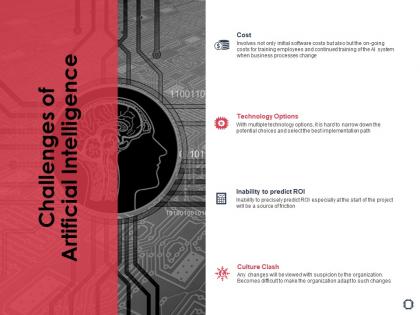
Challenges of artificial intelligence ppt powerpoint presentation professional show




Try Before you Buy Download Free Sample Product
 Impress Your
 Audience
 100%
100% Editable
 Save Hours
 of Time


Cater for calamities with our Challenges Of Artificial Intelligence Ppt Powerpoint Presentation Professional Show. Initiate action to control the degree of damage.
People who downloaded this PowerPoint presentation also viewed the following :
Challenges of artificial intelligence ppt powerpoint presentation professional show with all 5 slides:
Identify different factions with our Challenges Of Artificial Intelligence Ppt Powerpoint Presentation Professional Show. Figure out the factors causing differences.


FAQs for Challenges of artificial intelligence ppt powerpoint
So basically there are three big issues with AI making decisions. First, bias - if you train it on crappy data, it'll make crappy biased choices about hiring or loans or whatever. Second is the whole black box thing where you literally can't see how it decided something, which is super sketchy when it affects real people. Then there's accountability - like, who's actually responsible when an AI screws up? I honestly think this stuff moves way too fast sometimes. You've got to audit these systems constantly and keep humans involved in the big decisions.
So first thing - audit your training data for gaps and old prejudices baked in. Get diverse people on your team too, because honestly same-background groups miss stuff that's super obvious to outsiders. During development, run bias detection tools and set your fairness metrics upfront before training even starts. Test across different demographics regularly - can't just assume it works for everyone. Oh and this part's key: monitor continuously after launch since bias sneaks back in when real-world data shifts. It's basically a never-ending process but worth it.
So there's a few solid ways to handle this. Data minimization is your best starting point - just grab what you actually need, nothing extra. Differential privacy adds some strategic noise to datasets so you can't pick out individual people. There's also federated learning which is honestly pretty slick - trains models without moving all the sensitive stuff to one place. Homomorphic encryption lets you crunch numbers on encrypted data without ever decrypting it (kinda mind-bending honestly). Oh, and run privacy audits regularly to catch problems early. Start with minimization though - it's low-hanging fruit and cuts your risk way down.
Yeah, AI's definitely taking jobs, but it's kinda random which ones get hit first. Manufacturing and data entry are getting crushed, customer service too with all these chatbots everywhere. What's wild is even creative stuff - AI writes articles and makes art now, which is honestly pretty scary. But you know what's weird? It's also making new jobs in AI development and managing these systems. My advice? Don't try to beat the machines at their own game. Focus on stuff they can't do well yet - like actual critical thinking, solving messy problems, anything where you need real human judgment. That empathy thing machines still suck at.
Ugh, the main headache is that old systems just weren't designed to work with modern AI stuff. Different data formats, weird protocols - it's a mess. You'll probably need some middleware to make them play nice, but that just adds more things that can break. Your old data is likely all over the place too, which makes it harder for the AI to actually do anything useful with it. Oh, and security gets weird when you're connecting ancient systems to shiny new AI tools. Honestly? Try it on something small first. Pick a system you don't care too much about and see what breaks.
Honestly, you need to have your team double-check everything before it goes out - especially anything customers will see. I'd set up a few review points where actual humans look over the AI stuff first. Detection tools are worth getting too, they'll catch synthetic content pretty well these days. The companies that skip this step? They always regret it later when something weird slips through. Make sure everyone knows the rules about when you're using AI and how to fact-check it. Oh, and definitely have clear policies written down somewhere so nobody's guessing what they should do.
Dude, transparency makes or breaks AI trust. People need to understand how your model actually works - what data it's using, how it makes decisions, all that stuff. I've watched projects totally bomb because users felt like they were dealing with some mysterious black box. Nobody wants to follow advice from something they can't figure out. Even basic explanations help tons. Start small though - just document the main factors your model considers and walk stakeholders through it first. Once people get the "why" behind recommendations, they're way more likely to actually use them.
Honestly, you've gotta nail down those audit trails first - document everything from training data to how decisions get made. When stuff inevitably breaks, you'll thank yourself later. Map out your current workflows and figure out where humans need to step in for the big calls. Someone has to own each part of the process, no passing the buck. Oh, and make sure your team can actually explain what the hell the system is doing - sounds obvious but you'd be surprised how many people skip this. High-stakes decisions definitely need human checkpoints though.
Honestly, language is just inherently messy - that's your main problem. Words mean different things depending on context, people use sarcasm (which computers hate), and there's so much implied knowledge humans just automatically know. Training models that actually get nuance instead of just matching patterns? That takes ridiculous computational power. Then you've got grammar quirks, slang that changes constantly, different languages... it gets overwhelming fast. My advice would be to pick something specific and narrow to start with. Don't try tackling general language understanding from day one - you'll go insane.
Honestly, it's all about balance - you don't want to crush innovation but you can't just let tech companies run wild either. Sandbox testing is pretty smart though, lets developers mess around within safe limits while regulators actually learn what they're dealing with. Problem is AI moves ridiculously fast and lawmakers are... well, slow. I'd say get involved in those industry conversations if you can. Push for rules that can actually adapt instead of some rigid framework that'll be outdated in six months. Otherwise you're just playing catch-up forever.
AI's kinda like giving both cops and robbers better weapons, you know? Bad guys are using it for nastier phishing scams and those creepy deepfake videos to trick people. They're also automating how they find security holes. But here's the thing - they were gonna do this stuff anyway. Meanwhile, the good guys get better threat detection that spots weird patterns super fast. Oh, and be careful what data you feed into AI systems because sometimes they accidentally leak info they shouldn't. It's getting wild out there.
Working with ethicists, lawyers, sociologists - they'll catch stuff your tech team totally misses. Philosophers are weirdly good at destroying your assumptions (learned this the hard way). You'll get perspectives on bias and real-world impacts that engineers don't think about. Historians can show you how past tech went sideways in unexpected ways. Psychologists spot the cognitive traps hiding in your algorithms. Don't wait until you're done to bring them in - that's backwards. Set up regular check-ins during development. Cross-disciplinary reviews save you from building something that works perfectly but causes problems you never saw coming.
Honestly, the main issues are cost and finding people who know what they're doing. Software licenses aren't cheap, and good AI developers? Even pricier. Most small businesses have their data all over the place too - spreadsheets here, random files there. AI hates messy data. Then there's getting everything to work together without breaking your current setup. It's kind of a nightmare sometimes. My advice? Don't go crazy right away. Pick one thing like a simple chatbot for customer questions and see how it goes first.
So AI's actually pretty good at this climate stuff. It can predict weather patterns for renewable energy planning and optimize smart grids to cut waste. Machine learning processes massive climate datasets way faster than we ever could - honestly kind of mind-blowing. There's cool research happening too, like discovering new materials for better solar panels and batteries. You can start small though. If you're doing any sustainability work, try AI tools that analyze your energy usage patterns first. Way easier entry point. Oh, and it helps optimize supply chains and building designs to reduce emissions. Worth checking out.
Ugh, healthcare AI is such a minefield for privacy stuff. Patient data gets way more exposed - medical records, genetic info, everything. The scary part? These algorithms can spot patterns in the data that reveal things patients never meant to share. Most people have no clue their info is training these systems either. Honestly, the consent process is a mess right now. You really need bulletproof data policies before rolling anything out. Oh, and make sure patients actually understand what they're agreeing to - not just some legal gibberish nobody reads.
No Reviews