


Artificial intelligence solution product features ppt powerpoint presentation infographics visual




Try Before you Buy Download Free Sample Product
 Impress Your
 Audience
 100%
100% Editable
 Save Hours
 of Time


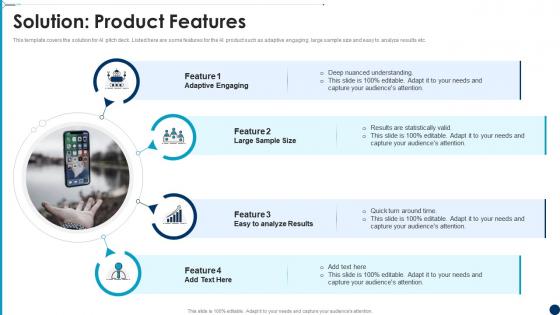
This template covers the solution for AI pitch deck. Listed here are some features for the AI product such as adaptive engaging, large sample size and easy to analyze results etc.
People who downloaded this PowerPoint presentation also viewed the following :
Artificial intelligence solution product features ppt powerpoint presentation infographics visual with all 6 slides:
Use our Artificial Intelligence Solution Product Features Ppt Powerpoint Presentation Infographics Visual to effectively help you save your valuable time. They are readymade to fit into any presentation structure.





FAQs for Artificial intelligence solution product features ppt powerpoint
So honestly, automation is where you'll see the biggest impact - stuff like invoice processing and customer inquiries just run themselves. Your team stops wasting time on boring admin work and can actually think strategically. Data-driven decisions become way easier too, plus you get better forecasting and personalized customer experiences (which customers love, obviously). Response times get crazy fast once everything's dialed in. Oh, and pick just one process to start with - something that's already sucking up hours of manual work. Don't try to automate everything at once or you'll hate yourself.
Honestly, AI tools are way more accessible now so you can compete pretty well. I'd start with the boring stuff that eats your time - chatbots for customer service, email automation, inventory tracking. That junk really adds up! Most solutions are subscription-based now so you don't need crazy upfront costs. Actually, you've got an advantage because big companies take forever to make decisions while you can just try something and pivot. Pick one area that's driving you nuts, test it for a month or two, then move on to the next thing. Way easier than it used to be.
Honestly, the biggest pain points are usually messy data and finding people who actually know what they're doing with AI. Integration with your current systems is a nightmare too. Most companies jump in expecting miracles but can't even define what "success" means - which is wild to me. Employees freak out about losing jobs, compliance gets complicated fast, and everything costs way more than you budgeted for. Oh, and timeline expectations are always unrealistic. Start with something small first. Pick one specific problem, set clear metrics, then expand from there once you've figured out what works.
Honestly, AI can make a huge difference for your customers. Netflix-style recommendations work really well, and chatbots that actually get context (not the annoying ones). You can automate the boring support stuff while it learns what people actually want. The 24/7 thing is clutch - nobody wants to wait until business hours anymore. It picks up on sentiment too, so you'll catch problems before customers get really pissed. Best part? It remembers everything, so people don't have to repeat their whole story every time. I'd start with just live chat, see how it goes from there.
Bias is probably the biggest headache - saw a hiring AI once that totally screwed over women candidates because of bad training data. Pretty messed up. You'll want to be upfront about how your system actually makes decisions, plus lock down user privacy and data protection. Accountability matters too since things definitely go sideways sometimes. Job displacement is worth thinking about, and honestly you can't control how people use your AI once it's out there. Regular audits help catch problems early. Oh, and have a solid plan for when stuff breaks because it will.
Honestly, AI is pretty amazing for product development. Instead of spending weeks digging through customer data, you can spot trends and unmet needs super quickly. The prototyping part is where it gets really cool though - you can generate tons of design variations and test performance without building anything physical yet. It'll also help predict which concepts might actually succeed (saves you from some painful failures). User behavior analysis becomes way easier too. But the biggest win? Your iteration cycles go from months down to days. I'm still getting used to how fast everything moves now, but it's definitely a game-changer for testing ideas.
So healthcare and finance use AI completely differently, which is kinda cool when you think about it. Doctors are using it to spot diseases in scans and predict how patients will do. Finance people? They're all about catching fraud and making trades faster. Oh, and drug discovery too - apparently AI can find new medicines way quicker than the old methods. Finance folks save companies money with better risk calls, but healthcare literally saves lives with better diagnosis. Honestly, it's wild how the same tech solves totally different problems depending on the industry.
So ML is basically what makes AI actually smart - it learns patterns from data instead of you coding every little rule. Like teaching a kid to spot cats, but with millions of examples and way faster. The algorithms crunch your data, find trends, then make predictions based on what they've learned. More data = smarter system. Honestly, I think people overthink the tech part when really it's all about having good training data first. That's where you should focus your energy - garbage in, garbage out, you know?
Honestly, the biggest game-changer is how much data this stuff can crunch compared to doing it by hand - we're talking spotting patterns you'd never catch otherwise. You get insights in real-time instead of waiting forever for reports. Plus it takes out a lot of the guesswork and bias from decisions. The predictive part is where it gets really cool though - forecasting customer behavior, market changes, operational issues before they bite you. I'd say start small with something specific like sales forecasting. Don't try to boil the ocean right away.
Honestly, the biggest thing to watch is AI getting baked into normal work stuff - like, tools that can actually handle multiple steps without you babysitting them. Edge AI is blowing up too (processing happens on your device instead of the cloud, so it's way faster). Oh and those no-code AI platforms are pretty cool - suddenly anyone can use this stuff, not just the tech people. My advice? Start messing around with AI tools now, even tiny ones. Better to learn while it's still early than be totally lost when everyone else is already using it.
Honestly, you gotta measure both the obvious stuff and the fuzzy benefits. Cost savings are easy - automation cuts expenses, better recommendations boost revenue. But also track how much faster your team processes data now. Time-to-insight is actually massive. The tricky part? Stuff like happier customers or less burned-out employees who aren't doing mind-numbing tasks anymore. Get your baseline numbers before rolling anything out, then check progress every quarter. Oh, and build a simple dashboard - sounds nerdy but you'll want to see those ROI numbers in one place.
Honestly, just throw them straight into using the actual tools - skip the boring theory sessions. Get them clicking around the interface until they're not intimidated by it anymore. Half the battle is people freaking out about AI taking their jobs, so keep hammering home that it's there to help them, not replace them. You'll want clear rules about when to trust what the AI spits out versus when they need to use their own brain. Oh, and set up some way for them to complain or suggest fixes as they figure things out - that feedback's gold. Trust me, I've watched companies botch this by going too theoretical upfront.
Yeah, AI definitely cranks up the privacy risks since you're dealing with way more sensitive data. Plus all the compliance stuff - GDPR, CCPA, whatever industry rules you've got - it's honestly a pain to navigate. The flip side though? AI can actually help with security through automated threat detection and spotting weird patterns. You'll need solid encryption and access controls since these systems chew through massive datasets. Oh, and audit trails are crucial. I'd start with mapping out exactly what data you're collecting and where it goes - sounds boring but it'll save you headaches later.
Netflix's recommendation thing is weirdly addictive - totally keeps me scrolling forever. Amazon uses predictive stuff for their warehouses, which makes sense given how fast they ship everything. IBM Watson helps doctors with cancer diagnosis, and Google cracked some protein thing that was apparently huge for science. Tesla's doing the self-driving cars obviously. Banks like JPMorgan catch fraud with AI too. Oh, and check out what companies in your industry are doing first - way more useful than random examples from everywhere else.
So basically you throw sensors on your machines to track vibrations, temps, all that stuff. Machine learning picks up on weird patterns way before anything actually breaks - it's kinda scary how good it gets. My buddy's factory saved tons just fixing things right when they needed it instead of guessing or waiting for disasters. Honestly, maintenance schedules are so outdated now. You don't need to go crazy either. Just grab one important machine, stick some IoT sensors on it, and start building your dataset from there.
-
Colors used are bright and distinctive.