

 0 Comment
 Customer Reviews

No one can deny how Artificial Intelligence (AI) has brought about significant change in the manufacturing industry with its own reels of efficiency, precision, and innovation. The expected growth rate of 33.5% CAGR makes it clear that AI in manufacturing is poised to blossom into an industry with a whopping value of $68.36 billion by 2032. Thus, there is strong motivation for companies to continuously adopt AI-oriented technologies so as to remain competitive in their core sectors.
Check out our blog on Top 10 Automated Manufacturing Systems PPT With Samples And Examples.
AI is transforming production processes around the globe, from predictive maintenance that cuts down on downtime by nearly 30% to automated quality control with improved defect detection rates of 90%. The integration of AI-powered robotics, machine learning, IoT, and big data analytics is enabling smart factories, where real-time monitoring and auto decision-making take over the processes to streamline a supply chain and minimize waste in production as well as deliver a better quality product.
As we approach hyper-automation and intelligent production, understanding AI’s role in manufacturing is no longer an option—it’s a necessity.
Let’s dive into how AI is shaping the future of manufacturing and how you can leverage it for your business or organization.
You can check out our Top 10 Digital Manufacturing PPT Templates With Examples And Samples
Template 1: AI Machine Learning In Manufacturing Industry PPT Template
This template has different AI-centric solutions that are in the form of individual headers. These include headings such as root-cause analysis for problem identification, process automation, and AI-based yield detractor detection for process optimization which you can do by analyzing chip design and smart data transmission using AI-powered sensors.
It also features the functionalities of machine learning algorithms that you can use for your business for predictive maintenance, stock management, and sending on-time repair alerts. It also focuses on AI-based production tools to utilize resources economically, alerts for automotive repair for preventive maintenance, and algorithm-enabled methodologies to minimize downtime. Lastly, it has data security and the reduction of testing costs for improved manufacturing processes.

Template 2: Uses Of Artificial Intelligence AI In Manufacturing Industry PPT Template
The following template covers four main areas of operation. The first box is titled Inventory Management, and it concerns efficient stock planning where results are more accurate than traditional forecasting and improving operational accuracy by 20%.
The second box, Price Forecasting, emphasizes AI-driven price predictions for raw materials, comparative analysis for pricing strategies, and a 40% reduction in operational time. The third box is Edge Analytics, showing AI contributions in the area of improving production quality yield, early detection of signs of performance deterioration, monitoring employees' health, and increasing retention rates by 30 % in employees. The last box, Quality Assurance has options that AI can detect deviations from typical outputs, alert the user in case of quality deterioration, and hence increase customer satisfaction by 10%.

Template 3: Manufacturing Jobs Future Impact Analysis Due To AI Powerpoint Slide
This slide highlights four key stages of transformation. The first phase covers routine tasks, which will be automated by AI for repetitive operations like line assembly, material handling, and packing. This will increase efficiency and productivity, which will create the need for workers to be skilled in being able to manage, maintain, and troubleshoot automated systems.
The second is Advanced Robotics. The third stage is Predictive Maintenance that will draw on AI-driven real-time monitoring and maintenance processes for employees to engage. Finally, the fourth stage is Flexible Manufacturing. It will introduce AI-powered adaptive production systems capable of customizing manufacturing processes to meet individual customer demands. You can modify each according to needs.

Get The Template Here change this link
Template 4: AI In Manufacturing PPT PowerPoint ACP Template
This template talks about the role of AI in manufacturing and explains four main areas. The first is Predictive Maintenance in which AI algorithms predict possible failures of the equipment. The second is Quality Control, which adopts computer vision systems to automatically identify defects in products during production processes. Then the third is Supply Chain Optimization to streamline supply chain operations. Lastly, Production Planning maximizes output while reducing inefficiencies. The slide portrays these advancements visually blended with the futuristic image of AI-controlled manufacturing to emphasize the futuristic concept of increasing AI technologies in modern industrial processes.

Get Access to this Template here!
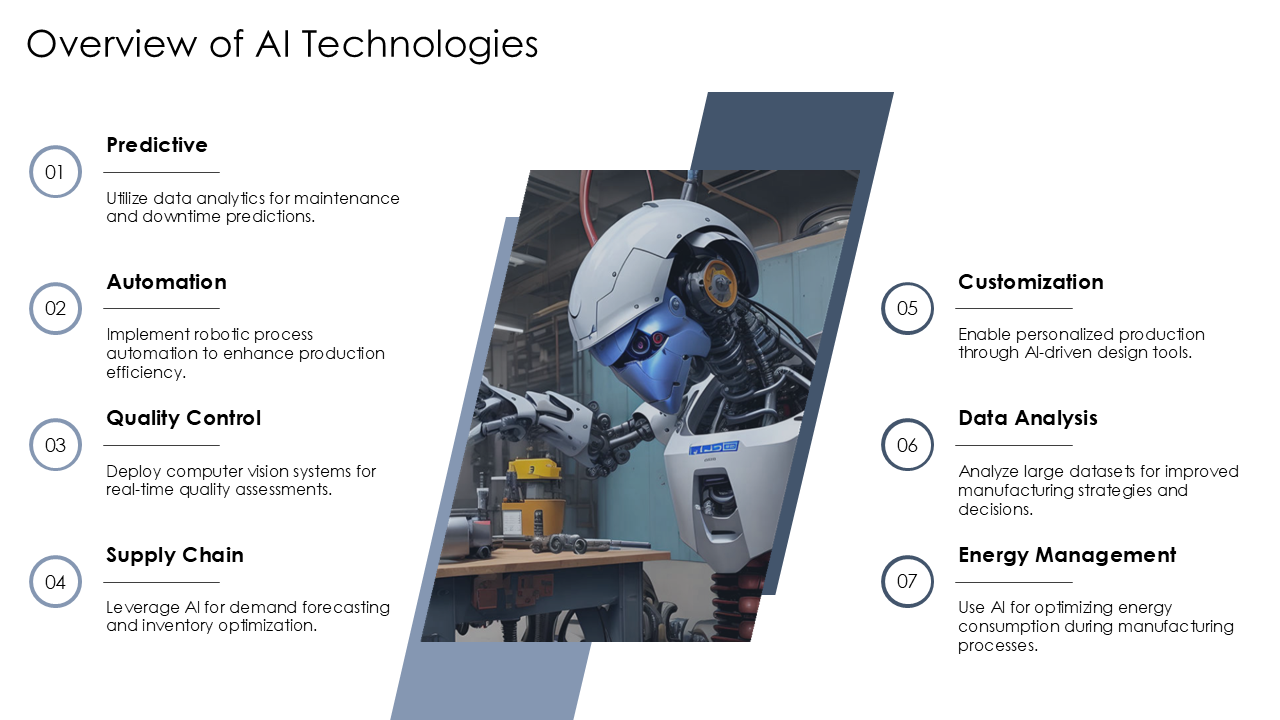
Template 5: Overview of AI Technologies PowerPoint Slide
This slide illustrates AI technologies that are used in manufacturing. These are grouped into seven dimensions. Predictive AI applies data analytics to predict the maintenance and downtime required to avoid incidental failures.
The slide has headers such as Automation, Quality Control, Supply Chain, Customization, Data Analysis and Energy Management. The other part of the slide made a detailed representation of these advancements through illustrations with an image of an AI-powered robotic system, which accentuates the ever-increasing role of AI in modernizing factories. These are all headers that you can use as it is or modify them as per your organization’s requirements.
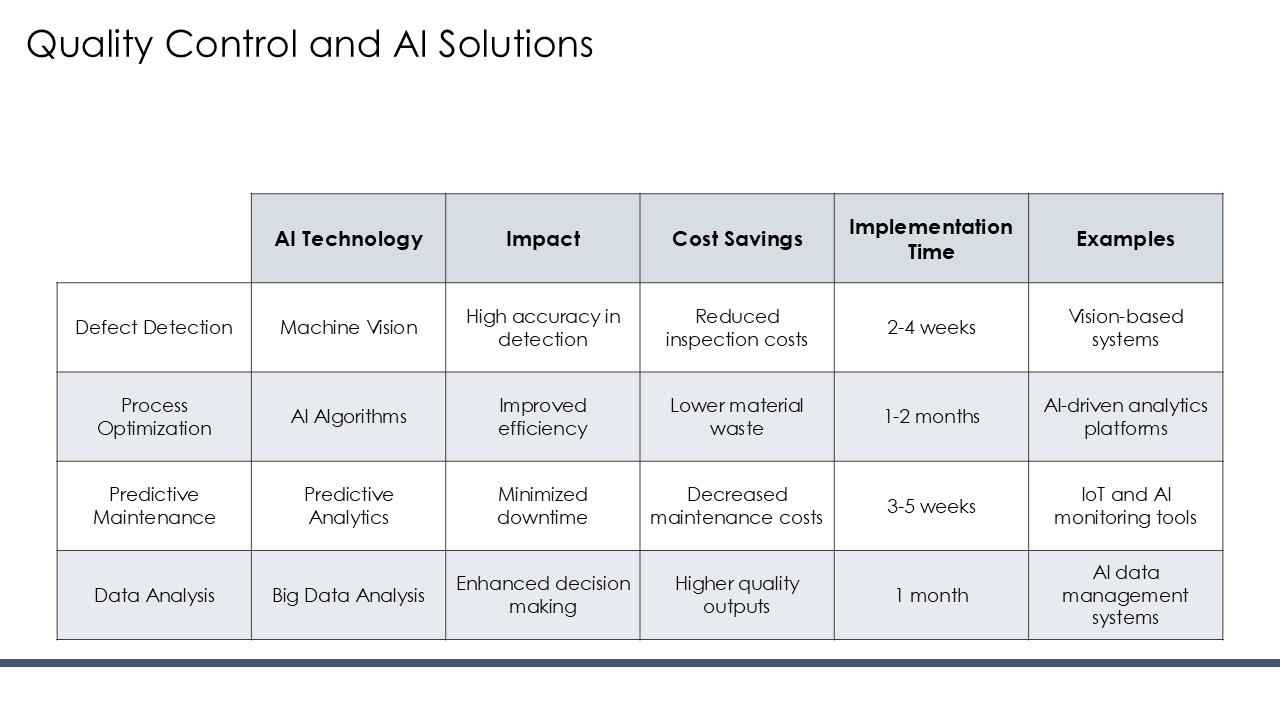
Template 6: Quality Control and AI Solutions PowerPoint Slide
This slide presents a structured comparison of AI technologies in manufacturing through a table with five key columns: AI Technology, Impact, Cost Savings, Implementation Time, and Examples. This table has been meticulously created for you to use as per your business needs. It lists and discusses four major AI-driven applications: Defect Detection, Process Optimization, Predictive Maintenance, and Data Analysis, showcasing their benefits and implementation timelines. This slide shows how different AI technologies can help in cost savings and operational improvements
Get Access To The Template Link
Template 7: Agenda- For AI In Manufacturing Powerpoint Presentation Slides
The slide features a professional dark-themed design with a visual representation of coding and AI technology. It has an agenda for AI in manufacturing, with key discussion points related to the integration of artificial intelligence in the industry.
The first agenda is a general overview of traditional manufacturing, its problems, and the need related to understanding how AI-driven advancements become necessary. The second agenda explores the evolution of the manufacturing industry. The third agenda focuses on cybersecurity in manufacturing automation. The fourth agenda allows for entry according to one's preference and adds further topics to the discussion.

Template 8: Table of Contents For AI in Manufacturing PPT Slide
This slide is a Table of Contents for the presentation on AI in Manufacturing, showing some of the principal areas of development and impact of artificial intelligence in the industry. It begins with a slight overview of the evolution of manufacturing, which is the transition from Industry 1.0 to Industry 4.0. The second section discusses technology applied to manufacturing to face challenges under four main areas.
Automation and Robotics explores the role of robots in manufacturing and major types of robots that can be used for manufacturing, including their applications in material handling, welding, and assembly, as well as their impact on operations.
It has a Smart Manufacturing and IoT section and Big Data Analytics. The slide helps in understanding the way AI technology is enhancing the manufacturing sector.

Template 9: Evolution of Manufacturing From Industry PPT Slide
This PowerPoint slide shows the transformation of manufacturing from Industry 1.0 to Industry 4.0. You can use it to make your audience and stakeholders understand the crux of your business activities in stages. This journey starts at the mechanization of production through steam and hydropower during Industry 1.0. Industry 2.0, where electric power took over the mass manufacturing assembly lines. The next phase, Industry 3.0, started with automation, computers, information technology (IT) systems, and robotics. Industry 4.0 takes us into a modern era of smart manufacturing through the integration of IoT (Internet of Things), machine learning, artificial intelligence, smart factories, and automated systems, creating highly interconnected and data-driven production environment.

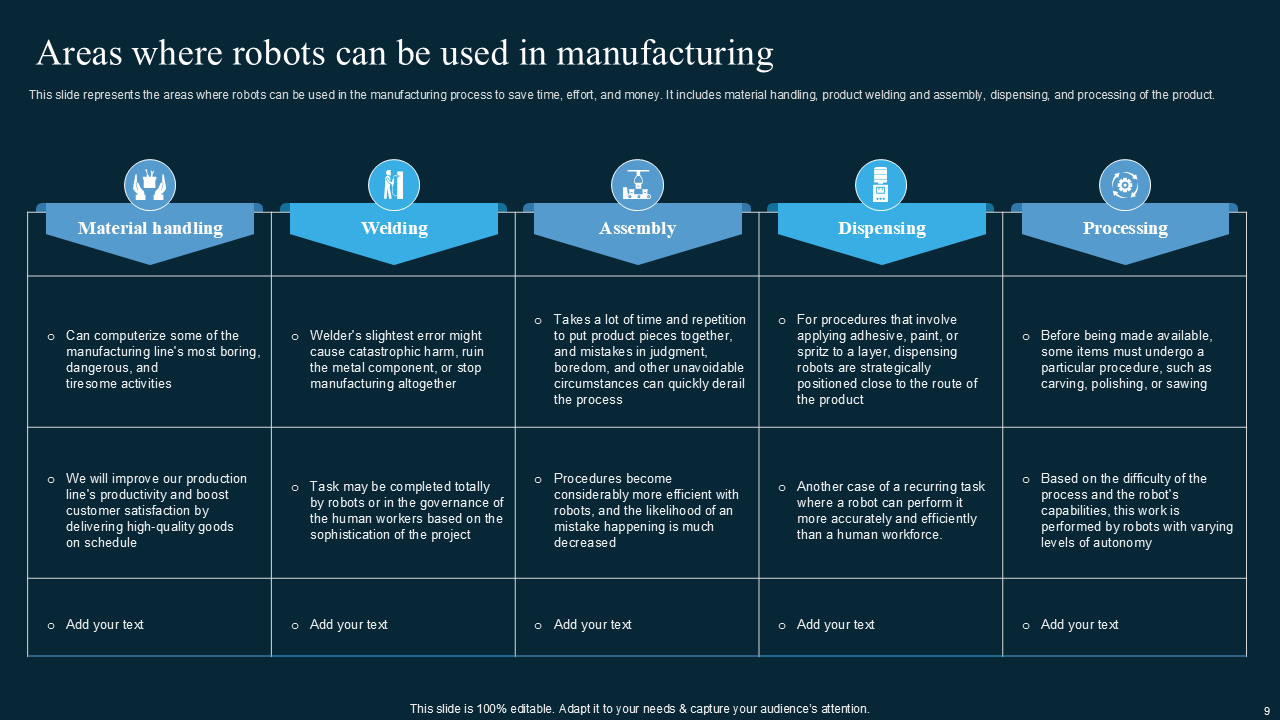
Template 10: Areas Where Robots Can Be Used in Manufacturing PPT Slide
This slide represents the key areas where robots can be integrated into the manufacturing process to enhance efficiency. It has several headers such as Material Handling, Welding, and Assembly. It also includes Dispensing tasks, such as applying adhesives, paints, or coatings. Finally, Processing, including operations like carving, polishing, and sawing, can be done using robotic systems. By integrating robots into these five areas, manufacturers can gain extensively.
Conclusion
AI is not only just transforming manufacturing—it is redefining it. New technologies like Smart factories, predictive maintenance, intelligent automation, and
real-time data analytics are empowering manufacturers to achieve more efficiency.
As AI continues to evolve, its role in manufacturing will only grow. Companies that embrace AI today will be the industry leaders of tomorrow. The future of manufacturing is AI-powered and highly automated. People who leverage these advancements will gain a competitive edge in the global market.
By harnessing the potential of AI, the industry is moving toward an era of limitless possibilities. The transformation is already underway—are you ready to be part of it?
PS: Check out our Top 10 Uses of AI PPT Templates here.