


Understanding Artificial Intelligence In Social Media Training Ppt




Try Before you Buy Download Free Sample Product
 Impress Your
 Audience
 100%
100% Editable
 Save Hours
 of Time


These slides depict the role of Artificial Intelligence in Social Media. Social Networking Sites are using AI to evaluate user data to determine trending topics, hashtags, and other patterns, which ultimately help comprehend user behavior. The advantages of adopting Artificial Intelligence in Social Media are increased security, recognition of images, AI-powered chatbots, and analyzing sentiments.
People who downloaded this PowerPoint presentation also viewed the following :
Content of this Powerpoint Presentation
Slide 1
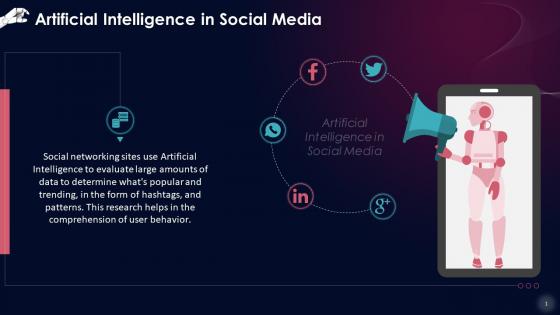
This slide depicts the role of Artificial Intelligence in Social Media. Social Networking Sites are using AI to evaluate user data to determine trending topics, hashtags, and other patterns, which ultimately helps comprehend user behavior.
Instructor’s Notes: Artificial Intelligence can monitor unstructured user comments to provide a tailored experience and detect crises. The technology can also help with content creation by evaluating multiple activities and demographics.
Slide 2
This slide highlights the major advantages of adopting Artificial Intelligence in Social Media. These benefits are increased security, recognizing images, AI-powered chatbots, and analyzing sentiments.
Instructor’s Notes:
- Increased security: Artificial Intelligence can assist social media sites in protecting user data and increasing the privacy of their information. This technology can assist users in improving the security of their social media accounts by providing user authentication, pattern detection, fraud protection, and other features
- To recognize images: AI-powered picture recognition software and applications aid in recognizing diverse photos, allowing users to better understand changes in their behavior or patterns. It can sift through millions of photos using advanced algorithms to extract useful information
- AI powered chatbots: Businesses that use social media can deploy AI-powered chatbots to respond quickly to their consumers' questions. By recognizing the purpose of an inquiry, AI-enabled chatbots can efficiently conduct dialogues with customers and provide answers they require. Businesses can significantly improve customer experience by doing so
- Analyzing sentiments: Since AI has the ability to analyze the nature or intent of a query, comment, or other item posted by a user, it can assist brands in identifying sentiments and understanding how you feel. Natural Language Processing (NLP) is used for this, and it may also identify good or negative terms in a comment or a post
Slide 3
This slide lists major social networking companies such as Twitter, Facebook, LinkedIn, and Pinterest that have already implemented AI to speed up their processes and keep the environment safe for their users.
Instructor’s Notes:
- Twitter: To build a thumbnail, Twitter employs AI to recognize a face from a complete image, and it uses neural networks to figure out which part of an image the user wants. This technique is also used to suggest replies while a user comments or responds to a comment
- Meta (formerly Facebook): Machine learning and AI are used by top social networking platforms such as Meta (formerly Facebook) to serve you relevant content, recognize your face in photos, recommend tag alternatives, identify graphics, and perform other functions
- LinkedIn: To anticipate appropriate candidates for a specific job role, this social networking platform uses Artificial Intelligence. Linkedin also uses AI to highlight candidates who are actively seeking new opportunities or are the most likely to respond
- Pinterest: Pinterest has more than 200 million users who pin on the network, with 80% consuming customized content. The platform uses neural networking to display consumers' content, based on relevance. It means that photographs on Pinterest are connected to a neural network based on a specific theme
Slide 4
This slide depicts how Artificial Intelligence can be used in Social Media Marketing. AI-powered solutions assist in analyzing a brand's social media profiles and traffic, allow brands to conduct sponsored advertisements based on demographics and behavioral targeting, and assist in determining how to optimize an ad for conversions and clicks
Instructor’s Notes:
- Using AI-powered solutions, you can understand users' behavior and what they say or write about your brand. This information can also help you understand your global brand equity, spot new trends, target new audiences based on their interests, and find new ways to promote yourself on social media
- These tools can also give you helpful information, such as which language will produce better results or which terms are commonly used by clients shopping for items or services similar to yours
- These tools also assist in evaluating the performance of an ad campaign to determine whether it is on track to produce the expected results
- AI can also assist in forecasting market growth and adjusting advertising efforts. You can boost your ROI and attract more clients to your business
Slide 5
This slide demonstrates the market overview of Artificial Intelligence in Social media. The AI Market in Social Media was valued at $815.33 million in 2020 and is predicted to reach approximately $3,714.89 million by 2026, having a Compound Annual Growth Rate (CAGR) of 28.8%.
Instructor’s Notes: One of the most important sources of customer intelligence data is social media. The demand for AI solutions to identify client preferences is expected to rise throughout the forecast period as the number of people using social media grows.
Understanding Artificial Intelligence In Social Media Training Ppt with all 21 slides:
Use our Understanding Artificial Intelligence In Social Media Training Ppt to effectively help you save your valuable time. They are readymade to fit into any presentation structure.







FAQs for Understanding Artificial Intelligence In Social
So basically, these algorithms are constantly watching what you click on, how long you stare at posts, what you like - all that stuff. They build this creepy-accurate profile of you. Then they decide what shows up in your feed based on what they think will keep you scrolling. You know how posts from certain friends always pop up first? That's the AI picking favorites based on your habits. It's wild how good they've gotten at this. Next time you're on Instagram or whatever, look at what's at the top - that's not random at all.
Honestly, automated responses can be pretty clutch for engagement. People hate waiting around for hours when they comment or DM you, so instant replies keep them interested. Even something basic like "Thanks for reaching out, we'll get back to you soon!" works. But here's where it gets tricky - most people can spot automation from a mile away. I'd use AI for the initial response and basic FAQ stuff, then have real humans handle anything complicated. Just don't make your automated messages sound like a robot wrote them, you know? That's always a dead giveaway.
So basically AI looks for patterns in text, images, and how users behave to catch fake stuff before it goes viral. It can spot manipulated photos, find inconsistencies in stories, and even identify when bot networks are coordinating fake accounts. The deepfake detection is honestly pretty impressive these days. Most platforms cross-reference posts against reliable sources instantly and track how false info spreads. Though I think the best approach combines AI with human fact-checkers - algorithms miss the subtle context stuff that needs actual judgment. Facebook, Twitter, they're all doing some version of this already.
So basically, these algorithms crawl through tons of social media posts looking for what's trending. They analyze everything - text, emojis, hashtags, how much people are engaging. Pretty crazy how good they've gotten at picking up on sarcasm too, honestly. The machine learning part tracks sudden spikes in mentions to catch trends before they blow up. You can set up alerts through most social media tools to monitor your brand mentions. Oh, and they'll tell you if people are talking positively or negatively about stuff in real-time, which is super helpful for keeping tabs on competitors.
Honestly, it comes down to three big things: privacy stuff, bias problems, and being upfront about what you're doing. Your AI might accidentally discriminate against certain groups when targeting ads - that's a real issue. People also hate when personalization gets too weird and stalky, you know? Plus there's the filter bubble thing where everyone just sees content that confirms what they already think. Oh, and definitely tell people when they're talking to a bot instead of a human. I'd say audit your tools regularly for bias issues, get proper consent for data collection, and don't try to hide that you're using automation.
So basically, social media platforms are mining your behavior for ad money. They track everything - your likes, how long you pause on posts, what you scroll past fast. Kinda creepy tbh. But it works crazy well for targeting ads. You'll browse hiking stuff and boom, hiking boot ads everywhere. Or they'll hit you with food delivery ads right when you're hungry and lazy on a Sunday. I swear they know me better than I know myself sometimes. Point is, your digital habits are constantly being used to get you to buy stuff.
Yeah, AI moderation is such a mess honestly. These algorithms can't handle context or sarcasm at all, so your joke gets deleted while actual misinformation stays up - makes zero sense. They're built for speed over accuracy, which means everything gets over-censored. I've seen people get flagged for the weirdest stuff while obvious bots slip through. Cultural nuances? Forget about it. The whole system just defaults to removing things when it's unsure. Learn each platform's appeal process though - that's literally your only shot at getting wrongful removals overturned.
Basically these AI tools dig through all your follower data - like who's engaging, where they're from, what they're into, when they're most active. Honestly saves you from manually scrolling through endless comments and likes (which would take forever). Sprout Social and Hootsuite are pretty solid for this stuff. They'll segment your audience and actually predict what content different groups will respond to. The best part? You get real insights about posting times and what messaging works for different demographics. Way better than just throwing content out there and crossing your fingers it lands.
Dude, AI is getting freakishly good at reading context in images now. It's not just "oh that's a cat" anymore - it can pick up on cultural stuff, emotions from faces, even sarcasm when someone posts "gorgeous weather!" with a pic of torrential rain. The multimodal stuff is wild too, processing video and audio together for way better content moderation. Honestly kinda creepy how well it works. This means platforms will understand your posts on a completely different level than before, so you might want to think about how that changes your content game going forward.
So you can basically feed all your old campaign data into AI tools and they'll predict how new influencer partnerships will do before you launch. The algorithms look at engagement rates, audience demos, posting patterns - all that stuff. Pretty cool actually. You'll get forecasts for reach, conversions, ROI, the whole nine yards. Honestly, the accuracy is getting pretty solid these days. Use those predictions to figure out which influencers are worth your budget and set realistic goals with your team. Oh, and it helps avoid those awkward conversations when campaigns flop because you can spot duds early.
Honestly, AI is a game-changer for social media customer service. Chatbots can handle your basic FAQs around the clock - customers actually dig the instant responses. There's this sentiment analysis thing that's pretty slick too, automatically catching pissed off customers so your team can swoop in fast. Complex stuff gets routed to the right people based on what the issue actually is. Oh, and it tracks complaint patterns which is clutch for catching bigger issues early. I'd start simple with just a basic FAQ bot and build from there though.
Honestly, the biggest pain points are data privacy headaches and algorithm bias - teaching machines to get human emotions is wild when we barely understand ourselves half the time. Implementation costs are brutal too. Social media moves so fast that you'll be constantly updating models, which gets expensive quick. Your legal team's gonna stress about compliance stuff around data usage. Oh, and transparency requirements are getting stricter everywhere now. I'd say start super small with just one use case. Test everything thoroughly first. Get your data governance sorted before you even think about scaling - trust me on that one.
So basically, AI is totally changing how we see news on social media now. Your feed isn't chronological anymore - algorithms are constantly analyzing what you click, share, and spend time reading to serve up "relevant" content. Honestly, it's kinda creepy how good they've gotten at predicting what'll grab your attention. They also try filtering out spam and fake news, though that's still hit or miss. The whole system boosts whatever's trending too. My advice? Just be aware this is happening behind the scenes and make an effort to check different news sources instead of only scrolling what gets fed to you.
Honestly, the biggest thing is your audience will totally call out generic, robotic content - it kills engagement. AI can also make up facts or completely miss cultural stuff that'll get you dragged on social media. I've watched brands get absolutely roasted for tone-deaf posts that were obviously AI-generated. Plus you risk losing what makes your brand voice actually yours if you lean on it too much. My take? Use it for brainstorming and rough drafts, but always have someone real review it first. Add your own spin before posting anything.
Honestly, AI can be a game-changer for your social media without costing a fortune. Buffer and Hootsuite will automatically post at the best times for your audience - saves so much mental energy. When you're totally blank on captions, ChatGPT or Jasper are lifesavers for brainstorming content ideas. Canva's AI design stuff is free and actually pretty decent now. Analytics tools show you what's working and what's flopping hard. My advice? Pick one tool and mess around with it for a month. See what your followers respond to, then maybe add another tool if you're feeling ambitious.
-
I can say with full confidence that all your business, academic, or professional work requirements will be sufficed with SlideTeam. Their gallery is as rich as 2Million+!!
-
Crisp and neat slides. Makes it fun and easier to curate presentations.