

Marketing In Age Of Artificial Intelligence Training Ppt




Try Before you Buy Download Free Sample Product
 Impress Your
 Audience
 100%
100% Editable
 Save Hours
 of Time


These slides give an overview of marketing in Artificial Intelligence. AI in marketing makes automated decisions based on data, analysis, and further consumer insights or economic trends that impact marketing strategies. AI can be used in email marketing, SEO and content marketing, voice and text-based marketing, and social media marketing.
People who downloaded this PowerPoint presentation also viewed the following :
Content of this Powerpoint Presentation
Slide 1
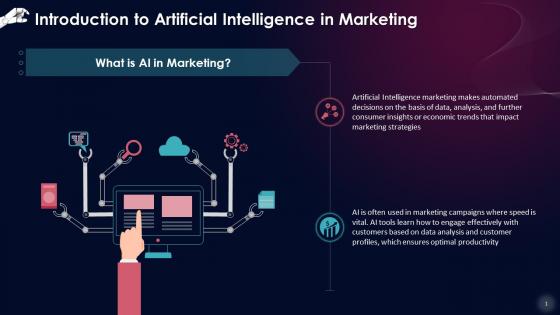
This slide gives an introduction to Artificial Intelligence in Marketing. AI in marketing makes automated decisions on the basis of data, analysis, and further consumer insights or economic trends that impact marketing strategies.
Instructor’s Notes: Today, marketers are using many AI tools to supplement marketing teams or to execute more tactical activities that require little human touch.
Slide 2
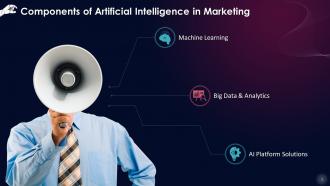
This slide highlights components of Artificial Intelligence in Marketing such as Machine Learning, Big Data and Analytics, and AI Platform Solutions.
Instructor’s Notes:
- Machine Learning: Machine Learning drives Artificial Intelligence, which entails computer algorithms that can study data and improve automatically over time. Machine Learning devices assess new data in the context of relevant historical data, making decisions based on history
- Big Data & Analytics: With the rise of digital media, there is a glut of data. This allows marketers to evaluate their efforts better and correctly allocate value across channels. Many marketers struggle to establish which data sets are worth gathering, resulting in accumulation of way too much data
- AI Platform Solutions: Effective AI-powered solutions give marketers a single platform to manage the massive amounts of data collected. These platforms may provide marketers with actionable marketing knowledge about their target audience, allowing them to make data-driven decisions about how to communicate with their potential customers. Frameworks like Bayesian Learning and Forgetting, for example, can assist marketers in better determining how receptive a customer is to a particular marketing attempt
Slide 3
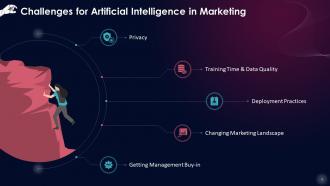
This slide lists challenges that mark adoption of Artificial Intelligence in Marketing. These include privacy issues, training time & data quality, deployment practices, changing marketing landscape, and getting buy-ins.
Instructor’s Notes:
- Privacy: Consumers and government regulators are monitoring how businesses use personal data. Marketing teams must guarantee that they handle customer data ethically and follow relevant regulations or face severe penalties and handle bad press. When it comes to AI, this is a challenge. Unless the tools are specifically developed to follow specific legal requirements, they may violate guidelines what is allowed on how to using consumer data
- Training time & Data Quality: Artificial Intelligence tools do not immediately understand which actions to take to achieve marketing objectives. They will need time and training to study business goals, customer preferences, historical patterns, understand the whole context, and establish competence. This is not only time-consuming, but it also necessitates data quality assurances. If AI technologies are not educated on high-quality data that is reliable, timely, and representative, the tool will make suboptimal decisions that do not reflect user preferences, lowering the instrument's value
- Deployment Practices: Because AI is a relatively new marketing tool, concrete best practices have yet to emerge to guide marketing teams through their initial deployment
- Changing Marketing Landscape: With the advent of AI, marketing activities will be disrupted daily, and marketers must evaluate which positions will be eliminated and which created. According to one study, marketing technology will eventually replace nearly six out of ten existing marketing specialist and analyst roles
- Getting Management Buy-In: It can be tricky for marketing teams to convince business stakeholders of the value of AI investments. While Key Performance Indicators (KPIs) like ROI and efficiency are straightforward to measure, demonstrating how AI has enhanced customer experience or brand reputation is more complicated. With this perspective, marketing teams must ensure that they have the tools necessary to credit these qualitative advantages to AI investments
Slide 4
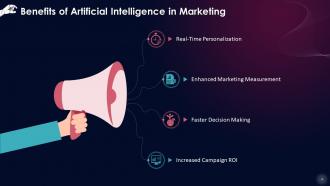
This slide showcases the advantages of Artificial Intelligence in Marketing. These benefits include real-time personalization, enhanced marketing management, faster decision making, and increased campaign ROI.
Instructor’s Notes:
- Real-Time Personalization: AI can help you send customized communications to customers at the ‘right’ times in their lives. AI may also assist marketers in identifying clients who are now disenchanted with a company and providing them information that will help change their mind and give the business another chance
- Enhanced Marketing Measurement: A lot of businesses fail to keep up with the volume of data generated through digital efforts, making it difficult to attribute success to specific campaigns. AI-powered dashboards provide a more comprehensive perspective of what's working, reproducing it across channels and allocating resources in the correct manner
- Faster Decision Making: AI can perform tactical data analysis faster than humans and use Machine Learning to make quick decisions based on campaign and customer context. This allows team members more time to focus on strategic projects, which can be used to inform AI-powered marketing. Marketers can leverage real-time information to make smarter marketing decisions with AI
Increased Campaign ROI: Marketers can use AI to alter their entire marketing campaign if they use it effectively, pulling the most useful insights from their databases and acting on these in real-time. AI tools can make quick decisions on how to spread expense across media channels or examine the most efficient ad placements to ensure that customers are consistently engaged, maximizing campaign value
Slide 5
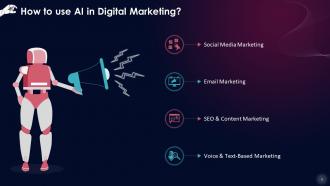
This slide depicts the use of Artificial Intelligence in Digital Marketing. It can be used in email marketing, SEO & content marketing, voice & text-based marketing, and social media marketing.
Slide 6
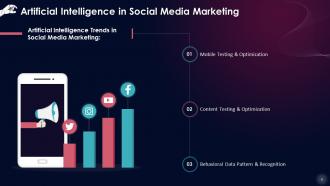
This slide lists top Artificial Intelligence trends in Social Media Marketing. These are mobile testing and optimization, content testing and optimization, and behavioral data pattern and recognition.
Instructor’s Notes:
- Mobile Testing & Optimization: You may design individual ads targeted at users based on the type of device they use via Artificial Intelligence. For example, someone browsing for products and services on a mobile device will have less screen space but may be more tempted to buy. When your AI tool identifies that this prospect is on a mobile device, it will present them with a mobile-friendly ad that will entice them to take the next step
- Content Testing & Optimization: By targeting audiences with specific, relevant digital text and compelling imagery, AI-powered technologies have helped organizations increase conversion significantly. This means that marketers can now personalize social media marketing messages depending on a user's previous patterns of preferences and habits
- Behavioral Data Pattern & Recognition: AI in social media aims to improve customization and targeting by using data from previous customer journeys to estimate outcomes and build automated marketing content/workflows
Slide 7
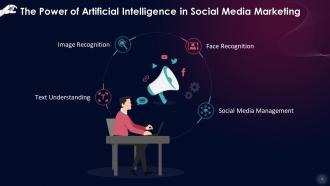
This slide discusses the impact of Artificial Intelligence on Social Media Marketing. Some of the ways AI can accelerate marketing are image recognition, face recognition, text understanding, and social media management.
Instructor’s Notes:
- Image Recognition: Images are abundant on social media platforms. For larger firms, manually screening hundreds of images of each individual would be too taxing. Advanced AI technology can immediately scan a large number of photographs, evaluate and sort these as needed. Facebook uses Machine Learning to extract specific information from photographs, such as the appearance of objects, company logos, etc
- Face Recognition: In 2010, Facebook became the first social media platform to use face recognition to identify people in photographs. Since then, face recognition has gotten significantly more widespread and accurate. According to a 2019 report, the facial recognition business would produce $7 billion in sales by 2024. What's more impressive is that modern facial recognition software has progressed to the point where it can recognize emotions on a human face. The ability to identify customers' moods results in more targeted, relevant advertisements adapted to each customer's emotional state
- Text Understanding: Machine Learning algorithms use Natural Language Processing (NLP) to assess how you converse, engage with diverse information, and react to issues. Most social media networks make use of text-deciphering algorithms. Facebook has effectively filtered massive text-based data present on its platform and Instagram using a deep learning engine called DeepText
- Social Media Management: Artificial Intelligence has the most direct and imminent impact on social media management. The majority of companies now have a presence on social media platforms. This accomplishes two goals: It broadens the company's reach to its target market, and it complicates the social media management process. When it comes to scheduling and distributing social media material, AI has proven to be valuable. Sophisticated technologies evaluate post engagement, gather useful data from user comments, and provide strategic post recommendations.
Slide 8
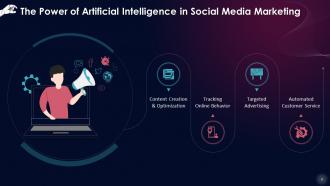
This slide discusses the impact of AI on Social Media Marketing. Some of the ways AI can accelerate marketing are content creation & optimization, tracking online behavior, targeted advertising, and automated customer service.
Instructor’s Notes:
- Content Creation & Optimization: Creativity and good research capabilities are required for content development. While AI may lack the former, it more than makes up for it with the latter. AI can generate good content because of its capability to conduct exhaustive research in a short amount of time. AI-based techniques have also proved to be beneficial in terms of content optimization. AI can provide ideas on optimizing your content for search engines after analyzing top search results on a specific topic
- Tracking Online Behavior: AI's superpower is its ability to recognize and track trends. It may gather and give you vital information such as user browsing behaviors, average time on site, bounce rates, clicks, and views, among other things. Once you have all the numbers, it will be much easier to figure out why visitors leave, which aspects of your website or social media account are working, and which need to be improved
- Targeted Advertising: Advertising is one of the most prevalent applications of AI. You can adapt your marketing efforts and deliver them to the right audience by gaining access to the metadata containing relevant information about your clients' demographics and preferences. Artificial Intelligence and deep learning tools can aid in the monitoring of ad campaign performance and keeping up with particular market trends. AI also makes competitor research and analysis immensely easier and more effective
- Automated Customer Service: Many firms find it challenging to respond to every consumer query immediately. By automating customer service, clients can receive faster responses, and firms will win their customers' trust
Slide 9
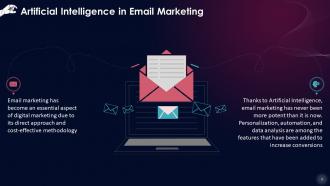
This slide showcases how the use of AI is enhancing Email Marketing. Email Marketing is an essential aspect of Digital Marketing and AI has made it more potent with features such as personalisation, automation, and data analysis.
Instructor’s Notes: AI is critical in improving your email marketing methods to offer your email plan that gives better outcomes.
Slide 10
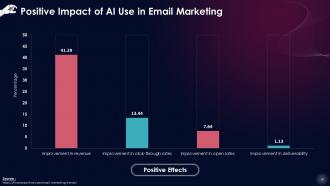
This slide depicts the positive effects of the usage of Artificial Intelligence in Email Marketing. There has been a perceptible improvement in revenue, click-through rates, open rates, and deliverability upon integrating AI with email components. AI can make sense of data better and faster than humans, making it a near-certainty that the industry will use it in the coming years.
Slide 11
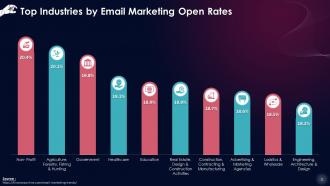
This slide highlights industries on Email Marketing Open Rates. These industries include non-profit organizations, agriculture, forestry, government, healthcare, education, real estate, construction, advertising, logistics, engineering, and architecture.
Slide 12
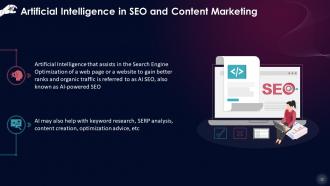
This slide talks about the use of Artificial Intelligence to assist in Search Engine Optimization of a web page or website to gain better ranks and more traffic. AI can help with SERP analysis, content creation, optimization advice, etc.
Slide 13
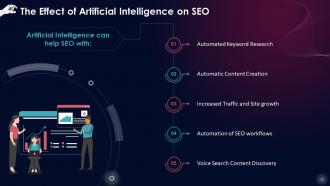
This slide lists issues in SEO that AI can help with. These include automated keyword research, automatic content creation, increased traffic & site growth, automation of SEO workflows, voice search content discovery.
Instructor’s Notes: With the emergence of AI, digital marketers can now work with greater accuracy, speed, and precision while enhancing SEO accuracy. Marketers will be able to satisfy their clients' goals while also improving productivity by using AI-assisted content generation and optimization to swiftly get to the point of action.
Slide 14
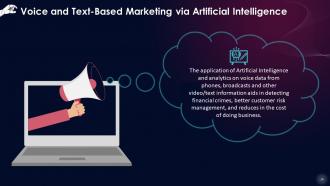
This slide talks about the application of Artificial Intelligence and analytics based on voice content from phones and broadcasts in detecting financial crimes, better customer risk management, and reduces the cost of doing a business.
Instructor’s Notes: The overall cost of financial crime compliance, which includes unfavorable media screening, is expected to reach $180.9 billion by 2020.
Marketing In Age Of Artificial Intelligence Training Ppt with all 30 slides:
Use our Marketing In Age Of Artificial Intelligence Training Ppt to effectively help you save your valuable time. They are readymade to fit into any presentation structure.







FAQs for Marketing In Age Of Artificial
So right now ChatGPT and Claude are crushing it for content stuff. HubSpot's AI does solid work on lead scoring and email optimization too. Jasper's pretty good if you need marketing copy at scale. Adobe's Sensei is honestly getting a little scary with how good the creative automation is getting. For social, Hootsuite and Buffer have these timing features that actually work. But here's the thing - don't go crazy trying every new tool. Pick like 2-3 that fix your actual problems. I'd start with content creation since you'll see results fast and it pays for itself pretty quickly.
Don't try to AI everything right away - that's a recipe for chaos. Pick one annoying thing first, like lead scoring or those repetitive emails you hate writing. Whatever tool you choose needs to work with your current CRM and stuff, otherwise you're just making more headaches. Go for the boring, data-heavy tasks first since AI actually rocks at those. My old boss tried to automate everything at once and it was a disaster. Start small, see what works, then expand from there. You'll save yourself so much frustration this way.
So basically AI looks at how people behave on your site and uses that to show them stuff they'll actually want. Like personalized emails, product suggestions, that kind of thing. It's honestly scary how good it gets once you feed it enough data - almost creepy sometimes lol. You can start simple with email campaigns or maybe product recs on your homepage. The whole point is making customers feel like you actually know what they want instead of just blasting everyone with the same generic content. Trust me, once people think you "get" them, engagement goes way up.
Honestly, just be straight up about how you're collecting data - nobody likes feeling tricked. Watch out for bias in your targeting too, because some of that demographic stuff gets weird fast if you're not paying attention. Privacy matters more than people think. Oh, and those massive AI models? They're energy hogs. Here's my test: would you be cool with customers seeing exactly how your system works? If that makes you nervous, probably time to change things up. Transparency beats clever any day.
So basically AI predictive analytics stops you from throwing marketing budget at the wall and seeing what sticks. You can actually predict who's gonna buy, what they want, and when they're ready to purchase. Pretty crazy how spot-on it gets once you feed it enough data. Focus your ad spend on people who'll actually convert instead of wasting it on dead ends. You'll know which content to personalize for different customers, plus you can forecast how campaigns will perform before you even launch them. Honestly beats the old spray-and-pray approach by miles.
So ML is like having a super smart assistant running your ads 24/7. It figures out which audiences and placements actually convert, then moves your budget there automatically. The crazy part? It spots trends you'd totally miss - like maybe your ads crush it on Tuesdays with millennials or something random like that. Bid adjustments, audience tweaks, creative swaps - it handles all of it based on what's actually working. Honestly, just flip on automated bidding in whatever platform you're using. That's the simplest way to start and you'll probably see better ROI pretty quickly.
So basically AI can crunch way more data than we ever could - like demographics, buying patterns, how people click around your site, social media stuff. It finds these weird connections you'd never notice, like customers who browse product pages for 3+ minutes but skip your blog are probably ready to purchase. The algorithms create these super specific micro-segments that actually update in real-time as behavior shifts. Way better than those useless "25-40 females into fitness" categories that don't really tell you anything useful anymore. I'd start by dumping your customer data into something like HubSpot or Salesforce Einstein and see what patterns pop up.
Look at Netflix - their algorithm drives 80% of what people actually watch. Pretty wild when you think about it. Spotify's Discover Weekly is insane at creating playlists (mine's weirdly spot-on with obscure indie bands I didn't know I'd love). Amazon makes 35% of their revenue just from "you might also like" suggestions. Even Sephora's got AI chatbots giving makeup advice that actually gets people buying. Honestly, don't overthink it at first. Pick one thing - maybe email personalization or a simple chatbot. See how your customers react, then expand from there.
Dude, these language models are basically like having a writing buddy who never burns out. I use them for cranking out blog posts and social media stuff way faster than I could alone. They're also weirdly good at sifting through tons of articles to find what actually matters for your audience. The crazy part? They can mimic your brand voice pretty well now. Though honestly, sometimes that feels a little unsettling. Just use them for the grunt work while you handle strategy and add those human touches that actually make content worth reading.
Start with conversion rates and customer acquisition cost - that's where the money actually is. Engagement metrics too. Time-to-conversion is huge since AI usually speeds things up. Click-through rates and lead quality scores matter way more than vanity stuff like impressions (though I still peek at those sometimes, not gonna lie). The real question is whether your AI moves people through faster and cheaper than before. Set up dashboards comparing before vs after performance. Monthly reviews help you catch trends early. ROI is what your boss cares about anyway.
Honestly, AI chatbots are pretty game-changing for customer service. They handle the boring stuff 24/7 - password resets, order tracking, you know the drill. What's wild is they're getting crazy good at understanding what people actually mean, not just keywords. I've heard they can knock out like 80% of basic issues right away. The cool part? Your actual human staff gets freed up for the messy problems that need real thinking. Oh, and the bots literally learn as they go, so they don't stay stupid forever. I'd start by figuring out what questions you get asked most and train it on those first.
Honestly, you should start playing with AI personalization tools now - they're creating custom content for each customer automatically and it's pretty mind-blowing. Voice search is huge too, so don't just focus on written SEO anymore. The predictive stuff is getting creepy accurate at guessing what people want before they even know (which is both cool and terrifying). Here's the thing though - since AI content will be everywhere soon, being genuinely human becomes your secret weapon. I know it sounds overwhelming but just pick one area and mess around with it. The learning curve sucks but you'll be glad you started early.
So basically, AI takes all the guesswork out of your marketing decisions. You're not just throwing stuff at the wall anymore - you actually get predictions about how campaigns will perform before you blow your budget. The coolest part? It finds patterns you'd never spot yourself, like which customers are about to buy or why some ads totally flop. I'd honestly start with something simple like sorting your audience into groups. Once you see how well it works, you can branch out from there. Way better than going with your gut on everything.
Honestly, the messiest part is your data - it's probably way more chaotic than you think. AI can't magically fix garbage data, so that's step one. Then there's the whole "do we even know what we're doing" problem - you'll need someone who can actually read the AI results and turn them into real decisions. Oh, and getting it to play nice with whatever systems you're already using? Total nightmare. I'd say pick one tiny thing to test first instead of going full robot takeover on your marketing. Smaller budgets make it trickier but not impossible.
Honestly, AI can totally change your lead gen game. Set it up to score prospects automatically by tracking how they interact with your site and what their demo looks like. No more manually going through every single lead - such a time suck. The really sick part is how it personalizes everything. Your email sequences, chatbot messages, even the actual website content changes based on who's visiting. It's like having nurture campaigns running 24/7 that actually know what each person cares about. I'd start with just one workflow though, don't go crazy right away.
-
“I required a slide for a board meeting and was so satisfied with the final result !! So much went into designing the slide and the communication was amazing! Can’t wait to have my next slide!”
-
Appreciate the research and its presentable format.