

Types Of Artificial Intelligence Training Ppt





Try Before you Buy Download Free Sample Product
 Impress Your
Audience
 100%
Editable
 Save Hours
of Time


This set of slides discusses two categories of AI based on functionality and capabilities. The functional types of AI include limited theory, reactive machine, theory of mind, and self-aware AI. The second category based on capabilities comprises Artificial Narrow Intelligence ANI, Artificial General Intelligence AGI, and Artificial Super Intelligence ASI.
People who downloaded this PowerPoint presentation also viewed the following :
Content of this Powerpoint Presentation
Slide 1
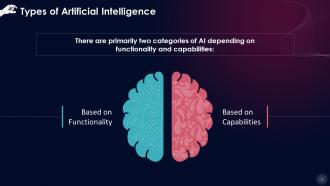
This slide lists the types of Artificial Intelligence. There are primarily two categories of AI depending on functionality and capabilities.
Slide 2
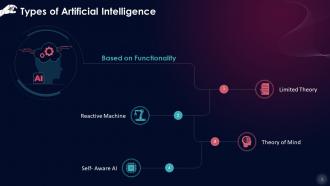
This slide illustrates that functional categorization classifies AI based on its resemblance to the human mind and its ability to think and feel like humans. The functional types of AI are:
Instructor Notes:
- Limited Theory: This sort of AI has memory capabilities, allowing it to use prior information/experience to make better future judgments. Most applications that we encounter today, fit into this category. These AI applications may be taught by storing a considerable amount of training data in their memory in a reference model
- Reactive Machines: These are the most basic and ancient form of Artificial Intelligence. These simulate a human's capacity to respond to many types of inputs. Because this sort of AI lacks memory power, it cannot access previously acquired information/experience to get better results
- Theory of mind: With little to no presence in our daily life, this kind of AI is primarily at the "Work in Progress" stage, and is restricted to research labs. Once created, these types of AI will have a thorough understanding of human brains, including their wants, preferences, emotions, mental processes, and so on. The AI will change its response based on its comprehension of the human brain and its whims
- Self-aware AI: It is the last stage in the evolution of AI. Its existence is speculative and can only be discovered in science fiction films. These kinds of AI can comprehend and elicit human emotions and feelings. These types of AI are decades, if not centuries away from becoming a reality. This is the type of AI that sceptics like Elon Musk are concerned about. Once an AI becomes self-aware, it can enter self-preservation mode; it may view humanity as a possible threat and may directly or indirectly pursue efforts to terminate our race
Slide 3
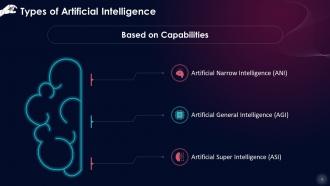
This slide demonstrates that the second categorization method is more common in the IT business, and is based on capabilities of AI against human intelligence.
Instructor Notes:
- ANI is the foremost level of AI that we have achieved to date
- AGI stands for Artificial General Intelligence, sometimes known as human-level AI
- ASI is an Artificial Super Intelligence that is sharper than the world's brightest people's combined intellect in every discipline
Slide 4
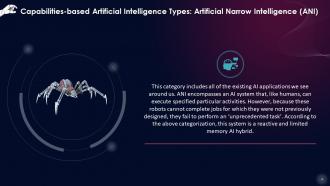
This slide depicts that artificial narrow intelligence encompasses an AI system that, like humans, can execute specified particular activities. However, because these robots cannot complete jobs for which they were not previously designed, they fail to perform an ‘unprecedented’ task.
Slide 5
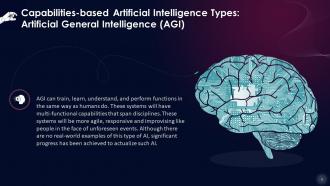
This slide showcases that artificial general intelligence can train, learn, understand, and perform functions as humans do. These systems will have multi-functional capabilities that span disciplines, and these systems will be more agile, reacting and improvising like people in the face of unforeseen events.
Slide 6
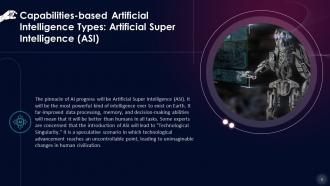
This slide illustrates that Artificial Super Intelligence (AI) will be the most powerful kind of intelligence ever to exist on Earth. It far-improved data processing, memory, and decision-making abilities will mean that it will be better than humans in all tasks. Some experts are concerned that the introduction of ASI will lead to Technological Singularity.
Instructor Notes:
Technological Singularity: It is a speculative scenario in which technological advancement reaches an uncontrollable point, leading to unimaginable changes in human civilization.
Types Of Artificial Intelligence Training Ppt with all 22 slides:
Use our Types Of Artificial Intelligence Training Ppt to effectively help you save your valuable time. They are readymade to fit into any presentation structure.








FAQs for Types Of Artificial
So supervised learning is like having a teacher - you show the AI labeled examples, like "this is a cat, this is a dog" until it gets it. Pretty straightforward. Unsupervised learning? Way cooler but harder. You just dump raw data on it and see what patterns it finds on its own. No labels, no hand-holding. I'd definitely start with supervised if you're new to this stuff. It's so much easier to debug when things go wrong (and they will). Plus you can actually tell if it's working or just making stuff up. Unsupervised feels like magic when it works though.
So reinforcement learning is like trial and error but way more intense - your AI just does stuff and learns from getting rewarded or punished. Different from supervised learning where you spoon-feed it examples. The agent figures things out by actually doing it, kinda like how you'd learn a video game by playing it a million times (which sounds awful but works). Takes forever compared to other methods and gets messy, but honestly it's your best bet when you can't create normal training data. Perfect for decision-making problems or when you need something to control systems.
So transfer learning is when you grab a model that's already been trained on tons of data and just tweak it for what you need. Way better than building from zero. The model already knows general patterns, so you're just teaching it your specific stuff with way less data. Saves crazy amounts of time too. Oh and BERT or ResNet are good starting points - though honestly ResNet's been around forever at this point. But yeah, it's like getting a head start instead of doing everything yourself. Total lifesaver for most projects.
So basically you train one model on multiple related tasks at the same time instead of building separate ones. The cool thing is it actually performs better than individual models because it learns more general patterns - kinda like how playing different sports makes you more athletic overall, if that makes sense. You'll avoid overfitting too since the model can't just memorize one specific task. Honestly, it's way more efficient resource-wise. Start with tasks that use similar data types. Works really well when the reasoning skills overlap between tasks.
Your model is only as good as the data you feed it. Bad data? You'll get garbage predictions back - it's that simple. I learned this the hard way on a project last year where we had tons of missing values and biased samples. The whole thing fell apart during testing. Clean, well-balanced datasets make your model way more accurate and reliable. Honestly, I'd rather have less data that's high quality than mountains of messy stuff. Spend time upfront scrubbing your data and checking for weird patterns. Trust me, it beats debugging a broken model later when you're under deadline pressure.
Ugh, so many issues to watch out for. Bias is huge - your training data basically teaches the model society's prejudices, so you get hiring algorithms that discriminate against women or facial recognition that can't identify Black people properly. Privacy's another mess since you're often using data people never agreed to share. Then there's the black box thing where nobody understands why it made a decision. Honestly feels overwhelming sometimes. Your best bet is testing everything for fairness across different demographics, keeping detailed records, and auditing your datasets constantly. It's tedious but necessary.
So GANs are pretty cool - you've got two neural networks basically fighting each other. One makes fake data, the other tries to spot what's real vs fake. Think of it like a forger going up against a detective who keeps getting sharper. The generator gets way better at creating realistic stuff because it's constantly being challenged by this tough discriminator that won't let anything slide. That's why GAN-generated images and audio can look so legit now. You should mess around with PyTorch if you want to see how this whole adversarial thing actually works in practice.
Honestly, it depends what you're building, but I'd start with the basics. Accuracy, precision, recall, F1-score - these will give you different angles on how well things are working. Loss during training is huge too because that's how you catch overfitting (which happens way more than you think). Oh, and don't just trust your test numbers! Real-world performance can be totally different. For specialized stuff like translation you'll need custom metrics like BLEU scores, but most people overcomplicate this at first. Start simple, then add complexity as you actually need it.
So quantum computing could totally change AI training - the math is insane but basically these systems can test multiple solutions at once instead of going one by one. Neural networks could train way faster on certain problems. But honestly? We're nowhere near ready yet. Current quantum computers are too glitchy and unreliable for real AI work. I'd watch the hybrid stuff though - quantum handles the tricky optimization bits while regular computers do everything else. That seems more realistic than the full sci-fi version everyone talks about.
Dude, synthetic data is a lifesaver when you don't have enough real training data. You can create tons of diverse examples without worrying about privacy issues or spending crazy money on data collection. The labeling happens automatically too, which saves so much time and cash. Edge cases are where it really shines - stuff that barely happens in real life but could totally wreck your model. I learned this the hard way on my last project, actually. Just make sure your synthetic data matches real-world patterns or you'll train on complete nonsense. Mix it with real data to start.
So continuous learning lets AI systems update with fresh data instead of getting stuck with whatever they learned initially. Your models can adapt to new patterns and user behaviors without rebuilding everything - which honestly saves so much time. It's like how you get better at stuff through practice, except automated. Performance stays solid longer too, which is huge because nobody wants their AI going stale after six months. Oh, and it handles market shifts way better than static models. Pretty much keeps your systems from becoming outdated paperweights.
Honestly, it's brutal. Your biggest headache will be computational limits - you're trying to learn and respond instantly with barely any processing power. Data quality becomes a nightmare too since there's no time to properly validate what you're feeding the model. Latency kills everything because users want immediate responses, but the learning process slows things down. Oh, and if your model starts acting up? Good luck rolling that back quickly. I'd definitely start small with simple models first. Build solid monitoring from day one - trust me on this one, you'll need it way more than you think.
So basically, you get actual humans to review your AI's work and correct it as it learns - like having someone check your homework. The model picks up on real human judgment instead of just crunching data patterns. Works really well for tricky stuff where context matters or when things get subjective. Your AI ends up making way fewer bizarre mistakes and actually gets nuance better. Plus it learns faster since humans catch errors early. I'd honestly just start with having people review your most important outputs first - no need to go crazy with it right away.
PyTorch is where it's at for research stuff - way easier to debug when things inevitably break. TensorFlow still runs most production setups though, their serving tools are solid. Cloud-wise, you've got SageMaker, Vertex AI, Azure ML - they all handle the scaling headaches for you. Honestly picking one and actually sticking with it matters more than which one you choose (I learned this the hard way). Start with PyTorch if you're learning. TensorFlow feels like navigating a maze sometimes, especially when you're just trying to figure out the basics.
Honestly, you need both types of people in the room or your training's gonna miss key stuff. Domain experts catch the weird edge cases and context that doesn't show up in your data - like, they actually know what matters in the real world. Meanwhile, your AI people handle the technical setup and can spot problems before they blow up your whole process. I've seen this work best when the domain folks help pick features and validate results while the tech team does their optimization thing. Seriously though, just get them talking during your next design phase - you'll catch so many issues early it's not even funny.
-
The quality of the templates is as fine as it could get. It was a purchase well made!
-
The design is very attractive, informative, and eye-catching, with bold colors that stand out against all the basic presentation templates.