


Applications Of AI In HR Training Ppt




Try Before you Buy Download Free Sample Product
 Impress Your
 Audience
 100%
100% Editable
 Save Hours
 of Time


These slides highlight the importance of the amalgamation of Artificial Intelligence within the Human Resources Department and how it can make it more efficient. AI in HR combines the human component with intelligence and upgrades working conditions for applicants and employees.
People who downloaded this PowerPoint presentation also viewed the following :
Content of this Powerpoint Presentation
Slide 1
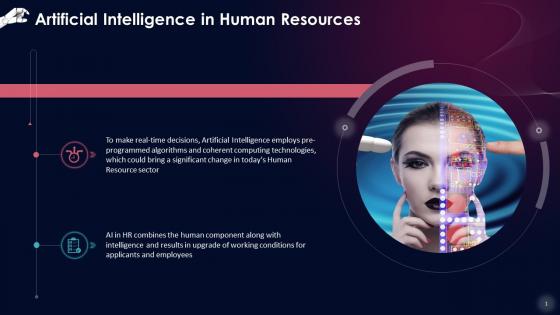
This slide highlights the importance of amalgamation of Artificial Intelligence within the Human Resources Department and how it can make it more efficient. AI in HR combines the human component along with intelligence and results in upgrade of working conditions for applicants and employees
Slide 2
This slide lists areas where Artificial Intelligence can be implemented in the Human Resources sector. AI can help in the recruitment and training of employees, which can be a tedious job and can lower the burden on the people working in the important business domain.
Instructor’s Notes:
Talent Acquisition and Recruitment: Bringing creative professionals under the group will lead to the company's potential growth; hence, talent acquisition is critical for the HR department. AI minimizes the time and effort required to execute these and other tedious tasks, from screening applications to managing databases, scheduling interviews, and responding to and resolving issue and queries that candidates may have
- Onboarding: Newly hired staff will be taught corporate knowledge and policies via AI-based integrated systems. Artificial Intelligence in HR allows procedures to be tailored to the specific needs of employees and their responsibilities to be segregated. AI tracks the company's vital contact information and other essential functions such as legal document verification
- Training the recruits: Using AI development services, employees will be able to learn and teach themselves about appropriate responsibilities and needs. AI helps them stay updated by offering knowledge on current industry technology and software improvements
- Enhancement of Employee Experience: AI may be incorporated effectively throughout the employee lifecycle, from recruitment and onboarding through HR service delivery and career pathing, resulting in a tailored employee experience. Human Resource departments can now analyze employee engagement and job satisfaction more precisely with targeted feedback and employee appreciation programs
- Leadership: AI enhances the functioning approaches of trainers and project leaders in a company because it will aid and develop trainees. By questioning members of their respective teams, AI will assess the structure of the leader's qualities and provide them with the skills they lack or the traits they need to modify
Slide 3
This slide lists challenges faced during the implementation of Artificial Intelligence in Human Resources such as security and privacy concerns, less human interaction, lack of trust, and maintenance of AI.
Instructor’s Notes:
- Security & Privacy concerns: The most common concern among HR executives is making AI more accessible and safe to use. The most common reason why people are apprehensive about adopting AI at work is security and privacy concerns
- Less Human Interaction: According to an Oracle survey, 31% of respondents stated they would rather interact with a human than a machine in the job. HR professionals must also be prepared to deal with these difficulties by keeping up with changing trends and technologies
- Lack of Trust: Employees expect their employers to preserve their personal information and gain their consent before using technology to gather data on them. Organizations want to feel secure in the event of a data breach, thus HR professionals are forced to take a leap of faith
- Maintenance of AI: The upkeep of AI is another issue that needs to be addressed. Artificial Intelligence necessitates ongoing reviews and modifications, which is a time-consuming process
Applications Of AI In HR Training Ppt with all 19 slides:
Use our Applications Of AI In HR Training Ppt to effectively help you save your valuable time. They are readymade to fit into any presentation structure.









FAQs for Applications Of AI In
So the AI looks at how each person on your team learns and what skills they're missing, then builds personalized training for everyone. No more boring one-size-fits-all courses that half your people will hate. It tracks if someone's a quick learner or needs extra time on certain topics, then adjusts everything automatically. Honestly, it's pretty neat - like Netflix recommendations but for work skills. You can set it up to suggest courses based on career goals too. Just make sure you've got decent data on where everyone's at skill-wise first, or it won't work as well.
So basically you can set up ML to watch how people actually learn and perform after training. It tracks completion rates, quiz scores, time spent, plus their actual job performance later. Pretty smart at catching patterns you'd totally miss doing it by hand. What's cool is it can even predict who might struggle before they start, so you can tweak things ahead of time. Just make sure you're feeding it decent data consistently - honestly, crappy data will just give you crappy insights. Works way better than guessing if your training actually stuck.
Honestly, bias is probably your biggest headache - these systems learn from whatever data you feed them, so if that's skewed, you're screwed. Be upfront about what employee data you're grabbing and why. People get weird (rightfully so) when they don't know AI is deciding their training or evaluating them. I'd audit everything for bias before launch - companies love to skip this step then act shocked when things go sideways. Also make your data policies dead simple to understand. Nobody reads 20-page legal documents anyway.
Honestly, AI can handle so much of the boring onboarding stuff for you. Chatbots are surprisingly decent at answering all those repetitive questions about benefits and company policies - they work 24/7 too which is nice. You can automate paperwork processing and create personalized training schedules based on people's roles. The learning paths thing is pretty cool actually, it adapts to each person's experience level. My advice? Start small with just a chatbot for FAQs since you'll see results right away. Don't try to implement everything at once or you'll overwhelm yourself and your team.
Dude, NLP is a game-changer for this stuff. It'll scan through all your employee feedback automatically and find patterns you'd miss going through everything manually. Like, imagine having hundreds of training comments - the system spots common themes, picks up on sentiment, and flags specific problems across your whole team. You can actually see if people hate certain modules or feel overwhelmed. It sorts everything by topic too, which is honestly pretty slick. The urgent stuff gets flagged right away so you know what to fix first. I'd probably start with whatever training program gets the most feedback - makes sense to test it there before rolling it out everywhere else.
So there's a bunch of ways you can go with this. Cornerstone OnDemand and Docebo have AI built right in - they'll create custom learning paths based on what each person actually needs. Chatbots are pretty popular too, answering questions whenever and walking people through modules. Gloat and Eightfold do this cool thing where they match your employees with skills training that actually makes sense for them. Oh, and Axonify breaks everything into small chunks that people don't forget immediately (which honestly is a game-changer). My advice? Don't try to do everything at once. Pick something specific like onboarding first and see how it goes.
So basically, AI goes through all your employee stuff - performance reviews, training records, project results - and finds patterns that would take your HR team forever to catch. Takes thousands of profiles and crunches them in minutes instead of weeks, which is honestly pretty wild. It compares what skills people have now against what jobs actually need, plus what the company will need down the road based on industry trends. You get these reports that spell out exactly where your training budget should go and which teams need help first. Way better than guessing, tbh.
Dude, AI is a game-changer for scaling training. Once you set it up, it can handle personalized learning for hundreds of people without you needing extra staff or meeting rooms. The system automatically figures out where each person is at, adjusts the difficulty, tracks everything. It's honestly crazy how much time it saves you. Your team can access it whenever, wherever - no more scheduling nightmares around trainer availability. I'd probably start with just one module first (less overwhelming that way) then expand once you see how it works.
So basically, predictive analytics looks at your team's performance data and figures out what training they'll need before you even realize it. Pretty neat, right? It spots patterns in project outcomes, assessment scores, employee feedback - stuff you'd probably miss on your own. The system can tell you when certain skills are about to become huge in your industry or which team members need upskilling soon. Way better than scrambling last-minute to train everyone. I'd start by checking what data you're already collecting though - that's gonna be your starting point for any decent predictions.
Honestly? Employee pushback is gonna be your biggest headache. Nobody wants AI watching how they learn - feels creepy, right? Budget for training costs too because that stuff adds up fast. Your current systems probably won't mesh well with whatever AI platform you pick, so expect some technical nightmares there. Oh, and don't just slap some generic solution on everyone. Find something that actually fits how your people work. I'd definitely test it with a small group first before going all-in company-wide.
Honestly, AI learning platforms are a game-changer for remote teams. They customize content based on what you actually need to learn for your specific role. The bite-sized modules are perfect when you're swamped - plus those AI chatbots will answer random questions at like 2am when you're debugging something. Your progress gets tracked automatically, and it'll recommend courses that match your career goals. One thing I really like? It identifies which skills are trending in your field so you're not wasting time on outdated stuff. I'd say pilot one with your team first and compare how much people actually engage versus those boring traditional training sessions.
Honestly, AI's gonna nail the boring stuff - matching people up based on skills and personality, scheduling meetings, tracking how things are going. Pretty smart how it can even spot when mentor relationships aren't clicking. But here's the thing - it can't replace those real conversations where someone actually gets what you're going through and shares hard-won wisdom. The trust-building? That's still totally human territory. I'd say start playing around with AI tools for all the admin headaches, but don't slack on teaching your mentors how to really connect with people.
So AI can catch bias in training materials that you'd totally miss. It scans language patterns and flags exclusive terms, then suggests better alternatives. Plus it checks if your examples actually show different perspectives - which honestly, most people suck at doing on their own. You can also set it up to customize learning paths for different cultural backgrounds and learning styles. Makes the content way more relatable. Just don't forget to feed it diverse data from the start, or you'll end up making existing problems worse instead of fixing them.
So you'll want to track completion rates and retention scores first - that's the basic stuff. Time-to-competency is huge too since that shows if people are actually learning faster. Engagement metrics matter - how long are sessions, do people come back? The cost savings can be insane with AI, honestly worth tracking just to make your boss happy. Oh and compare how different AI-generated learning paths perform against each other. That personalization piece is where you'll see the real magic happen. Just make sure you've got solid baselines from before you rolled out the AI. Otherwise you're basically guessing.
So AI training actually makes a huge difference with keeping people engaged. It personalizes everything to match where someone's at skill-wise and how fast they learn. Way better than those boring generic presentations we've all suffered through, right? Instant feedback keeps people motivated too. The retention piece is solid - when employees see you're investing in their specific growth path, they stick around longer. AI maps out career progression based on their actual performance and goals. Oh, and definitely start with just one department as a pilot. Don't go all-in right away.
-
It saves your time and decrease your efforts in half.
-
The PPT layout is great and it has an effective design that helps in presenting corporate presentations. It's easy to edit and the stunning visuals make it an absolute steal!