

Automation In Steel Industry Powerpoint Ppt Template Bundles





Try Before you Buy Download Free Sample Product
 Impress Your
Audience
 100%
Editable
 Save Hours
of Time


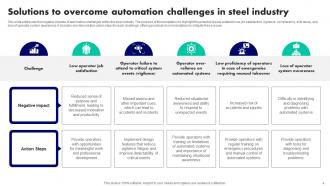
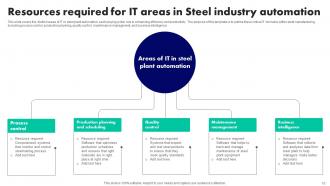
Automation in the steel industry involves the integration of advanced technology and robotics to streamline and optimize various processes within steel production. This includes tasks such as material handling, melting, casting, rolling, and quality control. By automating these operations, steel manufacturers can enhance efficiency, reduce labor costs, improve safety, and ensure consistent product quality. Automation not only increases the competitiveness of the steel industry but also contributes to sustainability efforts by minimizing energy consumption and emissions in the production process.This template encompasses a comprehensive presentation on the progressive automation technologies within the steel industry. It initiates with insights into advanced automation applications, detailing action steps to overcome automation challenges. The pivotal role of supervisors in integrating automation and the essential features for success are discussed. Real-world case scenarios exemplify automations impact, while diverse classifications and hierarchy levels of automation are explored. The template also sheds light on the critical areas of IT within steel industry automation, articulates the implementation process, and delves into the burgeoning applications of AI. In addition, it incorporates visual icons to enhance comprehension. Lastly, it summarizes these integral components.
People who downloaded this PowerPoint presentation also viewed the following :
Automation In Steel Industry Powerpoint Ppt Template Bundles with all 26 slides:
Use our Automation In Steel Industry Powerpoint Ppt Template Bundles to effectively help you save your valuable time. They are readymade to fit into any presentation structure.














FAQs for Automation In Steel Industry Powerpoint
So you're basically looking at three big wins: efficiency goes up, costs drop, and way fewer mistakes. Automation just crushes repetitive stuff - like, ridiculously faster than doing it manually. Your team can actually work on things that matter instead of mindless data entry. Consistency is huge too since robots don't call in sick or forget random steps. And honestly? The accuracy improvement alone might sell you on it. No more typos screwing up your quarterly reports. My advice - pick one process that's currently a massive time suck and start there. Once you can show it's actually working, then go crazy with it.
Dude, automation is a lifesaver for all that mind-numbing stuff - data entry, generating reports, sorting through emails. Basically anything that makes you want to scream into the void. Machines don't mess up like we do, which is honestly pretty clutch for keeping quality consistent. Plus they work way faster since they're not scrolling Instagram every five minutes (guilty). The best part? Your team can actually focus on interesting work instead of boring manual tasks. I'd say pick one process that annoys you most and start there. Don't try to automate everything at once.
You want to focus on stuff that's super repetitive and follows clear rules - data entry, processing invoices, tracking inventory, basic customer support replies. Manufacturing does this really well with assembly lines. Finance teams automate their reconciliations and compliance reports (which honestly sounds mind-numbing to do manually). Healthcare's big on automating appointment scheduling and prescription refills too. Really, once you start thinking about it, there's tons of potential. My advice? Start with whatever your team complains about most - the boring, mistake-prone tasks. Map out how it currently works, then automate bit by bit instead of trying to do everything at once.
So basically, instead of doing the same boring stuff over and over, you get to focus on the bigger picture stuff - strategy, creative problem-solving, that kind of thing. Yeah, there's a learning curve at first, but honestly? Most people feel relieved once they're not stuck doing mindless tasks all day. You'll spend time monitoring how the automation's working, jumping in when something goes wrong that the system can't handle. Oh, and you'll probably end up teaching other people how to use the new tools too. My advice - just roll with it and stay curious about learning the tech instead of fighting it.
Honestly, most companies I've seen hit 20-40% savings in year one, which is pretty solid. The big money comes from cutting out all that tedious stuff - data entry, processing invoices, answering the same customer questions over and over. Your employees probably hate doing that anyway. Automated systems run around the clock without needing coffee breaks or health insurance, so that's where you really start seeing the numbers add up. Fewer mistakes means less cash spent on cleanup too. I'd say look at whatever's eating up the most hours right now and crunch those numbers - that'll give you a realistic target.
Honestly, just grab Zapier's free plan or IFTTT and connect stuff you already use. You'll save way more time than you think. Go after your biggest annoyances first - maybe auto email replies or scheduling social posts with Buffer's free version. Invoice reminders too if you're using accounting software. Here's the thing though - most apps you already pay for have automation stuff buried in the settings that nobody ever finds. Pick one annoying task you do every week and spend like 30 minutes googling how to automate it. Nine times out of ten there's a free way to do it.
So AI is basically turning automation from dumb robots into smart ones that actually think. Instead of just following rigid rules, these systems can now make real decisions and adapt when weird stuff happens. Like, your maintenance systems can actually predict when something's about to break, or chatbots that get what customers are really asking for (finally!). The crazy part? They keep getting better at their jobs over time without you having to reprogram anything. Honestly, even small tweaks to your current automation with AI can make a massive difference. Worth looking into for sure.
Go for the stuff that's super repetitive and follows the same steps every single time - data entry, invoice processing, that kind of thing. Honestly? Just start with whatever's making your team want to pull their hair out. Those are usually your best bets anyway. High-volume tasks where people mess up a lot or you're just burning hours on boring manual work. I always tell people to map out their worst daily processes first - like the ones that make you groan when you see them on your to-do list. Then just score them: how much time will this actually save vs. how much of a pain will it be to set up?
Oh man, legacy systems are going to be your worst nightmare - nothing wants to talk to each other properly. Data migration is a mess too. Your team will probably hate you at first because everyone thinks they're getting replaced or whatever. Budget way more for integrations than they tell you, trust me on this. Implementation gets messy and training takes forever. Start with something small first, maybe just one department? Get people involved early so they don't feel like you're just dumping change on them. Also the vendors always make it sound easier than it actually is, so yeah... prepare for that reality check.
Okay so first thing - nail down what you actually want to achieve and get everyone on board upfront. Trust me, this saves so much drama later. Before you automate anything, really understand your current processes. I made the mistake once of automating something that was already broken... not fun. Your team needs to be involved the whole time since they're stuck using whatever you build. Test small chunks instead of launching everything at once. People will push back on changes - totally normal but still annoying. Oh and track your results! You'll need proof it's working plus you'll spot what needs fixing.
Honestly, automation just gives customers what they're craving - instant everything. Chatbots handle quick questions right away. Real-time order tracking keeps people happy (no more "where's my stuff?" emails). Simple issues get solved without those awful hold times. You can also personalize stuff automatically based on what customers actually do, not just generic blasts. The real win though? Your team gets to focus on the messy problems that need human brains. My advice - don't go crazy at first. Pick one annoying repetitive task and automate that. See how it goes.
So honestly, I'd focus on stuff that robots just can't do yet - like creative problem solving and reading people. Critical thinking is huge too. Learn to work WITH the tech instead of fighting it, you know? Communication becomes way more important since teams are getting smaller and need to move fast. Adaptability is probably the biggest one though - everything changes so damn quickly now. Oh, and maybe look at your current job and figure out what parts might get automated, then position yourself around the strategy side of those processes. That's where the real value is.
Look, the biggest issue is you're basically firing people without warning them first. That sucks. Plus all those efficiency savings? They usually just pad shareholder pockets instead of helping anyone who actually needs it. Some jobs honestly shouldn't be automated anyway - anything needing real empathy or complex judgment calls. You'd want to set up retraining programs, roll things out slowly, maybe even cut displaced workers in on the profits somehow. I mean, sounds idealistic but still. Focus on the human cost, not just making things faster and cheaper.
Honestly, you need both the hard numbers and the fuzzy stuff to really know if it's working. Track your obvious wins - time saved, costs cut, fewer screwups, better throughput. Then do the math: savings vs what you spent on implementation. But here's the thing - don't ignore the intangible benefits like happier employees (trust me, nobody wants to do mind-numbing tasks forever) and better customer experience. Set up some kind of monthly dashboard to watch these metrics. Oh, and measure everything before you automate anything, otherwise you're basically flying blind on whether you actually improved.
Honestly, hyperautomation is where things are heading - it mixes AI, machine learning, and RPA to automate whole workflows instead of just bits and pieces. Conversational AI is getting ridiculously good at handling customer stuff that used to need actual people. Low-code platforms are blowing up because your business folks can finally build things without bugging IT constantly (thank god). There's also this shift toward document processing that gets context, not just data scraping. My two cents? Pick one process first. See how your team handles it before you go crazy with everything else.
-
“Excellent service from the customer support team when I wanted a slide that was a bit different from those on their standard menu. Super helpful.”
-
The website is jam-packed with fantastic and creative templates for a variety of business concepts. They are easy to use and customize.