

Using Ai For Predictive Maintenance Deploying Automation Manufacturing





Try Before you Buy Download Free Sample Product
 Impress Your
 Audience
 100%
100% Editable
 Save Hours
 of Time


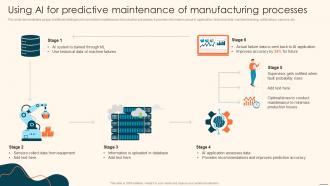
This slide demonstrates usage of artificial intelligence for predictive maintenance of production processes. It provides information about AI application, historical data, machine learning, notifications, sensors, etc.
People who downloaded this PowerPoint presentation also viewed the following :
Using Ai For Predictive Maintenance Deploying Automation Manufacturing with all 6 slides:
Use our Using Ai For Predictive Maintenance Deploying Automation Manufacturing to effectively help you save your valuable time. They are readymade to fit into any presentation structure.





FAQs for Using Ai For Predictive Maintenance
Dude, predictive maintenance is seriously worth looking into. Three big things happen: no more surprise equipment failures, way lower maintenance costs, and your machines last longer. My buddy's factory started doing it last year - total game changer. Basically you're watching your equipment's health data and jumping on problems right before they blow up. Way smarter than just fixing broken stuff or doing scheduled maintenance that might not even be needed. Downtime drops like crazy because you catch issues early. I'd say start with whatever equipment would screw you over most if it died.
So basically predictive maintenance is like having sensors and data tell you when stuff's actually gonna break, instead of just doing it on a schedule or waiting for things to fail. Way better than the old "every 3 months whether it needs it or not" approach, you know? It's honestly pretty brilliant - you only fix things when they actually need it, which saves money and stops those random breakdowns that always happen at the worst times. The trick is getting decent monitoring set up first. I'd start with whatever equipment would screw you over most if it died, then figure out what kind of data you can pull from it.
IoT sensors are your best bet - they track vibration, temp, pressure, and sound in real-time. SCADA pulls data from whatever equipment you've already got running. Thermal cameras catch heat patterns that show problems coming. Some places use drones now too (honestly didn't think that would catch on but here we are). Machine learning crunches all this data to predict failures. Start simple though - vibration sensors for rotating stuff, thermal for electrical. Pick one equipment type first. Don't try to do everything at once or you'll go crazy. Then just expand.
Look, ML algorithms are insanely good at spotting failure patterns we'd never catch ourselves. They're constantly analyzing vibration, temp, pressure - like hundreds of variables at once. What's crazy is how they learn what "normal" means for each machine, then flag anything weird way before it breaks. The predictions keep getting sharper as more data flows in. Oh, and start collecting sensor data now even if you're not implementing anything yet - you'll thank yourself later when you have that baseline to work with. Trust me on this one.
Honestly, IoT sensors are what make predictive maintenance actually work. They're constantly tracking vibration, temperature, pressure - all that stuff your equipment needs monitored 24/7. The data gets fed to analytics platforms that spot failure patterns way before you'd notice anything wrong. Without it, you're basically just doing manual checks and crossing your fingers (which, let's be real, plenty of companies still do). Those algorithms can catch tiny changes that would slip right past us. I'd start small though - just put basic sensors on your most critical equipment first and build from there.
Honestly, the difference is pretty huge. Your equipment throws off tons of data - vibrations, temps, all that stuff - and analytics can catch warning signs way before you'd ever notice them. We're talking months ahead of actual failures. The cool part? Machine learning actually gets better as it goes, learning how your specific machines behave. More data = better predictions, basically. I'd start small though - just hook up sensors to your most important equipment first. Once you see how well it works (and trust me, you will), then you can expand from there.
Honestly, the worst part is usually your data being a complete mess - scattered everywhere, half of it's wrong or missing. Good luck building anything reliable with that! Getting your maintenance crew to actually trust some algorithm instead of their gut feeling? Yeah, that's another battle entirely. You're looking at dropping serious cash upfront too - sensors, software, training everyone. Oh and trying to make new tech play nice with whatever ancient systems you've got running... total headache. My advice? Pick one important piece of equipment first, prove it actually works, then slowly expand from there.
So basically predictive maintenance means you fix stuff right before it breaks. Way better than scrambling after everything falls apart. Your downtime drops like crazy - and honestly, things always break at the worst moments anyway. You'll save money by avoiding those nightmare emergency repairs and your equipment lasts longer too. Plus your team isn't running around putting out fires all the time. Oh and you can actually plan maintenance during slow periods instead of having machines die during your busiest days. I'd start with whatever equipment is most critical first.
Dude, manufacturing and energy companies are killing it with predictive maintenance - also transportation. Basically anywhere you've got crazy expensive equipment that can't go down. Factories, power plants, airlines, oil rigs... the ROI is insane. Healthcare's jumping on this too because nobody wants their MRI breaking mid-scan, you know? Honestly, if your equipment failure costs way more than just preventing it, you should already be doing this. I'd start with whatever assets are most critical and figure out which downtime scenarios would totally wreck your budget.
Honestly, start with your sensor setup - that's where most people screw up. Get them calibrated properly because I've watched so many good projects die from rushing this part. Set up automated checks that catch weird readings, missing data, or when sensors start drifting. You'll want baseline metrics for each piece of equipment so you can spot when things go sideways. Also do regular reviews of your whole data collection process and toss any corrupted old data. Maybe audit your current sensor network this week?
Training is seriously everything for predictive maintenance - I can't stress this enough. Your people need to actually understand the data and trust what those sensors are telling them, not just go with their gut like they always have. Too many companies waste money on fancy monitoring equipment but then technicians just ignore the alerts because they don't get it. Honestly, it's like buying a Ferrari and letting your grandpa drive it (sorry grandpa). Start with workshops that use your actual equipment, not some generic examples. Get them comfortable with the tools first, then the interpretation part clicks way easier.
Honestly, the results are pretty impressive. GE cut locomotive maintenance costs by 25% just by using sensors to predict engine failures. Boeing's doing something similar - they monitor aircraft engine vibrations and catch problems early, saving them millions. Smaller companies see wins too. This paper mill (can't remember which one) tracked pump temps and vibrations, ended up reducing unplanned downtime by 70%. Manufacturing loves this approach because equipment failures are ridiculously expensive when they happen unexpectedly. My advice? Pick one critical piece of equipment first, prove it works, then expand from there.
So basically predictive maintenance is huge for cutting environmental waste. You catch problems before they turn into total disasters, which means no more junking perfectly good parts during emergency fixes. Equipment actually lives its full life instead of dying early from neglect - honestly, most companies are still terrible at this. Short bursts vs longer flowing thoughts help here. You're not constantly running those energy-hungry backup systems either. The trick is mapping out your current breakdown patterns first. That way you can spot where switching to predictive scheduling would actually move the needle on sustainability. Way better than the old "pray it doesn't explode" method.
Track your equipment uptime first - that's the big one. Mean time between failures matters too. Oh, and definitely watch how much you're saving on maintenance costs compared to before. The prediction accuracy rate is huge because if you get too many false alarms, your team will stop trusting the system (learned that one the hard way). I'd set up some kind of monthly dashboard to track all this stuff. Honestly, the best metric is just counting how many disasters you prevent - feels pretty satisfying when a machine was about to die and you caught it early.
Dude, regulatory stuff will totally make or break your predictive maintenance project - especially if you're in aerospace, pharma, or energy. Those industries have insane compliance requirements like FDA protocols and aviation safety standards. Some regulations literally force you to do certain maintenance practices, so you can't just throw new tech at everything. The paperwork alone is brutal, honestly. But once you get your PM system to play nice with regulations, leadership usually loves it because compliance gets easier. Oh, and definitely map out what compliance stuff you're already dealing with before you pick any tools. Trust me on that one.
-
I was able to find the right choice of PPT template for my thesis with SlideTeam. Thank you for existing.
-
Commendable slides with attractive designs. Extremely pleased with the fact that they are easy to modify. Great work!